
Battle Rope Wholesale Supplier | Factory Direct Bulk Pricing 2026
Most buyers think battle rope pricing is about length. It isn’t. The real cost drivers are core material density, outer braid composition, anchor sealing method, and the MOQ tier your order falls into — and getting any one of these wrong turns a functional piece of functional training gear into a liability within months.
If you’re sourcing from a battle rope wholesale supplier in 2026, here is the direct answer to what you actually pay for: material and sealing account for the majority of the cost gap between a rope that survives a year of commercial use and one that frays at the anchor after a single season. Diameter changes the price, yes — but not nearly as much as the invisible construction choices inside the rope and at its termination points. [NEED_CITE: textile fiber cost index and commercial fitness equipment material cost breakdown]
I learned this the hard way. A gym chain in the Middle East ordered what looked like a solid batch — proper diameter, clean braid, decent weight. Three months in, the inner cores were unraveling. The gym owner blamed the glue. We blamed the tension machine. The truth was somewhere in between: the polyester core hadn’t been tensioned consistently during braiding, so under repetitive axial loading, the inner strands migrated and broke free of the anchor. We replaced an entire container’s worth. That loss didn’t come from the rope being too cheap — it came from not understanding what the price actually covered.
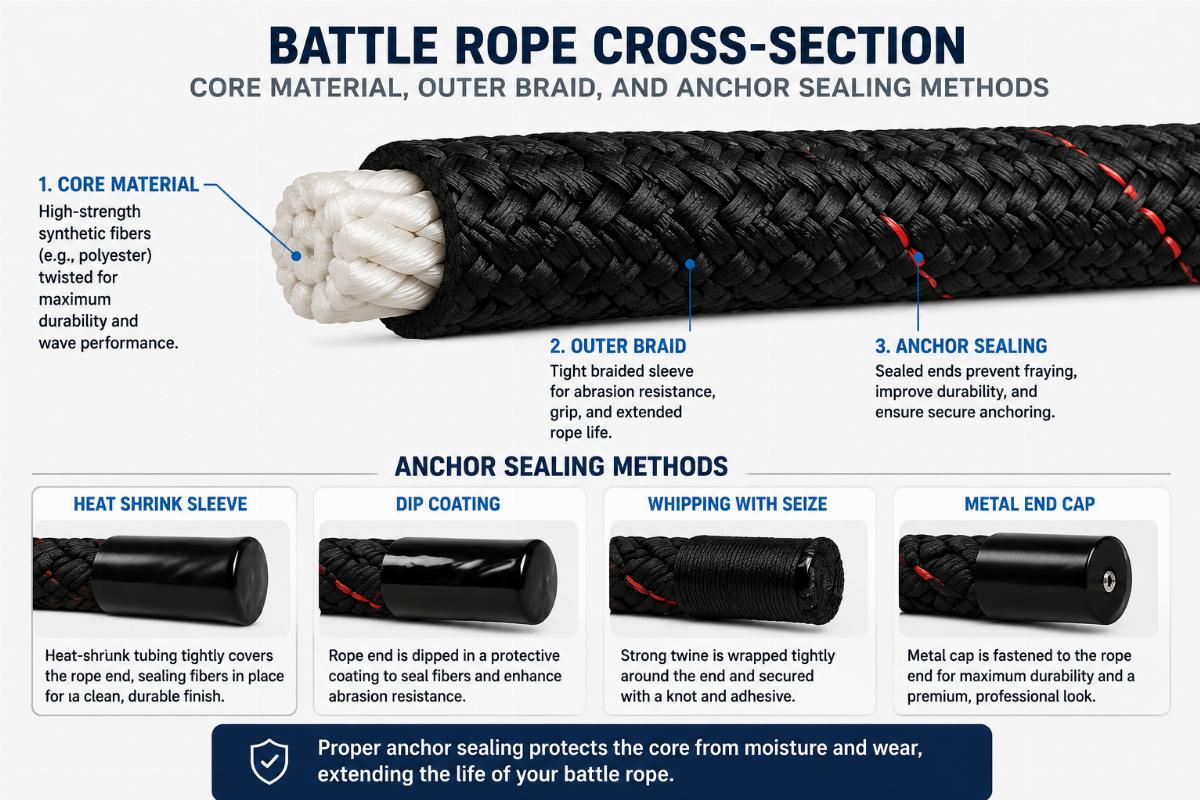
Let me walk you through where the money actually goes when you request a quote from a battle rope wholesale supplier, and how to read that quote without getting burned.
What Actually Determines Battle Rope Price in 2026?
Three factors drive the majority of cost variance between quotes from different battle rope wholesale supplier options: core material, outer braid composition, and anchor sealing method. Length and diameter matter, but they’re linear cost additions — the real margin killers sit inside the rope and at its ends.
The core is the structural backbone. Most commercial-grade battle ropes use a polyester multifilament core because it holds tension well under repetitive whipping forces. Some suppliers cut costs by using recycled polyester or blended cotton cores — these feel fine in the showroom but break down noticeably faster under daily commercial use. [NEED_CITE: polyester vs cotton fiber fatigue resistance under cyclic loading] The cost difference between virgin polyester core and blended core is modest per unit, but it compounds across a full container order and shows up in warranty claims rather than on the invoice.
The outer braid determines abrasion resistance and hand feel. Nylon braids are the commercial standard — they resist floor abrasion, don’t absorb sweat, and hold color through UV exposure. Polyester outer braids are cheaper but pill faster. Cotton outer braids feel premium in boutique studio settings but degrade quickly in high-humidity environments and absorb odor. A battle rope wholesale supplier quoting significantly below market is almost always saving on the outer braid material.
Then there’s the anchor — the termination point where the rope meets the handle or wall mount. This is where most failures happen, and where the cheapest quotes hide their corners. Heat-shrink tubing alone is the lowest-cost sealing method. It looks clean, but under repetitive axial loading, it migrates. The proper approach is a dual-seal system: adhesive injection into the rope end followed by heat-shrink encapsulation. The adhesive fills the interstitial spaces between strands, locking them against pull-out forces. The heat-shrink provides the mechanical containment. Skipping the adhesive saves a small amount per unit but turns the anchor into the weakest link. [NEED_CITE: industrial rope termination testing standards for axial pull-out resistance]
| Cost Factor | Low-End Approach | Commercial-Grade Approach |
|---|---|---|
| Core Material | Blended or recycled polyester | Virgin polyester multifilament |
| Outer Braid | Cotton or basic polyester | Nylon or high-denier polyester |
| Anchor Sealing | Heat-shrink only | Adhesive injection plus heat-shrink |
| Braid Tension | Uncontrolled during manufacturing | Controlled tension during braiding |
| UV and Abrasion Resistance | Vulnerable | Resistant |
A CrossFit studio we worked with in Southeast Asia was going through ropes at an alarming rate — replacing anchors every few months despite moderate daily usage. When we pulled a failed rope apart, the heat-shrink had slipped cleanly off the rope end. No adhesive residue inside. The strands had simply pulled free under load. Switching to dual-seal anchors extended their replacement cycle substantially, and the per-unit cost increase was a fraction of what they’d been spending on replacements.

Price Breakdown by Specification: 1.5 Inch vs 2 Inch vs 2.5 Inch
Diameter affects battle rope pricing, but not as dramatically as most buyers assume — and the price gap between diameter tiers narrows significantly at container-level MOQ from a battle rope wholesale supplier.
The common assumption is that a 2.5-inch rope costs nearly double a 1.5-inch rope because it uses more material. In reality, the material cost increase is meaningful but not proportional, because the core-to-braid ratio shifts at larger diameters. The outer braid thickness doesn’t scale linearly with diameter — it increases, but the core makes up a growing share of the cross-section at larger sizes. Since core material is generally less expensive per kilogram than nylon braid, the marginal cost of going wider is lower than buyers expect.
What does scale linearly is shipping volume. A 2.5-inch rope at standard length takes up noticeably more container space than a 1.5-inch rope. For buyers paying by cubic meter on LCL shipments, this matters. For full container loads, the impact is diluted but still present.
Here is how the cost structure typically breaks down across diameter tiers when sourcing from a battle rope wholesale supplier at commercial volumes:
| Specification | Typical Length | Core Material Share | Outer Braid Share | Anchor Cost Share | Relative Unit Cost Tier |
|---|---|---|---|---|---|
| 1.5 Inch | 30-50 ft | Noticeably reduced | Dominant cost driver | Standard | Entry |
| 2 Inch | 30-50 ft | Standard | Significant | Standard | Mid |
| 2.5 Inch | 30-50 ft | Substantially extended | Moderate | Standard | Upper-mid |
The 1.5-inch tier is where outer braid quality matters most, because the braid represents the largest share of the material cost at that diameter. A supplier cutting corners on braid material will show the biggest price advantage here — and the biggest quality risk.
The 2-inch tier is the commercial sweet spot. It’s the most requested diameter for general-purpose gym use, and the cost structure is balanced enough that quality differences show up clearly in pricing without being masked by material volume.
The 2.5-inch tier is where buyers often overpay by assuming thicker means better. For most commercial gym settings, the 2.5-inch rope offers diminishing returns on user experience while adding noticeable cost in both unit price and shipping volume. It makes sense for dedicated strongman or heavy-conditioning zones, but specifying it as the default across a full gym floor is a budget misallocation.
A distributor in West Africa was comparing 1.5-inch and 2-inch quotes from multiple battle rope wholesale supplier options. The price gap looked significant on paper. But when we walked through the end-user pricing they could command in their market, the 2-inch rope offered a noticeably better margin ratio — the wholesale cost increase was modest, but the retail price point they could set was substantially higher because end users perceived the 2-inch as the professional standard. The 1.5-inch, by contrast, was often perceived as a home-grade option in that market.

The Hidden Cost of Bad Sealing
A poorly sealed anchor doesn’t just fail — it fails in a way that creates replacement claims, reputational damage, and warranty costs that dwarf the original per-unit savings from choosing the cheapest battle rope wholesale supplier option.
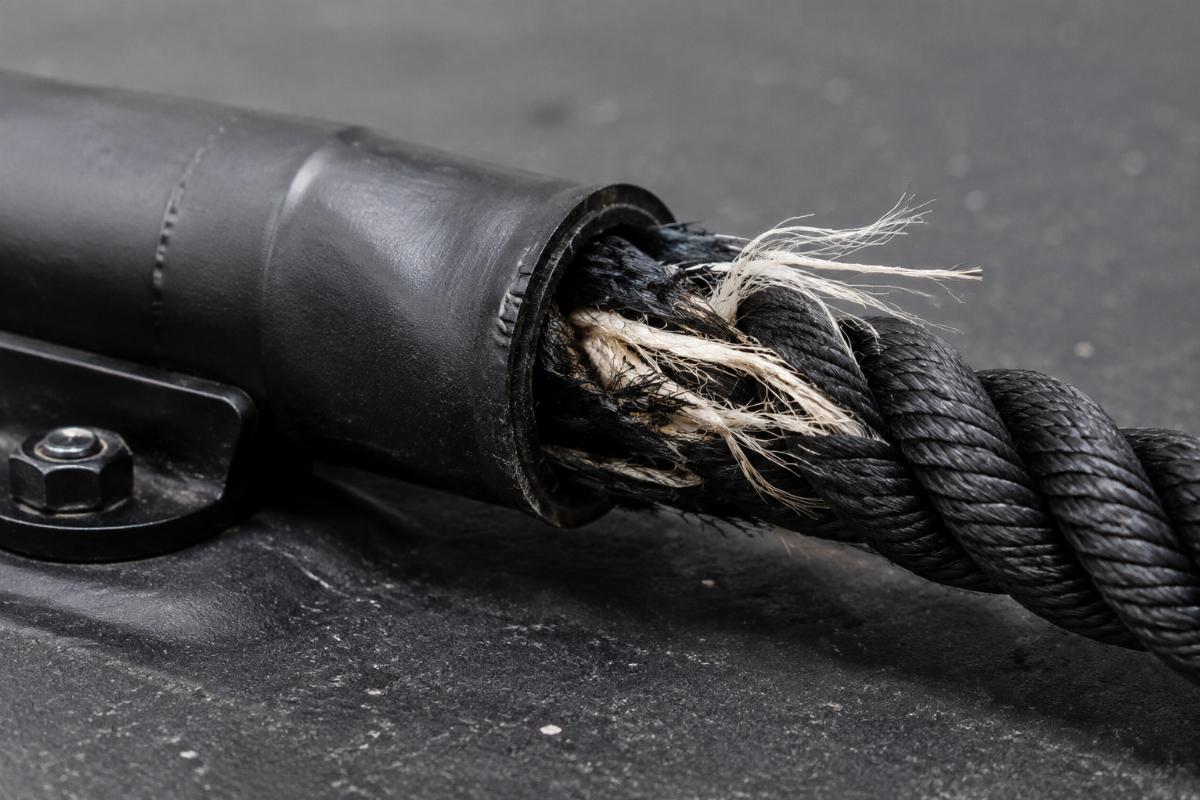
The anchor is the single highest-stress point on a battle rope. Every wave, every slam, every lateral whip sends axial and shear forces directly into the termination. If the strands aren’t locked in place, they migrate. Once migration starts, it accelerates. The rope feels loose at the handle, then visible core fibers emerge, then the structural integrity collapses entirely.
The most common failure pattern I’ve seen across multiple markets follows the same sequence: the heat-shrink tubing looks intact from the outside, but the adhesive bond inside has failed. The rope pulls free of the anchor under load, the heat-shrink slides down the rope shaft, and the end user is left holding a handle attached to an empty tube of plastic.
This isn’t a rare defect. It’s the default failure mode for ropes sealed with heat-shrink only — and heat-shrink-only sealing is the standard approach at the lowest price tiers from many battle rope wholesale supplier operations.
The cost math is unforgiving. If a gym buys ropes at a modest per-unit saving by accepting heat-shrink-only anchors, and those ropes fail within months, the replacement cost per unit is the same as the original purchase price — but now the gym is also paying return shipping, handling labor, and dealing with member complaints. For a distributor, the math is worse: you’re replacing product under warranty, absorbing freight both directions, and risking the customer relationship.
The fix is straightforward but not free. Adhesive injection before heat-shrink application adds a small cost per unit and a small amount of production time. But it transforms the anchor from the rope’s weakest point into one of its strongest. The adhesive fills the gaps between individual strands, creating a mechanical interlock that resists pull-out forces far better than heat-shrink compression alone.
We ran a comparison for a commercial gym chain in Eastern Europe that had been cycling through ropes at a rate that didn’t make financial sense. Same diameter, same length, same usage pattern — but ropes from one supplier lasted substantially longer than ropes from another. The price difference between the two suppliers was modest. The difference in anchor construction was everything. The longer-lasting ropes used dual-seal anchors. The shorter-lasting ones used heat-shrink only. The per-unit savings on the cheaper ropes was erased many times over by the replacement frequency.
How to Read a Factory Quote: MOQ, Lead Time, and Real Unit Cost
The lowest per-unit price on a battle rope wholesale supplier quote is rarely the real cost — and the gap between quoted price and real cost widens when you factor in MOQ requirements, shipping efficiency, and defect rates.
Here’s what a typical quote structure looks like, and where the hidden costs live.
MOQ tiers are the first thing to examine. Most battle rope wholesale supplier operations structure pricing in tiers — a small batch price, a mid-volume price, and a full-container price. The gap between tiers can be significant. If your order falls just below a tier threshold, pushing it over the edge by adding complementary products to fill the container can bring your effective per-unit cost down substantially. This is where consolidation matters: a battle rope wholesale supplier who also manufactures racks, free weights, and flooring can help you fill a container with mixed product, hitting the volume tier on each line item without overcommitting to a single SKU.
Lead time affects your real cost in two ways. First, there’s the cash flow impact — longer lead times mean your capital is tied up in transit for a longer period. Second, there’s the stockout risk — if you’re relying on a single shipment with a long lead time and a quality issue surfaces on arrival, you’re facing a re-order delay that leaves your gym floor or your customers without product. A battle rope wholesale supplier with consistent production scheduling and reasonable lead times reduces this risk, even if their per-unit price isn’t the absolute lowest.
Defect rate is the quietest and most expensive variable. If a supplier quotes a low unit price but has a defect rate that requires you to order extra units as buffer stock, your real per-good-unit cost is higher than a supplier with a slightly higher quoted price but consistent quality. This is especially true on anchor sealing — visual inspection at the factory won’t catch adhesive bond failures. Those only show up under load. A battle rope wholesale supplier who controls tension during braiding and uses dual-seal anchors will have a meaningfully lower field failure rate, even if their factory price isn’t the bottom of the market.
A distributor in the Gulf region was comparing quotes from several battle rope wholesale supplier options for a large gym chain order. The lowest quote looked attractive on paper. But when we factored in the MOQ requirement — which would have forced them to overcommit to a single diameter — and the shipping inefficiency of the packaging format, the real landed cost was higher than a slightly more expensive quote that offered mixed-diameter flexibility and container-efficient packing. The lowest quote wasn’t the best deal. The best deal was the one that matched their actual order profile.

Checklist: What to Ask Your Battle Rope Wholesale Supplier Before Ordering
Before placing an order with any battle rope wholesale supplier, confirm these specifications and testing points — each one maps directly to a failure mode or cost driver discussed above.
-
Core material composition. Ask specifically whether the core is virgin polyester multifilament or a blend. Request a material certificate. Blended cores save the supplier money but cost you in field failures. [NEED_CITE: commercial fitness equipment textile material specification standards]
-
Outer braid material and denier. Nylon braid is the commercial standard. If the supplier is quoting polyester or cotton outer, understand why — and whether the price reduction justifies the abrasion and moisture trade-offs.
-
Anchor sealing method. Confirm whether anchors are heat-shrink only or dual-seal with adhesive injection. Request a cut-away sample so you can verify the adhesive presence inside the anchor. This single question separates suppliers who build for commercial use from suppliers who build for price.
-
Braid tension control during manufacturing. Ask how tension is maintained during the braiding process. Uncontrolled tension leads to inconsistent core density, which leads to internal strand migration under load. This isn’t visible on external inspection.
-
MOQ tier structure and mixed-SKU flexibility. Understand where your order falls in the pricing tiers, and whether the supplier allows mixed product to hit volume thresholds without forcing overcommitment on a single SKU.
-
Sample testing protocol. Request production samples — not showroom samples — and test them under load before committing to a full order. Anchor pull-out resistance, braid abrasion after repeated floor contact, and core integrity after cyclic whipping are all testable before you place a container order.
A boutique studio group in Northern Europe was evaluating a new battle rope wholesale supplier for their functional training zones. They requested samples and ran a simple test: anchored the ropes, applied repeated axial loading to simulate months of use, then cut the anchors open to inspect adhesive bond integrity. The cheapest sample failed the anchor test — no adhesive inside, heat-shrink only. The mid-priced sample passed. They went with the mid-priced option, and their replacement frequency dropped noticeably over the following year.

Conclusion
Battle rope pricing is a function of material integrity, sealing construction, and order structure — not just diameter and length. The cheapest quote from a battle rope wholesale supplier often reflects savings in core material quality, anchor sealing method, or braid tension control — savings that surface as field failures, warranty claims, and replacement costs that dwarf the original per-unit difference. Understanding what the price actually covers is the only reliable way to evaluate a quote, protect your margin, and keep your end users equipped with product that performs through real commercial use.


