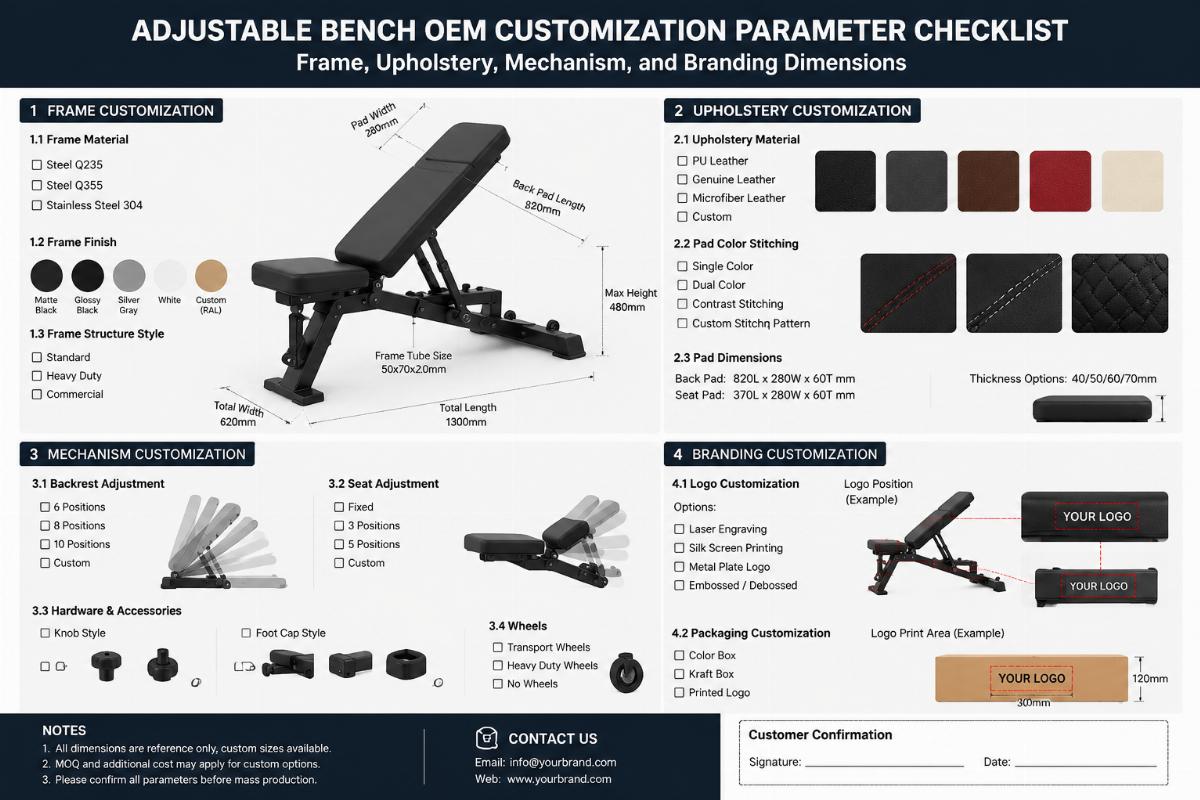
BP-Bench Press Sub-Series Container Loading and MOQ Reference
Most buyers assume a full container is always cheaper than LCL shipping, but when SKU mix exceeds a certain threshold, per-cubic-meter LCL costs actually drop below full container rates.
A standard 40HQ container holds approximately 45 to 55 pure bench press units depending on KD packaging configuration, while mixed Smith machine and bench press combinations can achieve over 90 percent space utilization through strategic frame-to-flat ratio optimization. MOQ ranges from a single unit for sample verification to full turnkey gym packages, with correct HS code classification and documentation alignment being the single most critical factor in preventing port delays that routinely cost more than the equipment profit margin itself.
I still remember the morning I got the call from Huangdao port customs. A full container of Smith machines headed to Dubai had been held because a single digit in the CE certificate serial number was transposed on the packing list. The container sat in the yard for over ten days. The demurrage charges ended up exceeding the profit on the entire shipment, and the buyer nearly rejected the cargo outright. That was the moment I stopped treating documentation as paperwork and started treating it as a production line checkpoint. Fitness equipment is bulky, accessory-heavy, and sits in a customs classification gray zone that varies wildly by destination port. A wrong HS code doesn’t just mean higher duty—it means doubled inspection rates and weeks of delay. [NEED_CITE: root cause distribution of fitness equipment customs delays at major Chinese export ports]

Let me walk through the loading math, the real MOQ structure, the documentation traps, and the landed cost levers that most buyers overlook until it is too late.
How Many Bench Press Units Fit in a 40HQ Container?
The answer depends entirely on whether you are shipping pure bench press racks or combining them with frame-heavy equipment like Smith machines and power racks in a mixed SKU load.
A pure bench press unit in knock-down packaging typically occupies between 0.35 and 0.45 cubic meters per set, depending on whether the uprights are separated from the base frame and whether the seat pad is packed flat or nested. In a standard 40HQ with an internal volume of approximately 76 cubic meters, you can physically stack 45 to 55 units if the KD design allows flat nesting of uprights and the weight distribution stays within floor load limits. [NEED_CITE: internal volume and maximum payload specifications for ISO standard 20GP, 40GP, and 40HQ shipping containers]
But here is where most buyers miscalculate. When you mix bench press stations with Smith machines—which have tall, narrow frame profiles that waste vertical space if loaded alone—the per-unit space cost changes dramatically. A Middle East distributor once loaded a container with a 60-40 ratio favoring Smith machines over flat benches. The Smith machine frames created unavoidable void columns above the bench press cartons because the frame height did not align with the bench press box height. The result was roughly 15 to 20 percent wasted volume that could not be recovered without reconfiguring the SKU mix.
The fix is a frame-to-flat ratio model. Smith machines and power racks serve as the vertical structural columns. Bench press units, dumbbell racks, and plate-loaded machines fill the horizontal gaps between those columns. When the ratio is balanced correctly, container utilization climbs above 90 percent. [NEED_CITE: space optimization methodology for mixed fitness equipment container loading based on KD packaging dimensions]
| Packaging Type | Space per Unit | Stackability | Mixed Load Compatibility |
|---|---|---|---|
| Fully Welded Frame | Noticeably high | Poor | Low |
| Partial KD (uprights detached) | Moderate | Good | Moderate |
| Full KD (all components flat-packed) | Noticeably reduced | Excellent | High |
A Southeast Asian hotel project buyer initially ordered a single sample bench press via LCL to test packaging durability. The corner iron reinforcement scheme we applied reduced damage rates to well under one percent during transit. Once the packaging was validated, the buyer converted to full container orders with mixed strength series loads, and the per-unit freight cost dropped substantially compared to the original LCL rate.

What Is the Real MOQ for Commercial Gym Equipment Orders?
The honest answer is that MOQ is not a fixed number—it is a sliding scale tied to customization depth, and ordering below the economic batch threshold silently inflates your per-unit cost through packaging and freight overhead.
For standard catalog bench press models with no branding changes, a single unit can be produced and shipped as a sample. This is how most new buyers start. They order one bench press, one Smith machine, one cable crossover, test the build quality, check the welds, sit on the seat pad, and then decide whether to proceed.
Once OEM branding enters the picture—custom color, logo printing, engraved weight stack covers, branded upholstery—the MOQ typically shifts to a small batch range. The reason is straightforward: powder coating lines require minimum batch runs to avoid color contamination, and upholstery suppliers set their own minimum cuts for custom vinyl. Ordering just one or two branded units means the setup cost gets absorbed entirely by those units, pushing the per-piece price well above what a slightly larger batch would cost.
For full turnkey gym packages—complete cardio, strength, and free weight setups for a commercial facility or hotel fitness center—there is technically no MOQ ceiling, but there is a practical floor. A 20GP container can hold a compact boutique studio package. A 40HQ can hold a full commercial gym layout. The key is matching the equipment list to the container volume during the space planning stage, not after the order is placed. [NEED_CITE: standard MOQ structures for OEM fitness equipment manufacturing including customization tiers]
Here is the counterintuitive part. Many buyers insist on the lowest possible MOQ to minimize upfront risk. But when the order is too small to fill even a partial container, the packaging cost per unit rises because custom carton sizes and foam inserts are amortized across fewer pieces. The freight cost per unit also spikes because LCL rates include consolidation fees, documentation surcharges, and destination deconsolidation charges that do not apply to full container loads.
An African distributor placed an initial trial order of a small batch of bench press units via LCL. The purpose was to validate packaging integrity over a long ocean transit. The corner reinforcement adjustments made during that trial became the standard for all subsequent full container orders, and the damage rate stayed consistently low across multiple shipments to the region.

Which Documents Prevent Port Delays and Extra Charges?
The three documents that determine whether your container clears customs in days or weeks are the CE certificate, the commercial invoice with HS codes, and the packing list—and they must match each other exactly, down to the serial number digit.
I cannot stress this enough because I have watched otherwise smooth transactions collapse at the port over documentation errors that took minutes to make and weeks to fix.
The CE certificate is mandatory for most European destination ports and increasingly requested by customs authorities in the Middle East and Southeast Asia. The certificate number on the CE document must match the number printed on the commercial invoice and the packing list character for character. A single transposed digit—a seven written where a one should be—triggers a customs hold that requires the factory to issue a corrected certificate, the shipping agent to amend the manifest, and the destination broker to resubmit the entry. This process routinely takes well over a week, and the demurrage accumulates daily. [NEED_CITE: CE certification documentation requirements and common compliance errors for fitness equipment exported from China]
The HS code classification is equally critical. Fitness equipment generally falls under HS 9506.91 for general exercise articles, but specific sub-classifications exist for weightlifting machines, cardio equipment, and free weights. The wrong code does not just mean a duty rate discrepancy—it means the customs officer at the destination port may flag the shipment for physical inspection, which adds days to the clearance timeline and introduces the risk of damage during inspection repacking.
A buyer in Southeast Asia once received a full container of cardio and strength equipment for a hotel project. The CE certificate number had a typo on the packing list. The container was held at the port for over ten days. The demurrage charges ended up exceeding the profit on a single-unit basis for the entire order. That is not a rounding error. That is a mid-five-figure loss caused by a one-character mistake.
| Document | Critical Checkpoint | Consequence of Mismatch |
|---|---|---|
| CE Certificate | Serial number alignment across all docs | Customs hold, extended demurrage |
| HS Code on Invoice | Correct sub-classification for equipment type | Duty rate discrepancy, inspection flag |
| Packing List | Piece count and weight matching invoice | Customs query, potential re-inspection |
The packing list must also reflect the actual loaded quantity and gross weight. If the container is mixed-load and the packing list shows only one SKU, the customs officer will question the discrepancy. Full transparency in the packing list—listing every SKU, every carton count, and every gross weight—eliminates the ambiguity that triggers inspections.

How to Reduce Landed Cost Beyond the FOB Price?
The FOB price is the starting line, not the finish line. The real cost battle is won through container load optimization, correct HS code classification, and strategic use of destination-port duty reduction programs.
Most buyers focus exclusively on negotiating the factory price. But the landed cost—the total amount you pay from the moment the goods leave the factory floor to the moment they arrive at your warehouse door—includes freight, insurance, import duty, port handling charges, inland transportation, and any demurrage or storage fees incurred during customs clearance.
Container load optimization is the first lever. As discussed earlier, mixing frame-type equipment with flat-type equipment in the correct ratio maximizes the number of sellable units per container. More units per container means lower per-unit freight cost. This is not theoretical. A buyer who adjusted the Smith machine to bench press ratio in a mixed container saw the per-unit freight cost drop noticeably compared to the previous shipment where the ratio was unbalanced. [NEED_CITE: freight cost per unit calculation methodology for mixed fitness equipment container loads]
HS code classification is the second lever. Different destination countries apply different duty rates to different HS sub-classifications within the fitness equipment category. A code that classifies a piece of equipment as a general exercise article may carry a lower duty rate than a code that classifies it as a specialized weightlifting machine. The difference can be substantial—enough to shift the landed cost by a meaningful percentage on a full container order. Working with a customs broker who understands fitness equipment classification at the destination port is essential.
The third lever is destination-port duty reduction programs. Many countries offer reduced or zero duty rates for fitness equipment imported under specific trade agreements or investment promotion schemes. A hotel developer importing equipment for a new resort fitness center may qualify for duty exemption if the import is classified under a tourism infrastructure investment category. An African distributor may benefit from regional trade agreement preferences that reduce the applicable duty rate. These programs exist, but they are not automatically applied. The importer must proactively claim them with supporting documentation. [NEED_CITE: destination country duty reduction programs and trade agreement preferences applicable to fitness equipment imports]
A buyer who combined all three levers—container load optimization, correct HS classification, and duty reduction program utilization—reduced the total landed cost by a substantial margin compared to the initial FOB-based estimate. The equipment was identical. The factory price was identical. The difference was entirely in the logistics and compliance execution.

Conclusion
Container loading efficiency, MOQ flexibility, and documentation precision are the three pillars that determine whether a fitness equipment import project runs on budget or bleeds money at the port. Getting the SKU mix right maximizes units per container. Understanding the real MOQ structure prevents silent cost inflation on small orders. And aligning every digit across the CE certificate, invoice, and packing list prevents the demurrage traps that have cost buyers more than the equipment profit itself. These are not back-office details. They are the operational foundation of a profitable import business.