BP-Bench Press Sub-Series Specifications and Buyer Reference | Wholesale Supplier
Most buyers assume all benches within one series share similar load ratings. They don’t. Structural design gaps between flat, incline, and adjustable models can shift real-world load capacity by a noticeable margin.
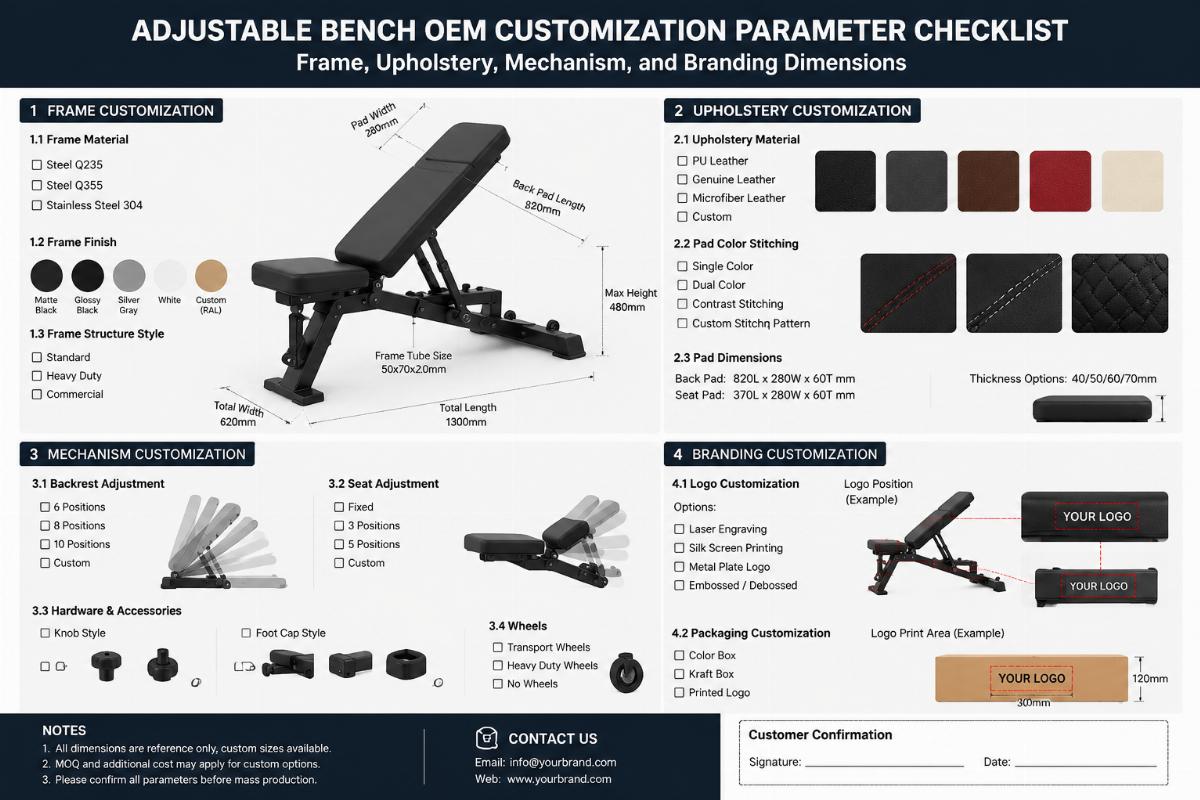
BP bench press sub-series differ primarily in frame tube thickness, static and dynamic load capacity, pad foam density, and locking mechanism rating. Flat benches carry the highest static load because the frame is a single rigid plane. Incline benches lose some rigidity to the backrest pivot. Adjustable benches sacrifice the most load margin to the angle-locking mechanism. Matching the right sub-model to actual usage frequency and user profile is the only way to avoid premature frame flex, pad collapse, or pin failure.
I started on the welding floor of a fitness equipment plant in Shandong, then moved into export sales covering Latin America for years. Mexico, Brazil, Chile — I’ve loaded containers of BP bench press units into all three. Early on, I spec’d a standard flat model for a Mexican commercial gym chain. They ran it at a usage frequency far beyond what the pad foam density and tube wall thickness were engineered for. Within months, the vinyl split and the frame developed play at the joint. Reshipping replacement pads and reinforced uprights cost several times the original pad value in freight alone. That order taught me to map every BP bench press sub-model against real usage intensity, not just catalog weight numbers. [NEED_CITE: relationship between foam density and long-term compression set in upholstery foams]

Let’s break down what actually separates these sub-models and how to pick the right one for your facility type.
What Sub-Models Exist Within the BP Series?
The BP bench press lineup covers four structural categories: flat, incline, adjustable, and olympic. Each serves a different training protocol and load profile.
Flat benches are the simplest structure — a horizontal pad on a welded rectangular frame. No moving parts means maximum rigidity. These are the workhorses of any commercial free-weight zone.
Incline benches add a fixed-angle backrest, typically set between thirty and forty degrees. The frame must accommodate the angled pad mount, which introduces a stress concentration at the rear crossmember.
Adjustable benches introduce a multi-position backrest with a pin-and-ladder or pop-pin locking mechanism. This is where structural compromise begins. Every angle position adds a potential flex point, and the locking pin itself becomes a load-bearing component.
Olympic benches are built for heavy barbell work with spotter arms and often a integrated rack. The frame tube diameter and wall thickness jump noticeably compared to standard flat models.
| Sub-Model | Frame Configuration | Load-Bearing Complexity | Typical Use Case |
|---|---|---|---|
| Flat | Single rigid plane | Lowest | High-volume commercial floors |
| Incline | Fixed-angle backrest mount | Moderate | Hypertrophy-focused zones |
| Adjustable | Multi-position pivot and lock | Highest | Boutique studios, multi-use areas |
| Olympic | Integrated rack and spotter arms | Highest | Heavy barbell training areas |
[NEED_CITE: structural load path analysis of pinned vs welded gym bench frames]
A Brazilian hotel project once ordered adjustable BP bench press units for a light-commercial fitness room. The end users were hotel guests — low frequency, varied fitness levels. But the procurement spec called for commercial-grade durability. The adjustable model’s locking mechanism was over-engineered for the actual use, while the tube wall thickness on the main frame was adequate but not exceptional. The mismatch wasn’t a failure — it was an efficiency gap. They paid for adjustability they didn’t need and could have spec’d a heavier flat model at similar cost.

Where Do Core Specifications Actually Diverge?
The three specification axes that separate BP bench press sub-models are frame tube wall thickness, static versus dynamic load rating, and pad foam density. Confusing static load with dynamic load is the most common sourcing error.
Static load rating measures how much weight the frame can hold without deformation when the load is applied slowly and held. Dynamic load rating measures what the frame can absorb during actual lifting — including the force spike when a barbell is lowered and pressed back up. Dynamic loads routinely exceed static loads by a significant margin. [NEED_CITE: difference between static and dynamic load testing standards for strength equipment per EN and ASTM]
Frame tube wall thickness is typically specified in millimeters. A thicker wall resists flex under dynamic loading, but adds weight and cost. The difference between a light-commercial and full-commercial frame is often just a few millimeters of wall thickness — but that small gap determines whether the frame develops visible deflection after extended heavy use.
Pad foam density is measured in kilograms per cubic meter. Higher density foam resists compression set over time. A thick pad with low density foam will feel comfortable on day one and collapse into a permanent dip within months of daily use. A thinner pad with high density foam maintains its shape far longer. [NEED_CITE: foam density thresholds for commercial gym upholstery durability]
| Specification Axis | Light-Commercial Grade | Full Commercial Grade | Verification Method |
|---|---|---|---|
| Tube Wall Thickness | Basic | Robust | Caliper measurement on sample |
| Load Rating Type | Self-reported static only | Certified static and dynamic | Third-party test report |
| Pad Foam Density | Basic | Robust | Density certificate from foam supplier |
| Weld Quality | Standard | Controlled | Visual and destructive sample check |
[NEED_CITE: gym bench pad foam density ranges and compression set testing methods]
A Chilean distributor received a batch of BP bench press incline models where the catalog listed a high static load number. But the test report only covered static loading — no dynamic test had been performed. When end users began pressing heavy loads with controlled eccentrics, the backrest pivot point developed audible flex. The static number had been technically accurate but operationally meaningless for that use case.

How Should Different Facility Types Choose?
Facility type determines whether you spec for maximum durability, space efficiency, or cost optimization. The BP bench press sub-model match is different for each.
Full commercial gyms with high daily member traffic need flat and olympic BP bench press models as the primary selection. The frame rigidity and pad density must withstand continuous use across extended operating hours. Incline models are appropriate for dedicated hypertrophy zones but should carry the same commercial-grade tube and pad spec as the flat models. Adjustable models have limited placement here — they belong in functional training areas where exercise variety matters more than maximum load.
Boutique studios and personal training facilities benefit from adjustable BP bench press models. Space is typically constrained, and a single adjustable bench can replace multiple fixed-angle benches. But buyers must verify that the locking mechanism’s load rating matches the heaviest expected user plus barbell load. The adjustability premium is worth paying only if the lock mechanism is rated for the actual dynamic load.
Hotel and apartment fitness rooms fall into light-commercial territory. Usage frequency is lower, user weight ranges are broader, and maintenance access is limited. A standard flat BP bench press with moderate tube thickness and medium-density pad foam usually suffices. Over-specifying here wastes budget; under-specifying creates warranty exposure.
| Facility Type | Primary BP Bench Press Sub-Model | Secondary Option | Key Spec Priority |
|---|---|---|---|
| Full Commercial Gym | Flat, Olympic | Incline (commercial grade) | Dynamic load rating, pad density |
| Boutique Studio / PT | Adjustable | Incline | Locking mechanism rating, footprint |
| Hotel / Apartment | Flat (light-commercial) | Incline (light-commercial) | Cost per unit, maintenance simplicity |
[NEED_CITE: usage frequency benchmarks for commercial vs light-commercial gym equipment]
A Mexican big-box retail chain stocking home-grade BP bench press units faced a wave of warranty claims when commercial buyers purchased them for small studio use. The home-grade frames were not designed for the dynamic load profile of repeated daily use by multiple users. The retail chain had no way to distinguish the intended use at point of sale. The lesson for exporters: clear sub-model labeling and spec sheets prevent downstream misapplication.

Where Do Buyers Commonly Spec Wrong?
The most frequent BP bench press specification errors come from assuming catalog load numbers tell the whole story, choosing pad thickness over pad density, and ignoring the locking mechanism rating on adjustable models.
Catalog load numbers without test standard references are unreliable. A manufacturer may list a static load rating tested under ideal conditions — load applied slowly, centered on the pad, no lateral force. Real-world bench pressing involves dynamic loading, off-center bar paths, and lateral stabilization forces. Without a dynamic load test report, the catalog number is a marketing figure, not an engineering guarantee. [NEED_CITE: common discrepancies between catalog load ratings and independent test results for gym benches]
Pad thickness is a visual and tactile cue that misleads. A thicker pad feels more comfortable during a brief test sit. But comfort under short-term load is irrelevant if the foam collapses after weeks of use. The correct metric is foam density, not foam thickness. A high-density pad at moderate thickness will outlast a low-density pad at double the thickness by a substantial margin.
On adjustable BP bench press models, the backrest locking mechanism is the structural weak point. The pin, ladder, or pop-pin must resist not just the static weight of the user but the dynamic force of pressing movements at an angle. Some adjustable models rate the frame for a certain load but do not rate the locking mechanism separately. If the lock fails under dynamic load, the backrest drops — a serious safety hazard.
| Error Pattern | What Buyers See | What Actually Matters | Risk if Ignored |
|---|---|---|---|
| Trusting catalog load number | High static load figure | Dynamic load test report | Frame flex or failure under real use |
| Choosing pad by thickness | Thick pad feels plush | High foam density | Permanent pad deformation |
| Ignoring lock mechanism rating | Adjustable model lists frame load | Separate lock mechanism rating | Backrest drop under load |
[NEED_CITE: failure mode analysis of adjustable bench locking mechanisms under dynamic loading]
A Middle East distributor received a complaint batch where the adjustable BP bench press backrest pins showed visible bending after limited use. The frame itself was intact — the failure was isolated to the locking pins. The manufacturer’s spec sheet listed frame load capacity but did not provide a separate rating for the pin mechanism. The distributor had no basis for evaluating the lock’s adequacy before shipment.

What Documents Should Buyers Confirm Before Ordering?
Before placing a BP bench press order, request and verify four categories of documentation: load test reports, material certificates, foam density data, and welding quality records.
Load test reports should specify both static and dynamic ratings, reference the test standard used, and be issued by a third-party lab or the manufacturer’s certified internal lab. Self-reported numbers without test method references carry limited value. [NEED_CITE: recognized third-party testing laboratories for fitness equipment load certification]
Material certificates should confirm the steel grade and tube dimensions for the main frame. The certificate should match the physical sample — verify tube outer diameter and wall thickness with calipers on a production unit, not just a pre-shipment sample.
Foam density data should come from the foam supplier, not just the bench assembler. The density value should match the foam specification in the product spec sheet. Request a compression set test result if available — this shows how the foam performs under prolonged loading.
Welding quality records are harder to verify remotely but critical. Request photos of weld joints on production units. Look for consistent bead width, no visible porosity, and full penetration at structural joints. If possible, arrange a destructive weld test on a sample unit from the production batch.
| Document Category | What to Request | What to Verify |
|---|---|---|
| Load Test Report | Static and dynamic ratings, test standard reference | Third-party issuance or certified internal lab |
| Material Certificate | Steel grade, tube dimensions | Match with physical sample measurement |
| Foam Density Data | Density value, compression set result | Supplier-issued, matches spec sheet |
| Welding Quality | Production weld photos, destructive test if possible | Consistent bead, no porosity, full penetration |
[NEED_CITE: documentation checklist for commercial gym equipment import compliance]
A European gym chain operator now requires all BP bench press suppliers to provide foam density certificates with every shipment, not just at initial qualification. They had experienced a batch where the production foam density was lower than the approved sample — the supplier had switched foam vendors without notification. The documentation requirement closed that gap.

Conclusion
BP bench press sub-models are not interchangeable. Flat, incline, adjustable, and olympic configurations carry different structural trade-offs in tube thickness, load rating type, and pad foam density. Matching the sub-model to facility usage intensity — not just catalog numbers — prevents frame flex, pad collapse, and locking mechanism failure. Verify test reports, material certificates, and foam data before every production order.