Bumper Plate Set for Functional Training Studios | Wholesale Supplier
Most buyers assume all rubber bumper plates look the same until the third month of daily use, when the rubber tears, the steel inserts rust, and the barbell sleeves get scratched. The right bumper plate set for functional training studios must feature virgin rubber compounds, precision-machined stainless steel inserts, and IWF-compliant diameter tolerances—sourced from a supplier who understands cross-training abuse patterns, not just catalog specs. A reliable wholesale supplier delivers consistent density, odor-free materials, and proper weight calibration across every plate in the set, ensuring your studio floor and barbells survive years of drops.
I still remember a container of plates we sent to a CrossFit affiliate in Melbourne years ago. The client called within weeks saying the rubber smelled like a tire yard and the chrome inserts were already pitting. We pulled a plate from our own warehouse floor, compared it side by side with theirs, and the difference was obvious—recycled rubber blend versus virgin rubber, plated steel insert versus stainless. That shipment came from a trader who mixed sources to chase a lower price. Since then, I have made it a point to walk buyers through exactly what separates a plate that lasts from one that becomes a liability. [NEED_CITE: material composition differences between virgin and recycled rubber in bumper plate manufacturing]

Let me walk you through what actually matters when you are sourcing a bumper plate set for a functional training studio, and why the cheapest quote often ends up costing the most.
What Rubber Compound Actually Determines Plate Longevity?
The rubber compound is the single most important factor in bumper plate durability, yet it is the hardest variable to verify from a product photo alone. Functional training studios drop plates hundreds of times per day. The rubber must absorb impact energy without cracking, deforming, or off-gassing, while the steel insert must resist rust from sweat, humidity, and floor cleaning chemicals.
Virgin rubber—specifically high-density natural rubber or premium SBR blends—offers consistent shock absorption, minimal odor, and long-term structural integrity. Recycled rubber, often blended with crumb rubber from industrial waste, may look identical in photos but breaks down faster, emits a strong chemical smell, and can leave black marks on platform surfaces. [NEED_CITE: performance comparison of virgin rubber versus recycled rubber in impact-absorbing fitness equipment]
| Property | Virgin Rubber Compound | Recycled Rubber Blend | Low-Grade Mixed Compound |
|---|---|---|---|
| Odor After Unboxing | Negligible | Strong chemical smell | Moderate to strong |
| Impact Resistance After Repeated Drops | Robust | Vulnerable | Vulnerable |
| Insert Corrosion Resistance | Robust | Noticeably reduced | Vulnerable |
| Surface Marking on Platforms | Resistant | Uncontrolled | Uncontrolled |
| Weight Calibration Consistency | Controlled | Standard | Uncontrolled |
A studio owner in the Pacific Northwest once ordered a full set from an online marketplace at a price that seemed too good. Within months, the plates developed flat spots from repeated drops, and the rubber began crumbling around the insert collar. The replacement cost was several times the original savings, not to mention the downtime for his programming. When we supplied his replacement order, we used compression-molded virgin rubber with stainless steel inserts, and his facility has run those plates for years without a single complaint.

How Do Weight Tolerances Affect Competition and Training Accuracy?
A bumper plate set that claims "20 kg" but actually weighs 19.2 kg or 20.8 kg creates problems far beyond a numbers game—it affects programming accuracy, athlete confidence, and competition readiness. Functional training studios that host internal competitions or prepare athletes for events need plates that hold tight weight tolerances.
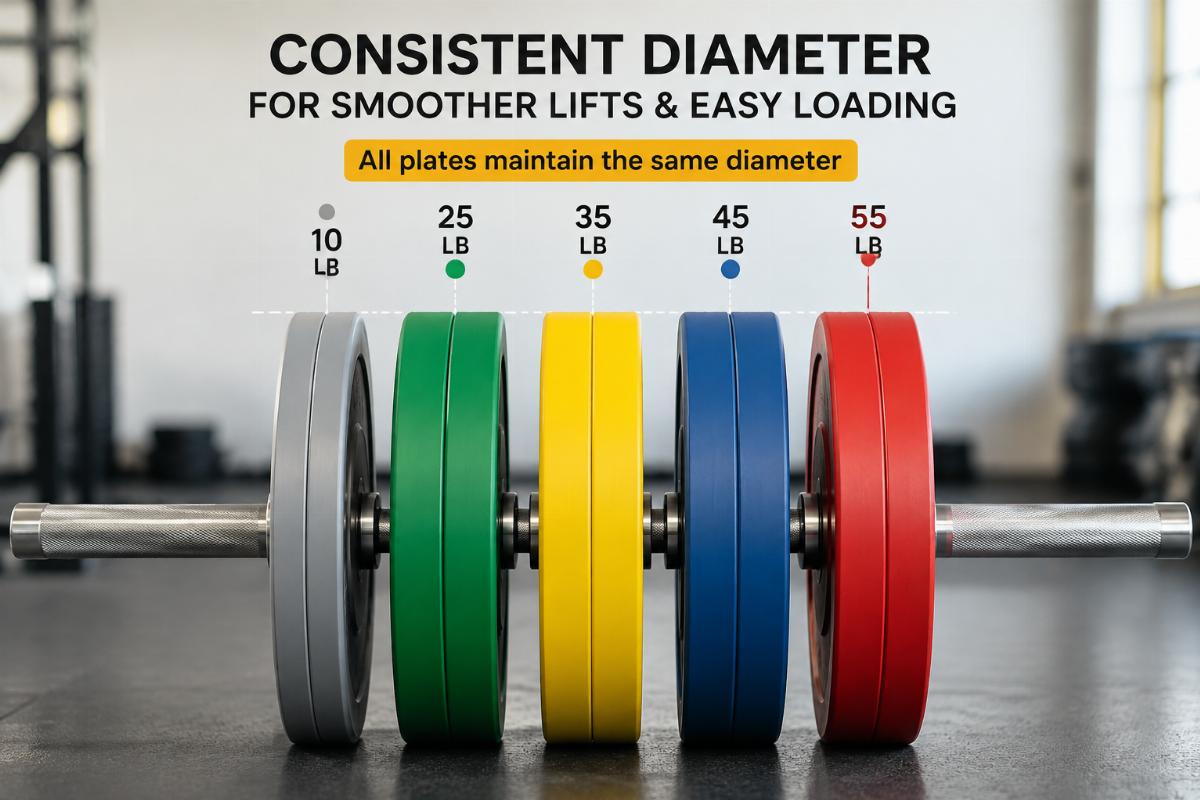
Industry-standard competition-grade plates follow IWF diameter specifications: all plates from 10 kg upward share the same outer diameter so that the barbell always sits at the correct height off the platform regardless of load. [NEED_CITE: IWF technical and competition rules regarding plate dimensions and weight tolerances] Weight tolerance for competition plates typically falls within a narrow range, while training-grade plates allow wider variance. The issue is that many wholesale suppliers label plates by nominal weight without disclosing their actual tolerance range.
| Tolerance Grade | Typical Application | Weight Consistency | Diameter Consistency |
|---|---|---|---|
| Competition-Grade | Certified meets, serious athletes | Controlled | Controlled |
| Commercial Training-Grade | Daily studio use, group classes | Standard | Standard |
| Budget Grade | Light home use | Uncontrolled | Uncontrolled |
I worked with a gym chain operator in Southeast Asia who was outfitting multiple locations. He needed one spec across all sites so that athletes transferring between branches would feel the same bar height and load. We consolidated the entire order into a single production run, calibrated every plate on the same jig, and shipped them in coordinated container loads. The result was uniform feel across every location—something impossible when sourcing from multiple traders who each ship whatever comes off different production lines.
Why Does Insert Material and Mounting Method Matter More Than Buyers Think?
The steel insert is the structural spine of a bumper plate. If it rusts, loosens, or pulls through the rubber, the plate is dead—regardless of how good the rubber looks. Functional training environments are harsh: chalk dust, sweat, humidity, rubber mallets, and concrete platforms all conspire against weak insert designs.
Stainless steel inserts resist corrosion far better than chrome-plated or bare carbon steel inserts. Beyond material, the mounting method determines long-term reliability. Compression-molded inserts that are vulcanized into the rubber during the curing process create a mechanical bond that resists spinning and pull-out. Pressed-in or glued inserts, common in budget production, gradually loosen under repeated impact. [NEED_CITE: failure modes of bumper plate insert mounting methods under repetitive impact loading]
A distributor in the Middle East brought us a sample from a competitor—beautiful color, clean labeling, but the insert spun freely inside the rubber when gripped by hand. The production method was a simple press-fit with adhesive, no vulcanization. His clients had been filing warranty claims for months. We redesigned his spec with stainless steel inserts molded directly into the rubber matrix, and his return rate dropped to near zero.

What Should Studio Buyers Verify Before Placing a Bulk Order?
Requesting a sample is not optional—it is the only way to confirm that what you see in a catalog matches what arrives in your container. Too many buyers place bulk orders based on photos and price lists, only to discover material and calibration discrepancies when the container opens.
Here is a practical verification sequence I recommend for any buyer sourcing a bumper plate set for functional training studios:
- Request production samples from the actual batch, not showroom pieces. Showroom samples are often hand-selected. Ask for random pulls from the production line.
- Conduct a smell test within the first hour of unboxing. Strong chemical odor indicates recycled or low-grade rubber blends with high volatile organic compound content. [NEED_CITE: volatile organic compound emission standards for indoor fitness equipment materials]
- Weigh each sample plate on a calibrated scale. Verify that actual weight falls within the supplier’s stated tolerance range.
- Drop-test the sample plates on a platform for consecutive repetitions. Listen for unusual sounds—hollow thuds may indicate poor rubber density; metallic ringing suggests loose inserts.
- Inspect the insert collar after drop testing. Check for any rubber separation, insert rotation, or surface cracking around the hub.
- Verify color consistency and labeling accuracy across the full set. Color coding should match industry-standard conventions (e.g., red for 25 kg, blue for 20 kg, yellow for 15 kg, green for 10 kg).
A boutique studio owner in Europe was comparing quotes from several suppliers. One quote was significantly lower than the rest. She ordered samples from all of them. The cheapest sample had visible mold lines, uneven color, and a noticeable chemical smell. The insert was carbon steel with visible surface rust spots despite being sealed in plastic. She chose our production instead—slightly higher per-unit cost, but zero warranty claims over the following years. The cheap option would have cost her far more in replacements and reputation damage.

How Does Order Consolidation Reduce Risk for Multi-Site Buyers?
Ordering a bumper plate set from a single production run ensures consistency across every plate—and across every location you equip. When buyers source different items from different suppliers, they inherit different material batches, different calibration standards, and different quality levels. This creates a fragmented experience for end users.
Consolidated container loading solves this. When cardio equipment, strength machines, free weights, and functional training gear all ship from one coordinated source, the buyer controls one spec standard, one quality checkpoint, and one shipping timeline. For studio chains, hotel fitness centers, and multi-branch operators, this eliminates the nightmare of mismatched equipment arriving from different corners of the supply chain.
A hospitality group developing fitness centers across several resort properties needed complete setups—cardio, strength, free weights, and functional zones—all matching in quality tier and delivery schedule. We coordinated the entire package from a single facility, consolidated into shared containers, and delivered to each site on a synchronized timeline. The operations team reported that setup was straightforward because every piece met the same durability standard.

Conclusion
Sourcing a bumper plate set for functional training studios is a material science decision, not just a price comparison. Virgin rubber compounds, stainless steel vulcanized inserts, tight weight tolerances, and verified production samples separate equipment that performs from equipment that fails. Work with a supplier who controls production end to end, offers consolidated shipping, and stands behind every plate that leaves the factory floor.