
Buy Commercial Smith Machine Wholesale from China Factory
The heavier a Smith machine feels, the less stable it often is.
When you buy Smith machine wholesale, the real sourcing battle isn’t about negotiating unit price—it’s about matching steel gauge, bearing grade, and rail architecture to your actual usage scenario. Mismatched specs are the single biggest cause of bulk returns, warranty claims, and freight losses in this category.
I still remember standing in a welding bay in Shandong, watching a foreman tap a Smith machine frame with a hammer and listen to the ring. He wasn’t checking weight—he was listening for weld density. Years later, when I visited a gym chain in Dubai that had just returned an entire container of Smith machines, I understood why. The frames were heavy because the manufacturer had stuffed sand-filled tubes into the base. The actual load-bearing steel walls were thin, the linear bearings were household grade, and the guide rails warped after months of high-frequency use. The buyer had saved on the invoice and lost several times that amount in return shipping, replacement freight, and member complaints. [NEED_CITE: failure mode distribution in commercial strength equipment per ISO 20957-1]

If you are sourcing for a gym chain, a hotel fitness center, or a distribution business, the selection criteria below will save you from the mistakes I have watched importers repeat across multiple continents.
How to Choose the Right Smith Machine for Your Business Type?
A Smith machine built for a 24-hour commercial gym will be over-engineered for a boutique studio, and a studio-grade unit will collapse under commercial traffic within months.
The first mistake buyers make is treating "Smith machine" as a single product category. In reality, the market splits into three distinct tiers, and each tier demands a completely different spec sheet.
| Parameter | Commercial Grade | Light Commercial | Home / Boutique |
|---|---|---|---|
| Frame Steel Wall | Heavy-duty | Mid-range | Light |
| Linear Bearing | Industrial grade | Commercial grade | Basic grade |
| Daily Usage Capacity | Extended high-frequency cycles | Moderate daily cycles | Low daily cycles |
| Bar Path System | Dual linear rail | Single rail | Cable-guided or single rail |
| Weight Stack Integration | Plate-loaded compatible | Optional | Selectorized only |
| Typical Buyer | Gym chains, distributors | Hotel gyms, PT studios | Home retailers, e-commerce |
[NEED_CITE: equipment classification standards per EN 957-1 / EN 20957-1]
Let me walk you through a real scenario. A Middle East gym chain once ordered a batch of light commercial Smith machines for their flagship locations. The unit price looked attractive, and the showroom finish was polished. But their facilities ran well beyond typical operating hours, with members loading heavy plates and performing high-volume sets around the clock. Within a short operational window, the guide rails began showing visible deflection. The linear bearings seized. The bar path drifted off-center. The entire batch had to be pulled, and the cost of reverse logistics and replacement units erased any initial savings.
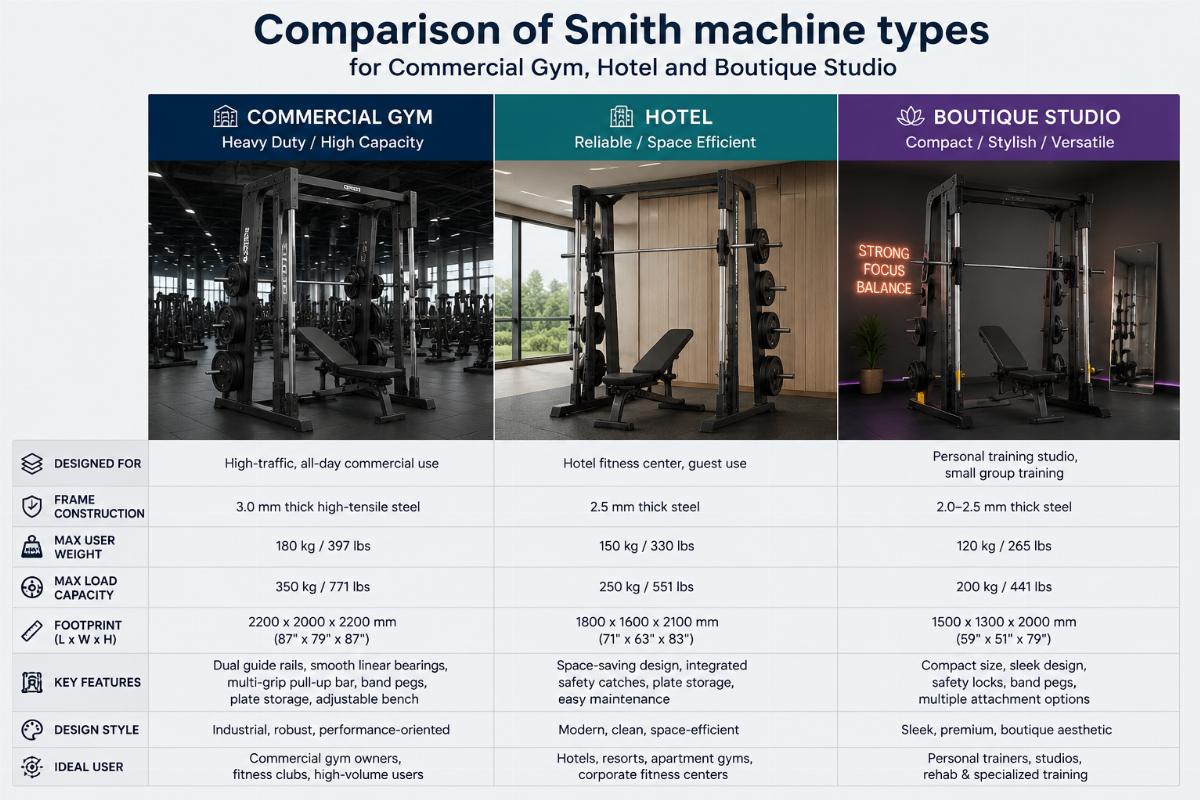
The lesson is straightforward: match the machine class to your traffic model. If you operate a high-volume commercial gym or distribute to one, you need industrial-grade bearings and heavy-wall frames. If you supply hotel fitness rooms with moderate daily use, light commercial can work—but only if you verify the bearing spec. If you sell into home or boutique markets, a lighter build is acceptable, provided you are transparent with your end users about usage limits.
When you buy Smith machine wholesale, always ask the factory for the intended usage classification of each model, not just the catalog photo.
What Steel Gauge and Bearing Grade Should You Demand?
Frame steel thickness and linear bearing class are the two non-negotiable specs that separate a machine that lasts from one that becomes a warranty nightmare.
Many buyers focus on total machine weight as a proxy for quality. This is misleading. A frame can be made heavy by adding decorative shrouds, sand-filled bases, or thick outer wraps, while the actual structural tubing—the parts that bear dynamic load—remains dangerously thin. What matters is the wall thickness of the main load-bearing tubes and the welding process used on the joints.
| Steel Wall Class | Structural Behavior | Suitable Scenario |
|---|---|---|
| Heavy-wall | Resistant to deflection under dynamic load | High-frequency commercial use |
| Mid-wall | Adequate for moderate use | Hotel gyms, light commercial |
| Light-wall | Prone to flex under repeated heavy loading | Home use only |
[NEED_CITE: structural integrity requirements for strength training equipment per ASTM F2216]
Now let’s talk about linear bearings, because this is where most wholesale buyers get quietly destroyed.
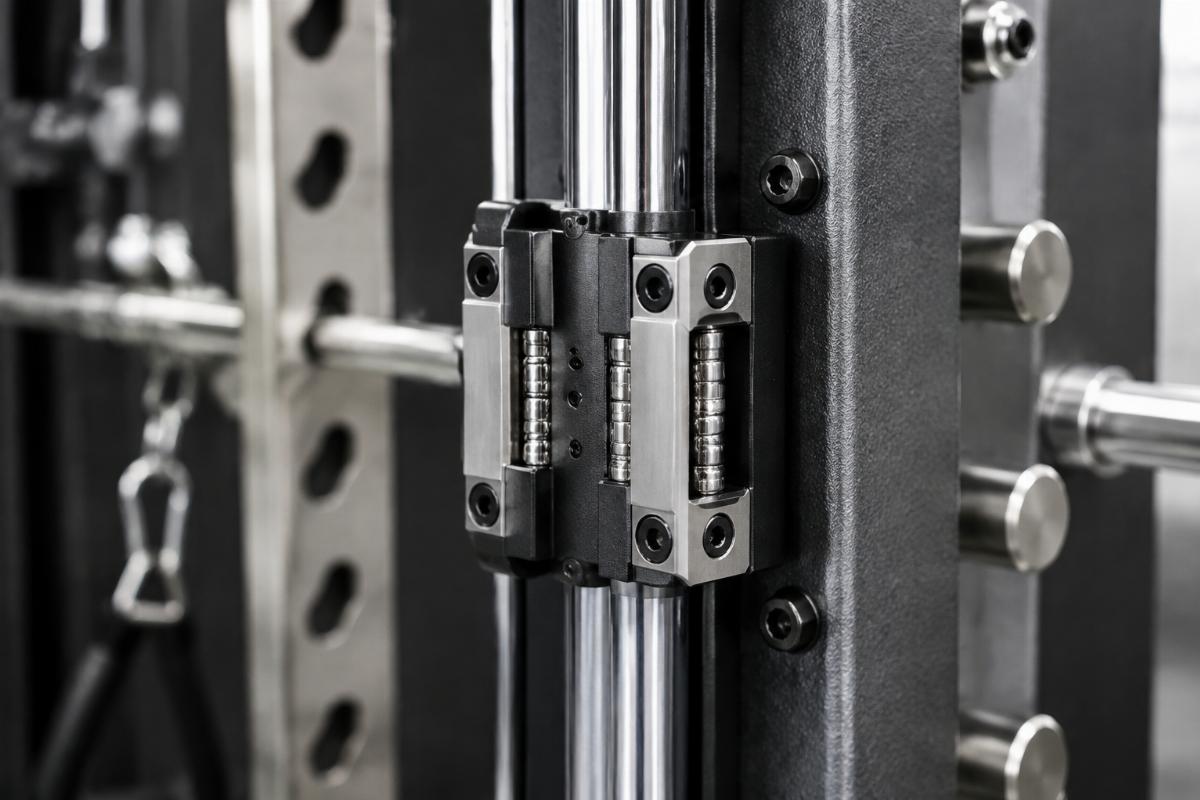
A Smith machine bar travels on linear bearings riding along guide rails. In industrial-grade units, these bearings are built to handle continuous, high-load cycling. In lower-tier machines, manufacturers substitute household-grade bearings that look identical from the outside but cannot survive sustained commercial use. Under moderate traffic, you might not notice the difference. Under heavy daily use, the inferior bearings generate heat, wear prematurely, and eventually seize—creating a safety hazard and a warranty claim.
| Bearing Class | Load Endurance | Thermal Behavior | Expected Service Under Heavy Use |
|---|---|---|---|
| Industrial grade | High | Stable under extended cycling | Substantially extended service life |
| Commercial grade | Moderate | Acceptable under normal cycling | Adequate for mid-traffic venues |
| Basic grade | Low | Prone to overheating | Noticeably reduced; failure-prone |
[NEED_CITE: linear bearing load rating standards per ISO 4378]
I have seen shipments arrive at port looking perfect—clean powder coat, smooth bar glide during a quick hand test. But after a few months on a gym floor, the same bearings started grinding. The root cause was never the design; it was the bearing class hidden inside the carriage.
When you evaluate a wholesale Smith machine supplier, ask for the bearing specification sheet, not just the catalog claim. Request a sample unit and run it through a sustained load test before placing a bulk order.
How to Optimize Container Loading and Reduce Freight Costs?
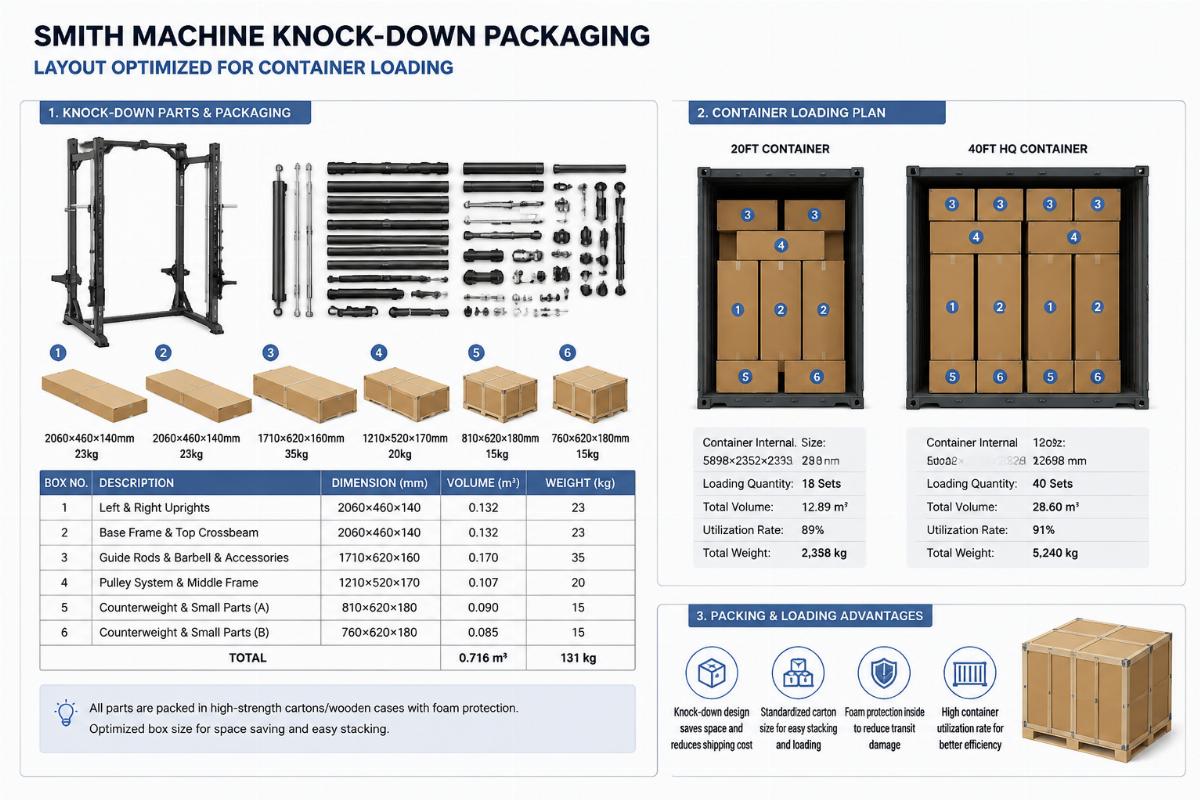
Freight cost per unit can swing dramatically based on whether the Smith machine ships fully assembled or in a knock-down configuration with separated weight components.
For importers buying Smith machine wholesale, logistics is often the hidden margin killer. A fully assembled Smith machine occupies a large cubic volume, and the weight plates—often the heaviest single component—consume payload capacity without adding proportional value to the container fill rate.
A Latin American distributor I worked with was importing mixed containers: Smith machines alongside cable crossovers, plate-loaded machines, and free weight sets. Their first few shipments were loaded with fully assembled Smith machines and integrated weight stacks. The container reached its weight limit long before it reached its volume limit, meaning they were paying for unused cubic space. By switching to a knock-down frame design and shipping the weight plates in separate bulk packaging, they noticeably increased the number of units per container and reduced the per-unit freight cost substantially.
| Loading Strategy | Container Volume Use | Weight Payload Efficiency | Per-Unit Freight Impact |
|---|---|---|---|
| Fully assembled with integrated weights | Low | Poorly balanced | Noticeably higher |
| Knock-down frame, plates packed separately | Substantially improved | Optimized | Noticeably reduced |
| Mixed-container consolidation | Maximized | Balanced across SKUs | Significantly reduced |
[NEED_CITE: container loading optimization principles per ISO 17363]
The key is to work with a manufacturer that offers knock-down packaging as a standard option, not a custom request. The frame should be designed for flat-pack assembly with clear hardware labeling, and the weight plates should be palletized separately so they can fill dead space in mixed containers.
Another point worth noting: safety limiters and bar catch mechanisms should be pre-assembled at the factory. These are small, heavy steel components that are easy to lose or misplace during on-site assembly, and missing parts trigger warranty calls that cost far more than the component itself.
What OEM and MOQ Options Are Available for Wholesale Buyers?
Flexible minimum order quantities and genuine OEM capability are what separate a transactional vendor from a long-term manufacturing partner.
Not every buyer needs a full container of identical Smith machines on the first order. A new gym owner may want a single unit to test the floor response. A distributor entering a new market may need a small batch with custom branding before committing to volume. A hotel developer may need a mixed package of strength and cardio equipment tailored to a specific floor plan.
Bick, as a Shandong-based manufacturer serving gym operators, hotel developers, and equipment distributors across multiple regions, structures its wholesale terms around these real-world scenarios. The MOQ starts from a single unit, which allows buyers to validate product quality and member response before scaling. For distributors and gym chains, full OEM and ODM branding is available—including custom color schemes, logo placement, and specification adjustments to match local market preferences.
| Buyer Stage | Typical Order Profile | Bick Support |
|---|---|---|
| New gym / studio | Single unit or small batch | Single-unit MOQ, standard specs |
| Distributor testing a market | Small batch with branding | OEM branding, custom color and finish |
| Gym chain expansion | Full container, mixed SKUs | Full container consolidation, turnkey packages |
| Hotel / apartment project | Space-planned mixed package | Turnkey fitness center packages |
[NEED_CITE: OEM manufacturing flexibility standards in commercial fitness equipment]
One advantage of working directly with a factory-based supplier like Bick is pricing transparency. Because the products are manufactured in-house rather than sourced through trading intermediaries, the cost structure sits noticeably below major international brands, while the build quality targets the same commercial-grade benchmarks. CE certification is standard across the product line, and after-sales support includes spare parts supply and technical guidance.

The product range extends well beyond Smith machines. If you are outfitting a complete facility, Bick supplies the full ecosystem: power racks, cable crossovers, plate-loaded and selectorized machines, commercial treadmills, ellipticals, spin bikes, rowing machines, free weights, functional training accessories, and gym flooring. This allows buyers to consolidate sourcing under one manufacturer, simplifying logistics, warranty management, and brand consistency.
Conclusion
Buying Smith machine wholesale is a spec-matching exercise, not a price-chasing exercise. Align frame steel gauge, bearing class, and packaging format to your actual usage scenario and logistics model, and the unit price becomes secondary. Partner with a manufacturer that offers transparent specifications, flexible MOQ, and genuine OEM capability, and you build a supply chain that scales without surprise costs.


