CC-800 Cable Crossover for Japan Market | Wholesale Supplier
Most buyers assume Japan simply rewards brand loyalty. The real gatekeeper is electrical certification and dimensional compliance.
The CC-800 Cable Crossover is fully available for the Japan market, with flexible MOQ ranging from single-unit boutique orders to full container loads, and OEM branding options tailored to Japanese gym operators and distributors. Key compliance points include PSE electrical certification, 100V/50-60Hz voltage adaptation, and compact footprint design aligned with typical Japanese facility ceiling heights and floor area constraints.
I still remember a shipment that sat at Yokohama port longer than anyone expected — not because of quality issues, but because the weight stack pulley ratio documentation didn’t match the declared HS code on the bill of lading. The customs broker needed three extra working days just to reconcile the paperwork. That kind of delay eats into margins fast, especially when warehouse space in Japan is priced per square meter by the day. Since then, I’ve made it a habit to cross-check every technical spec against the import declaration before the container even leaves the loading bay.
When sourcing a CC-800 Cable Crossover for Japan-based facilities, the conversation always starts with whether the machine physically fits — both in the room and in the regulatory framework. Japanese gym owners operate under severe space constraints, often working with ceiling heights that limit traditional dual-stack crossover designs. At the same time, METI’s PSE mark requirement means any electrical component — even something as seemingly simple as a cable tension sensor or motorized adjustment mechanism — must carry proper certification before it crosses the border [NEED_CITE: PSE electrical appliance safety act scope and covered product categories].

Getting these details right from the start is what separates a smooth delivery from a costly lesson. Let’s walk through what actually matters.
What Are the Key Specifications for Japan Compliance?
The CC-800 Cable Crossover must meet PSE certification requirements, operate on Japan’s 100V supply at either 50Hz or 60Hz depending on the destination region, and fit within typical Japanese facility dimensional constraints.
Japan’s electrical grid splits between 50Hz in the eastern regions including Tokyo and 60Hz in the western areas including Osaka. Any CC-800 Cable Crossover shipped there needs to handle both frequencies without manual adjustment, or the buyer must specify the exact installation region at the time of order. This isn’t optional — PSE inspectors will flag frequency mismatches during random market surveillance checks [NEED_CITE: PSE mark enforcement and frequency compatibility requirements for imported equipment].
Here’s how the specification matrix breaks down for Japan-bound units:
| Parameter | Standard Export Version | Japan-Compliant Version |
|---|---|---|
| Voltage | 220-240V | 100V adapted |
| Frequency | 50/60Hz selectable | Auto-switching 50/60Hz |
| PSE Certification | Not included | Mandatory for electrical components |
| Weight Stack Increment | 10 lbs | 5 kg increments for Asian user range |
| Overall Height | Standard frame | Reduced top clearance for low-ceiling facilities |
| Pulley Ratio | Fixed standard | Adjustable for rehabilitation and general fitness |
A boutique studio owner in Osaka once ordered a dual-stack crossover from a supplier who assumed "Asia means 220V." The machine arrived, the local electrician refused to connect it without a step-up transformer, and the transformer added both cost and a tripping hazard in a space where every centimeter matters. The CC-800 Cable Crossover we later supplied came pre-configured for 100V with the PSE documentation already attached to the control board housing.
The weight stack granularity deserves special attention. Japanese users — particularly in rehabilitation-focused and female-dominated studio environments — often require finer increments than the standard 10-pound jump. The CC-800 can be configured with 5 kg plates as the minimum increment, which aligns with the typical progression needs of the local market [NEED_CITE: typical resistance progression ranges for Japanese fitness demographics].

The steel frame thickness and pulley cable specifications remain consistent with commercial-grade standards. What changes is the peripheral compliance layer — the voltage, the certification paperwork, and the user-facing increment logic.
How to Import Cable Crossover to Japan Without Delays?
Correct HS code classification, complete PSE documentation, and accurate packing list details are the three pillars that prevent port delays when importing a CC-800 Cable Crossover to Japan.
The HS code for cable crossover machines typically falls under the strength training equipment category, but the exact classification depends on whether the unit includes any electrical components requiring PSE coverage. If the CC-800 Cable Crossover has any motorized adjustment, electronic display, or powered resistance mechanism, the customs declaration must reflect both the mechanical equipment classification and the electrical component compliance status [NEED_CITE: Japan customs HS code classification for fitness equipment with electrical components].
I’ve seen shipments held because the commercial invoice listed "gym equipment" generically, while the packing list broke it down by component. Japanese customs officers are thorough — they will open the container and count every piece if the documentation doesn’t match the physical inventory perfectly.
Here’s the documentation checklist that prevents problems:
- Commercial invoice with itemized breakdown matching the packing list exactly
- Bill of lading with HS code consistent with the import declaration
- PSE certification documents for any electrical components, issued by a recognized testing body
- Material safety declarations for any rubber or polymer components
- Fumigation certificate for wooden packaging materials, if applicable
- Certificate of origin if claiming tariff preferences under applicable trade agreements
A distributor in Nagoya once faced a two-week delay because the bill of lading described the cargo as "fitness machines" while the import declaration used a more specific subheading. The mismatch triggered a physical inspection, which then revealed that the wooden crate hadn’t been properly fumigated according to Japanese agricultural import requirements. The CC-800 Cable Crossover units inside were perfectly fine, but the administrative overhead cost the distributor a meaningful portion of the order margin.
The lesson is simple: treat the paperwork with the same precision as the manufacturing specs. Japanese customs operates on documentation accuracy, and ambiguity in any field invites scrutiny.

What’s the Container Loading & Delivery Timeline?
A 40HQ container can accommodate a calculated number of CC-800 Cable Crossover units based on the disassembly configuration, and the total delivery timeline from factory loading to Japan port arrival typically spans a predictable range when documentation is prepared in parallel.
The CC-800 Cable Crossover is designed with a detachable weight stack tower and removable pulley housings, which significantly improves container loading efficiency. Fully assembled units consume substantially more cubic space than partially disassembled configurations. For Japan-bound orders, we typically ship with the weight stacks separated and the main frame partially folded, allowing more units per container.
The ocean freight timeline from major Chinese ports to Japanese main ports — Yokohama, Kobe, Nagoya, or Tokyo — is relatively short compared to other destinations. However, the total lead time includes production scheduling, quality inspection, documentation preparation, ocean transit, customs clearance, and final delivery to the facility.
Here’s how the timeline typically unfolds:
| Stage | Duration | Key Dependency |
|---|---|---|
| Production & QC | Variable based on order size | PSE component procurement lead time |
| Documentation prep | Overlaps with final production week | Buyer-provided import license details |
| Ocean transit | Short regional route | Port congestion conditions |
| Customs clearance | Standard processing if docs are complete | HS code and PSE doc accuracy |
| Final delivery | Domestic trucking from port | Facility receiving availability |
A hotel fitness center project in Fukuoka required delivery coordinated with a construction completion date. The CC-800 Cable Crossover units were loaded in a configuration that allowed partial unloading at the port, with the first batch delivered for installation while the remaining units waited in a bonded warehouse until the facility was ready. This kind of phased delivery requires advance coordination but is entirely manageable.

The key is to start the documentation process before production finishes. Waiting until the goods are packed to prepare the PSE paperwork or verify the HS code is how delays happen. Parallel processing — where the compliance team works alongside the production team — keeps the timeline tight.
Why Choose Bick as Your Japan Market Supplier?
Bick provides direct factory pricing, full OEM capability, and Japan-specific compliance support for the CC-800 Cable Crossover, with experience handling the documentation precision that Japanese customs requires.
We manufacture the CC-800 Cable Crossover in our Shandong facility, which means every specification adjustment — from the 100V voltage adaptation to the 5 kg weight stack increments — happens under our direct control. There’s no intermediary adding markup or introducing communication delays when you need a technical modification for a specific Japanese client.
Our pricing structure reflects factory-direct economics. Compared to purchasing equivalent commercial-grade cable crossovers from established international brands, buyers sourcing the CC-800 Cable Crossover from Bick typically see cost savings in a significant range, while receiving equipment built to the same commercial durability standards [NEED_CITE: typical price differential between Chinese factory-direct and international brand commercial fitness equipment].
We hold CE certification for our product lines and can support OEM branding requirements — from custom nameplates to specific color schemes aligned with a Japanese distributor’s brand identity. The MOQ flexibility means a boutique studio can order a single CC-800 Cable Crossover for testing, while a national distributor can commit to container-load quantities with consistent unit-to-unit quality.
After-sales support includes spare parts supply and technical guidance. Japanese buyers particularly value knowing that replacement cables, pulleys, or weight stack pins can be sourced without returning the entire unit. We maintain component inventory specifically for the CC-800 series, ensuring that maintenance needs are met promptly.
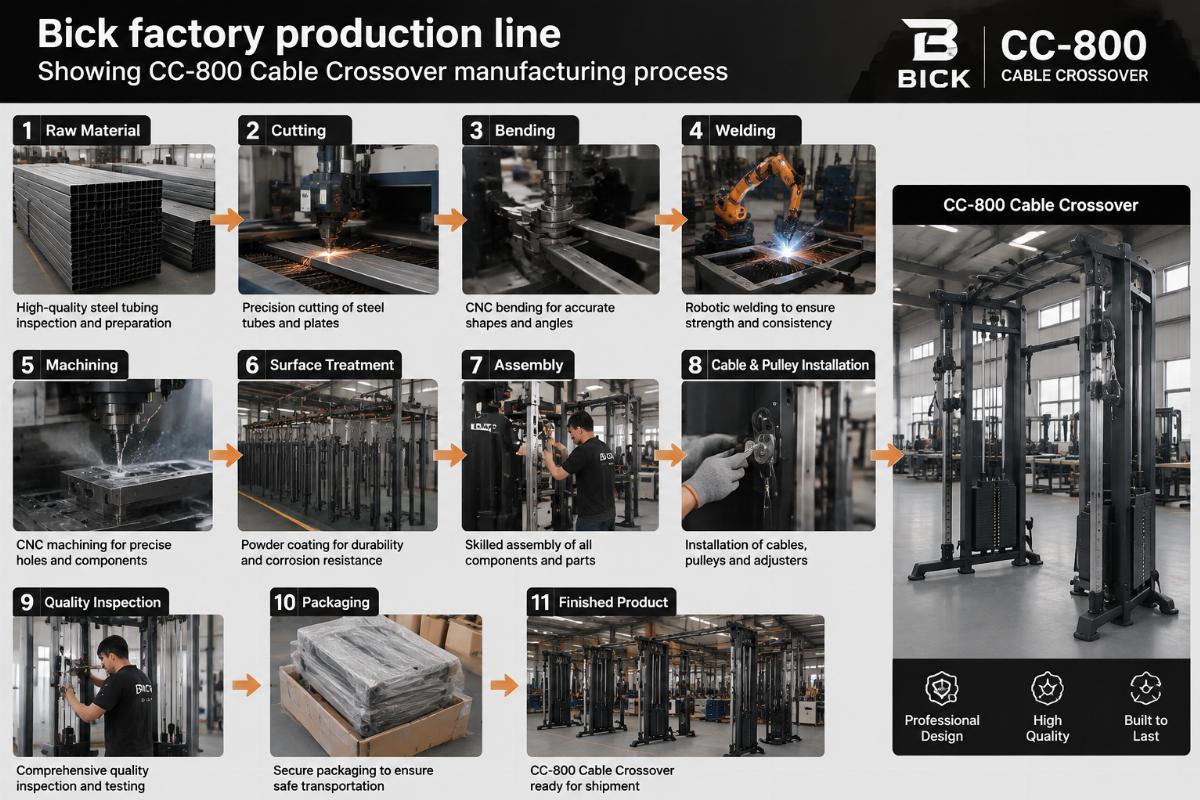
The combination of manufacturing control, compliance familiarity, and logistical experience means that when you order a CC-800 Cable Crossover for the Japan market, you’re getting a partner who understands that the machine is only half the equation — the documentation, the certification, and the delivery precision are the other half.
Conclusion
Japan market entry for the CC-800 Cable Crossover hinges on electrical compliance, dimensional adaptation, and documentation accuracy — not just product quality. The machine itself is straightforward commercial-grade equipment. What makes the difference is whether the voltage matches the local grid, whether the PSE paperwork is ready before the container ships, and whether the HS code on the bill of lading aligns perfectly with the customs declaration. Get those elements right, and the CC-800 Cable Crossover delivers reliable performance in Japanese facilities ranging from boutique studios to hotel fitness centers to full-scale commercial gyms.