CC-800 Cable Crossover for Strongman Gyms | Wholesale Supplier
Most cable crossovers sold as "commercial grade" are engineered for bodybuilding rep ranges, not strongman loading patterns — and that mismatch is the single biggest cause of premature failure in strength-focused facilities.
The CC-800 cable crossover is built specifically for strongman training environments: it features a reinforced heavy-gauge steel frame, weight stacks exceeding standard commercial limits, high-tensile aircraft cables, and oversized pulley systems rated for extreme-load applications. As a factory-direct wholesale supplier, we produce this machine to order for commercial gyms, strongman boxes, and equipment distributors worldwide.
I spent years on the procurement side before moving to manufacturing, so I have seen this problem from both ends of the transaction. At a European trade show, a Nordic strongman gym operator compared our quote against a cheaper competitor. He assumed a standard weight stack would suffice. I asked what loads his athletes were pulling on cable movements. He mentioned numbers that immediately told me the competitor’s machine would be overloaded within weeks. He chose the cheaper option anyway. Months later, a cable snapped under tension, damaged the flooring, and nearly injured an athlete. After that, every order he placed came with the same opening line: "Tell me what will break first." Across trade shows in Chicago, Cologne, and Hanover, I have watched buyer after buyer focus on unit price while ignoring the actual工况 demands of strongman training. A strongman-ready cable crossover is fundamentally different from a standard commercial machine — frame gauge, cable specification, weight stack ceiling, and pulley bearing capacity all need to match the training intensity. [NEED_CITE: equipment failure root causes in high-load commercial gym environments]

The gap between marketing claims and real-world structural capacity is where most procurement mistakes happen. Let us break down exactly what separates a strongman-rated cable crossover from a standard commercial unit.
Why Standard Cable Crossovers Fail in Strongman Gyms?
Standard commercial cable crossovers are designed around typical hypertrophy and general fitness loading patterns, which fall well below the forces generated during strongman-specific cable training.
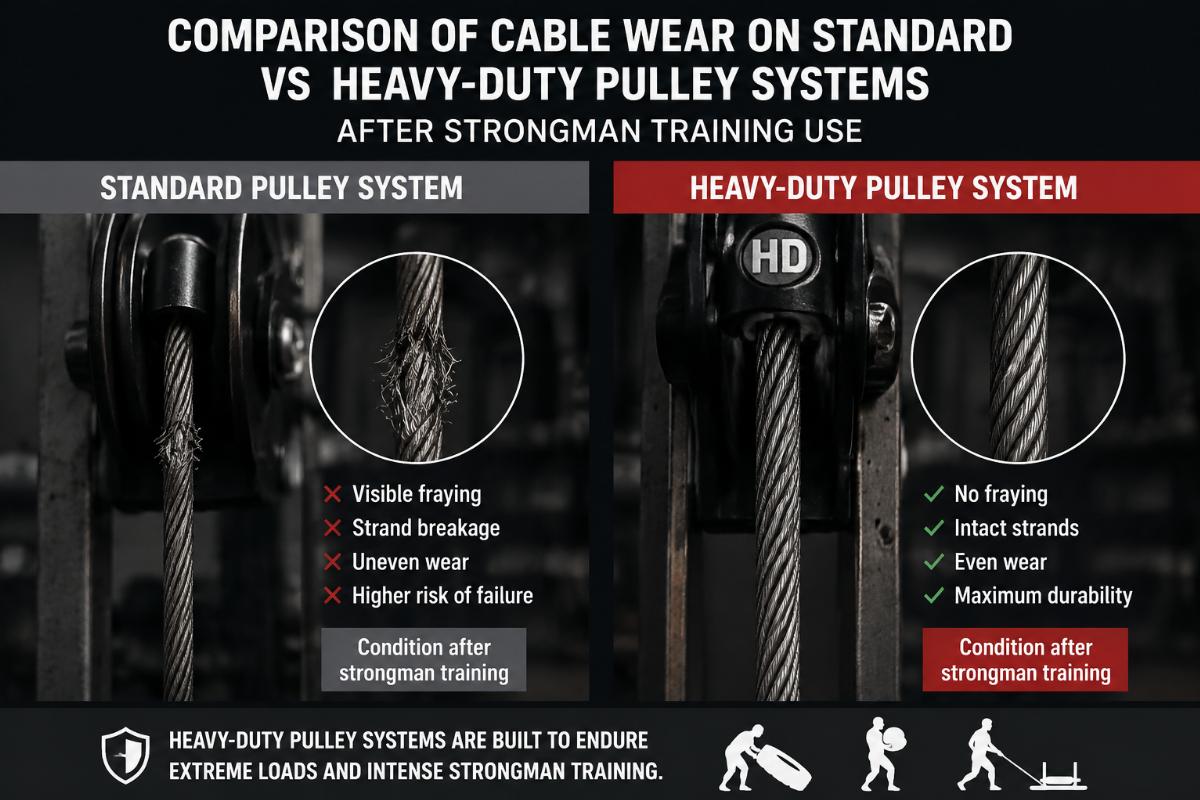
The core issue is load mismatch. Strongman athletes routinely apply forces that exceed the design envelope of conventional machines. Cable flyes, standing rows, and resisted sled pulls performed by strongman competitors generate peak tension values substantially higher than those seen in bodybuilding or general fitness use. When a machine rated for moderate loads is subjected to these extremes, failure modes appear in predictable sequence: cable fraying at the pulley groove, pulley bearing seizure under sustained high tension, frame flex causing pulley misalignment, and weight stack guide rod deformation. [NEED_CITE: structural failure modes in cable-pulley systems under cyclic overload]
A Middle Eastern distributor once placed an OEM order for a strongman-focused gym chain. The initial specification called for standard commercial weight stacks. During the prototype review, we flagged that the planned stack ceiling would be insufficient for the intended exercises. The distributor insisted on proceeding with the standard configuration to control costs. Within a short operational window, multiple units exhibited cable wear at accelerated rates, and two machines required emergency cable replacement. The retrofit cost — including shipping replacement components and downtime — far exceeded the initial savings from choosing lighter-duty specifications.
The physics are straightforward. Strongman training emphasizes maximal or near-maximal force production across compound pulling movements. Cable crossover exercises adapted for strongman — such as heavy resisted carries, high-tension face pulls, and loaded rotational work — place sustained peak loads on the cable-pulley-frame system. Standard machines are not engineered for this duty cycle. The result is not a question of if failure occurs, but when.
CC-800 Specs vs Standard Commercial Crossover: What is Different?
The CC-800 cable crossover differs from standard commercial machines across every structural dimension that matters under strongman loading conditions — frame gauge, weight stack capacity, cable specification, and pulley system durability.
The following matrix compares the key parameters that determine whether a cable crossover can withstand strongman training demands. All comparisons use qualitative ratings based on industry-standard engineering classifications rather than brand-specific proprietary data.
| Parameter | Standard Commercial Crossover | CC-800 Strongman-Rated Crossover |
|---|---|---|
| Frame Steel Gauge | Light-gauge commercial | Heavy-gauge reinforced |
| Weight Stack Capacity | Standard commercial range | Extended heavy-load range |
| Cable Tensile Rating | Standard commercial grade | High-tensile aircraft cable |
| Pulley Bearing Type | Commercial sealed bearing | Heavy-duty oversized bearing |
| Weld Construction | Standard commercial weld | Reinforced structural weld |
| Frame Rigidity Under Load | Noticeable flex at peak load | Minimal deflection at peak load |
| Pulley Groove Wear Resistance | Standard wear profile | Substantially extended wear life |
| Intended Duty Cycle | General commercial fitness | High-load strongman training |
[NEED_CITE: steel gauge thickness standards for commercial fitness equipment frames]
A US-based functional training facility tested a single CC-800 unit before committing to a full gym fit-out. The evaluation period covered continuous strongman programming including heavy cable pulls, resisted strongman-specific movements, and high-volume cable circuit work. After the trial period, the facility placed a bulk order to equip the entire cable training zone. The decision was driven by observable differences in frame stability under load, cable smoothness at high tensions, and the absence of the micro-flex that causes premature wear in lighter machines.
The weight stack difference deserves specific attention. Strongman athletes often require resistance levels that exceed the upper limits of standard commercial stacks. The CC-800 offers extended stack capacity to accommodate these loads without requiring awkward plate-loading workarounds that compromise exercise mechanics. [NEED_CITE: resistance requirements for strongman-specific cable training movements]
Pulley system design is equally critical. Oversized pulleys with heavy-duty bearings maintain smooth cable travel under extreme tension, reducing friction-induced cable wear and preventing the binding that occurs when undersized pulleys are subjected to strongman-level loads. The bearing specification directly affects both user experience and component longevity.

How to Verify a Cable Crossover is Strongman-Ready?
Procurement verification for strongman-rated cable crossovers must go beyond marketing claims and focus on four verifiable structural parameters: weight stack ceiling, frame construction documentation, cable breaking strength certification, and pulley bearing specification.
When sourcing a cable crossover for strongman use, request the following documentation and physical verification points before placing an order:
Weight Stack Range Documentation
Confirm the maximum stack weight in both the primary and secondary columns. For strongman applications, the stack ceiling must exceed standard commercial offerings. Request written confirmation of the stack configuration and verify that the guide rod and selector pin system are rated for the full stack weight plus dynamic loading factors.
Frame Construction Verification
Request material certification for the frame steel, including gauge thickness and steel grade. Physically inspect weld quality at all primary structural joints. The frame must demonstrate rigidity under load — any visible flex during testing indicates insufficient gauge thickness for strongman duty. [NEED_CITE: structural testing standards for commercial strength equipment frames]
Cable Breaking Strength Certification
Aircraft cable used in strongman-rated machines must carry documented breaking strength ratings substantially above the maximum stack weight multiplied by the pulley ratio. Request the cable specification sheet and breaking strength test certificate. Standard commercial cables are insufficient for strongman loading — the tensile rating must reflect the extreme forces involved.
Pulley Bearing Specification
Verify the pulley bearing type, size, and load rating. Heavy-duty oversized bearings are essential for strongman applications. Standard commercial bearings will degrade rapidly under sustained high-tension use. Request bearing specification documentation and confirm that the pulley groove profile matches the cable diameter to prevent accelerated wear.
A European buyer learned this verification process the hard way. After receiving a shipment of cable crossovers marketed as "heavy-duty," the buyer discovered during installation that the frame gauge was lighter than specified, the cable breaking strength documentation was absent, and the pulley bearings were standard commercial grade. The machines were unsuitable for the intended strongman programming, and the return logistics cost exceeded the equipment value. Proper pre-shipment verification would have prevented this loss.

CC-800 Wholesale Options for Gyms and Distributors
The CC-800 cable crossover is available through factory-direct wholesale channels with flexible order quantities, full OEM and ODM branding support, and pricing structured for commercial gym operators and equipment distributors sourcing heavy-duty strongman training equipment.
As a manufacturer based in Shandong Province with extensive export experience, we produce the CC-800 to order with customization options tailored to the specific requirements of strongman facilities and distribution partners. The wholesale model supports single-unit procurement for facility testing, multi-unit orders for gym zone fit-outs, and container-load quantities for distributors serving regional markets.
OEM branding services include custom frame color, logo application, weight stack labeling, and packaging design. ODM modifications can accommodate specific weight stack configurations, pulley ratio adjustments, and attachment options based on the training programming requirements of the end user. All customization is performed at the manufacturing facility, ensuring quality control throughout the production process.
The factory-direct supply model eliminates intermediary markups, providing cost advantages compared to sourcing through traditional distribution channels. This pricing structure is particularly relevant for strongman-rated equipment, where the engineering and material requirements inherently increase production costs relative to standard commercial machines.
A distributor in the Latin American market initially ordered a small batch of CC-800 units for market testing. After receiving positive feedback from strongman gym operators in the region, the distributor scaled to regular container-load orders. The consistent quality, reliable lead times, and responsive technical support established a long-term supply relationship that continues to expand as the strongman training segment grows in the region.
Technical support and spare parts supply are integral to the wholesale offering. Cable replacement kits, pulley assemblies, weight stack components, and other wear items are available for prompt shipment, minimizing equipment downtime in commercial settings where training continuity is essential.

Conclusion
Strongman training demands cable crossovers engineered for extreme loads — standard commercial machines will fail under these conditions. The CC-800 addresses this gap through reinforced frame construction, extended weight stack capacity, high-tensile cables, and heavy-duty pulley systems designed specifically for strongman duty cycles. Procurement verification must focus on documented structural parameters rather than marketing claims. Factory-direct wholesale sourcing provides cost advantages and customization flexibility for gyms and distributors serving the strongman training market.