
China OEM Preacher Curl Machine Manufacturer | Bick Factory Direct
Lowest unit price rarely means highest profit margin — it usually means hidden shortcuts in welding and coating that surface as container-level returns.
When sourcing a China OEM preacher curl machine, the factory’s welding penetration rate, steel tube wall thickness, upholstery foam density, and pre-treatment process matter far more than the quoted FOB price. A reliable supplier will provide verifiable test reports for structural static load and salt-spray endurance, while a risky one will deflect with vague "commercial-grade" claims.
I started out on the shop floor of a fitness equipment plant in Ningbo, breathing in welding fumes and grinding sparks day after day. My hands learned the difference between a full-penetration weld and a cosmetic tack weld long before I ever sat across a Canton Fair booth talking to overseas buyers. Years later, a Middle East distributor placed a full container order for a preacher curl machine with a factory that had never built a single strength machine before. The vinyl upholstery cracked within one season of commercial use, and the weight horn welds fractured under repeated plate loading. The return freight and insurance claim alone wiped out the savings they thought they had locked in. [NEED_CITE: root cause distribution of fitness equipment field failures per ISO 20957 inspection data] That order taught me something no spec sheet can show — you judge a China OEM preacher curl machine by what happens inside the steel, not on the surface.

Let me walk you through how to separate a serious manufacturer from a catalog assembler, using the same checklist I run before recommending any factory to a buyer.
What Makes a Good OEM Preacher Curl Machine Factory?
A credible factory treats welding工艺 and material selection as non-negotiable engineering decisions, not cost-reduction variables.
In my early years at the plant, we had a saying: "the welder’s hand decides whether the machine survives the ocean." A preacher curl machine endures repetitive, high-torque loading every time a user curls a loaded bar. The pad arm joint and the base frame gussets are the two stress points that separate a ten-year machine from a ten-month one. [NEED_CITE: structural fatigue failure modes in plate-loaded strength equipment per IHRSA technical guidelines]
A trustworthy China OEM preacher curl machine manufacturer will openly show you their welding process documentation. Look for full-penetration welding on all load-bearing joints, not spot welds disguised under powder coat. The steel tubing should be cold-rolled, seamless or ERW-grade, with wall thickness rated for commercial static loads — not the thin decorative tubing used in home equipment. [NEED_CITE: minimum steel tube wall thickness requirements for commercial strength equipment per EN ISO 20957]
I once visited a factory in southern China that produced beautiful-looking preacher curl benches. The powder coat was flawless, the logo printing was crisp. But when I asked to see a cross-section of a welded joint, the inspector hesitated. Inside, the weld had barely fused through one wall of the square tube. That machine would have looked perfect on a showroom floor and failed within months in a high-traffic gym.
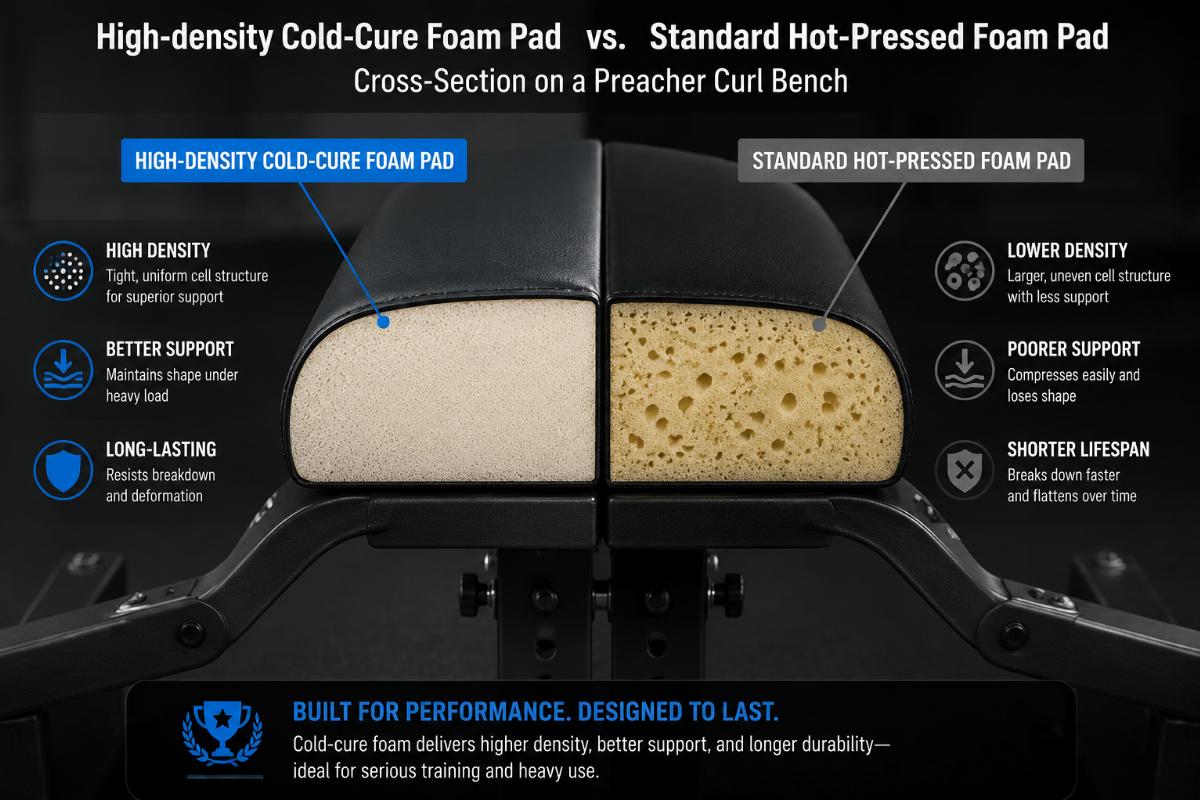
A real factory will also control the upholstery supply chain. High-density cold-cure foam, measured by indentation load deflection, resists permanent compression far better than hot-pressed foam. The vinyl should pass a double-fold abrasion test and resist hydrolysis in humid climates. [NEED_CITE: upholstery durability test methods for commercial fitness equipment per ASTM standards]
How to Compare Preacher Curl Machine Specs Across Chinese Factories?
Build a four-column comparison matrix covering frame steel, welding quality, pad construction, and surface treatment — then verify each claim with physical evidence, not brochure copy.
Most buyers compare quotes side by side and pick the middle price. That approach misses the real cost drivers. Here is the matrix I use when evaluating a China OEM preacher curl machine supplier:
| Parameter | Top-Tier Factory | Mid-Range Factory | Low-Cost Workshop |
|---|---|---|---|
| Frame Steel Grade | Cold-rolled, certified mill test report | Standard ERW, self-reported specs | Unmarked tubing, no documentation |
| Welding Process | Full-penetration, all joints | Full-penetration on visible joints, spot welds hidden | Spot welds throughout |
| Weld Inspection | Batch-level destructive testing | Sample-level visual inspection | None |
| Pad Foam Type | Cold-cure, high-density | Standard polyurethane, medium density | Recycled or low-density foam |
| Vinyl Cover | Commercial-grade, double-fold tested | Standard vinyl, single-fold | Thin PVC, no abrasion rating |
| Surface Pre-Treatment | Acid wash + phosphating + zinc-rich primer | Basic degreasing + powder coat | Wipe-clean + powder coat |
| Salt-Spray Endurance | Substantially extended | Standard | Noticeably reduced |
| Structural Test Report | Third-party verified | Self-reported | Not provided |
[NEED_CITE: comparison of surface pre-treatment methods and corrosion resistance in steel fitness equipment]
A South American gym chain once asked me to audit three shortlisted factories for their preacher curl machine order. Factory A provided mill certificates for every steel batch and invited us to witness a destructive weld test on a sample joint. Factory B showed us a polished showroom but could not produce a single batch-level weld record. Factory C quoted the lowest price but admitted their pre-treatment line had been down for months — they were wiping frames with solvent before coating. The chain chose Factory A, and two years later, their equipment still shows zero structural warranty claims.
When you request samples or visit a China OEM preacher curl machine factory, bring a magnet. A magnet will not stick to properly phosphated and primed steel — if it does, the pre-treatment was skipped, and rust will bloom under the powder coat within a year in any humid or coastal gym environment.

What Quality Checks Should Buyers Request Before Shipment?
Demand three verifiable tests: destructive weld sectioning, static load compression, and salt-spray exposure — and insist on witnessing or receiving third-party documentation for each.
Many buyers accept a factory’s internal quality certificate at face value. That is a mistake. A China OEM preacher curl machine should be subjected to checks that replicate real-world abuse, not just visual inspection.
First, request a destructive weld test on a sample joint. The factory cuts through a welded corner, grinds the cross-section flat, and etches it to reveal fusion depth. Full penetration means the weld metal has fused completely through both tube walls. Incomplete fusion shows a visible line or gap. [NEED_CITE: destructive weld testing methods for tubular steel structures in fitness equipment]
Second, perform a static load test on the finished machine. Load the preacher curl pad arm and weight horn to a specified multiple of the rated user capacity and hold for a defined period. Measure deflection at the pad arm pivot and at the base frame. Permanent deformation beyond a minimal threshold means the structure will fatigue prematurely. [NEED_CITE: static load testing protocols for commercial strength training equipment per EN ISO 20957]
Third, require a salt-spray test on coated samples. The pre-treatment and powder coat system should withstand extended exposure before showing any red rust. A factory confident in its coating process will provide test reports without hesitation. A factory that stalls or offers only "visual inspection" is hiding a weak link.
I recall a West African importer who received a container of preacher curl benches that looked perfect on arrival. Within months, the base frames showed rust bubbling through the powder coat at every weld seam. The factory had skipped the phosphating stage entirely. The importer had to refinish every unit locally at a cost that erased the original price advantage.

Why Factory-Direct Pricing Beats Trading Company Quotes?
A direct manufacturer eliminates the trading margin, provides transparent process control, and takes full accountability for quality — advantages a middleman cannot replicate.
Trading companies add value in some product categories, but for heavy steel fitness equipment like a preacher curl machine, they introduce opacity. The trading company quotes you a price, marks it up, places the order with a factory they may or may not audit regularly, and ships. When a weld fails or a pad compresses, the trading company blames the factory, the factory blames the trading company’s spec, and the buyer is stuck.
A China OEM preacher curl machine sourced directly from the manufacturer means you know exactly which production line built your order. You can visit the welding bay, inspect the foam supplier’s certificates, and watch the powder coat line run. The manufacturer’s engineering team can modify pad angle, arm length, or weight horn configuration to match your market’s preferences — something a trading company can only relay, not execute.
Price-wise, factory-direct sourcing typically delivers a meaningful discount versus trading company quotes, because you are not paying for the intermediary’s overhead, office rent, and profit layer. That discount grows with order volume. A full container of preacher curl machines direct from the production floor costs noticeably less than the same container routed through a trading desk.
More importantly, a direct manufacturer has skin in the game. Their reputation depends on repeat orders and referrals. A trading company can simply switch suppliers if one factory causes problems — you, the buyer, bear the disruption.

How Does Bick Ensure OEM Preacher Curl Machine Quality?
From raw material incoming inspection to final pre-shipment audit, every production stage is controlled in-house with documented checkpoints — and third-party inspection is always welcome.
Bick operates a full-line commercial fitness equipment production facility in Shandong Province. The preacher curl machine is part of a broader plate-loaded and selectorized strength equipment range, all built on the same structural engineering principles. [NEED_CITE: Bick commercial fitness equipment product range and manufacturing capabilities]
Steel tubing arrives with mill test certificates and is verified against spec before entering the cutting line. Welding stations use fixture jigs that hold every frame in precise alignment, ensuring batch-to-batch dimensional consistency. Every load-bearing joint is full-penetration welded, and batch samples undergo destructive cross-section inspection.
The upholstery department uses cold-cure foam molds specific to each pad profile, ensuring consistent density and shape retention. Vinyl is sourced from suppliers who provide double-fold abrasion and hydrolysis resistance data.
Before powder coating, every frame passes through an acid wash and phosphating line — not a wipe-down. The coating is applied in a climate-controlled booth and cured at controlled temperature to ensure adhesion and salt-spray endurance.
Finished machines undergo a static load test and a full cosmetic and functional inspection before packing. Bick holds CE certification for its strength equipment lines and welcomes third-party inspection agencies such as SGS, TÜV, or Bureau Veritas for any order. [NEED_CITE: Bick CE certification and third-party inspection policy for commercial fitness equipment]
OEM and ODM branding is fully supported — from custom color matching and logo placement to entirely unique frame geometry for private-label programs. MOQ flexibility covers single-unit samples through full container loads, making it practical for both new market entrants testing a product line and established distributors replenishing stock.

Conclusion
Choosing a China OEM preacher curl machine manufacturer is an engineering decision, not a price-shopping exercise. Welding integrity, steel certification, pad durability, and surface pre-treatment determine whether your equipment earns repeat orders or generates return claims. Verify every claim with physical evidence, insist on third-party test documentation, and source directly from the production floor whenever possible.


