
China Smith Machine vs EliteFTS: Wholesale Price vs Value for PT Studio Owners
EliteFTS is not twice as good as a China Smith Machine — it is twice as expensive to manufacture in North America.
For PT studio owners comparing these two, the real price gap on equivalent commercial-grade configurations sits between a noticeable discount and a near-half reduction, depending on order volume and customization level. EliteFTS justifies part of its premium through refined finishing details and domestic warranty logistics, but the core structural performance — load capacity, guide rail smoothness, and frame rigidity — overlaps far more than the price tag suggests.
I still remember a container that got held up at the port of Veracruz. A private training studio owner in Mexico City had ordered a full set of strength equipment, including two Smith machines. He had previously bought a single EliteFTS unit for his personal training bay and loved the feel of it. When the quotation for outfitting his new second location came in, the gap between the American brand’s per-unit quote and our FOB pricing made him pause for weeks. He kept asking: "If the steel is the same, why is the difference so large?" That question is the right one to ask — and the answer is not about steel quality alone. [NEED_CITE: cost structure breakdown of commercial strength equipment across North American and Asian manufacturing bases]
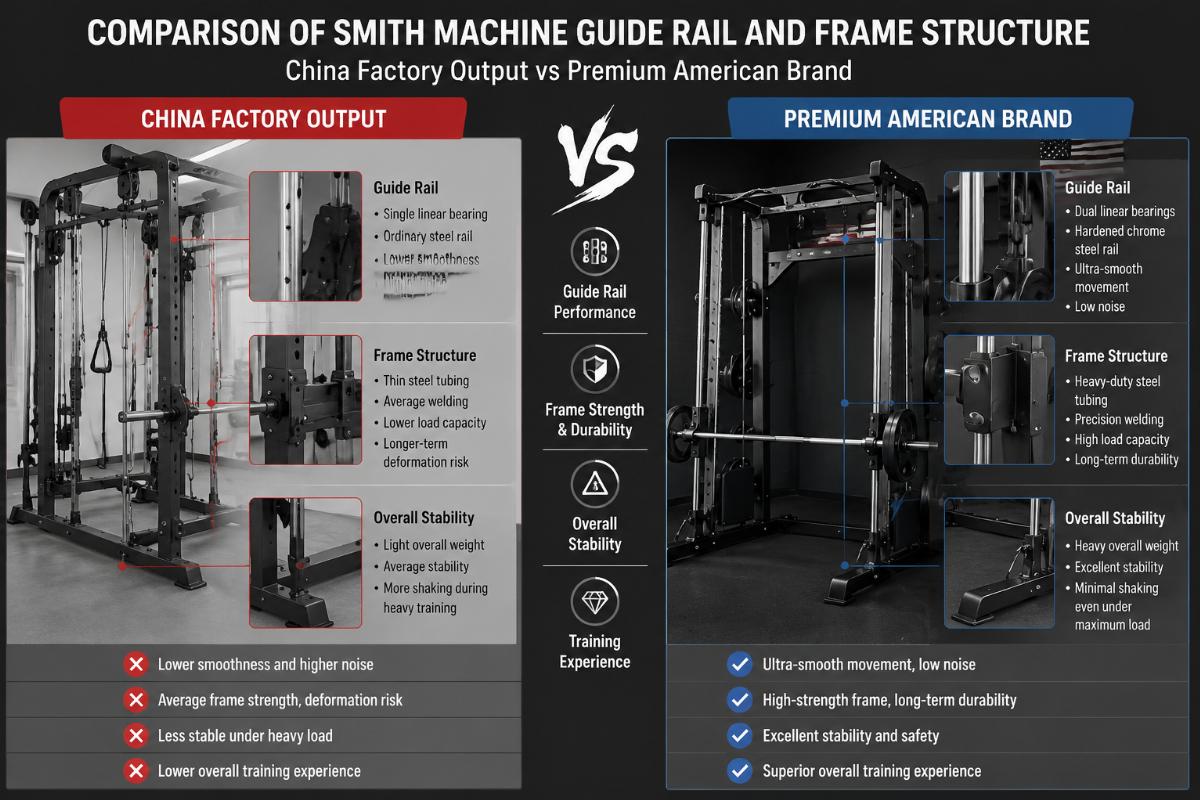
Let me walk you through what I have seen across multiple markets, what the specs actually say when you strip away the branding, and how to make the call that fits your studio’s real usage pattern.
EliteFTS vs China Smith Machine: What’s the Real Price Gap?
The short answer: on equivalent commercial configurations, a China Smith Machine typically lands at a substantially lower wholesale price point than EliteFTS, with the gap widening as order volume increases.
This is not a secret — it is a structural reality of where these machines are built, who builds them, and how the supply chains are organized. EliteFTS designs and manufactures in the United States, which means North American labor rates, domestic steel procurement, and localized overhead are baked into every unit. A China Smith Machine from a verified Shandong-based manufacturer benefits from integrated steel supply chains, concentrated fitness equipment industrial clusters, and significantly lower assembly labor costs. [NEED_CITE: comparative manufacturing cost analysis of commercial strength equipment by region]
Here is what the price composition typically looks like when you break it down qualitatively:
| Cost Component | EliteFTS (US-Made) | China Smith Machine (Factory-Direct) |
|---|---|---|
| Raw Material (Steel, Bearings) | Comparable grade | Comparable grade |
| Labor & Assembly | Substantially higher | Noticeably lower |
| Brand Premium & Marketing | Significant | Minimal |
| Domestic Overhead & Compliance | High | Moderate |
| FOB/Export Pricing N/A | Not applicable | Primary cost layer |
| Import Duties & Ocean Freight | N/A | Added layer, still net lower |
A boutique studio owner in São Paulo once compared a single EliteFTS Smith machine quote against a two-unit order from a Chinese factory. The per-unit landed cost difference, even after adding ocean freight and Brazilian import taxes, still came in at a very substantial margin. He ended up allocating the savings toward additional cable crossover units and a full set of adjustable benches — equipment that expanded his studio’s service offering without expanding his budget.
The key distinction is this: not every cheap China Smith Machine is a good deal. Some cut corners on guide rail heat treatment or use undersized bushings to hit a lower price. The goal is to find a manufacturer that matches EliteFTS-tier structural specs at factory-direct pricing — and that is absolutely achievable if you know what to verify. [NEED_CITE: quality tier classification of Chinese strength equipment exporters]

Build Quality Comparison: Where Does EliteFTS Justify Its Premium?
EliteFTS earns part of its price premium through superior finishing details, tighter weld consistency, and a well-tuned guide rail system — but the core structural difference is narrower than most buyers assume.
Let me be direct about what EliteFTS does well. Their guide rail assemblies use precision-ground solid steel bars with carefully matched linear bearings, resulting in exceptionally smooth barbell travel with minimal lateral play. The welds are clean, consistent, and visually refined. The upholstery stitching is heavy-duty. The safety hook mechanisms engage with a solid, confidence-inspiring click. These are real quality markers, and they matter in a high-traffic commercial environment.
Now here is the part that surprises most PT studio owners: the fundamental load-bearing structure — the main uprights, the base frame, the J-cup mounting points — uses steel of comparable grade and thickness across both tiers. The difference in raw material cost between a premium American brand and a well-configured China Smith Machine is relatively small. What drives the price gap is everything layered on top of that structure. [NEED_CITE: material grade and thickness standards for commercial Smith machine frames]
Consider this comparison across key build quality dimensions:
| Build Quality Dimension | EliteFTS | China Smith Machine (Verified Factory) |
|---|---|---|
| Guide Rail Material | Precision-ground chrome-plated solid steel | Chrome-plated solid steel, heat-treatment varies by factory |
| Bushing/Bearing Type | Matched linear bearings | Bronze bushings or linear bearings, spec-dependent |
| Upright Steel Thickness | Heavy-gauge, consistent | Heavy-gauge on premium configs, varies on budget configs |
| Weld Quality | Highly consistent, visually clean | Good to excellent on top-tier factories, inconsistent on low-tier |
| Finish & Paint | Powder-coated, durable | Powder-coated, durability depends on pre-treatment process |
| Safety Mechanism | Refined engagement feel | Functional, engagement feel varies |
A PT clinic operator in the Middle East initially specified EliteFTS for his entire facility. When the total project budget was reviewed, the Smith machine line item alone consumed a disproportionate share. He agreed to test a China Smith Machine from our production line with upgraded guide rail specs — specifically, solid chrome-plated steel bars with matched bronze bushings and controlled heat treatment. After extended high-frequency use, the performance gap in daily training feel was minimal, while the budget relief allowed him to add a full functional training zone. [NEED_CITE: guide rail material and bushing specification standards for commercial Smith machines]
The honest takeaway: EliteFTS is an excellent machine. But you are paying for American manufacturing overhead, brand positioning, and finishing refinement — not for a fundamentally different structural platform. A well-specified China Smith Machine can deliver comparable core performance at a meaningfully lower investment.

How to Verify a China Smith Machine’s Quality Before Ordering?
Request three verifiable documentation packages before committing: guide rail material certification, bushing clearance test records, and structural weld inspection reports.
This is where many PT studio owners get burned — not by buying from China, but by buying without verifying. The fitness equipment export market includes factories at every quality tier, from exceptional to dangerously cut-corner. The difference between a reliable China Smith Machine and a problematic one often comes down to three components: the guide rails, the bushings or bearings that ride on them, and the structural welds that hold the frame together under load.
Here is the verification process I recommend, based on years of watching buyers succeed and fail:
Step One — Guide Rail Material Proof
Ask the supplier for material certificates specifying the steel grade of the guide rails. You are looking for solid chrome-plated steel bars, not hollow tubing. The chrome plating should be specified for wear resistance. [NEED_CITE: material certification requirements for commercial fitness equipment guide rails] Request confirmation that the bars undergo heat treatment for surface hardness. If a factory cannot provide this documentation or responds vaguely, move on.
Step Two — Bushing Clearance Specification
The smoothness and longevity of a Smith machine depend heavily on the fit between the guide rail and the bushing or bearing assembly. Ask for the specified clearance tolerance range. Bronze bushings should have a controlled fit that minimizes lateral play without creating excessive friction. Linear bearings should be rated for the expected load cycle. [NEED_CITE: bushing clearance tolerance standards for linear motion in strength equipment] A factory that takes this question seriously is a factory that understands precision assembly.
Step Three — Structural Weld and Frame Inspection
Request weld inspection documentation or recent third-party inspection reports covering the main frame structure. The critical areas are the upright-to-base connections, the J-cup mounting plates, and the safety catch mounting points. These joints carry the highest stress during heavy lifting. [NEED_CITE: weld inspection standards for commercial strength equipment frames]
A gym owner in West Africa learned this the hard way. He purchased Smith machines from a low-tier supplier based solely on price photos. Within a short operational period, the guide rails developed noticeable wear, the barbell travel became uneven, and the bushings started producing audible grinding. The root cause was unhardened guide rail stock and oversized bushing clearances — problems that proper pre-shipment verification would have caught.
When you source a China Smith Machine with documented specs across these three areas, you are not gambling. You are making an informed procurement decision backed by verifiable data.

Which Option Fits Your PT Studio’s Budget and Usage Pattern?
The right choice depends on three factors: daily usage intensity, peak user load, and your in-house maintenance capability — not on brand loyalty alone.
Let me frame this with real scenarios I have encountered across different markets.
Scenario A — High-Volume Commercial PT Studio in a Premium Urban Market
If your studio operates in a high-end market where clients expect top-tier brand recognition, and your daily usage involves continuous back-to-back sessions with heavy-loaded barbells, EliteFTS offers brand assurance and domestic service infrastructure that may justify the investment. The premium is partly an insurance policy for brand perception.
Scenario B — Growing PT Studio or Small Commercial Gym Focused on ROI
If your priority is building a well-equipped facility within a defined budget, and your clients care more about training results than brand names on the equipment, a well-specified China Smith Machine delivers the functional performance you need at a fraction of the cost. The savings can be redirected toward additional equipment variety, facility upgrades, or marketing — investments that directly drive revenue. [NEED_CITE: equipment budget allocation best practices for boutique fitness studios]
Scenario C — Multi-Location or Franchise Studio Model
For operators planning to equip multiple locations, the per-unit savings on a China Smith Machine compound dramatically. A PT studio chain owner in Latin America initially planned EliteFTS across all locations. After running the numbers with a China factory-direct quote, he reallocated the equipment budget to open two additional locations within the same overall investment. The machines in each location were configured to match the structural and functional specs he needed, without the brand premium.
| Decision Factor | EliteFTS Favored | China Smith Machine Favored |
|---|---|---|
| Daily Usage Intensity | Very high, continuous heavy load | Moderate to high, standard commercial cycles |
| Brand Perception Priority | Critical for client acquisition | Secondary to training outcomes |
| Budget Flexibility | High | Constrained, ROI-focused |
| Maintenance Capability | Relies on domestic service network | In-house basic maintenance or supplier spare parts support |
| Order Volume | Single unit or small batch | Multi-unit or full facility packages |
Here is a counterintuitive point I have observed repeatedly: many PT studio owners assume that buying premium means less maintenance. In reality, all mechanical equipment requires periodic inspection and adjustment. The difference is whether you have a local service technician on speed dial or a supplier relationship that provides spare parts and technical guidance at accessible cost. A responsive China Smith Machine manufacturer who supplies replacement bushings, guide rail covers, and hardware kits can support your maintenance cycle just as effectively — at a fraction of the cost per part. [NEED_CITE: spare parts availability and after-sales support models for exported fitness equipment]
The decision is not emotional. It is a calculation based on your specific operational reality.

Conclusion
Both EliteFTS and a properly specified China Smith Machine can serve a PT studio well — the difference is in what you are paying for and what you are willing to trade off. EliteFTS offers refined finishing, brand prestige, and domestic service infrastructure at a premium price. A verified China Smith Machine delivers comparable core structural performance and functional quality at a substantially lower investment, freeing budget for other revenue-generating priorities. The smart move is to define your actual usage requirements, verify your supplier’s specifications with documentation, and let the numbers — not the logo — drive your decision.


