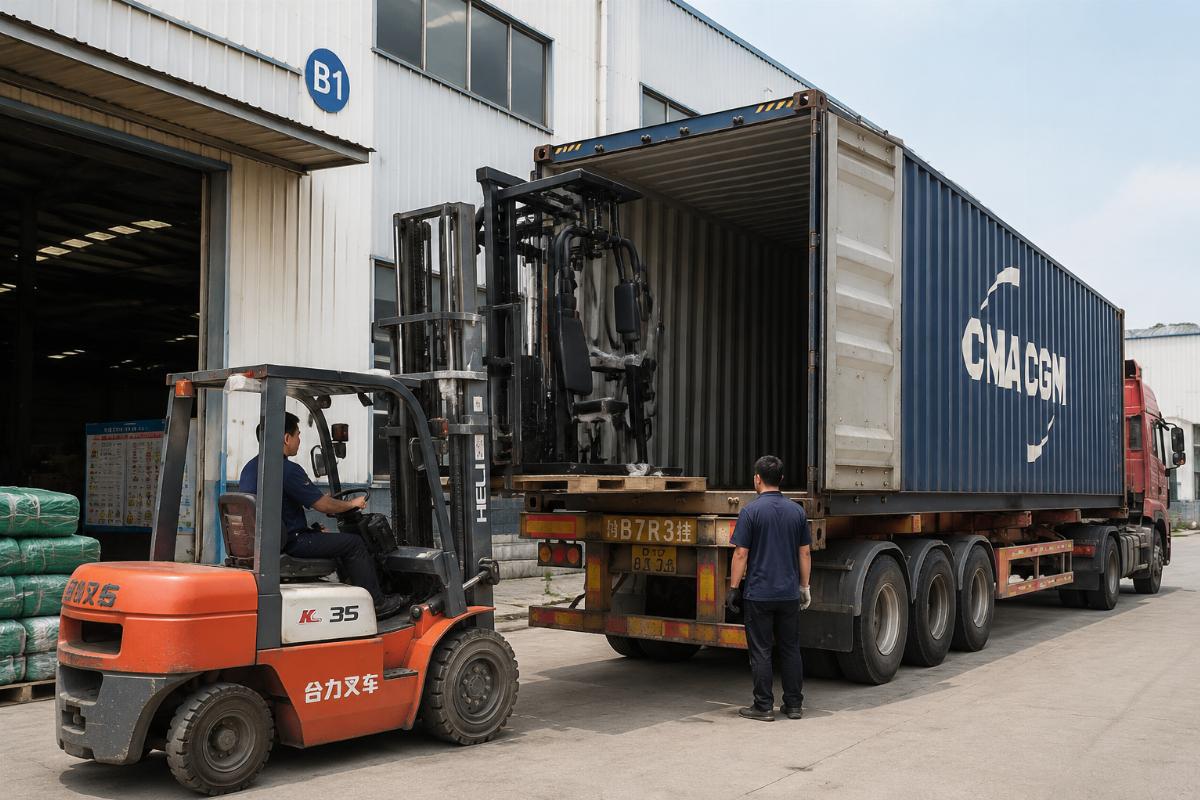
Commercial Prone Leg Curl Machine for Sale | Bick Manufacturer
Most buyers assume gym strength machines carry a flat, low import duty into Russia. The reality is far more complicated—HS code classification alone can swing your landed cost by several percentage points, and that is before VAT and certification fees stack on top.
Prone leg curl machines entering Russia fall under the EAEU Common Customs Tariff with HS code 9506.91 as the primary classification for general strength training equipment. The standard import duty rate for this subheading sits in the single-digit percentage range, but the exact rate depends on the country of origin and any applicable bilateral trade preferences. On top of duty, importers must budget for a 20% VAT, mandatory EAC certification under Technical Regulation TR CU 004/2011, and customs brokerage fees—all of which collectively shape the true landed cost far more than the duty rate alone. [NEED_CITE: EAEU Common Customs Tariff classification for HS 9506.91 strength training machines]
I still remember a container of seated leg extension machines we shipped to a distributor in Moscow a few years back. The client had pre-calculated his landed cost using a generic "fitness equipment" duty rate he found on a freight forwarder’s website. When the goods hit customs in St. Petersburg, the broker flagged the declaration because the invoice description said "gym machine" without specifying the exact type. The hold lasted nearly two weeks, storage fees piled up, and the broker ended up reclassifying the shipment under a different subheading that carried a slightly higher rate. The Import Duty Rate for Prone Leg Curl into Russia was never the real problem—it was the sloppy paperwork and vague product descriptions that turned a routine clearance into a costly headache.

Getting the paperwork right from the start saves everyone time and money. Let me walk you through exactly how this works.
What HS Code Applies to Prone Leg Curl Machines in Russia?
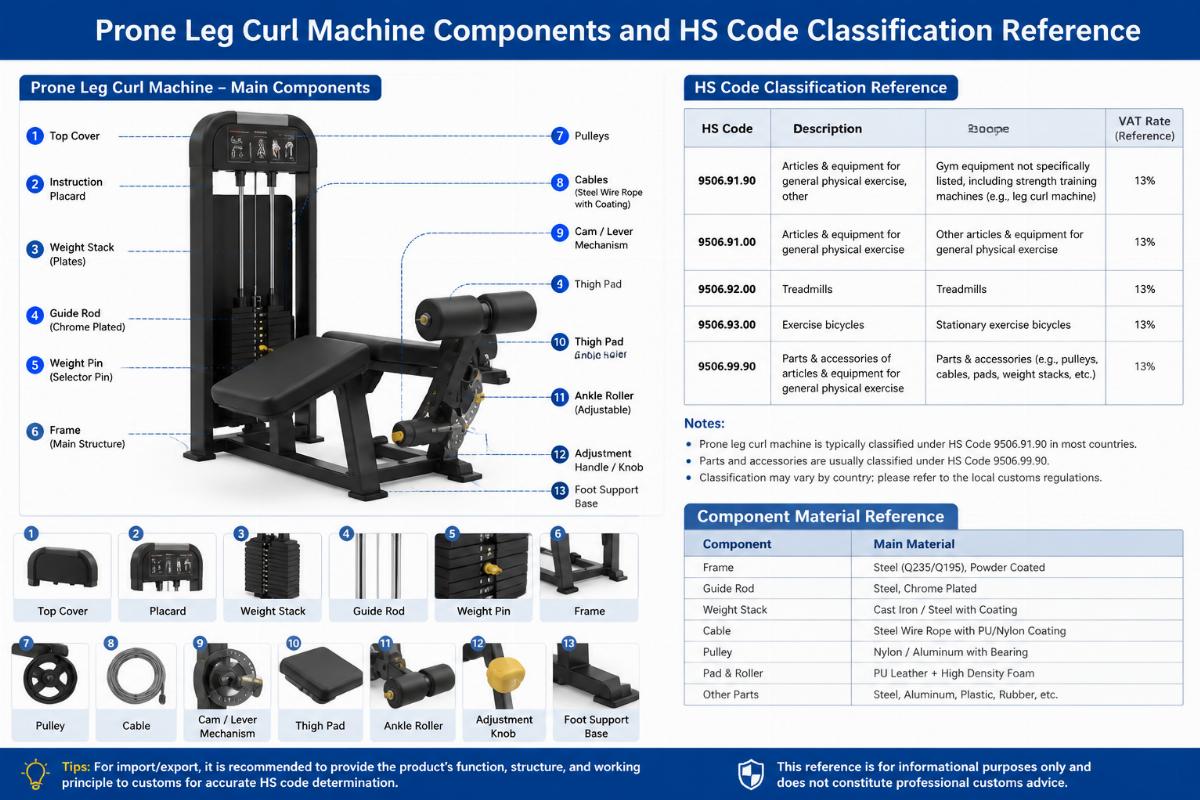
Prone leg curl machines are classified under HS code 9506.91 in the EAEU tariff schedule, which covers "articles and equipment for general physical exercise." This subheading captures most selectorized and plate-loaded strength machines used in commercial gym settings. [NEED_CITE: EAEU CCT subheading 9506.91 scope for gym strength equipment]
Here is where things get tricky. Some importers have tried to classify component parts—like weight stacks, frames, or adjustment mechanisms—under separate headings, arguing that disassembled shipments should be treated differently. The EAEU customs code is clear on this: if the imported goods have the essential character of a finished article, they must be classified as the complete article. [NEED_CITE: EAEU General Rule of Interpretation for incomplete or unassembled goods]
A distributor in the Middle East once ordered a full container of leg curl machines from us, but asked us to ship the weight stacks separately from the frames to a different consignee. His logic was that splitting the declaration might lower the overall duty burden. It did not work that way. Russian customs reviewed both shipments, recognized them as components of the same machine, and consolidated the classification under 9506.91 anyway. The delay added weeks to the delivery timeline, and the client ended up paying storage penalties on top of the original duty.
The key takeaway is that HS code classification for the Import Duty Rate for Prone Leg Curl into Russia is not a gray area you can exploit through creative invoicing. The machine is a strength training device, and it gets classified as one—whether it arrives fully assembled or in knock-down form.
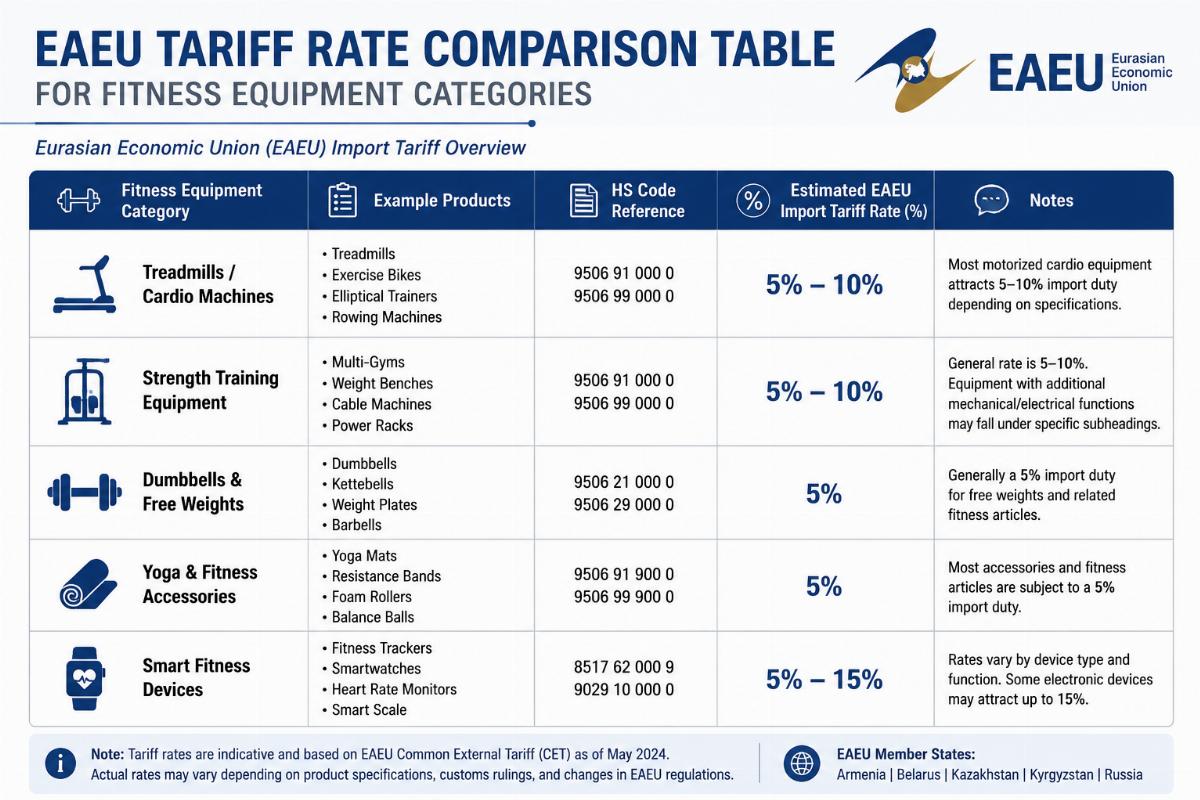
What Is the Current EAEU Import Duty Rate for This Category?
The EAEU Common Customs Tariff sets the duty rate for HS 9506.91 at a single-digit percentage for most third-country origins, including China. The exact figure within that range depends on whether the exporting country has a preferential trade agreement with the EAEU. [NEED_CITE: current EAEU CCT duty rate for HS 9506.91 from non-preferential origins]
For Chinese-manufactured fitness equipment—which represents the majority of commercial gym machines imported into Russia—the standard Most-Favored-Nation rate applies. There is no reduced tariff under current bilateral frameworks for this specific product category. Some importers confuse this with the reduced rates available for certain industrial machinery or medical devices, but strength training equipment does not qualify for those preferential brackets.
I have seen buyers from Central Asian countries attempt to route shipments through Kazakhstan or Belarus, hoping that different national tariff interpretations would apply. The EAEU customs union operates on a harmonized tariff, so the duty rate for the Import Duty Rate for Prone Leg Curl into Russia remains consistent across all member states. What varies is the efficiency of local customs brokers and the speed of clearance procedures—not the rate itself.
One practical point: the duty is calculated on the CIF value (cost, insurance, and freight), not the FOB value. This means the shipping cost and insurance premiums are included in the taxable base. Buyers who only calculate duty on the invoice price of the goods are in for an unpleasant surprise when the customs assessment arrives.
What Additional Costs Beyond Duty Must Buyers Budget For?
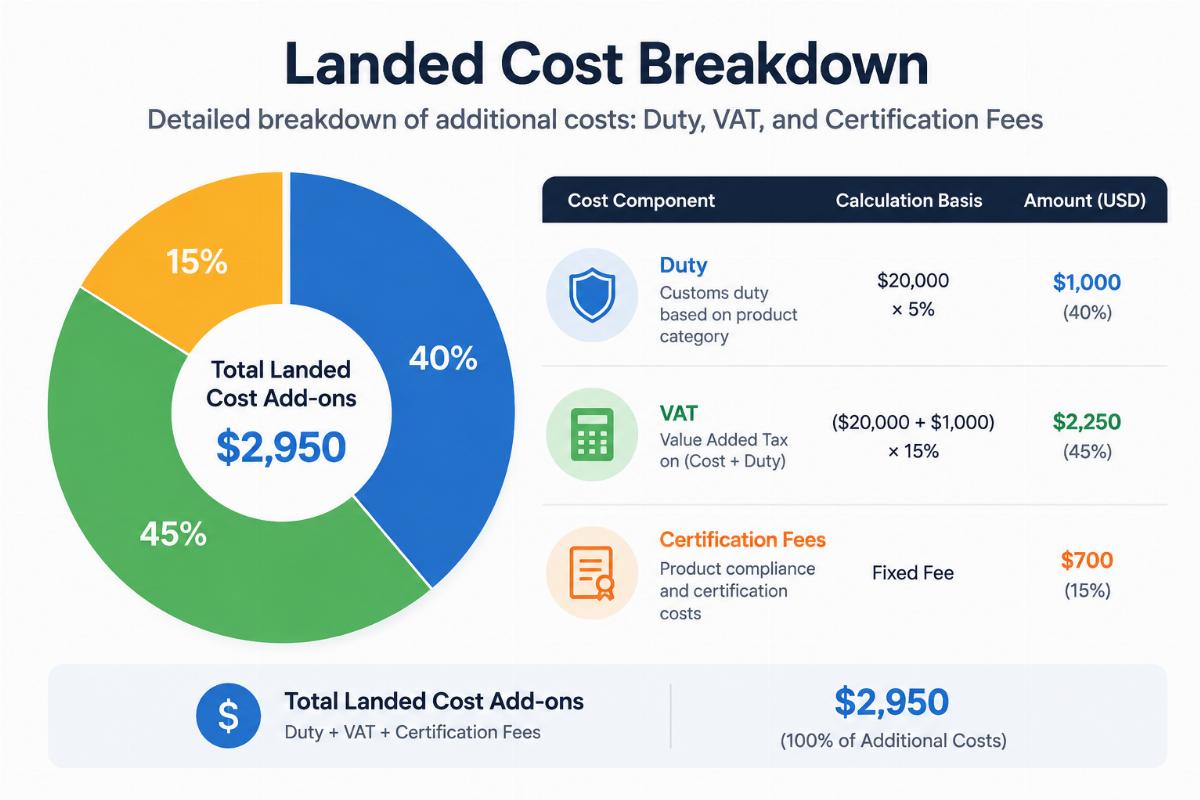
The import duty is only the starting point. The 20% Russian VAT, EAC certification fees, and customs brokerage charges collectively add far more to the landed cost than the duty itself. [NEED_CITE: Russian VAT rate and EAC certification requirements for fitness equipment under TR CU 004/2011]
Let me break this down with a real scenario. A gym project buyer in Kazakhstan ordered a mixed container of cardio and strength equipment from us. He had budgeted for the duty and assumed the VAT would be a minor line item. When the total landed cost calculation came back, the VAT alone was nearly triple the duty amount. The EAC certification fees—amortized across the order—added another meaningful layer. And that was before the customs broker’s service charge.
Here is the cost structure you need to plan for:
- VAT at 20%: Applied to the sum of CIF value plus duty. This is non-negotiable and applies to all imported goods sold or used within Russia. [NEED_CITE: Russian VAT calculation base for imported goods]
- EAC Certification: Mandatory for any fitness equipment entering the EAEU market. The certification covers electrical safety and mechanical integrity under TR CU 004/2011. The cost varies depending on whether you are certifying a single model or an entire product series, but it is a fixed upfront expense that must be amortized into your unit cost.
- Customs Brokerage: Local brokers charge for declaration preparation, document verification, and liaison with customs authorities. Fees vary by port and broker, but they are a predictable line item if you establish a relationship with a reliable agent.
- Storage and Demurrage: If your paperwork is incomplete or your HS code is disputed, goods will sit at the port. Daily storage fees accumulate quickly and can dwarf the original duty amount.
We have learned over the years that providing complete CE and EAC documentation at the time of shipment—along with pre-assembled machines rather than knock-down kits—dramatically reduces the risk of clearance delays. When a machine arrives with all certification papers attached and the invoice description matches the physical product exactly, the broker can process the declaration in a single pass.
How Do You Avoid Customs Delays and Misclassification Penalties?
The single most effective way to avoid delays is to confirm the HS code with your Russian customs broker before the goods leave the factory, and to ensure every document—from the commercial invoice to the packing list—uses identical product descriptions. [NEED_CITE: Russian Federal Customs Service documentation requirements for fitness equipment imports]
I cannot overstate how many clearance problems originate from mismatched descriptions. The proforma invoice says "strength training machine," the packing list says "gym equipment," and the bill of lading says "fitness apparatus." To a customs officer reviewing hundreds of declarations a day, these inconsistencies trigger red flags. The result is a physical inspection, a reclassification review, and a delay that nobody planned for.
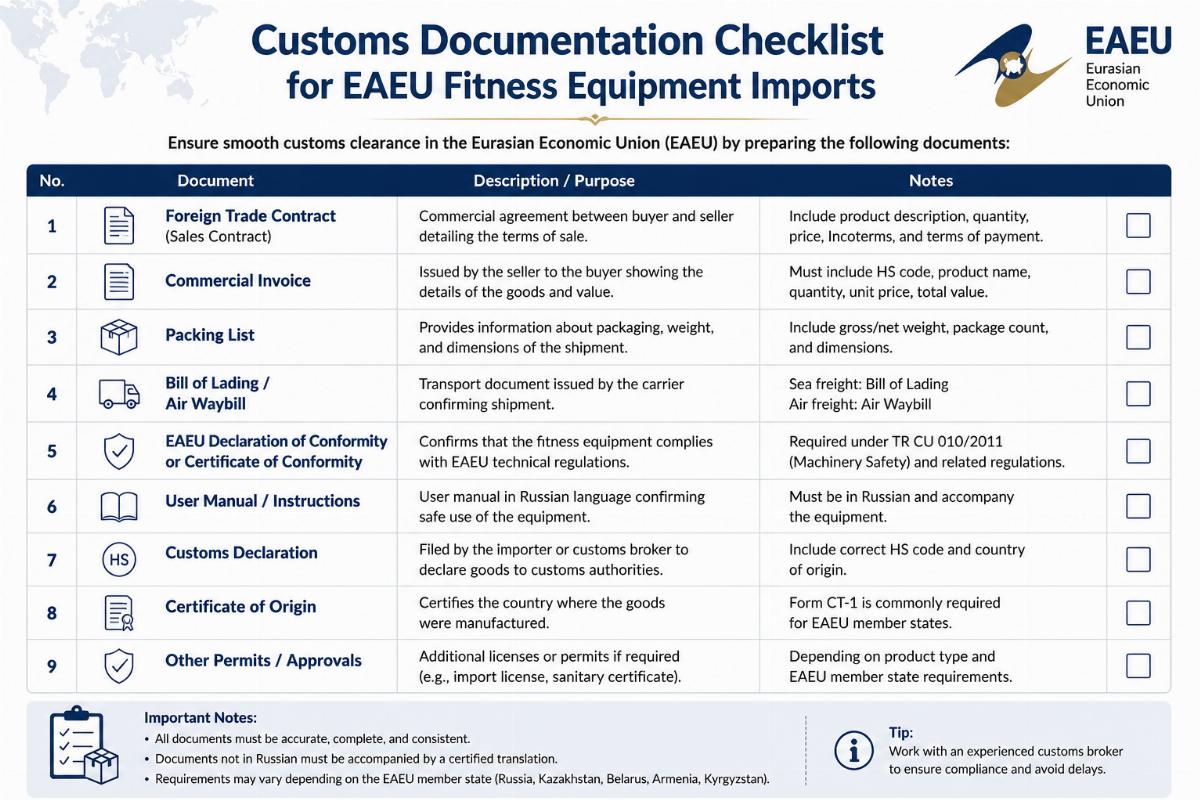
Here is a checklist we use for every shipment heading into Russia and the EAEU:
- Pre-shipment HS code confirmation: Send the product specification sheet and photos to the broker at least two weeks before loading. Get written confirmation of the classification.
- Unified product descriptions: The commercial invoice, packing list, bill of lading, and certificate of origin must all use the exact same wording. "Prone leg curl machine, model XX, for commercial gym use" is specific enough. "Gym machine" is not.
- Complete EAC documentation: The certificate must be valid, cover the exact model being shipped, and be presented in the format required by Russian customs (typically a certified copy with the original available for inspection).
- Accurate weight and dimension declarations: Customs officers will verify the gross weight and container contents against your declaration. Discrepancies trigger inspections.
A client in the Caucasus region once received a container of plate-loaded machines where the weight declaration was off by several hundred kilograms because the packaging materials were not included in the declared net weight. The customs officer ordered a full container strip and re-weigh. The delay cost more in storage fees than the duty on the entire shipment.
For the Import Duty Rate for Prone Leg Curl into Russia, the rate itself is straightforward. It is the surrounding documentation and compliance steps that determine whether your goods clear in days or weeks.
Conclusion
The Import Duty Rate for Prone Leg Curl into Russia is a single-digit percentage under HS 9506.91, but duty is the smallest component of the total landed cost. VAT, EAC certification, and brokerage fees collectively outweigh the duty, and documentation errors—not tariff rates—are the primary cause of costly clearance delays. Confirm your HS code with a local broker before shipment, unify every product description across all trade documents, and ensure EAC certification is complete and model-specific.