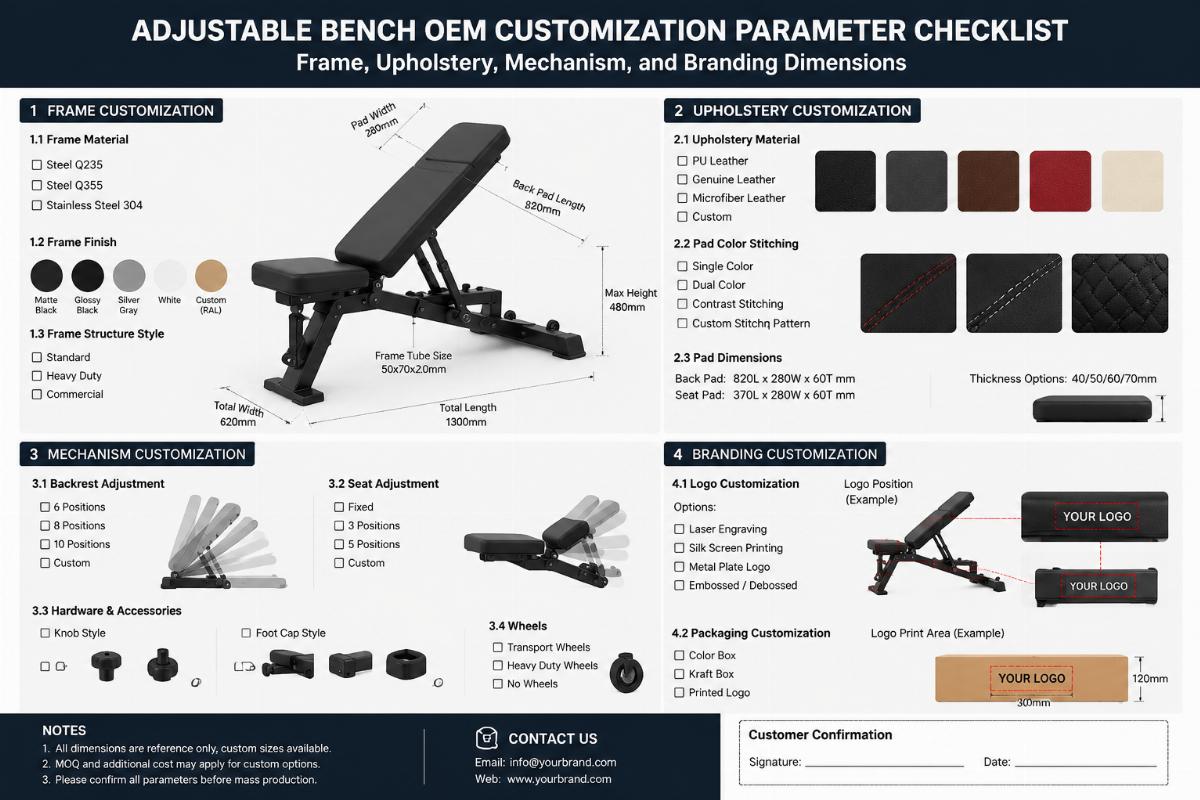
FW-500 Free Weight Series OEM Customization Manufacturer
Thicker coating does not mean better protection — in many cases, excessive coating thickness pushes weight plates outside tolerance and causes barbell sleeve imbalance.
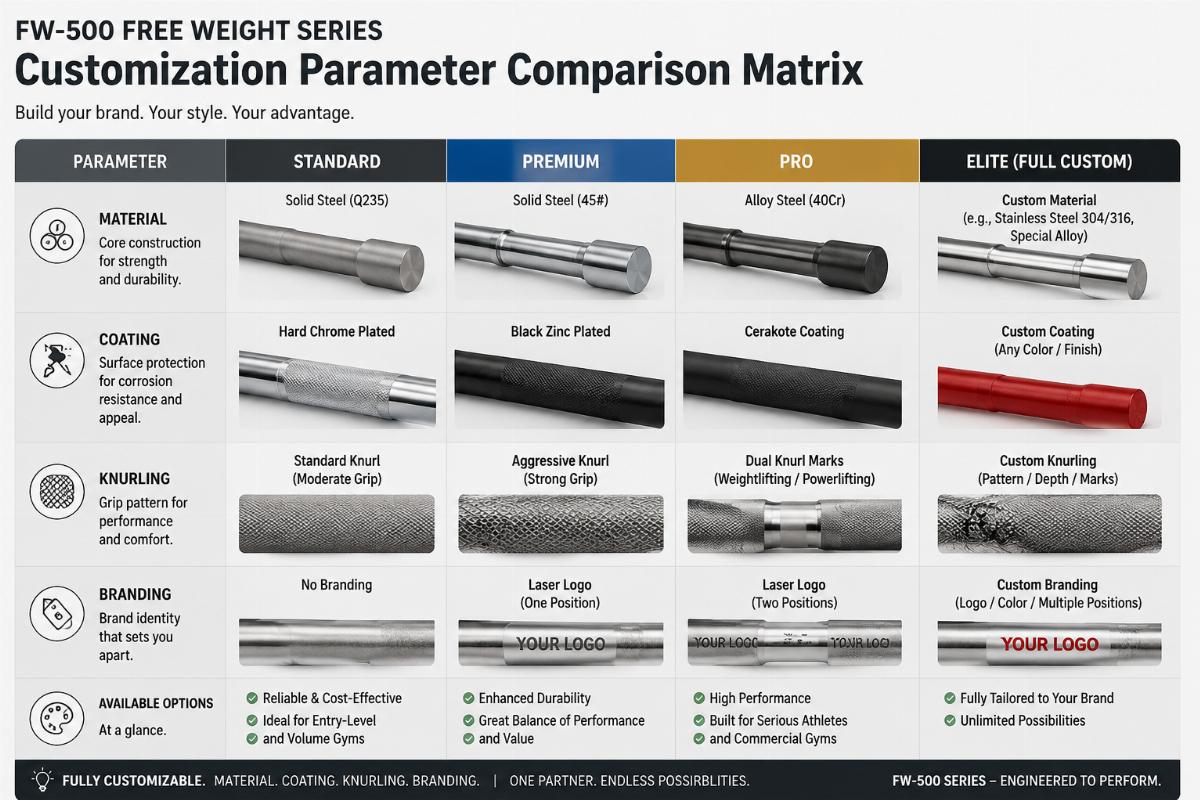
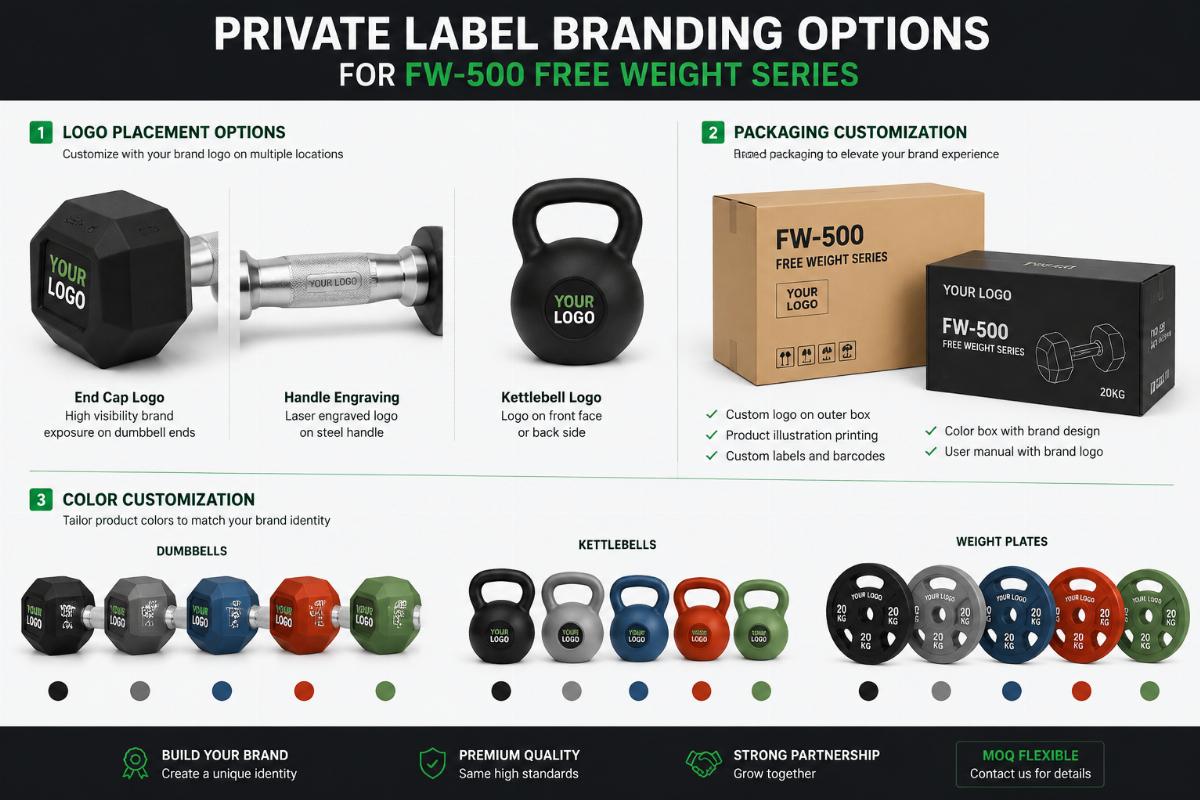
The FW-500 free weight series allows full OEM customization across material grade, coating type, knurling pattern, weight tolerance, branding, and packaging. Buyers can select from cast iron, virgin rubber, urethane, chrome-plated, or e-coated finishes; choose knurling depth from passive to aggressive; and apply private-label logos, color-matched packaging, and custom weight markings — with MOQ flexibility depending on whether standard SKUs or custom molds are involved.
I remember a container of custom hex dumbbells we shipped to a commercial gym chain in the Middle East. The buyer wanted their own logo laser-engraved on each dumbbell, plus a specific rubber coating color to match their brand palette. The sample looked perfect. But within a few months, the gym manager was on my phone complaining about coating edge delamination and members slipping during heavy sets. The root cause was not the rubber compound itself — it was the combination of high ambient humidity, high daily usage frequency, and a coating thickness that had not been adjusted for that environment. We ended up air-shipping replacement units and absorbing rework costs that wiped out the margin on the entire order. That situation reshaped how I handle every FW-500 free weight series OEM customization inquiry: before we talk about price, we talk about where the equipment will live and how hard it will be used. [NEED_CITE: environmental factors affecting rubber and urethane coating adhesion in commercial gym settings]

Once you understand the environment, the customization choices become much clearer — and that is exactly what the following sections break down.
What Customization Parameters Can You Adjust in the FW-500 Free Weight Series?
Nearly every visible and structural parameter in the FW-500 free weight series is adjustable within engineering limits — from raw material selection and weight tolerance to surface finish, knurling geometry, branding placement, and retail packaging.
When a buyer first contacts us about the FW-500 free weight series OEM customization, the conversation usually starts with branding: "Can you put our logo on it?" The answer is always yes, but that is only the surface layer. The real customization depth lies in the structural and performance decisions that sit beneath the logo.
Take material grade as the first branching point. The FW-500 series supports cast iron cores for traditional plates and dumbbells, virgin rubber compounds for commercial gym environments where floor protection and noise dampening matter, urethane for premium installations such as hotel fitness centers and high-end boutique studios, and chrome or e-coating for Olympic barbells and specialty bars where grip feel and corrosion resistance are priorities. Each material choice then cascades into decisions about weight tolerance, surface texture, and long-term durability. [NEED_CITE: material selection criteria for commercial free weight equipment per industry standards]
Knurling is another parameter that buyers often underestimate. On Olympic bars within the FW-500 series, knurling depth and pattern can be specified from a smooth, passive feel suitable for general fitness users to an aggressive, mountain-style grip designed for powerlifting and competitive CrossFit environments. The wrong choice here does not just affect comfort — it affects blister rates, grip security under sweat, and ultimately the end-user’s willingness to recommend the gym.
Branding extends beyond logo engraving. Buyers can customize weight marking fonts and placement, choose between laser-etched, embossed, or painted markings, and specify color-matched packaging for retail-ready presentation. A distributor in Latin America once asked us to match the packaging Pantone exactly to their existing product line — the result was a shelf-ready product that looked like it came from a single brand family, which helped them win a national retail chain contract.
| Customization Parameter | Available Options | Typical Application |
|---|---|---|
| Material Grade | Cast iron, virgin rubber, urethane, chrome-plated steel, e-coated steel | Varies by environment and price tier |
| Weight Tolerance | Standard commercial tolerance, precision tolerance | Precision for competitive settings |
| Knurling Pattern | Passive, moderate, aggressive | General fitness to powerlifting |
| Coating Color | Standard black, custom Pantone matching | Brand consistency requirements |
| Branding Method | Laser etch, emboss, paint fill, silk screen | Depends on material and durability needs |
| Packaging | Bulk carton, retail color box, custom insert | Wholesale vs. retail channel |
The key takeaway is that the FW-500 free weight series OEM customization is not a menu of isolated choices — each decision interacts with the others. A urethane coating, for instance, changes the weight tolerance calculation compared to raw cast iron, which then affects how tightly the production run must be controlled. [NEED_CITE: weight tolerance standards for commercial free weight equipment]
Which Material and Coating Combination Fits Your Target Market?
The right material and coating combination depends on three variables: installation environment, usage frequency, and end-user price sensitivity — and mismatching any one of them leads to premature complaints or margin erosion.
Let me walk through a situation that illustrates this clearly. A boutique studio owner in Northern Europe ordered urethane-coated kettlebells from the FW-500 free weight series in a custom teal color. The sample was approved, the bulk order was produced, and the goods were shipped. When the containers arrived, the studio owner noticed the bulk batch color was visibly different from the sample — slightly greener, slightly less saturated. The Pantone reference had been communicated verbally rather than locked with a physical swatch, and the production batch had drifted within what the factory considered acceptable tolerance. The studio had already marketed the equipment to members with photos of the sample color. The mismatch cost the buyer a rebranding exercise and damaged credibility with their membership base.
This is why material and coating decisions in the FW-500 free weight series OEM customization must be treated as a system, not a single spec line.
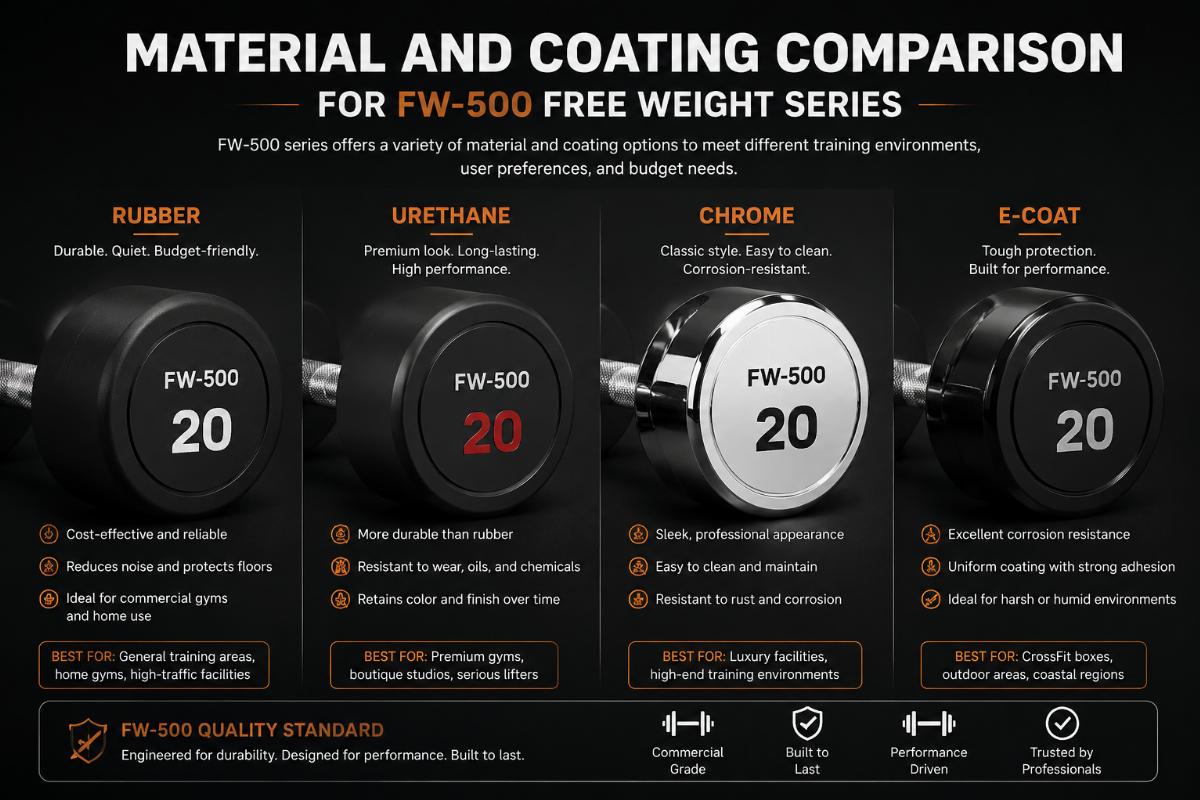
Cast iron with e-coating is the most economical option and works well for home gym markets and budget-conscious commercial buyers. The e-coat provides basic corrosion resistance and a uniform matte finish, but it is not designed for heavy-drop environments or high-humidity installations. [NEED_CITE: e-coating performance characteristics for indoor fitness equipment]
Virgin rubber coating over cast iron is the workhorse of commercial gym free weights. It absorbs impact, protects flooring, and dampens noise significantly. However, rubber compounds vary in quality — recycled rubber blends off-gas noticeably*ber maintains integrity substantially longer. In hot, humid climates, rubber coating edge adhesion becomes a critical quality checkpoint.
Urethane coating sits at the premium end. It is virtually odorless, highly resistant to abrasion and UV, and maintains color consistency across production batches when Pantone references are physically locked. The trade-off is cost — urethane raw material pricing is substantially higher than virgin rubber, and the molding process requires tighter temperature and pressure control.
Chrome plating on Olympic bars and specialty barbell handles delivers a bright, corrosion-resistant finish with a smooth grip feel. It is popular in boutique studios and hotel gyms where aesthetics matter. However, chrome can feel slippery under heavy sweat compared to bare steel or knurled finishes, so it is often combined with a center knurl section.
| Coating Type | Odor Level | Impact Resistance | Color Consistency | Cost Tier | Best Environment |
|---|---|---|---|---|---|
| E-coat over cast iron | Noticeable initially | Basic | Standard | Entry | Home gym, budget commercial |
| Virgin rubber | Moderate initially | Robust | Standard | Mid | General commercial gym |
| Urethane | Virtually none | Highly robust | High with locked Pantone | Premium | Hotel, boutique, premium studio |
| Chrome plating | None | Moderate | High | Mid-High | Boutique studio, hotel |
A distributor in Southeast Asia learned this matrix the hard way. They ordered rubber-coated plates for a chain of budget gyms in a tropical climate, but specified the thinnest coating layer to keep unit costs down. Within months, the plates were chipping at the edges from repeated drops on concrete-adjacent flooring. The rework and replacement logistics cost several times the initial savings. The lesson: coating thickness must be matched to drop height and floor type, not just to budget targets. [NEED_CITE: rubber coating thickness and impact durability correlation in commercial free weights]
How Should Knurling Depth and Grip Be Matched to End-User Profiles?
Knurling is not a cosmetic choice — it is a performance specification that directly affects grip security, hand comfort, and injury rates, and it must be matched to the actual user profile of the installation.
This is the parameter I see buyers get wrong most often in the FW-500 free weight series OEM customization process. The typical mistake is choosing the most aggressive knurling available because "it looks more professional" — without considering who will actually grip the bar.
Let me explain why this matters with a real scenario. A distributor in the Gulf region ordered Olympic barbells from the FW-500 series with maximum-depth mountain knurling for a chain of general-purpose commercial gyms. The bars looked impressive in product photos. But the gym membership base included a large proportion of recreational users — office workers, beginners, and group fitness participants — who were not accustomed to aggressive knurling. Within weeks, the gym was fielding complaints about hand blisters and callus tearing. The gym manager called us asking if there was a way to "smooth down" the knurling on bars already in use. There was not. The entire batch had to be replaced with moderate-knurl bars, and the original aggressive-knurl bars were redirected to a powerlifting-focused facility where they were appropriate.
The FW-500 series offers knurling specifications across a defined range:
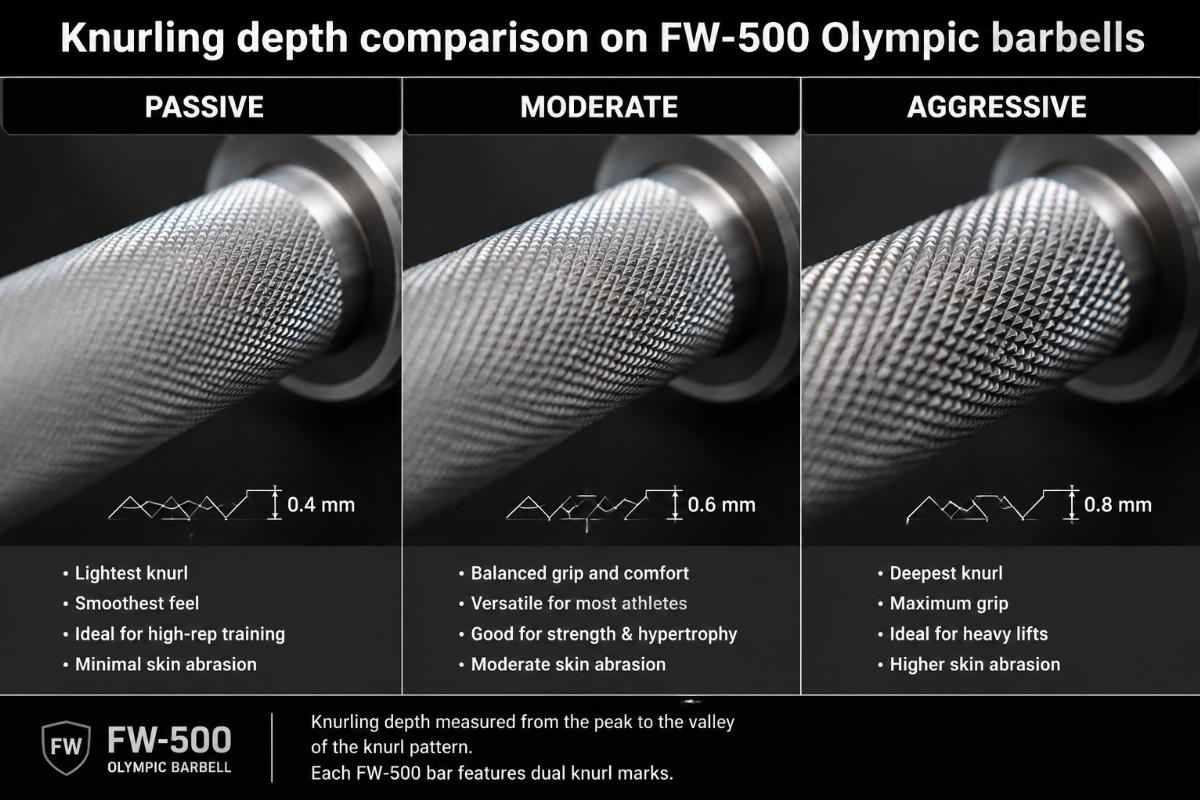
Passive knurling features shallow, widely spaced diamonds that provide a smooth feel with minimal skin abrasion. This is appropriate for hotel fitness centers, apartment complex gyms, and general-purpose commercial installations where user skill levels vary widely and equipment must be forgiving.
Moderate knurling is the most versatile option. It delivers noticeable grip security without aggressive skin bite, making it suitable for the majority of commercial gym environments. This is the default recommendation for buyers who serve mixed membership bases.
Aggressive knurling features deep, sharply defined diamonds designed for maximum grip under heavy loads and chalk use. This is appropriate for powerlifting gyms, competitive CrossFit boxes, and strength-focused facilities — but it is genuinely uncomfortable for unconditioned hands. [NEED_CITE: knurling depth classification and grip performance in Olympic barbells]
Beyond depth, knurling pattern and placement matter. Center knurl placement on Olympic bars affects back squat comfort — a high center knurl can dig into the cervical spine during low-bar squats, while a subdued or absent center knurl is preferred by many lifters. Dual-marking systems (IPF and IWF ring positions) can be specified based on the target market’s competition standards.
| Knurling Type | Depth Profile | Skin Impact | Ideal User Profile |
|---|---|---|---|
| Passive | Shallow, rounded | Minimal abrasion | Recreational, hotel, apartment gym |
| Moderate | Medium, defined | Noticeable grip, low blister risk | General commercial gym |
| Aggressive | Deep, sharp | High grip, high blister risk for unconditioned users | Powerlifting, competitive strength |
One additional factor that buyers rarely consider: climate affects knurling performance. In humid environments, bare steel knurling can develop surface rust between uses if not maintained, which degrades grip feel and accelerates hand wear. Chrome-plated or cerakote-finished knurl sections resist this but change the grip texture. These trade-offs need to be discussed before the order is locked. [NEED_CITE: corrosion resistance options for barbell knurling in humid environments]
What Are the MOQ, Lead Time, and Branding Requirements for Private Label Orders?
MOQ for the FW-500 free weight series OEM customization depends on whether you are ordering standard SKUs with logo branding or requesting custom molds and non-standard specifications — and understanding this distinction early prevents budget and timeline surprises.
Let me break this down the way I walk buyers through it during initial discussions.
Standard SKU private label orders — meaning you select from existing FW-500 series products (standard dumbbell weights, standard plate sizes, standard barbell lengths) and add your own logo, color, or packaging — carry the lowest MOQ threshold. This is because the production tooling already exists, and the customization is limited to surface-level finishing and branding steps. Buyers testing a new market or launching a pilot product line typically start here.
Semi-custom orders — where you modify specific parameters such as knurling pattern, coating color matched to a Pantone reference, or non-standard weight increments — require moderate MOQ commitment. The reason is straightforward: changing knurling wheels on CNC lathes, mixing custom rubber or urethane compounds, and running Pantone-matched color batches all involve setup time and material minimums from raw material suppliers.
Full custom mold orders — such as uniquely shaped dumbbell ends, proprietary plate designs, or entirely new kettlebell silhouettes — require the highest MOQ. Custom molds represent a significant upfront tooling investment, and the manufacturer needs volume commitment to justify the mold cost and production line setup.
| Order Type | Customization Level | MOQ Requirement | Tooling Investment | Typical Lead Time |
|---|---|---|---|---|
| Standard SKU + branding | Logo, packaging, color marking | Flexible, low threshold | None | Short |
| Semi-custom | Knurling, Pantone coating, non-standard weights | Moderate commitment | Minimal adjustment | Moderate |
| Full custom mold | Unique shapes, proprietary designs | High volume commitment | Significant mold cost | Extended |
Lead time follows the same logic. Standard SKU orders with branding move through production quickly because the base product is already in the manufacturing schedule. Semi-custom and full-custom orders require dedicated production slots, raw material procurement for custom compounds, and additional quality control checkpoints — all of which extend the timeline.
A practical tip I share with every buyer: if you are planning a full gym fit-out that includes cardio, strength machines, and free weights, consolidating the entire order into container-load shipments dramatically improves per-unit economics. The FW-500 free weight series can be loaded alongside strength equipment and cardio units in mixed containers, which reduces per-unit freight cost and simplifies customs clearance at the destination port. [NEED_CITE: container consolidation logistics for mixed fitness equipment shipments]
Packaging customization deserves separate attention. Retail-ready color boxes with custom inserts, foam protection, and printed handling instructions add cost per unit but significantly reduce damage rates during transit and improve the unboxing experience for end consumers. Bulk carton packaging is more economical for distributor warehouse operations where equipment is repackaged or delivered directly to gym installations.
How Do You Verify Quality Before Shipment to Ensure Batch Consistency?
Sample approval does not guarantee production batch consistency — without locked CNC parameters, raw material batch tracking, and third-party inspection protocols, production batches can deviate from approved samples in weight, coating adhesion, and knurling geometry.
This is perhaps the most critical section for any buyer serious about the FW-500 free weight series OEM customization. I have seen too many buyers approve a sample, place a large order, and then discover that the bulk shipment does not match the sample — not because of intentional quality reduction, but because production parameters were not locked and monitored.
Here is the verification framework I recommend to every buyer.
Weight tolerance verification should be conducted on a statistical sample basis, not just on a few cherry-picked pieces. Request that the manufacturer provide weight test certificates for a defined sample size from each production batch. Commercial-grade free weights typically operate within a tolerance band, and precision-grade products for competitive settings require tighter control. [NEED_CITE: weight tolerance testing methodology for commercial free weight equipment]
Coating adhesion testing uses standardized cross-cut methods where a lattice pattern is cut into the coating and tape is applied and pulled to measure how much coating detaches. This test reveals whether the coating will hold up under repeated impact and environmental stress. Request adhesion test reports with photographic evidence from the actual production batch, not just from the sample.
Knurling depth measurement requires caliper or profilometer verification. Visual inspection is not sufficient — two bars can look identical to the naked eye but have measurably different knurling depths that produce completely different grip experiences. If knurling specification is critical to your order, require dimensional inspection reports.
Raw material traceability is often overlooked but essential. The manufacturer should be able to trace the steel grade, rubber compound batch, or urethane lot used in your production run back to supplier certificates. This traceability becomes critical if any quality issue surfaces after delivery — you need to know exactly which material batch was involved.
| Verification Checkpoint | Method | Documentation Required |
|---|---|---|
| Weight tolerance | Calibrated scale, statistical sampling | Batch weight test certificate |
| Coating adhesion | Cross-cut tape test | Test report with photographs |
| Knurling depth | Caliper or profilometer | Dimensional inspection report |
| Material traceability | Batch lot tracking to supplier certs | Material test certificates |
| Visual and branding | Physical inspection against approved sample | Inspection checklist with photos |
I strongly recommend engaging a third-party inspection service for any order above a minimal threshold. The cost of a pre-shipment inspection is negligible compared to the cost of discovering quality issues after the container has arrived at your warehouse — or worse, after the equipment has been installed at a gym and members are already using it. [NEED_CITE: third-party inspection protocols for fitness equipment manufacturing]

Conclusion
Successful FW-500 free weight series OEM customization requires aligning material selection, coating type, knurling specification, branding approach, and quality verification protocols with the actual installation environment and end-user profile — not just with the sample appearance. Every parameter interacts with the others, and decisions made at the specification stage determine whether the equipment performs reliably for years or generates complaints within months. Lock your Pantone references with physical swatches, match knurling depth to real user profiles rather than marketing aesthetics, verify production batch quality through documented testing rather than sample trust, and plan your MOQ and container consolidation strategy before the order is placed.