Half Rack Duty Cycle for Boutique Strength Studios | Wholesale Manufacturer
A half rack rated for continuous commercial gym use will sit idle most of the day in a boutique studio — and that mismatch is where buyers waste money or invite premature failure.
Half rack duty cycle describes the ratio of active load-bearing time to rest time a frame is engineered to sustain within a given operating window. For boutique strength studios, the correct half rack duty cycle typically falls between light commercial and moderate commercial, because class-based rotation creates short, intense loading bursts separated by longer rest intervals — fundamentally different from the near-continuous traffic of a big-box gym.
I still remember a batch of half racks we shipped to a boutique Pilates-and-strength studio in the Middle East. The owner had chosen the lightest commercial grade available, reasoning that his studio only served around twenty members per session. What he didn’t account for was the circuit-style format: clients rotated through squat stations every ninety seconds with barely any gap between classes. Within a few months, gusset welds began cracking and uprights showed visible flex at the bolt holes. When we pulled the units back for inspection, the root cause was obvious — the half rack duty cycle specification simply did not match the real-world loading pattern. That case reshaped how I walk every boutique studio client through rack selection. [NEED_CITE: duty cycle classification standards for strength equipment frames per EN ISO 20957]

Understanding this concept properly saves buyers from both over-specifying and under-specifying — and the consequences of each mistake are very different.
What Exactly Does Half Rack Duty Cycle Measure, and Why Do Boutique Studios Fall Into a Gap?
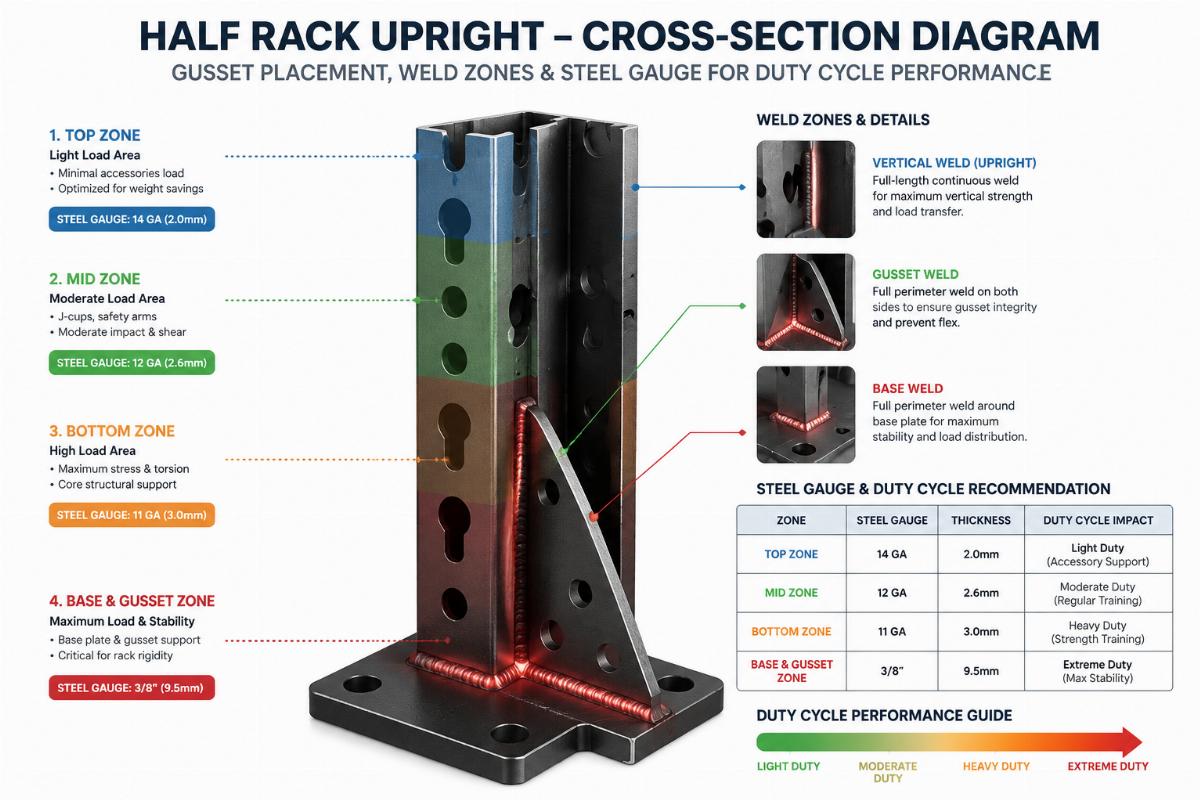
Half rack duty cycle is not a single number printed on a spec sheet; it is a composite of weld integrity, steel gauge, gusset geometry, and joint design that determines how long the frame can absorb repeated loading before fatigue symptoms appear.
In engineering terms, duty cycle for welded steel structures originates from crane and hoist classifications, where frames are sorted by the number of load cycles they can endure before inspection-level micro-cracks emerge. [NEED_CITE: FEM or ISO crane duty cycle classification methodology adapted to fitness equipment] The fitness industry borrowed this framework loosely, which is why you will see terms like "light commercial," "medium commercial," and "heavy commercial" without a single universal standard binding them.
For a traditional commercial gym, the half rack duty cycle expectation is high: members walk in and out continuously across twelve or more operating hours, and the rack may see loaded barbells racked and unracked hundreds of times daily. The frame is designed for that rhythm.
Boutique studios operate differently. A typical class might pack twelve to fifteen users into a forty-five-minute session, each performing compound lifts in rapid succession, followed by a ten-minute turnover before the next class. The rack experiences concentrated loading spikes, then sits nearly empty. Over a full day, total load cycles may actually be lower than a big-box gym — but the intensity per cycle is often higher because clients are coached to lift heavier under supervision.
This creates a gap: the half rack duty cycle required is not "light" in the traditional sense, because the per-cycle stress is elevated, yet it is not "heavy commercial" either, because total daily cycles are lower. Buyers who default to the cheapest light-commercial rack risk weld fatigue; buyers who spec heavy-duty endurance frames pay for capacity they will never use.
The key is matching the structural design to the actual loading rhythm, not to a marketing label. [NEED_CITE: fatigue testing methodology for welded gym equipment frames]
How Do Light, Medium, and Heavy Half Rack Duty Cycle Ratings Compare in Real Boutique Studio Conditions?
The practical difference between duty cycle tiers shows up not in static load capacity — which is often similar across tiers — but in how the frame handles repeated stress over time at critical joint locations.
When evaluating a half rack duty cycle tier for a boutique studio, buyers should look at several structural dimensions rather than just the advertised maximum load. The table below outlines how these dimensions typically differ across tiers, using qualitative descriptors that reflect real manufacturing practice.
| Structural Dimension | Light Commercial Tier | Medium Commercial Tier | Heavy Commercial Tier |
|---|---|---|---|
| Upright steel gauge | Thinner gauge, adequate for static loads | Mid-range gauge with added rigidity | Heaviest gauge, minimal flex under dynamic loads |
| Gusset reinforcement pattern | Minimal or single-plane gussets | Multi-plane gussets at high-stress joints | Full triangulated gusset coverage |
| Weld continuity at joints | Intermittent or partial penetration | Consistent fillet welds at primary joints | Full-penetration or continuous heavy fillet welds |
| J-cup and safety arm attachment | Bolt-through with basic backing plate | Reinforced backing plate with load distribution | Heavy-duty sleeve or weld-in cup design |
| Expected fatigue resistance under boutique rotation | Vulnerable to early weld cracking | Resistant under typical boutique patterns | Robust well beyond boutique requirements |
| Suitability for class-based rotation | Marginal for high-intensity formats | Well-matched to boutique studio cadence | Over-specified for most boutique applications |
[NEED_CITE: weld fatigue classification and inspection criteria for structural steel frames]
A boutique studio owner in Southeast Asia once ordered a full set of light-tier half racks for a high-intensity strength studio. The racks handled static loads perfectly during initial setup. However, the class format involved barbell complexes where clients performed clusters of five reps, re-racked, rotated, and returned — all within tight time windows. The cumulative effect was a high number of moderate-to-heavy load cycles concentrated into short bursts. Within half a year, several units developed hairline cracks at the base plate welds. The half rack duty cycle of the light tier was simply not built for that rhythm.
Conversely, a European boutique studio owner spec’d heavy-duty racks for a low-volume personal training space serving roughly a dozen clients per day. The racks performed flawlessly — but the capital outlay was substantially higher than necessary, and the extra steel weight complicated floor installation in a rented space. The half rack duty cycle was far beyond what the usage pattern demanded.
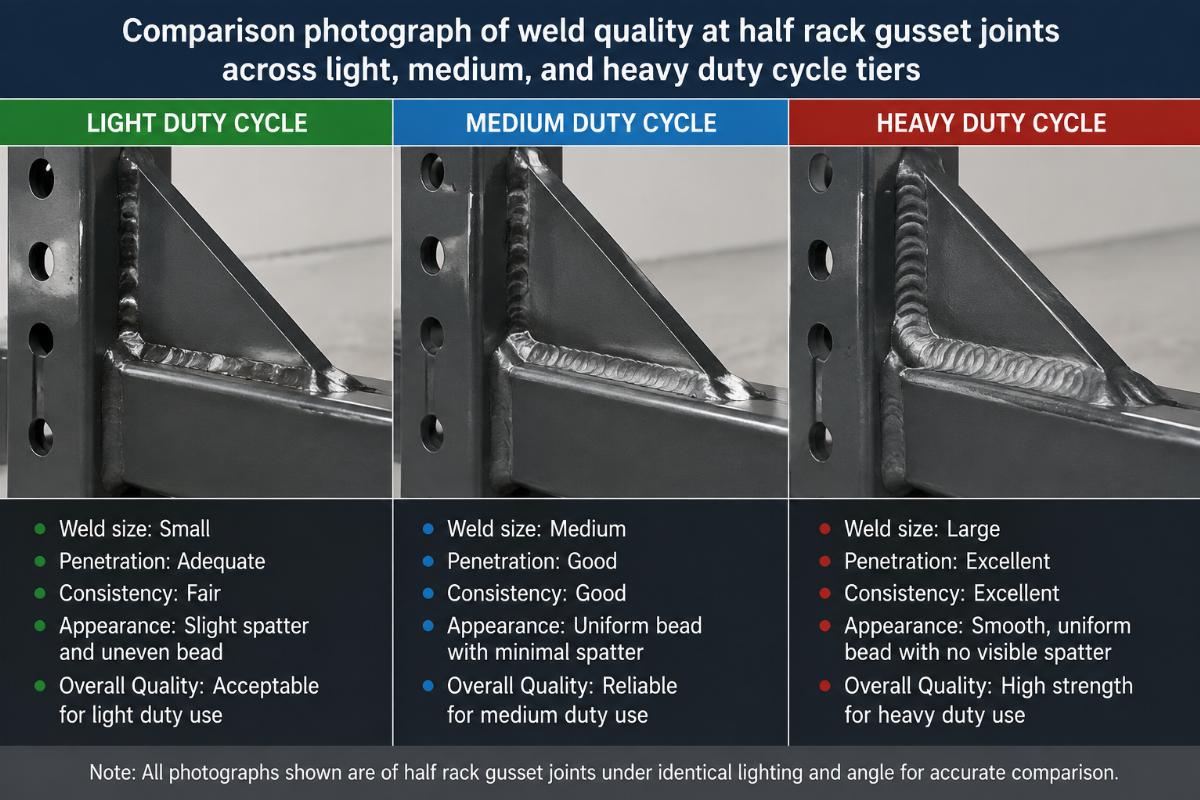
The takeaway is that medium-tier half rack duty cycle construction typically offers the best balance for boutique studios running structured class formats with compound lifts. [NEED_CITE: structural steel weld inspection standards for fitness equipment]
What Loading Patterns in Boutique Studios Actually Stress a Half Rack Differently From a Commercial Gym?
Boutique studios create a loading signature characterized by high peak forces, short rest intervals between users, and elevated barbell velocity — all of which demand a half rack duty cycle that accounts for dynamic shock, not just static weight.
Consider what happens during a coached barbell class. A client approaches the rack with a loaded barbell, performs a set of heavy squats or presses, and re-racks the weight — often with slightly imperfect alignment that introduces lateral impact forces into the uprights and J-cups. The next client is waiting, so there is minimal delay. This pattern repeats across the class.
Three factors distinguish this from traditional commercial gym use:
First, the dynamic loading component is higher. In a big-box gym, a member might load a barbell carefully, perform a controlled set, and re-rack with attention to alignment. In a coached class environment, speed and throughput matter, and re-racking impacts can be noticeably sharper. The half rack duty cycle must absorb these lateral and vertical shock loads repeatedly.
Second, the rest interval between load cycles is shorter for the equipment itself. A commercial gym rack might see thirty seconds to two minutes of active use followed by five to ten minutes of rest. A boutique studio rack in a class format might see two to three minutes of continuous cycling between multiple users, then only a brief turnover window. The thermal and mechanical rest periods for the steel and welds are compressed.
Third, the variety of movements performed on a single rack is often narrower but more repetitive. Boutique strength studios tend to program squat-dominant or press-dominant sessions, meaning the same joint locations on the rack absorb impact in the same orientation repeatedly. This accelerates fatigue at specific weld points compared to a commercial gym where usage is more varied.
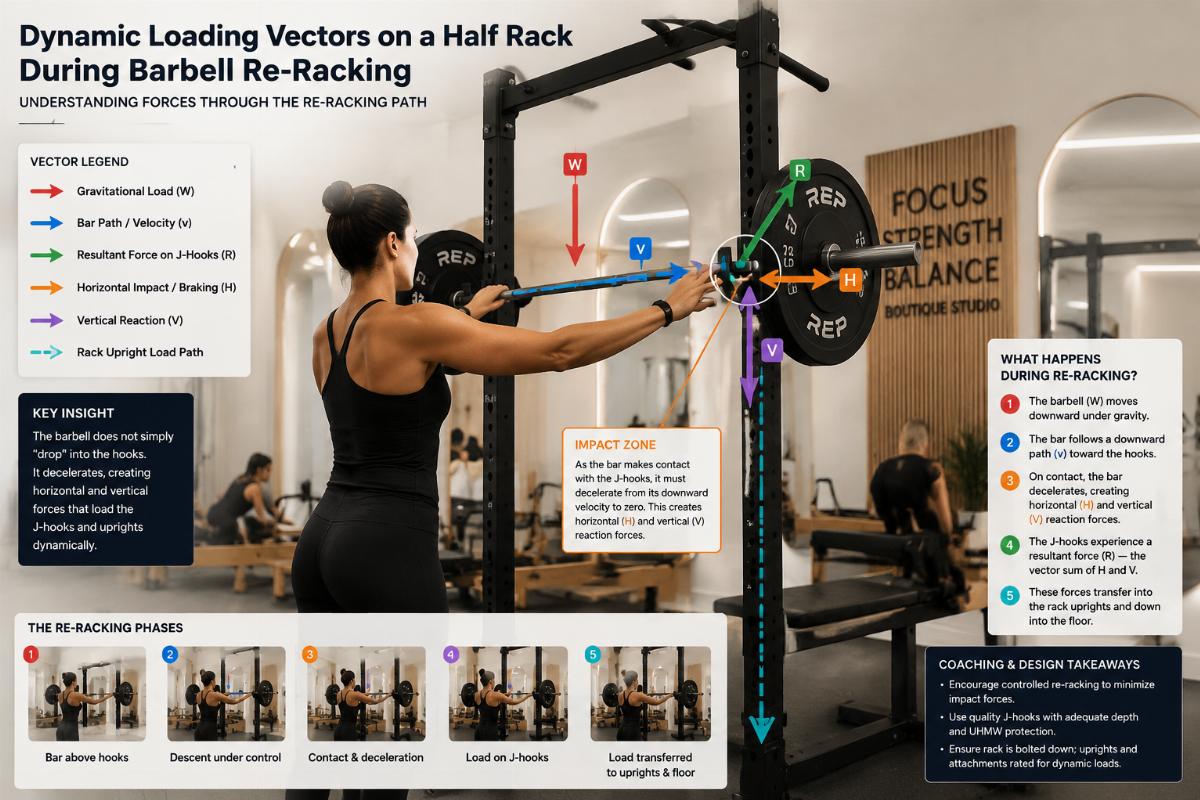
A studio operator in Latin America ran a strength-and-conditioning format where clients performed touch-and-go presses from the rack. The repeated impact of the barbell settling back onto the J-cups — hundreds of times per day across multiple classes — caused the J-cup mounting pins to loosen and the surrounding steel to deform. The half rack duty cycle of the racks they had purchased was rated for static load capacity that far exceeded the barbell weight, but the dynamic impact resistance was inadequate for that specific usage pattern. [NEED_CITE: dynamic impact testing protocols for fitness equipment load-bearing components]
The lesson is that half rack duty cycle evaluation must go beyond maximum static load and consider the dynamic, repetitive, and directional nature of actual studio use.
How Should Boutique Studio Buyers Evaluate Half Rack Duty Cycle When Sourcing From Manufacturers?
The most reliable way to assess half rack duty cycle is to request specific structural documentation and test evidence from the manufacturer, rather than relying on marketing tier labels alone.
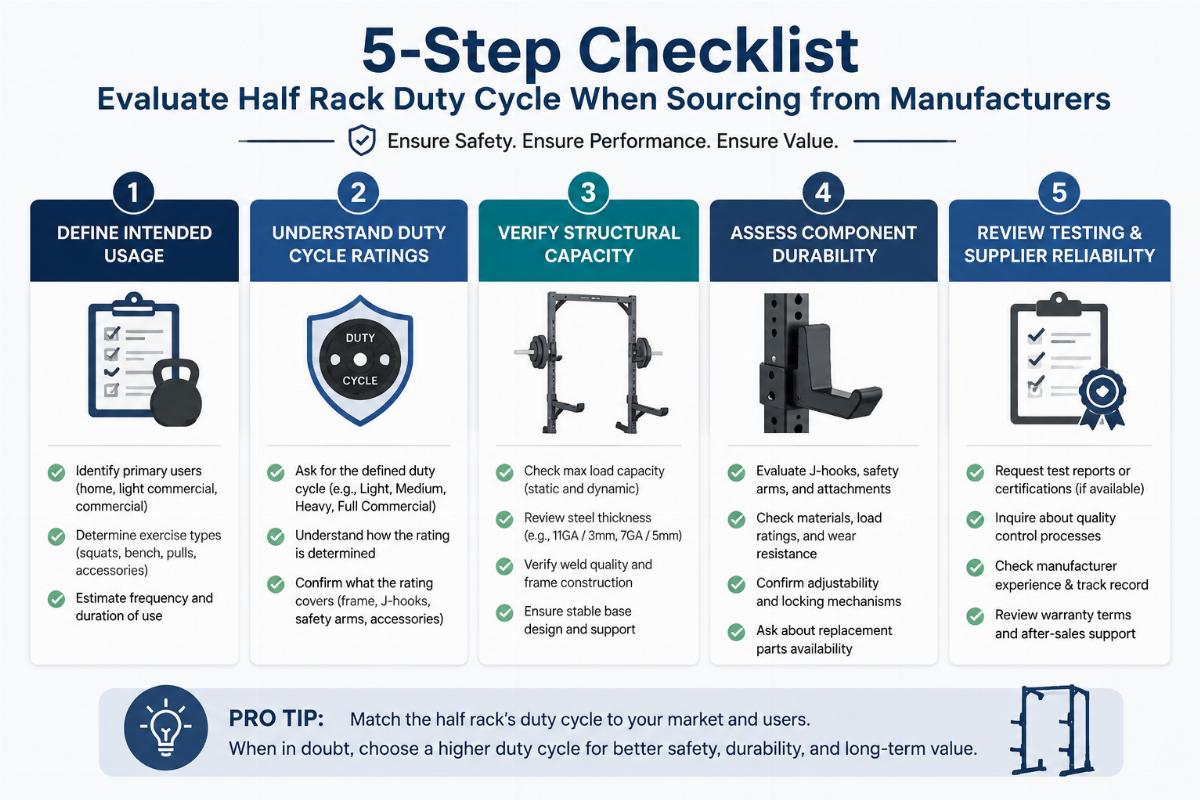
When I work with boutique studio buyers, I guide them through a structured evaluation process that focuses on verifiable engineering details. Here is the approach:
Step one: Request weld inspection documentation. Ask the manufacturer for weld procedure specifications and evidence of quality control at critical joints — specifically the upright-to-base plate connections, gusset-to-upright joints, and J-cup attachment points. [NEED_CITE: weld quality inspection standards applicable to fitness equipment manufacturing] A manufacturer confident in their half rack duty cycle engineering will provide this without hesitation.
Step two: Clarify steel specifications. Obtain the exact steel grade and gauge used for uprights and cross-members. Compare these across suppliers. The half rack duty cycle is directly tied to material thickness and yield strength — a rack built with thicker uprights and higher-grade steel will inherently sustain more load cycles before fatigue onset.
Step three: Examine gusset and reinforcement design. Request detailed drawings or physical samples showing gusset placement, size, and weld coverage. Multi-plane gusseting at high-stress joints is a strong indicator of a half rack duty cycle designed for repeated dynamic loading. Single-plane or minimal gussets suggest a lighter-duty construction.
Step four: Understand the intended usage classification. Ask the manufacturer to classify the rack according to their duty cycle framework and explain what usage patterns that classification is designed for. A transparent manufacturer will describe the expected load cycle range and typical application environments. If the response is vague or purely marketing-driven, treat it as a caution signal.
Step five: Request reference installations. Ask for examples of similar boutique studio deployments where the same rack model has been in service for an extended period. Direct feedback from comparable operators is one of the strongest indicators of whether the half rack duty cycle matches your intended use.
A buyer in North America followed this process when outfitting a new boutique strength studio. By requesting weld documentation and steel specifications upfront, they identified that two shortlisted suppliers were using markedly different gusset designs despite similar outward appearances. The supplier with superior gusset reinforcement — and a clearly articulated half rack duty cycle rationale — was selected. Those racks have been in continuous class-based service without structural issues, validating the evaluation approach. [NEED_CITE: fitness equipment procurement best practices for commercial buyers]
Conclusion
Matching half rack duty cycle to the actual loading rhythm of a boutique strength studio is the single most important factor in avoiding both premature failure and unnecessary capital expenditure. Boutique studios occupy a distinct operational zone between light home use and heavy commercial gym traffic, and their class-based formats create loading patterns that demand specific structural considerations — particularly around weld integrity, gusset design, and dynamic impact resistance. Buyers who evaluate racks based on verifiable engineering details rather than marketing tier labels will consistently make better sourcing decisions and build studios that perform reliably over the long term.