How China Functional Rig Compares to Titan Fitness on Durability
Most buyers assume Chinese rigs fail because the steel is inferior. The real gap is almost always wall thickness shortcuts and incomplete weld penetration — not the base material.
A China functional rig can match Titan Fitness durability at a fraction of the cost, but only when buyers verify three measurable dimensions before signing a purchase order: tube gauge, weld fusion depth, and J-cup locking tolerance. The steel grade is rarely the problem; the execution details are.
I still remember standing in a CrossFit box in Oregon, watching a coach yank a barbell off a rig that had been in service for less than half a year. The J-cup slipped. The lifter stumbled. The owner pointed at the bent crossmember and then at the Titan rack sitting three feet away — same layout, same usage, zero complaints. I pulled out my calipers on the spot. The uprights on our rig measured a full gauge number thinner than spec. The welds at the gusset joints were segmented, not continuous. That single shipment cost us a mid-five-figure claim and taught me that "durability" is not a marketing word — it is a stack-up of verifiable tolerances. [NEED_CITE: root cause distribution of functional rig field failures in commercial gym environments]

Let me walk you through exactly where a China functional rig diverges from Titan Fitness on durability, and what you can actually measure to close the gap.
What Are the Key Durability Differences Between China Functional Rig and Titan Fitness?
The durability gap concentrates on three checkpoints: tube wall gauge, weld penetration quality, and J-cup machining precision — not the steel chemistry itself.
Most reputable Chinese manufacturers source Q235 or Q345 structural steel, which sits in the same family as the grades used by American commercial rig brands. The divergence happens downstream, during fabrication. Here is how the three dimensions stack up in typical procurement scenarios:
| Durability Dimension | Titan Fitness Typical Spec | Typical China Functional Rig (Unverified) | Verified China Functional Rig (Buyer-Specified) |
|---|---|---|---|
| Upright Tube Gauge | Heavy-gauge structural | Often one gauge thinner than quoted | Matched to spec with caliper verification |
| Weld Type at Joints | Continuous full penetration | Segmented or spot-welded | Continuous with fusion depth verification |
| J-Cup Laser Cut Tolerance | Tight laser-cut tolerance | Plasma-cut with visible slag | Laser-cut with controlled insert-play |
| Surface Pre-Treatment | Acid wash + phosphate + powder coat | Light grinding + direct spray | Full acid-phosphate + electrostatic coat |
| Dynamic Load Rating | Published drop-test data | Static-only rating quoted | Static plus dynamic deflection verified |
[NEED_CITE: comparative failure modes of powder-coated functional rigs under repeated dynamic loading]
A distributor in the Middle East once asked me to randomly pull three percent of a container-load off the dock after arrival. We ran calipers on every sampled upright and did ultrasonic spot-checks on the welds. Batches where wall thickness stayed within a narrow tolerance band and weld fusion reached deep into the tube wall showed no structural deformation after extended heavy use. Batches that slipped on either metric started showing crossmember bow and loose J-cup fit within months. The steel was identical. The execution was not.

How Does Tube Gauge Affect Long-Term Functional Rig Performance?
A single gauge difference in upright wall thickness can multiply dynamic deflection severalfold, accelerating joint loosening and crossmember sag under repeated impact loading.
Wall gauge is the single most abused specification in cross-border rig sourcing. Here is why it matters more than most buyers realize:
- Static vs. dynamic loading. A rig rated for static load looks fine on paper. But every Olympic drop, every kipping pull-up, every box jump landing sends a shockwave through the uprights. Thinner walls flex more under that impulse. [NEED_CITE: deflection behavior of structural steel tubes under repeated impact per ASTM A500]
- Joint fatigue cascade. When the upright flexes, the hole pattern around the J-cup insert deforms microscopically with every rep. Over hundreds of sessions, the hole elongates. The J-cup starts to wobble. The wobble transfers to the safety strap, then to the barbell path.
- Crossmember torsion. Thinner uprights allow the entire bay to twist under uneven loading — think muscle-ups on one side, band-resisted sprints on the other. The top crossmember takes the torsional stress, and over time the bolt holes oval out.
I have seen rigs built with heavy-gauge uprights stand side by side with thinner-gauge equivalents in the same box. After extended heavy use, the thinner set showed visible crossmember droop and J-cup play. The heavier set looked nearly new. Same workouts. Same users. Different wall thickness.
| Tube Gauge Category | Approximate Wall Character | Typical Use Case | Dynamic Load Behavior |
|---|---|---|---|
| Heavy-Gauge Structural | Thickest commercial tier | High-traffic CrossFit boxes, competitive gyms | Minimal deflection under impact |
| Mid-Gauge Commercial | Mid-range thickness | Boutique studios, hotel gyms, light commercial | Noticeable deflection under heavy drops |
| Light-Gauge Imported | Thinnest tier | Home use, low-frequency studios | Significant flex; joint loosening accelerated |
[NEED_CITE: structural tube deflection limits per ISO 20957 for fixed training equipment]
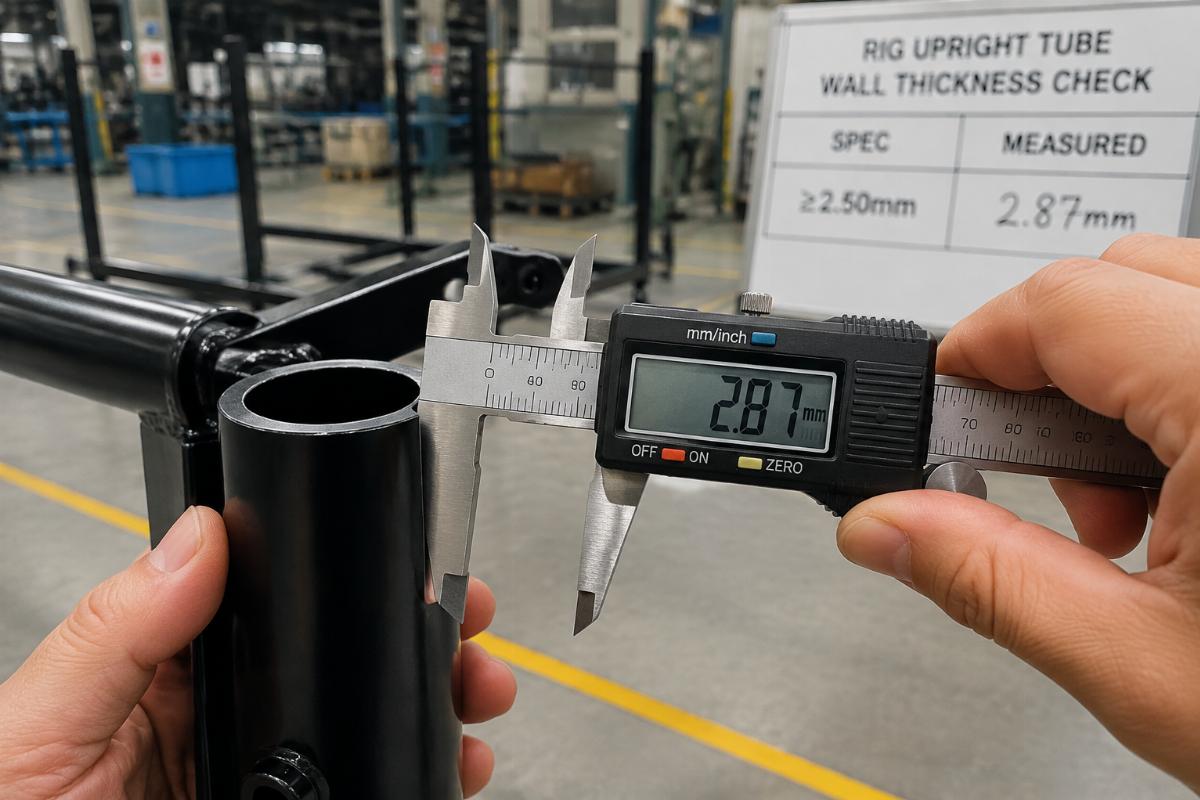
When I review a purchase spec with a buyer, the first question I ask is never "what is the price per unit?" It is "what gauge are the uprights, and can you send me a mill certificate plus a post-production caliper report?" If the supplier hesitates, move on.
What Weld Quality Should Buyers Demand From Chinese Suppliers?
Demand continuous full-penetration welds with fusion depth reaching deep into the tube wall — and require ultrasonic or destructive test reports to prove it.
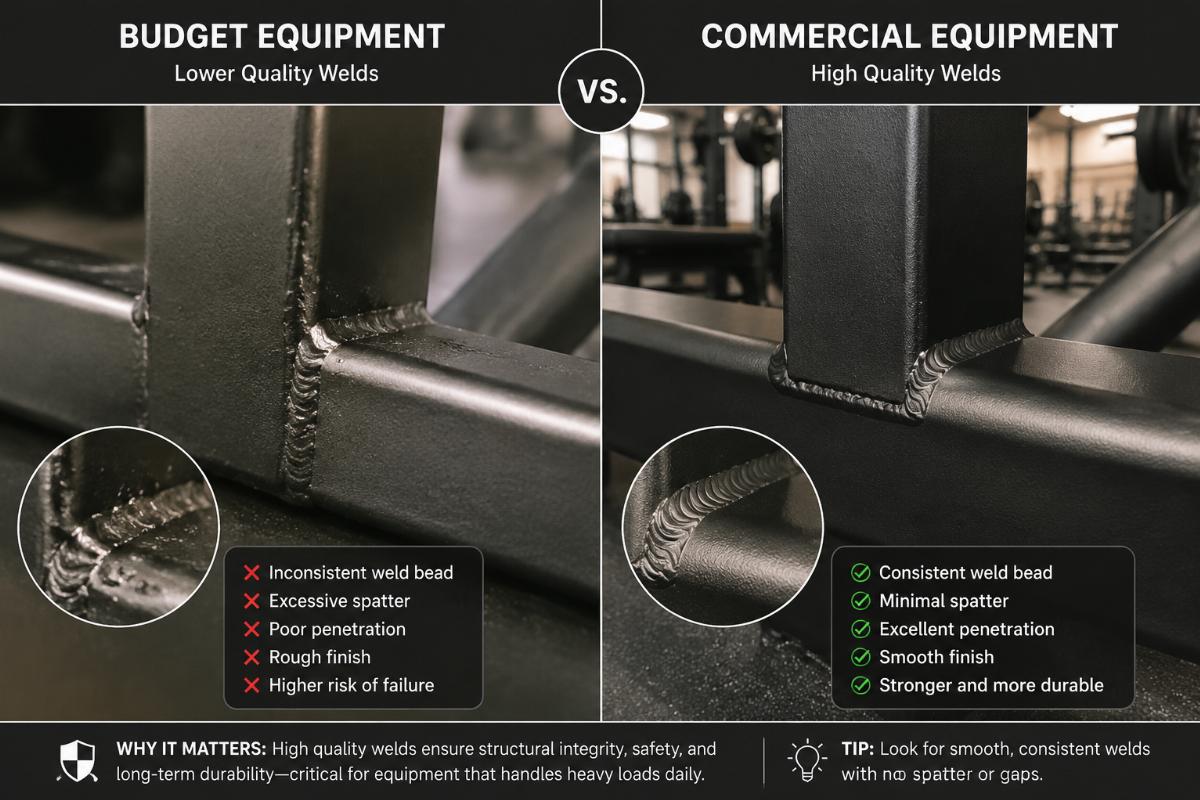
Weld quality is the second silent killer of rig durability, and it is far harder for a buyer to verify from a product photo than tube gauge. Here is what separates a rig that lasts from one that starts cracking at the gussets:
- Continuous vs. segmented weld. A full continuous weld distributes load along the entire joint length. A segmented or stitch weld concentrates stress at each weld start-stop point. Under repeated dynamic loading, those stress points become crack initiation zones. [NEED_CITE: fatigue crack initiation patterns in welded structural joints under cyclic loading]
- Fusion depth. A weld that only fuses to the outer skin of the tube is functionally a surface bond. Proper fusion must penetrate well into the tube wall thickness. Shallow fusion looks acceptable visually but fails under torsional stress.
- Weld profile and slag. Excessive spatter, undercut, or trapped slag create microscopic stress risers. A clean, consistent weld bead is not just cosmetic — it is a structural indicator.
A CrossFit box owner in Australia sent me photos of a rig that developed hairline cracks at the base plate joints after less than a year of heavy use. The welds looked "fine" to the untrained eye. Under magnification, the fusion had barely reached the tube surface. The entire joint was essentially a surface bond pretending to be structural.
| Weld Quality Tier | Visual Character | Structural Behavior Under Dynamic Load |
|---|---|---|
| Full Continuous Penetration | Uniform bead, deep fusion visible on cross-section | Robust under repeated impact and torsion |
| Partial Penetration Continuous | Acceptable bead, shallow fusion | Vulnerable to crack initiation over time |
| Segmented / Stitch Weld | Visible gaps between weld segments | Noticeably reduced fatigue resistance |
[NEED_CITE: weld penetration depth requirements for structural fitness equipment per AWS D1.1]
Here is what I tell buyers to put in their purchase contract: require the supplier to provide ultrasonic test reports on a random sample of every production batch, or agree to destructive cross-section cuts on sample joints that the buyer can inspect independently. If a supplier refuses, they already know what their welds look like inside.

How Can Buyers Verify Functional Rig Durability Before Placing a Bulk Order?
Build a pre-shipment verification protocol covering wall thickness, weld integrity, J-cup fit, and coating adhesion — and treat the data as the real purchasing decision.
Most buyers evaluate a China functional rig based on the quotation sheet and a few glossy photos. That approach leaves the most critical durability variables completely unverified. Here is a practical verification framework I have helped buyers implement:
- Wall thickness spot-check. Request a post-production caliper measurement report on a random sample of uprights and crossmembers. Compare against the quoted gauge. Any deviation beyond a narrow tolerance band is a red flag. [NEED_CITE: acceptable wall thickness tolerance per ASTM A500 for structural tubing]
- Weld integrity verification. Require ultrasonic test reports or agree to destructive cross-section sampling on joint welds. Verify that fusion depth reaches well into the tube wall across all structural joints.
- J-cup insertion play test. Perform repeated insert-and-remove cycles on J-cups and measure the gap expansion. Laser-cut hole patterns with controlled tolerances hold their fit far longer than plasma-cut alternatives. [NEED_CITE: machining tolerance effects on repeated-insertion fit of fitness equipment attachments]
- Coating adhesion and pre-treatment check. Verify that the supplier performs full acid washing and phosphating before powder coating, not just light grinding. Request salt-spray test data to confirm corrosion resistance. [NEED_CITE: salt-spray endurance comparison of properly pre-treated vs. minimally pre-treated powder-coated steel]
- Dynamic deflection review. Ask for crossmember deflection data under dynamic loading, not just static load ratings. A rig that publishes drop-test or repeated-impact data is signaling confidence in its structural design.
A European studio chain buyer I worked with implemented exactly this protocol. Their first batch came in with wall thickness on the low edge of tolerance and J-cup play that expanded noticeably after repeated cycling. They rejected the batch, renegotiated the spec with the supplier, and the second batch passed every checkpoint. That supplier has now become their long-term partner across multiple regions.

The verification cost is small relative to the cost of a field failure — a replacement shipment, a damaged reputation, a lost client. Build the protocol into your sourcing process before you sign the order, not after the first complaint arrives.
Can a China Functional Rig Match Titan Durability at Lower Cost?
Yes — but only when the purchase contract specifies verifiable durability parameters, not just a unit price.
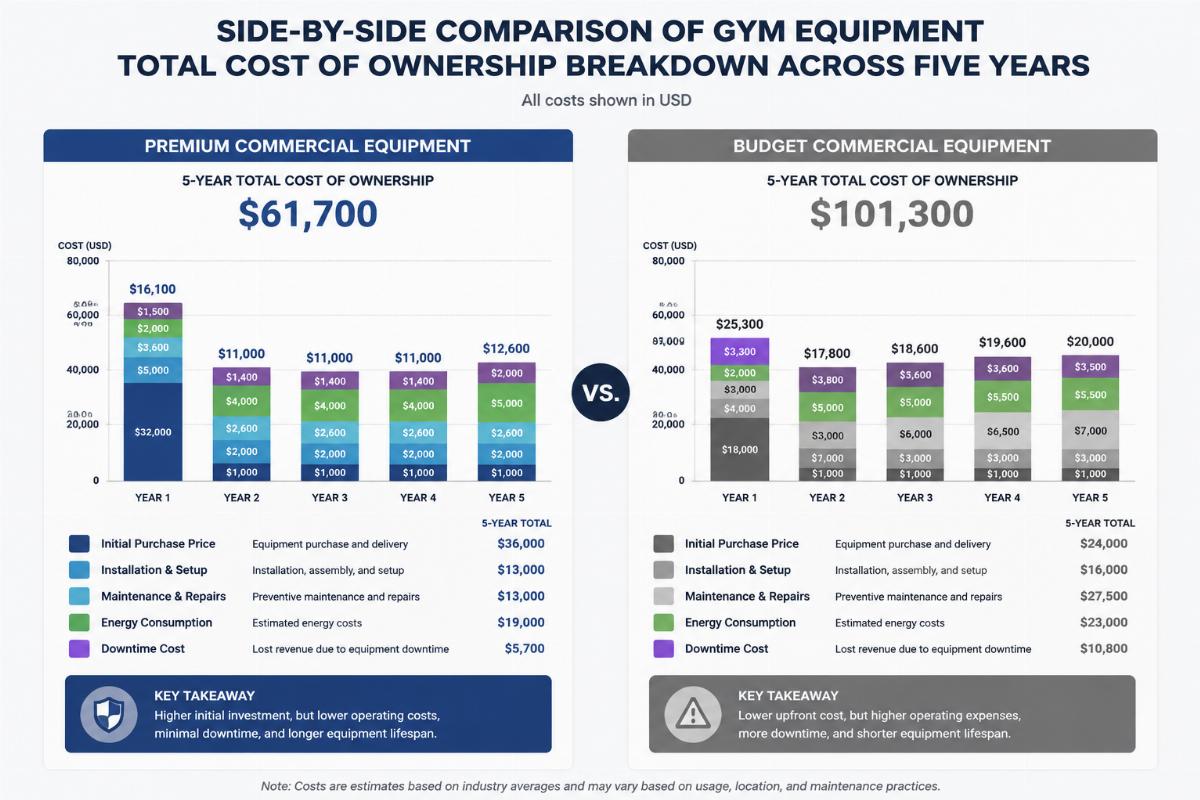
The cost advantage of sourcing a China functional rig over Titan Fitness is substantial when you compare equivalent build quality. The risk is not that Chinese manufacturing cannot deliver Titan-level durability. The risk is that without explicit, verifiable specifications, the default production will drift toward the thinner, faster, cheaper end of the range — and the buyer will not notice until the rig is in the field.
Here is the practical reality:
- Material cost is similar. Q235 and Q345 steel pricing is globally benchmarked. The raw material savings are marginal.
- Fabrication discipline is the variable. The supplier willing to hold tight wall-thickness tolerance, run continuous full-penetration welds, laser-cut J-cup plates, and perform full acid-phosphate pre-treatment is the supplier whose rig will perform like a Titan at a noticeably lower price point.
- Verification is the buyer’s leverage. A supplier who welcomes third-party inspection reports, provides mill certificates, and agrees to destructive weld sampling is a supplier who has nothing to hide. A supplier who deflects on these requests is telling you everything you need to know.
| Procurement Approach | Durability Outcome | Cost Outcome |
|---|---|---|
| Price-only sourcing, no spec verification | Uncontrolled — likely below Titan tier | Lowest unit cost, highest field-failure risk |
| Spec-defined sourcing with batch verification | Controlled — matched to Titan tier | Moderate unit cost, minimal field-failure risk |
| Over-specified sourcing with excessive testing | Marginally above Titan tier | Unnecessarily high unit cost |
[NEED_CITE: total cost of ownership comparison of verified-spec vs. unverified-spec commercial fitness equipment]
The buyers who get the best long-term outcome are the ones who treat the purchase specification as a structural engineering document, not a price negotiation sheet. Define the gauge. Define the weld standard. Define the J-cup tolerance. Define the pre-treatment process. Then verify every one of them on every batch.

Conclusion
A China functional rig can deliver Titan Fitness-level durability — but the gap between "can" and "does" is closed by specification discipline, not by luck. Tube gauge, weld penetration, and J-cup precision are the three verifiable dimensions that separate a rig that lasts from one that fails. Measure them before the order ships, and the cost advantage of Chinese manufacturing works entirely in your favor.