How Professional Sports Team Facilities Buyers Deploy Kettlebell Set
Most facility managers think heavier kettlebells equal better training outcomes. The reality is that structured weight progression systems, not raw tonnage, define athletic performance centers.
Professional sports facilities deploy kettlebell sets through a tiered weight architecture covering rehabilitation to explosive power zones, integrated into functional training areas with high-turnput rack systems, while prioritizing coating durability and load-bearing certifications over unit price to control long-term replacement costs.
I remember standing on a warehouse floor in Linyi, watching a forklift operator carefully stack pallets of cast iron kettlebells. Each piece had a slightly different surface texture from the coating process. A buyer from a Middle Eastern athletic performance center once rejected an entire shipment because the grip coating felt inconsistent under sweaty palms during high-rep swings. That rejection taught me that in professional sports environments, surface finish and ergonomic consistency matter far more than the nominal weight stamped on the side. Facility operators managing dozens of athletes daily cannot afford equipment that causes blisters or slips mid-rep. [NEED_CITE: injury prevention protocols in commercial strength equipment per international sports facility guidelines]

The deployment logic in these high-traffic environments follows patterns that most first-time buyers completely overlook. Let me break down what actually happens when a professional sports team facility decides to outfit its training floor.
Why Do Professional Sports Facilities Prioritize Structured Kettlebell Deployment?
Systematic deployment of kettlebell sets in athletic performance centers improves training throughput and reduces equipment management overhead significantly compared to ad-hoc placement.
When I first started visiting sports training facilities across different regions, I noticed a clear divide. Some centers treated kettlebell sets like afterthought accessories, tossing them into corners near the stretching mats. Others built dedicated zones with color-coded weight tiers, integrated flooring, and clear traffic flow patterns. The difference in athlete satisfaction and coach efficiency was immediately visible. [NEED_CITE: facility layout optimization principles for high-traffic strength training environments]
A European football club’s training base I consulted with reorganized their functional training area around a structured kettlebell deployment model. They separated rehabilitation-grade lighter units from explosive power training heavier units, creating distinct zones that prevented bottlenecks during peak hours. Coaches could now run parallel sessions without athletes crossing paths or waiting for equipment. The facility manager reported noticeably smoother session transitions and fewer scheduling conflicts.
The core principle here is that professional sports facilities operate on tight training schedules. Every minute of equipment hunting or zone congestion translates to compromised programming. A kettlebell set deployment that respects athletic workflow—moving from warm-up to activation to power output—directly supports coaching objectives. [NEED_CITE: athletic periodization and equipment accessibility in professional training environments]

What Weight Progression Specs Do Athletic Performance Centers Require?
A comprehensive kettlebell set deployment in professional sports facilities spans from lightweight rehabilitation units to heavy explosive power tools, with ratio allocation favoring mid-range weights for the majority of athletic programming.
Most buyers assume they need equal quantities across all weight levels. This is a fundamental misunderstanding of how athletic performance centers actually operate. The bulk of training volume happens in the mid-range—weights that challenge strength-endurance without compromising movement quality. Heavy units serve specific power development sessions, while light units handle warm-up protocols and injury prevention work.
A typical professional sports facility kettlebell set deployment follows a tiered structure:
| Weight Tier | Application | Allocation Ratio | Coating Priority |
|---|---|---|---|
| Light tier | Rehabilitation, warm-up, technique work | Substantial allocation | High grip comfort |
| Mid tier | Strength-endurance, hypertrophy, conditioning | Highest allocation | Balanced durability |
| Heavy tier | Explosive power, maximal strength | Limited allocation | Impact resistance |
[NEED_CITE: weight progression protocols in professional athletic strength and conditioning programs]
I worked with a basketball training center that initially ordered equal quantities across their kettlebell set range. Within months, their mid-range units showed accelerated wear while the lightest and heaviest pieces sat mostly unused. They had to reorder mid-range units twice while the extremes collected dust. The lesson was clear: deployment ratios must match actual training volume distribution, not theoretical weight coverage.
Another consideration is athlete-specific loading. Female athletes and younger developmental players often require different starting points than professional male athletes. A well-planned kettlebell set deployment accounts for these variations by stocking additional light-to-mid units in facilities serving mixed populations. [NEED_CITE: gender and age-based loading considerations in professional sports training equipment]

How Should Facilities Zone Kettlebell Areas for Maximum Throughput?
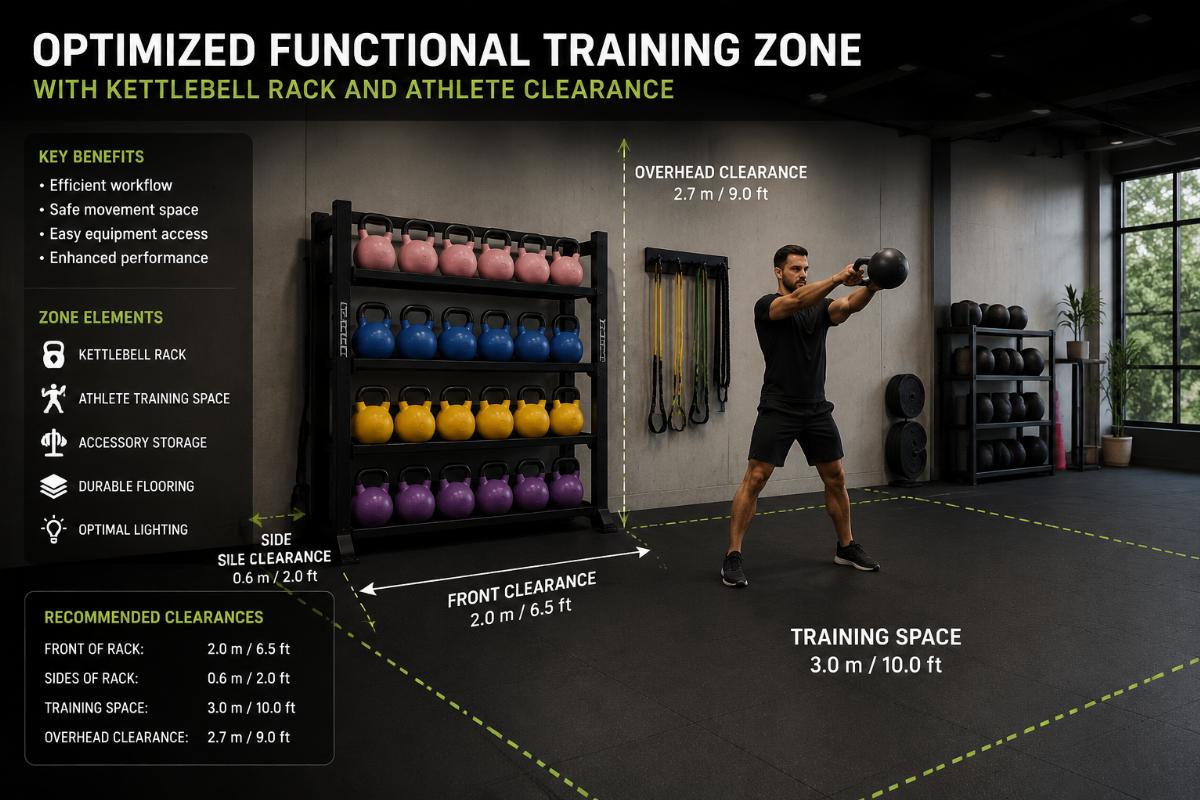
Dedicated functional training zones with optimized rack placement and clear traffic flow patterns enable professional sports facilities to serve multiple athlete groups simultaneously without congestion.
The physical layout of a kettlebell set deployment directly impacts how many athletes can train effectively in a given time slot. I have seen facilities where poor rack placement created dangerous swing paths crossing walking routes, or where athletes had to walk across the entire training floor to find their working weight.
A high-performance training center in Southeast Asia redesigned their kettlebell zone around three principles: dedicated rubber flooring with shock absorption, rack positioning that allows full swing arcs without obstruction, and weight organization that follows the typical training sequence from light to heavy. The result was a noticeable increase in simultaneous user capacity and a reduction in equipment-related interruptions.
Key zoning considerations for kettlebell set deployment include:
- Flooring material that withstands repeated impact from heavy units while providing joint protection during high-rep work
- Rack height and depth that allow easy visual identification and single-hand retrieval
- Clear demarcation between swing zones and stationary exercise areas
- Adequate spacing between athletes to prevent collision during dynamic movements
[NEED_CITE: spatial requirements and safety standards for functional training zones in commercial sports facilities]
I recall a facility that tried to save floor space by mounting kettlebell racks against a wall with insufficient clearance behind. Athletes performing swings kept hitting the wall with their free arms, causing bruising and movement compensation. They had to relocate the entire setup weeks later, wasting both time and installation costs. Proper zoning is not optional—it is a safety and performance requirement.
What Procurement Factors Impact Long-Term Deployment Costs?
Coating durability, handle ergonomics, and structural integrity determine the total cost of ownership for kettlebell sets in professional sports facilities, far exceeding the influence of initial purchase price.
Here is where most facility buyers make their most expensive mistake. They compare kettlebell set options based on per-kilogram pricing and choose the lowest quote. Then they wonder why replacement orders come due within a short cycle. The reality is that professional sports facilities put equipment through punishing daily use. Sweat, chalk, repeated drops, and constant handling accelerate wear in ways that residential or light commercial environments never encounter.
The coating on a kettlebell is not just cosmetic. It protects the cast iron core from corrosion caused by sweat and humidity, provides grip friction during dynamic movements, and resists chipping from impact with flooring or other equipment. A facility deploying a kettlebell set across multiple training zones needs coating that survives years of daily abuse, not months.
| Cost Factor | Low-Grade Option | Commercial-Grade Option |
|---|---|---|
| Coating durability | Vulnerable to chipping | Resistant to impact and corrosion |
| Handle finish | Inconsistent, prone to causing blisters | Uniform texture, sweat-resistant |
| Structural integrity | Potential voids or weak points | Solid cast, verified weight accuracy |
| Long-term replacement frequency | Noticeably higher | Substantially extended |
[NEED_CITE: material durability standards for commercial strength training equipment in high-usage environments]
A professional sports team facility I advised switched from budget kettlebell sets to commercial-grade units with verified coating specifications. Their replacement cycle extended dramatically. What used to be an annual reorder became a multi-year investment. The per-unit cost was higher, but the cost-per-use dropped significantly. This is the procurement math that separates experienced facility buyers from those learning through costly mistakes.
Handle geometry also matters more than most buyers realize. The thickness, surface texture, and corner radius of the handle affect grip security during high-rep swings and snatches. Athletes with smaller hands struggle with oversized handles, while athletes with larger hands find thin handles uncomfortable under load. A well-specified kettlebell set accounts for these ergonomic variables. [NEED_CITE: ergonomic design considerations for commercial free weight handles in athletic training]

How Do Buyers Verify Quality Standards for Commercial-Grade Kettlebells?
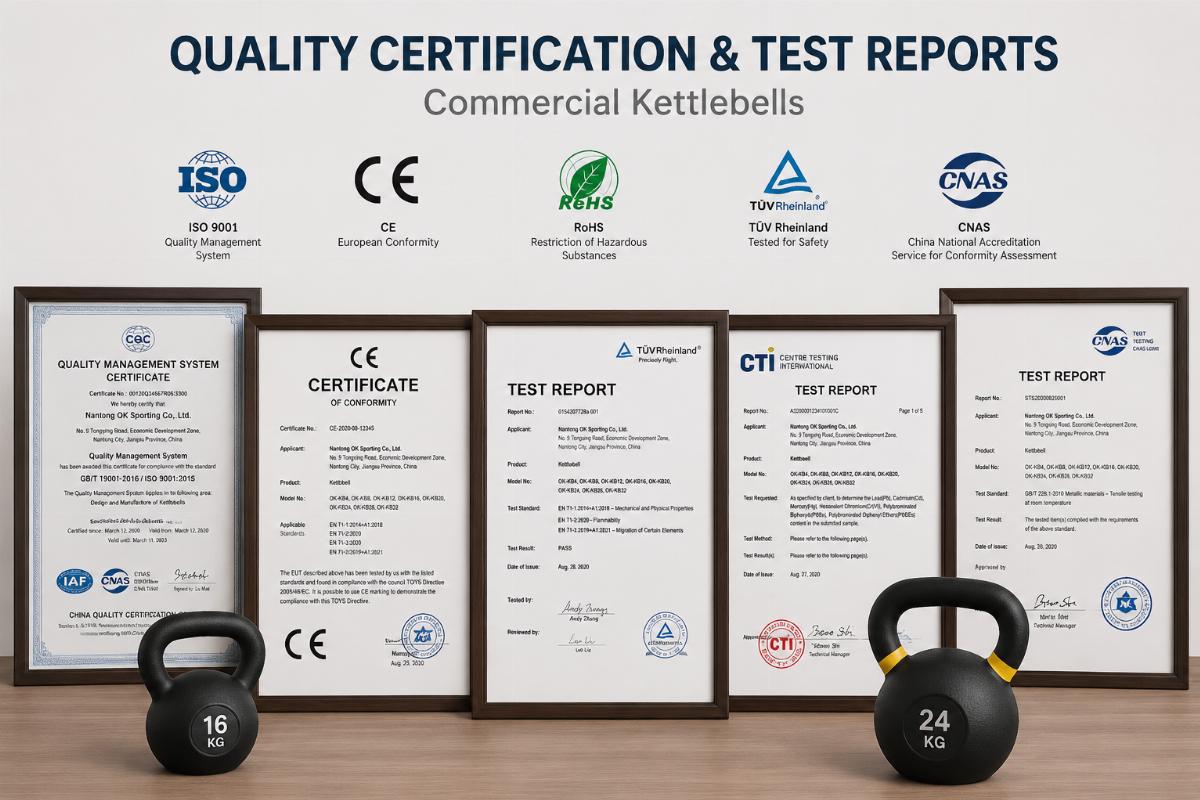
International certifications, third-party testing reports, and verifiable manufacturing documentation form the baseline quality verification for kettlebell sets destined for professional sports facilities.
When I started in this industry, I learned the hard way that paperwork matters as much as the product itself. A shipment of kettlebells I handled early in my career got held at customs because the certification documentation was incomplete. The delay cost the client dearly in expedited shipping fees and damaged their project timeline. Since then, I have become obsessive about verification documentation.
Professional sports facilities purchasing a kettlebell set should demand the following from suppliers:
- CE certification or equivalent regional compliance marking
- Third-party load testing reports verifying weight accuracy and structural integrity
- Coating material safety data sheets confirming non-toxic, sweat-resistant formulations
- Manufacturing facility audit reports or quality management system certifications
[NEED_CITE: international quality certification requirements for commercial fitness equipment imports]
A sports facility developer in Latin America once received a kettlebell set that looked perfect visually. But during installation, their maintenance team noticed that the weight markings did not match actual scale measurements. Some units were noticeably heavier than labeled, others lighter. This inconsistency created liability concerns and training programming errors. The supplier could not provide third-party verification of weight accuracy, forcing the facility to return the entire order.
Verification is not bureaucracy—it is risk management. Professional sports facilities cannot afford equipment that fails mid-training or causes injury due to manufacturing defects. A reputable supplier of kettlebell sets provides transparent documentation and welcomes quality audits. [NEED_CITE: quality assurance protocols for commercial strength equipment procurement in institutional settings]
Conclusion
Professional sports facility kettlebell deployment succeeds through systematic weight tiering, functional zone design, and durability-focused procurement rather than reactive purchasing.
Athletic performance centers that treat kettlebell sets as strategic training infrastructure—investing in proper weight progression ratios, dedicated zoning, and verified commercial-grade quality—achieve noticeably better training outcomes and lower long-term replacement costs. The facilities that cut corners on deployment planning or choose based solely on unit price inevitably pay more in equipment downtime, athlete frustration, and premature replacement cycles.