
Hyperextension Bench Factory Direct Wholesale Price 2026
Most buyers think brand premium pays for better padding. It doesn’t. It pays for marketing.
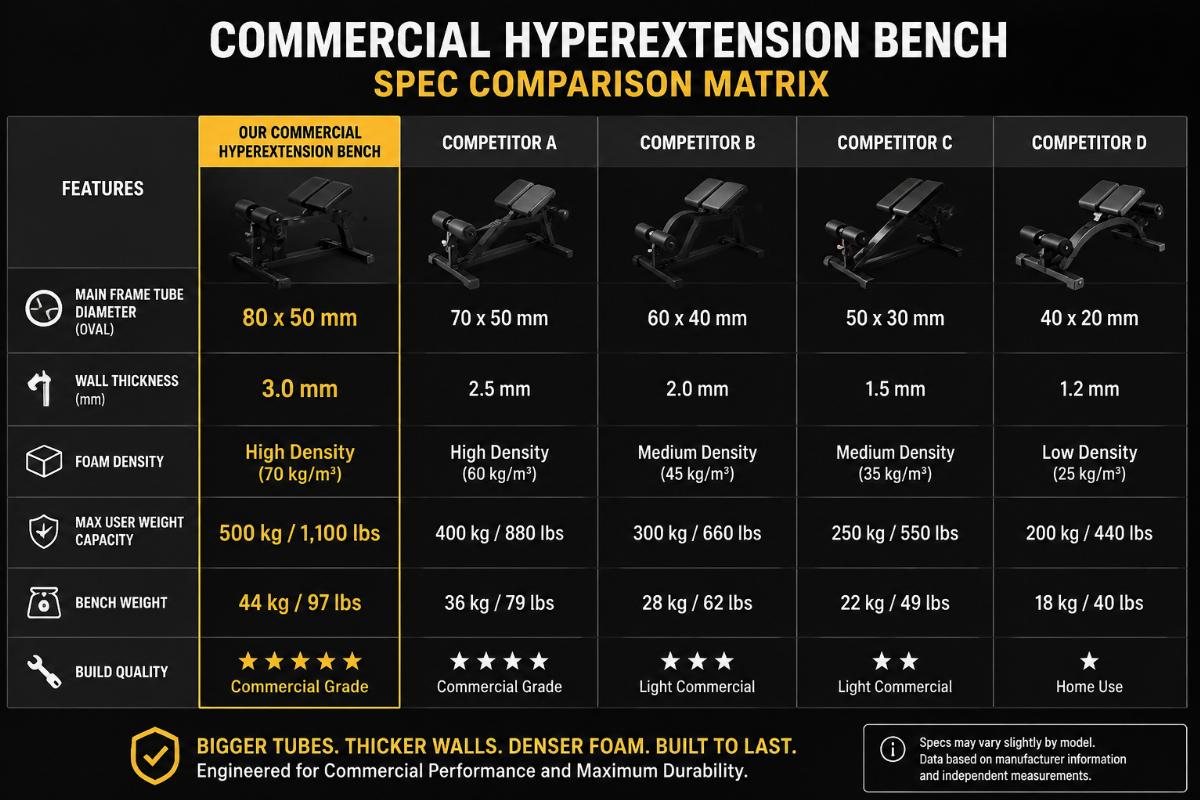
The real drivers of hyperextension bench factory direct wholesale price in 2026 are steel tube diameter, wall thickness, foam density, and adjustment mechanism complexity. A commercial-grade unit from a Shandong factory typically runs 40–50% below equivalent European or North American branded pricing, provided the buyer selects the correct spec tier for the actual usage scenario.
I still remember the warehouse in Monterrey where a full container of commercial hyperextension benches sat untouched for three months. The buyer had selected from our spec sheet, but the foam density felt too firm for his members’ preference, and the adjustment range didn’t accommodate shorter users properly. I flew down, spent a week swapping padding and modifying the hip pad bracket on-site, and learned a lesson that shaped every quote I’ve sent since: the spec sheet is only half the conversation. The other half is understanding what the end user actually does on that bench. [NEED_CITE: gym equipment failure root cause distribution by component category]
Let me walk through what actually moves the price, what gets hidden in shipping calculations, and where customization changes the unit cost.
Commercial vs Home Grade: Which Spec Matrix Matches Your Usage?
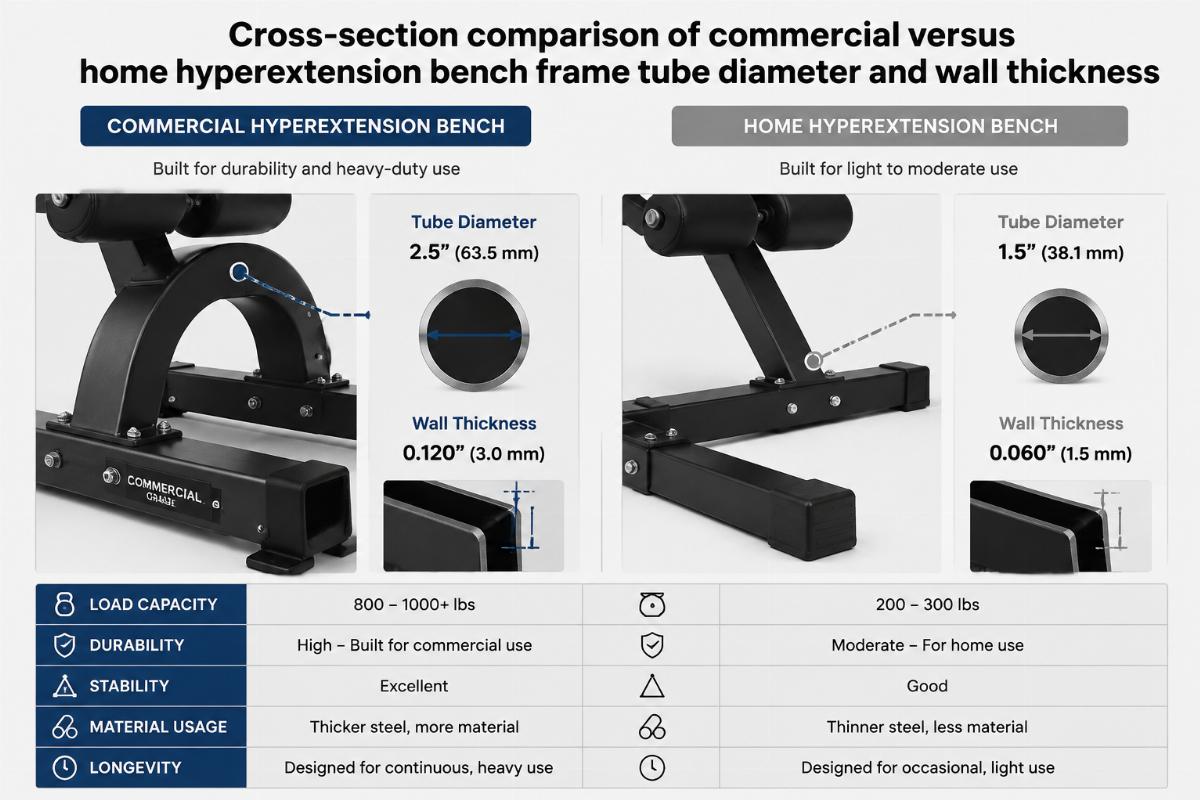
The gap between commercial and home hyperextension benches is not cosmetic. It is structural, and it determines whether the unit survives two years of peak-hour traffic or cracks under warranty.
When I started welding frames in the factory, the distinction was simple: commercial meant thicker steel, denser foam, and a pad adjustment system that could handle repeated repositioning without loosening. Home grade meant lighter tubing, thinner padding, and a simpler pin-lock mechanism. Today, the matrix looks like this:
| Parameter | Commercial Grade | Home Grade |
|---|---|---|
| Frame tube diameter | ≥50 mm | 38–42 mm |
| Wall thickness | ≥2.0 mm | 1.2–1.5 mm |
| Static load capacity | Substantially higher | Noticeably lower |
| Foam density | High-density, slow-rebound | Standard rebound |
| Pad adjustment | Multi-position with positive lock | Basic pin or ladder |
| Footplate | Wide, non-slip, adjustable | Narrow, fixed or limited |
| Frame finish | Powder-coated, multi-stage pretreatment | Single-stage paint or basic powder |
[NEED_CITE: commercial fitness equipment structural testing standards per EN ISO 20957]
A Middle East distributor once ordered a full container of home-grade hyperextension benches for a hotel fitness center project. The units arrived, looked acceptable in photos, but within weeks the adjustment pins started bending under repeated use by guests of varying body weights. The entire batch had to be pulled. The cost of return freight and replacement exceeded the original price difference between home and commercial grade by a wide margin.
The key insight: tube diameter and wall thickness determine load capacity and long-term frame integrity. Foam density determines user comfort and complaint frequency. Adjustment mechanism determines whether the bench stays stable over thousands of repositioning cycles. None of these are visible in a product photo.
China Factory Direct Pricing Breakdown: Where Does Your Money Go?
The hyperextension bench factory direct wholesale price is not a single number. It is a layered structure, and understanding each layer is what separates informed buyers from those who simply chase the lowest quote.
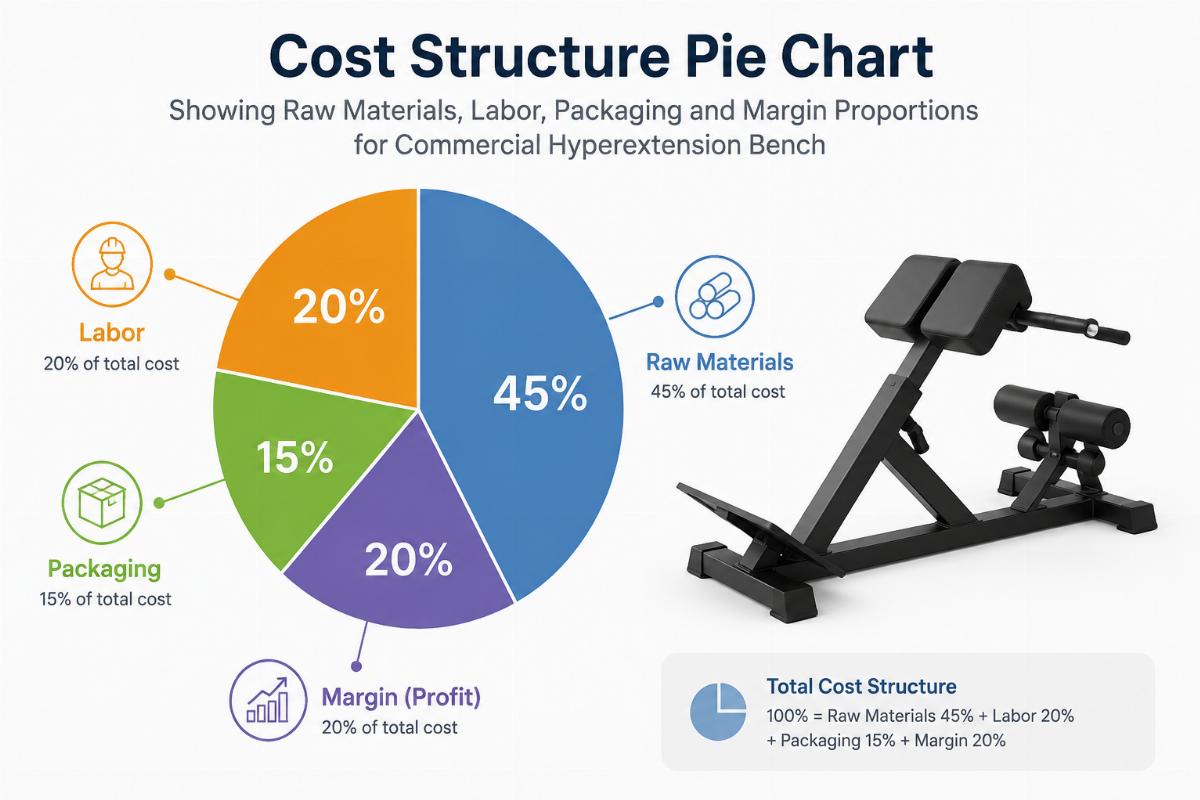
When a factory in Shandong quotes a commercial hyperextension bench FOB, the cost structure typically breaks down as follows:
| Cost Component | Proportion |
|---|---|
| Raw materials (steel tube, foam, vinyl, hardware) | Majority share |
| Labor (welding, grinding, powder coating, assembly) | Significant share |
| Packaging (carton, foam inserts, hardware bags) | Moderate share |
| Factory overhead and margin | Remaining share |
[NEED_CITE: fitness equipment manufacturing cost structure analysis by component category]
The raw material component is the most volatile. Steel tube prices fluctuate with global commodity markets, and foam density upgrades directly increase material cost. A commercial-grade bench with high-density slow-rebound foam will cost noticeably more in materials than one with standard rebound padding, even if the frame is identical.
Labor cost in Shandong remains competitive compared to coastal provinces, but skilled welding and multi-stage powder coating add meaningful cost. A factory that cuts corners on surface pretreatment will quote lower, but the finish will chip and corrode within a single year of gym-floor use.
The margin layer is where factory-direct sourcing delivers its primary advantage. When a buyer sources through a trading company or a branded distributor, each intermediary adds a layer of markup. Factory-direct pricing eliminates these layers, which is why the same hyperextension bench can carry a retail price that is substantially higher than the FOB cost from the manufacturing facility.
A Latin American gym chain buyer I worked with compared quotes from three channels: a European brand distributor, a trading company in Guangzhou, and direct from the Shandong factory. The factory-direct quote was lower by a wide margin, and the spec was identical because the European brand was sourcing from the same manufacturing region anyway. The brand premium was paying for a logo and a warranty administered from overseas.
Hidden Costs: Container Loading and Shipping Volume Optimization
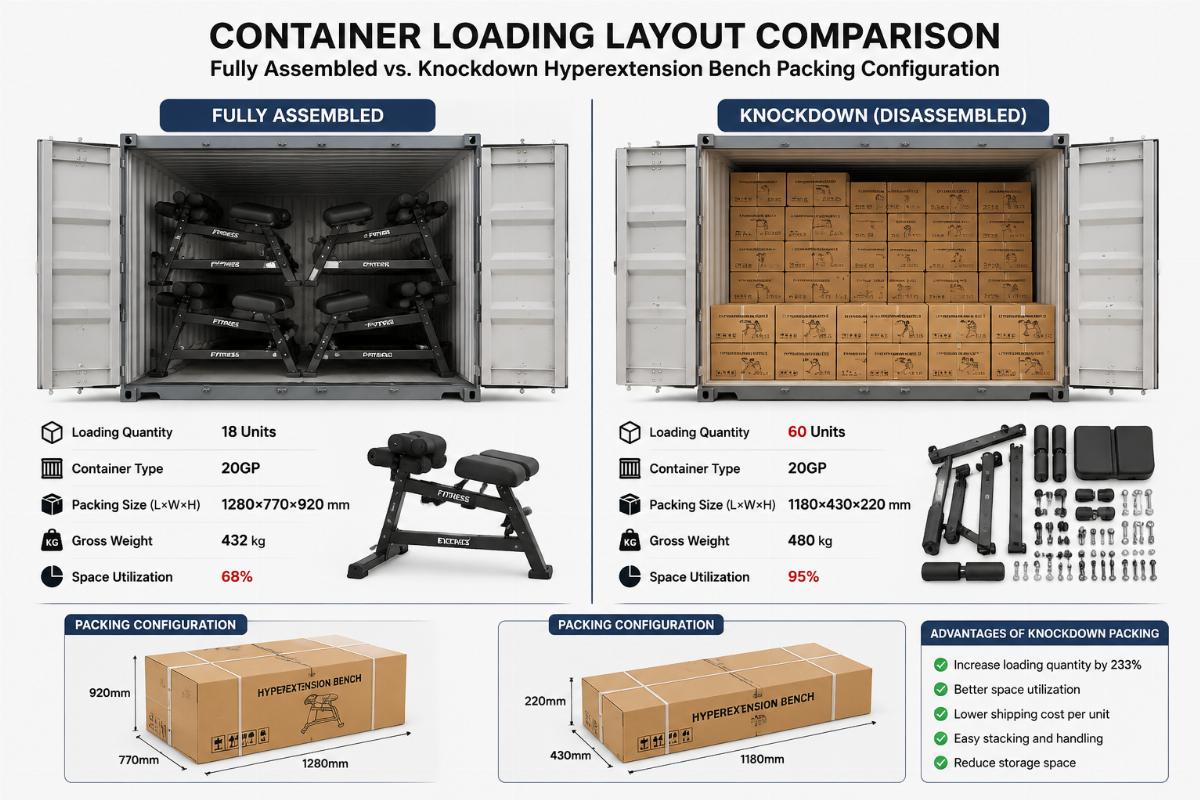
The FOB price is not the landed cost. The difference between a well-designed knockdown structure and a fully assembled unit can shift the per-unit shipping cost by a noticeable amount.
This is where many buyers miscalculate. A hyperextension bench that ships fully assembled takes up a large volume in the container. A bench designed for knockdown shipping, with the frame disassembled into flat-pack components and the pads removed, can fit substantially more units per container.
| Shipping Format | Units per 40HQ (approx.) | Per-Unit Shipping Cost Impact |
|---|---|---|
| Fully assembled | Lower capacity | Higher per-unit cost |
| Knockdown / flat-pack | Substantially higher capacity | Noticeably lower per-unit cost |
[NEED_CITE: container loading efficiency comparison for commercial fitness equipment by shipping format]
I once worked with a buyer in Chile who insisted on receiving fully assembled benches because his warehouse staff lacked assembly tools. The container held fewer units, the per-unit freight cost was higher, and by the time the goods reached Santiago, the shipping cost differential had erased most of the price advantage he’d negotiated on the product itself.
The solution is not always knockdown. Some buyers lack assembly capacity, and forcing knockdown on them creates a different problem. The solution is to calculate the total landed cost, including freight, and compare it against the assembled price. In many cases, the knockdown format delivers a clear advantage, especially for full-container orders.
Packaging design also matters. A factory that invests in custom foam inserts and reinforced carton corners will reduce damage rates during ocean transit. A factory that uses minimal packaging will quote lower, but the damage claim rate will eat into the savings.
OEM Customization Impact on Unit Price: What to Expect
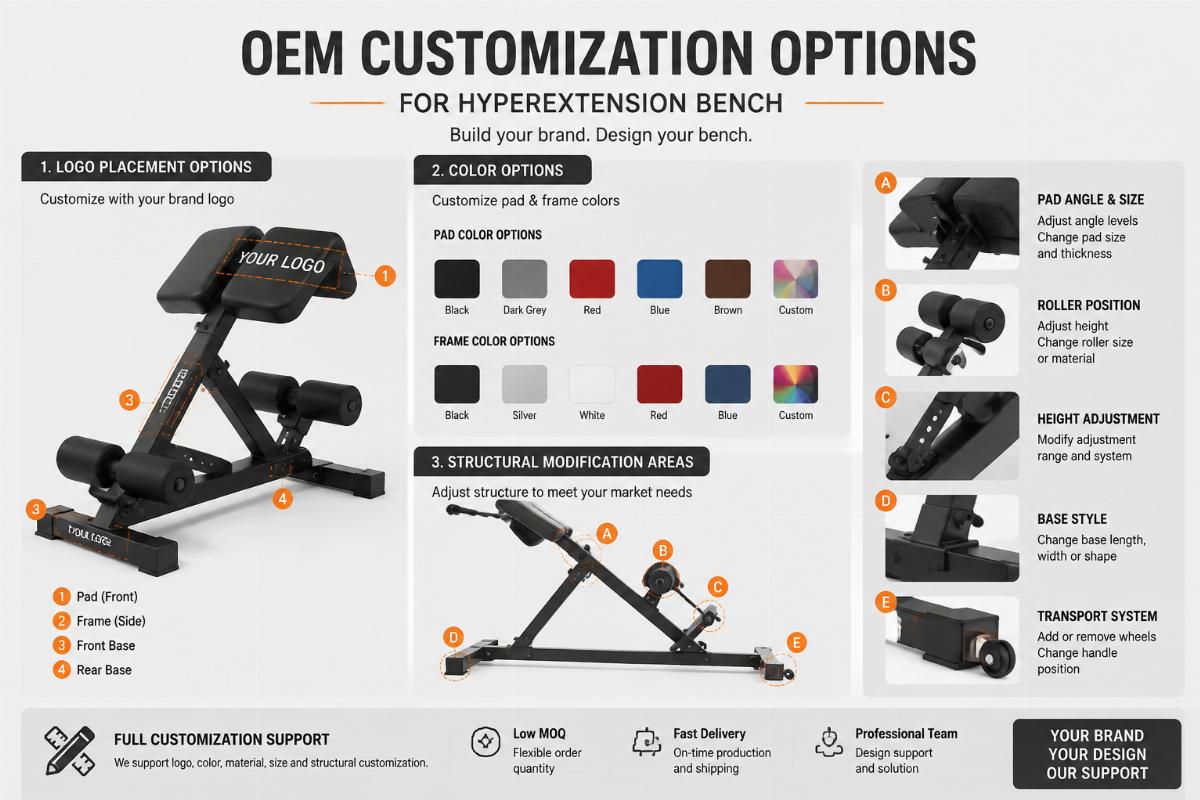
Customization is not free. Every modification to the standard spec carries a cost, and understanding the pricing logic prevents budget surprises.
The most common OEM requests for hyperextension benches include:
- Logo application (silk screen or laser engraving on frame): Adds a small per-unit cost. Minimum order may apply depending on the logo placement complexity.
- Custom frame color (non-standard powder coat): Adds a moderate per-unit cost due to powder coat changeover and minimum batch requirements at the coating line.
- Custom pad color or vinyl type: Adds a small to moderate per-unit cost depending on material availability.
- Structural modification (different tube diameter, altered adjustment mechanism, custom footplate design): Requires engineering review and potentially new tooling. One-time tooling cost applies, plus a per-unit cost adjustment.
[NEED_CITE: OEM customization cost impact analysis for commercial fitness equipment by modification type]
A boutique studio owner in Brazil wanted a hyperextension bench with a narrower hip pad to accommodate a predominantly female clientele. The modification required a new pad mold. The one-time mold cost was reasonable, but the per-unit cost increase was modest because the frame remained standard. The total investment made sense for a branded studio environment where equipment aesthetics and fit matter.
A distributor in Southeast Asia wanted a fully custom frame geometry to differentiate from competitors. The engineering review showed that the modification required new welding jigs and a revised powder coat mask. The one-time cost was substantial, and the per-unit cost increased noticeably. The distributor decided the differentiation was not worth the investment and opted for a custom color and logo instead.
The principle: cosmetic customization is low-cost and low-risk. Structural customization requires engineering validation and carries meaningful one-time and per-unit cost. Always request a detailed breakdown before committing.
Conclusion
The hyperextension bench factory direct wholesale price is determined by spec, not by brand. Tube diameter, wall thickness, foam density, and adjustment mechanism define the cost structure. Shipping format and OEM customization add layers that must be calculated into the total landed cost.
Buyers who focus solely on the FOB number miss the full picture. The spec must match the usage scenario. The shipping format must match the logistics reality. The customization must match the brand requirement. Get these three alignments right, and the factory-direct channel delivers clear cost advantage without compromising quality or durability.


