Incline Chest Press Duty Cycle for Bodybuilding Gyms – Bulk OEM
"Heavy-duty" stamped on a frame means nothing if the pivot bushings cannot survive a single peak-hour shift.
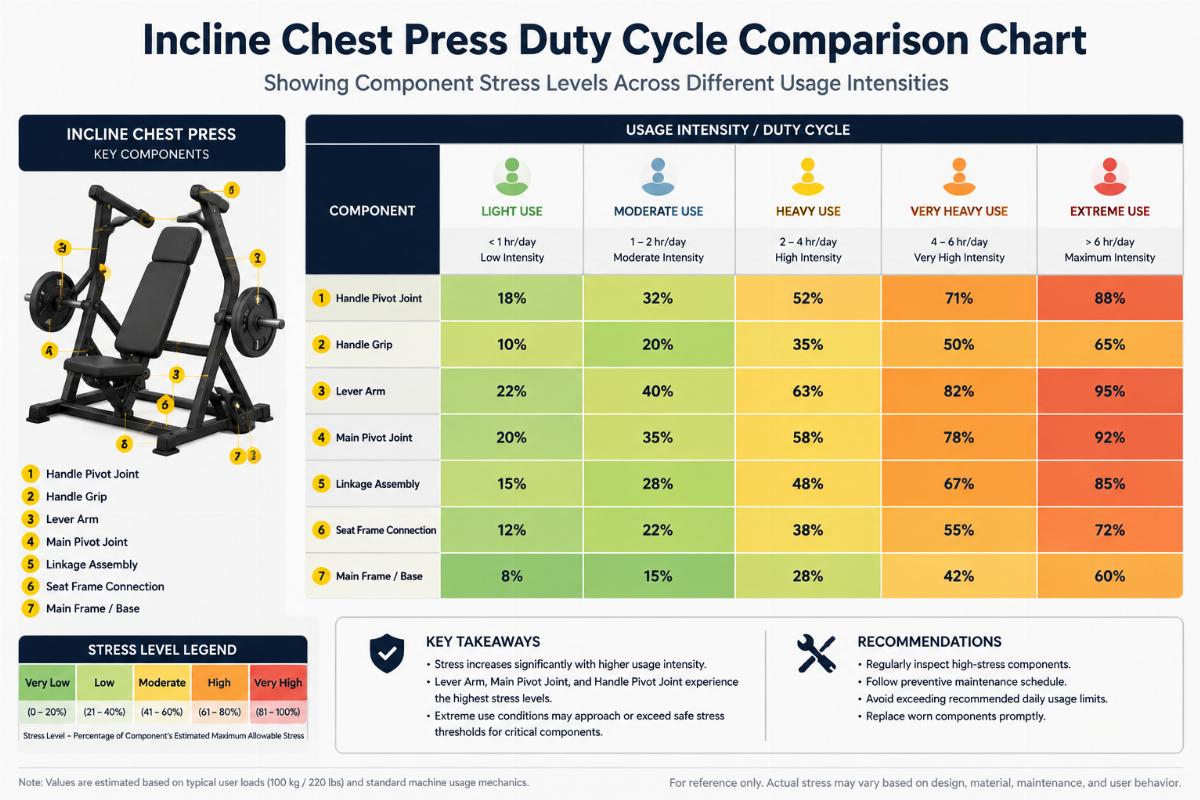
Duty cycle for an incline chest press defines how many continuous operating hours the machine can sustain under repetitive loading before critical components—bearings, seals, cables—require intervention. For commercial bodybuilding gyms running 14+ hours daily, matching the incline chest press duty cycle to actual traffic volume is the single most important specification that separates equipment that lasts years from equipment that fails within months.
I once oversaw a container load of incline presses shipped to a bodybuilding-focused gym in Lagos. The owner, a local competitive lifter, kept the floor open from early morning until late at night. Members trained heavy, non-stop. Within a few months, hydraulic seals started weeping fluid, and pivot points developed noticeable play. The machines had been bench-tested at the factory without issue, but the real-world duty cycle in a high-traffic West African gym exposed what spec sheets never reveal. Since then, every conversation I have with buyers about incline presses starts with the same question: how many hours per day, and how many members are on the machines at the same time? [NEED_CITE: commercial gym equipment failure rate correlation with daily operating hours]
That Lagos installation is not an isolated case. Across multiple regions, gym operators consistently underestimate what continuous cycling does to strength equipment. Let us break down what duty cycle actually means, how to calculate it for your facility, which components fail first when it is exceeded, and how to verify claims before committing to a purchase.
What Is Duty Cycle and Why Does It Matter for Incline Presses?
Duty cycle measures the ratio of active loaded use to total available time, expressed as a percentage of continuous operation a machine can tolerate before maintenance thresholds are reached.
In industrial engineering, duty cycle originates from motor and hydraulic system ratings—how long a component can run before thermal buildup or mechanical wear forces a cooldown. [NEED_CITE: industrial duty cycle definition per IEC motor rating standards] For strength equipment, the concept translates differently. An incline chest press does not have a motor, but it has pivot bearings, guide rods, cable systems, and—on hydraulic or selectorized models—fluid seals and internal cartridges. Each of these accumulates fatigue with every repetition.
The incline chest press duty cycle in a commercial gym context is not about whether the machine "works." It is about whether the machine works without developing play, noise, resistance inconsistency, or structural fatigue that compromises user safety and member experience.
Consider a typical bodybuilding gym during peak hours. Multiple members rotate through the same incline press station. Sets are heavy, reps are controlled, and rest periods are short. The machine sees continuous loading with minimal cooldown. In this environment, a machine rated for light commercial or home use will show accelerated wear at the pivot bushings, cable fraying at the pulley junctions, and seat adjustment mechanisms loosening well before their expected service life. [NEED_CITE: strength equipment bearing wear progression under continuous load conditions]
Conversely, a machine engineered with a high incline chest press duty cycle uses sealed cartridge bearings or precision bronze bushings at all pivot points, oversized guide rods with low-friction coatings, and cables rated for multiples of the maximum expected load. The frame may be identical in appearance to a lower-tier model, but the internal components tell a completely different story.
This is where the first misconception appears. Many buyers assume that a thicker steel frame automatically means higher duty cycle. Frame thickness contributes to static load capacity, but duty cycle is governed by the quality of moving parts—bearings, bushings, seals, and cables—under repetitive dynamic loading. A heavy frame with inferior pivot components will fail faster than a lighter frame with premium bearings.
How Do You Calculate Duty Cycle Requirements for Your Facility?
Duty cycle calculation for an incline chest press requires mapping your actual usage pattern—daily operating hours, peak concurrent users per machine, and average session intensity—against the manufacturer’s rated capacity.
There is no universal formula printed on every spec sheet, but the underlying logic is consistent. You need to estimate the total number of loading cycles each machine will experience per day, then compare that against the manufacturer’s tested endurance rating for critical components. [NEED_CITE: gym equipment usage cycle calculation methodology for commercial facilities]
Start with operating hours. A boutique studio running extended daytime and evening sessions may see twelve to fourteen hours of floor time. A twenty-four-hour gym or hotel fitness center operates continuously. Multiply operating hours by the average number of users per machine during peak periods. If your incline press station has two machines and peak hour brings six to eight users per machine, each machine is under near-constant load with only brief transitions between sets.
Next, factor in intensity. Bodybuilding gyms differ from general fitness centers in that members train with heavier loads and stricter rep control. Heavier loads generate higher peak forces at pivot points. [NEED_CITE: peak force impact on strength equipment joint fatigue versus repetition volume] Contrary to what some assume, low-rep heavy sets are not easier on machines than high-rep moderate sets. The peak force spike during a heavy press creates more structural stress at bearing interfaces than the cumulative volume of lighter reps.
Now compare this calculated demand against what the manufacturer rates. Many commercial-grade machines are rated for sustained daily operation, but the fine print often reveals exclusions for continuous use beyond certain thresholds. Warranty documentation from multiple manufacturers includes clauses that void coverage when equipment is operated beyond single-shift duration without documented maintenance intervals. [NEED_CITE: commercial fitness equipment warranty exclusions for extended daily operation]
A practical approach: request the manufacturer’s test data for bearing lifespan and seal endurance under specified cycle counts. If the manufacturer cannot provide cycle-based endurance data and only offers calendar-based warranty periods, that is a signal that the incline chest press duty cycle has not been rigorously validated for high-traffic environments.

What Components Fail First When Duty Cycle Is Exceeded?
When an incline chest press is operated beyond its rated duty cycle, pivot bushings, hydraulic seals, and cable systems show wear multiples faster than the frame itself.
The frame is the most visible part of the machine, but it is rarely the first thing to fail. Structural steel frames, when properly welded, tolerate enormous static and dynamic loads. The failure points are always at the interfaces—where moving parts meet, where cables redirect, where adjustment mechanisms lock.
Pivot bushings are the most common early failure. In machines with inferior bushing materials, continuous cycling causes the bronze or polymer insert to wear unevenly, introducing lateral play. Users feel this as a subtle wobble during the press motion. Over time, the play accelerates wear on the pivot pin itself, creating a compounding degradation cycle. [NEED_CITE: pivot bushing wear patterns in commercial strength equipment under high-cycle conditions] Sealed cartridge bearings resist this degradation significantly longer, but they cost more and are not universally specified by manufacturers targeting price-sensitive markets.
On hydraulic or pneumatic resistance models, seal degradation is the primary failure mode. Hydraulic cylinders rely on internal seals to maintain fluid pressure and smooth stroke feel. Under continuous cycling—especially in environments with elevated ambient temperatures—seals harden, crack, and begin to leak. The failure is not catastrophic immediately, but fluid loss leads to inconsistent resistance, which members notice quickly. In the Lagos case I mentioned earlier, seal failure appeared within months of continuous operation in a hot, humid environment with no scheduled cooldown periods. [NEED_CITE: hydraulic seal degradation curves relative to ambient temperature and cycle frequency]
Cable systems fail through a different mechanism. Cables on incline presses route through pulleys to redirect force. Under high duty cycle, the cable flexes over the same pulley groove thousands of times per day. If the pulley groove is not hardened or the cable is not rated for the actual peak load, internal wire fatigue causes fraying and eventual strand breakage. This is a safety-critical failure. Regular inspection intervals must be compressed in high-duty-cycle environments.
Seat adjustment mechanisms—pin-lock or dial-type—also suffer. Continuous adjustment by different users wears the locking surfaces. Pin-lock systems develop slop; dial-type mechanisms lose detent precision. Neither failure is immediate, but both degrade the user experience and generate maintenance tickets.
The key insight: when evaluating incline chest press duty cycle, look past the frame and ask specifically about bearing type, seal specification, cable rating, and adjustment mechanism construction. These are the components that determine real-world longevity.
How Do You Verify Duty Cycle Claims Before Purchase?
Verifying incline chest press duty cycle claims requires requesting test documentation, checking bearing specifications directly, and confirming reference installations with comparable usage patterns.
Manufacturers routinely label machines as "commercial grade" or "heavy duty." These terms are marketing descriptors, not regulated specifications. There is no universal certification body that assigns a duty cycle rating to strength equipment the way motor manufacturers rate IP or insulation classes. [NEED_CITE: absence of standardized duty cycle certification for commercial strength training equipment]
The first verification step is to request bearing specifications by name. Ask whether the pivot points use sealed cartridge bearings, open bronze bushings, or roller bearings. Sealed cartridge bearings offer the longest service life under continuous load because they retain lubrication and exclude contaminants. Bronze bushings are acceptable if they are precision-machined and paired with hardened steel pins, but they require periodic lubrication. Open bushings without sealed retention degrade fastest in dusty or humid gym environments. [NEED_CITE: bearing type lifespan comparison under continuous commercial gym loading]
The second step is to ask for cycle-based test reports. A manufacturer confident in their incline chest press duty cycle will have run endurance tests—cycling the machine through hundreds of thousands of repetitions and documenting wear at specified intervals. If the manufacturer cannot produce this data, they are relying on field reputation rather than engineering validation.
The third step is to request reference installations. Ask for gym operators in similar markets—same daily hours, same member volume—who have been using the equipment for an extended period. A manufacturer serving serious commercial clients will have reference accounts willing to speak about real-world performance. If the manufacturer hesitates or only provides references from low-traffic facilities, that is informative.
When I work with buyers on incline press specifications, we walk through these verification steps together. Our commercial-grade incline presses use sealed cartridge bearings at all pivot points, oversized guide rods with low-friction linear bearings, and cables rated well beyond maximum expected loads. We maintain reference installations across multiple regions where gym operators run extended daily hours, and we can connect prospective buyers directly with those operators for unfiltered feedback. [NEED_CITE: bearing specification impact on commercial strength equipment service intervals]

What Maintenance Adjustments Extend Equipment Life in High-Usage Gyms?
Maintenance intervals in high-duty-cycle gyms must be tied to cycle count rather than calendar time, and proactive wear component replacement prevents cascading failures.
Calendar-based maintenance schedules—lubricate quarterly, inspect semi-annually—assume relatively uniform usage. In a bodybuilding gym running long hours with heavy loads, a machine may accumulate the equivalent of several years’ worth of cycles within a single calendar year. Calendar-based maintenance will always lag behind actual wear.
The correct approach is cycle-based maintenance. Track the approximate number of daily cycles each machine experiences. During peak periods, compress inspection intervals accordingly. Cables should be inspected for internal fraying at intervals proportional to cycle count, not months elapsed. Pivot points should be checked for play using the same logic. [NEED_CITE: cycle-based versus calendar-based maintenance scheduling for commercial fitness equipment]
Proactive component replacement is equally critical. Waiting for a bearing to fail completely before replacing it means the damaged bearing has already scored the pivot pin, requiring a more expensive repair. Replacing bearings and bushings at predetermined cycle thresholds—before they generate measurable play—preserves the mating components and extends overall machine life. The same principle applies to cables and seals.
For hydraulic models, fluid condition should be checked at cycle-based intervals. Fluid degradation accelerates seal wear. In hot climates, fluid breakdown happens faster, and seal replacement intervals must be compressed accordingly.
Gym operators who adopt cycle-based maintenance consistently report longer equipment lifespans and fewer member complaints about machine feel. The incremental cost of more frequent inspections and proactive part replacement is minor compared to the cost of premature machine replacement or the reputational damage of equipment downtime during peak hours.

Conclusion
The incline chest press duty cycle is the specification that determines whether your equipment survives real-world commercial gym conditions or fails prematurely under continuous use.
Frame weight and marketing labels do not predict longevity—bearing quality, seal specification, cable rating, and adjustment mechanism construction do. Calculate your actual daily cycle demand, verify manufacturer claims with test data and reference installations, and shift maintenance to cycle-based scheduling. Equipment engineered for genuine commercial duty cycle will outlast, outperform, and cost less over its operational life than machines that merely look heavy-duty on the outside.