Military Base Strength Facility Retrofit Chest Press Machine Supplier
Most procurement teams assume military base gym retrofits are won on price alone. The real decision driver is equipment failure rate under extreme usage frequency and spare parts availability in theater.
Retrofitting military base strength facilities demands a three-way balance: heavy-duty durability rated for continuous multi-shift use, space-efficient layouts that maximize training capacity within existing footprints, and full compliance with defense procurement standards including CE certification and container-load consolidation for overseas deployment.
Working in fitness equipment export out of Shandong, I have watched base contractors repeatedly underestimate how fast a commercial chest press unit can degrade when subjected to round-the-clock troop training cycles. A Middle East military base gym renovation project I handled a few years back illustrates this clearly. The facility manager originally specified a traditional free-weight bench press setup for the upper-body zone. Within months, the combination of high humidity, salt-laden air, and continuous use caused visible corrosion on guide rails and seat adjustment pins. The unit required unplanned maintenance cycles that pulled it offline repeatedly. When we redesigned the zone with a plate-loaded chest press machine featuring industrial-grade coating and sealed bearing assemblies, the downtime dropped noticeably, and the maintenance crew could perform routine inspections on a predictable schedule rather than reacting to breakdowns [NEED_CITE: corrosion resistance testing standards for fitness equipment in marine environments].

That project reinforced a pattern I see across defense fitness programs: the equipment that looks adequate on a spec sheet often fails under the real conditions of a military installation.
Why Are Military Bases Retrofitting Strength Facilities Now?
Aging infrastructure combined with heightened emphasis on troop physical readiness is creating a wave of gym modernization projects across multiple regions.
Defense installations built decades ago were designed around basic calisthenics and a limited selection of resistance machines. Today’s military fitness doctrine treats strength training as a core component of combat readiness, not a supplementary activity. This shift means existing gym spaces must accommodate heavier loads, more diverse movement patterns, and higher daily user volumes than the original layouts anticipated [NEED_CITE: military physical readiness program updates emphasizing strength training integration].
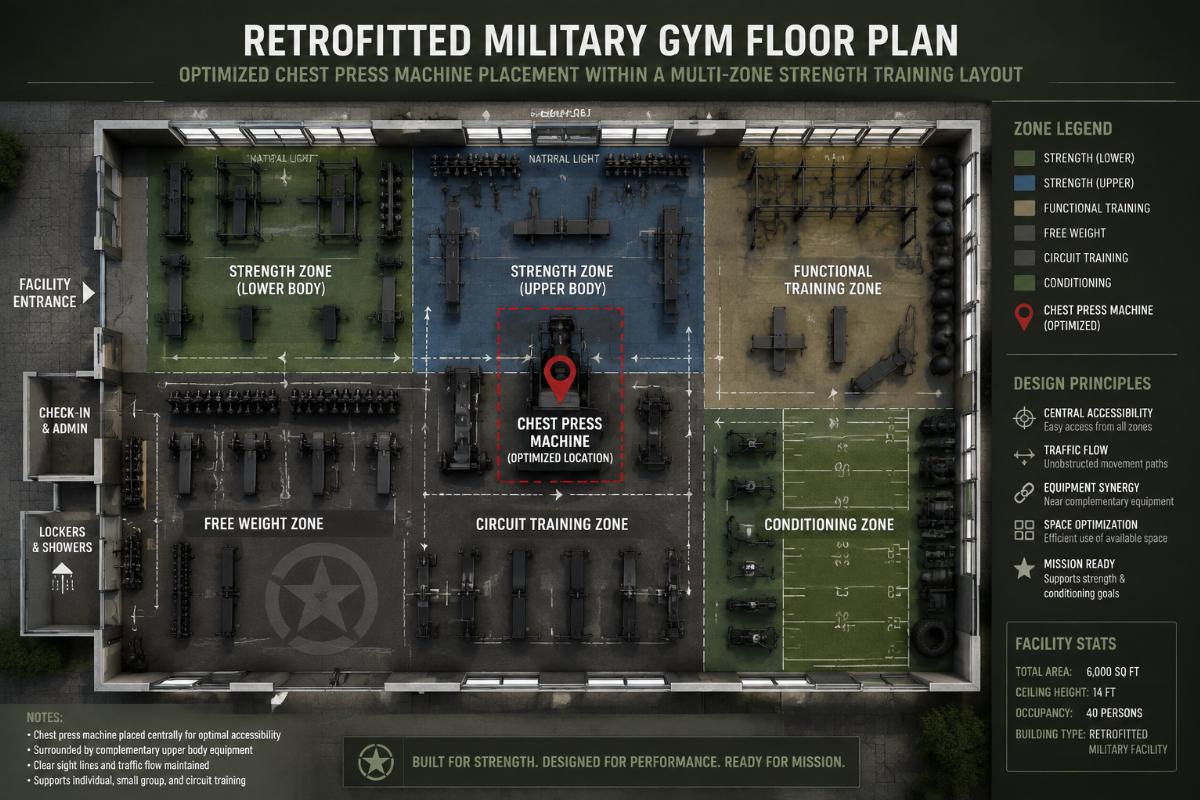
I have seen this play out in several Southeast Asian naval base dormitory gym conversions. The original facilities were small rooms with a handful of machines placed without clear traffic flow. When the base fitness program expanded to include structured strength circuits, the existing equipment could not handle the throughput. The retrofit had to address not just equipment replacement but fundamental space replanning—repositioning the chest press machine to create a logical push-pull training circuit, widening aisles for safe movement during peak hours, and reinforcing floor anchoring points for heavier plate-loaded units.
A less obvious driver is the procurement cycle itself. Defense budgets often allocate renovation funds in multi-year blocks, and facility managers know that delaying a retrofit means competing against newer priorities in the next funding window. This creates urgency to move from planning to container loading within compressed timelines, which in turn demands suppliers who can deliver complete gym packages with consistent lead times and documentation readiness [NEED_CITE: defense facility capital planning and budget execution timelines].
The convergence of these factors means that a military base strength facility retrofit is rarely a simple swap of old machines for new ones. It is a comprehensive reassessment of how the space serves its users under modern training protocols.
What Equipment Specs Matter Most for Base Gyms?
Heavy-duty frame construction, plate-loaded compatibility, and corrosion-resistant finishes are the three non-negotiable specifications for any strength machine destined for a military installation.
Commercial-grade equipment for defense facilities operates in a different category than standard gym equipment. The usage pattern is fundamentally different: multiple shifts of users, many of whom are performing high-intensity training under supervision, with minimal downtime for maintenance. A chest press machine in this environment may see continuous use across extended daily operating hours, far exceeding the load profile of a typical commercial fitness center.
| Specification Factor | Defense-Grade Requirement | Standard Commercial Grade | Light-Duty / Import Grade |
|---|---|---|---|
| Frame Steel Gauge | Heavy-wall structural tubing | Standard commercial tubing | Thin-wall tubing |
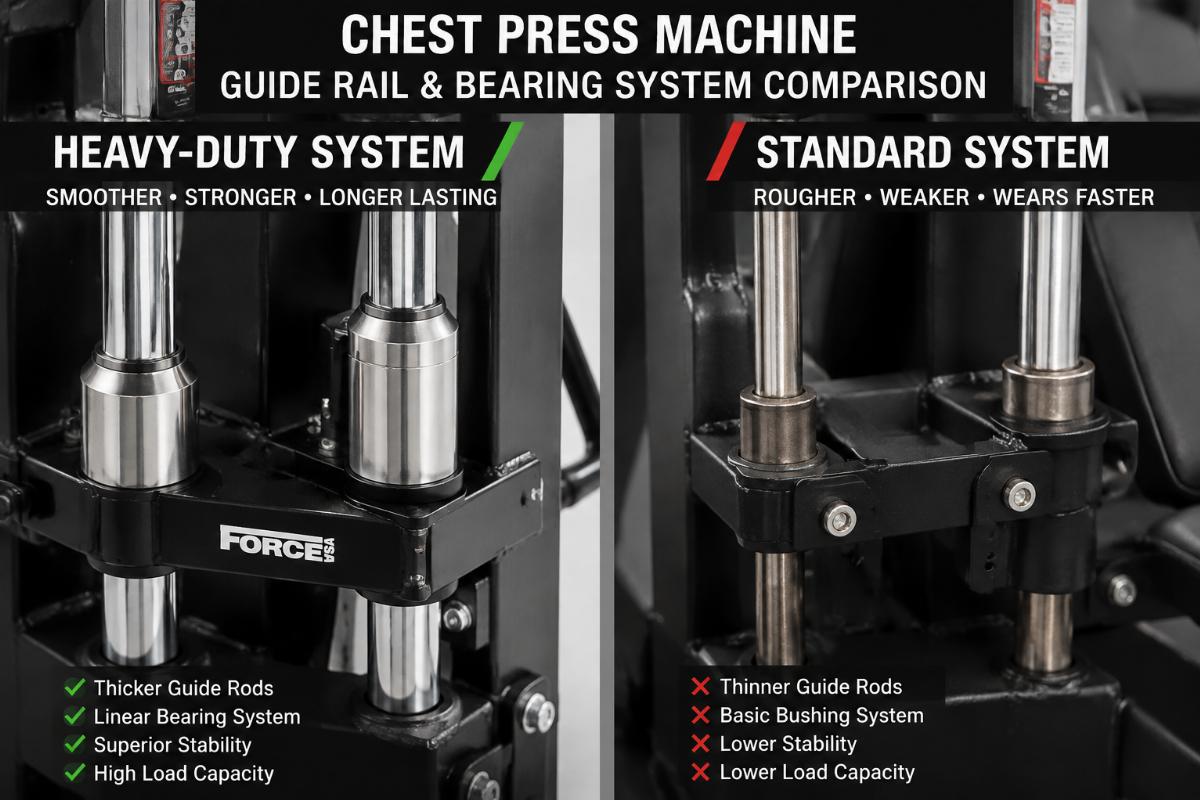
| Guide Rail System | Sealed bearing, corrosion-resistant | Standard linear bearing | Open rail, basic bushing |
| Surface Coating | Multi-stage industrial finish with salt-spray resistance | Standard powder coat | Single-stage paint or thin coating |
| Weight Stack / Plate Compatibility | Plate-loaded or high-capacity selectorized | Standard selectorized | Low-capacity stack |
| Adjustment Mechanism | Reinforced pin-and-plate with locking detent | Standard pop-pin | Basic friction adjust |
| Certification Documentation | Full CE test reports with traceable batch records | CE self-declaration | No verifiable documentation |
The coating specification deserves particular attention. In coastal or high-humidity installations, a standard powder coat will begin showing oxidation within a relatively short period. Industrial-grade finishes involving multi-stage pretreatment and thicker topcoat layers extend salt-spray endurance substantially, which directly translates to longer service intervals and lower lifecycle cost [NEED_CITE: industrial coating performance standards for steel structures in corrosive environments].
A Southeast Asian naval base retrofit I supported required us to provide detailed coating specification sheets before the procurement office would approve the shortlist. The base maintenance team had documented corrosion failures on previous equipment batches and was determined not to repeat the experience. The chest press machine units we supplied for that project went through an accelerated corrosion test protocol, and the resulting documentation became part of the permanent procurement file for future equipment orders.
Another specification point that catches buyers off guard is the adjustment mechanism. Military users vary widely in body dimensions, and seat and pad adjustments must withstand thousands of repositioning cycles without developing play or wobble. Reinforced adjustment systems with positive locking detents outperform basic friction-based designs in this regard, and the difference becomes apparent within the first year of heavy use.
How Does a Chest Press Machine Fit Into a Retrofit Plan?
A versatile commercial chest press machine can replace multiple single-angle press stations, reducing total equipment count while covering the full spectrum of upper-body pushing movements.
One of the most common misconceptions in base gym planning is that a chest press machine serves only one function. In reality, an adjustable commercial chest press unit can accommodate incline, decline, and neutral-grip pressing patterns, effectively consolidating what would otherwise require three separate machines into a single footprint. For a military base strength facility retrofit where floor space is often constrained by the existing building structure, this consolidation is a significant advantage.
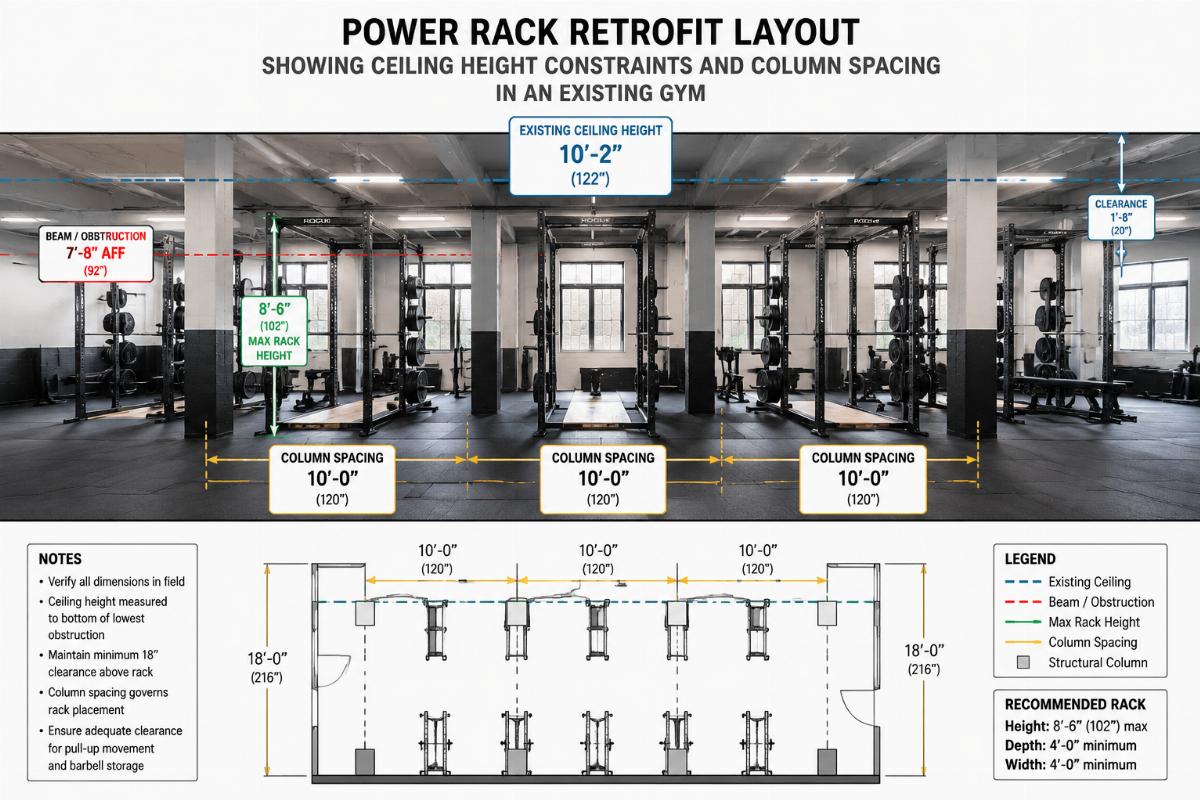
I worked through a space replanning exercise for a Middle East military base gym where the original free-weight zone occupied a rectangular room with fixed column positions. The initial layout called for separate incline press, flat bench, and dip stations. By substituting a multi-adjustable chest press machine as the primary pushing station, the redesigned layout reclaimed enough floor area to add a functional training zone with battle ropes and plyometric equipment—something the facility manager had wanted but thought was impossible within the existing walls [NEED_CITE: space planning methodologies for commercial strength facility layouts including equipment clearance and traffic flow calculations].
The key parameters in evaluating whether a chest press machine fits a retrofit plan include the machine’s overall footprint relative to the available zone, the range of seat and pad adjustments to accommodate diverse user anthropometry, and the ease of angle conversion between exercises. Machines that require tool-based adjustments for angle changes create friction in a high-throughput environment; quick-release lever systems are strongly preferred.
From a procurement perspective, the chest press machine also serves as a useful benchmark for evaluating supplier capability. If a supplier can demonstrate that their chest press unit meets heavy-duty frame specifications, offers smooth adjustment mechanisms, and carries full certification documentation, those same capabilities typically extend across their broader strength machine product line. This makes the chest press machine a practical evaluation vehicle during the supplier selection process.
What Should Procurement Teams Watch for in Supplier Selection?
Certification compliance verifiability, spare parts supply chain reliability, and container consolidation capability are the three supplier evaluation criteria that separate successful base gym retrofits from costly delays.
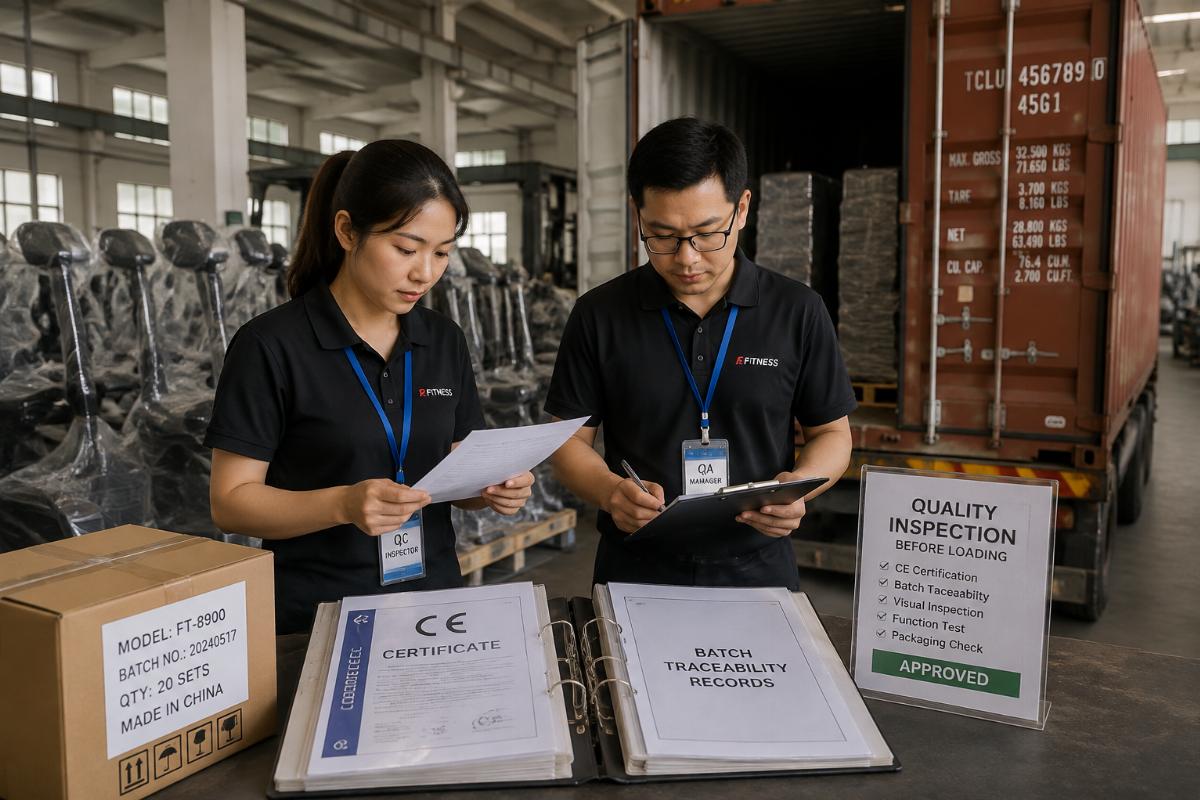
Certification documentation is the area where I have seen the most expensive mistakes. A shipment of commercial strength equipment I handled for a Middle East defense project was held at the port for nearly three weeks because the CE certification documents supplied by the original vendor had version mismatches with the actual product batch. The demurrage charges alone exceeded the profit margin on that entire order. Since that experience, I verify certification traceability at the factory stage—confirming that test reports correspond to the specific product models and batch configurations being shipped, not just generic category declarations [NEED_CITE: CE marking conformity assessment requirements for fitness equipment under applicable EU directives].
Spare parts availability is equally critical but often overlooked during initial procurement. A military base gym in a remote location cannot afford to have a chest press machine offline for weeks waiting for a replacement cable or a specific bushing. Suppliers who maintain documented spare parts inventories and can ship replacement components on short notice provide a measurable operational advantage. During supplier evaluation, asking for a spare parts catalog with lead time commitments is more informative than reviewing marketing brochures.
Container consolidation capability matters because military base retrofits typically involve mixed equipment orders—cardio machines, plate-loaded strength units, free weight sets, functional training accessories, and flooring—all destined for the same installation. A supplier who can consolidate a full container load with optimized packing plans reduces shipping costs and simplifies customs clearance at the destination port. I have seen projects where buyers sourced equipment from multiple vendors, resulting in partial containers, higher per-unit freight costs, and coordination headaches during delivery. A single-source supplier with proven container consolidation experience streamlines the entire logistics chain.
| Evaluation Criterion | What to Request from Supplier | Red Flag Indicator |
|---|---|---|
| Certification Compliance | Batch-specific CE test reports with traceable product model numbers | Generic category certificates not tied to specific SKUs |
| Spare Parts Availability | Detailed parts catalog with stated lead times for common wear items | No parts catalog or vague delivery commitments |
| Container Consolidation | Documented loading plans showing mixed-equipment container configurations | Inability to provide loading diagrams or unwillingness to consolidate |
| After-Sales Technical Support | Named technical contact with response time commitments | Only general email address with no response time guarantee |
Conclusion
Military base strength facility retrofits succeed when equipment durability, space optimization, and procurement rigor align behind a single supplier relationship.
A chest press machine is more than a single piece of equipment—it is a litmus test for whether a supplier understands the demands of defense-grade fitness environments. From coating specifications that resist corrosion in harsh climates, to adjustment mechanisms that endure thousands of cycles, to certification documentation that clears customs without delay, every detail of the product and the procurement process determines whether the renovated facility serves its users reliably for years to come.