PR-800 Power Rack Sub-Series Technical Data Sheet | Wholesale Supplier
The series name tells you almost nothing about load capacity. The PR-800 family contains multiple sub-series with meaningfully different upright wall thickness, column cross-sections, and beam load ratings — and the gap between the lightest and heaviest configurations is large enough to cause on-site failures if buyers only specify "PR-800" on the purchase order.
If you need a single answer before reading further: the PR-800 Power Rack technical data must be locked at the sub-series level, not the series level. Upright tube wall thickness, column profile dimensions, and beam connection architecture vary across sub-series, and these differences directly determine whether a rack safely handles heavy barbell work or only light accessory training. Any quotation that lists "PR-800" without specifying the exact sub-series, tube gauge, upright size, and beam type is incomplete by definition.
I still remember a container that sat in a Jakarta warehouse for weeks. A gym owner in Southeast Asia had ordered what his contract called "PR series power racks." When the crates were opened, the squat stations could not match the load expectations he had been promised — not because of a manufacturing defect, but because the quotation never separated the sub-series. The wall thickness was one to two gauge steps lighter than what his training volume required, and the beam structure was rated for noticeably lower dynamic loads. The cargo had to be re-inspected, reinforcement brackets had to be shipped separately, and the communication cost alone wiped out any margin on the deal. Since that job, I have made it a rule: every technical document I prepare puts the sub-series parameter differences on the very first page, so the buyer knows exactly which configuration is being priced. [NEED_CITE: root cause distribution of power rack field failures linked to specification ambiguity]

Let me walk you through the PR-800 Power Rack technical data the way it should be read — sub-series by sub-series, parameter by parameter — so your next order arrives on the floor ready to work.
Why Does the PR-800 Sub-Series Specification Matter More Than the Series Name?
Most buyers assume that one series name equals one load rating. In reality, the PR-800 Power Rack technical data is split across several sub-series, and the load capacity gap between the entry-level and top-tier sub-series can reach a range of 30–50% on dynamic lifts.
The reason is straightforward. Within the PR-800 family, the manufacturer uses different steel gauges for uprights, different column cross-sections, and different beam-to-upright connection methods depending on the intended use case. A light-duty sub-series designed for hotel apartments or boutique studios will carry a noticeably thinner wall and a smaller column profile than a sub-series built for a high-traffic commercial gym floor. [NEED_CITE: commercial strength equipment load classification per EN 957-1 and ASTM F2216]
I have seen this play out repeatedly. A distributor in the Middle East once asked us to private-label a full container of PR-800 units for a chain of fitness centers. The client’s purchase order only said "PR-800" — no sub-series, no wall thickness callout, no beam type. We had to go back through three rounds of confirmation just to separate the SKUs into the correct sub-series, because the end locations ranged from compact hotel gyms to full commercial floors. Each sub-series had its own upright dimension and welding specification, and mixing them on the same container without clear labeling would have caused chaos at the receiving end.
The practical takeaway is this: the series name is a family label, not a specification. The PR-800 Power Rack technical data only becomes actionable once you identify which sub-series your floor plan actually requires.

How Do Tube Thickness and Upright Dimensions Differ Across PR-800 Sub-Series?
The most visible structural difference between PR-800 sub-series is the upright column profile — both the outer cross-section dimension and the wall thickness change from one sub-series to the next, and these two parameters together determine the rack’s resistance to flex under heavy eccentric loads.
Here is how the sub-series typically separate on these dimensions:
| Parameter | Light-Duty Sub-Series | Mid-Range Sub-Series | Heavy-Duty Commercial Sub-Series |
|---|---|---|---|
| Upright cross-section profile | Smallest | Medium | Largest |
| Wall thickness | Lightest gauge | Standard commercial gauge | Heaviest gauge |
| Column height options | Fewer | Moderate | Full range |
| Intended environment | Boutique studio, hotel | CrossFit box, mid-scale gym | High-traffic commercial gym |
[NEED_CITE: steel tube gauge-to-wall-thickness conversion chart for structural hollow sections]
The cross-section difference alone is typically in the range of 15–20 mm between the smallest and largest uprights. That may sound minor on paper, but in practice it changes the moment of inertia of the column substantially, which is what resists bending when a loaded barbell is racked unevenly or dropped onto the J-hooks.
I worked with a hotel project in Vietnam that specified the compact sub-series for a small fitness room. The space was tight, and the procurement team wanted the smallest footprint possible. What they did not realize until we walked through the PR-800 Power Rack technical data together was that the compact sub-series also carried a lower safe working load range — a difference of several hundred kilograms compared to the mid-range sub-series. For their guest demographic, the compact unit was perfectly adequate. But if the same hotel had planned a staff training room with heavier barbell work, the compact sub-series would have been underspecified, and the safety margin would have been uncomfortably thin.
The lesson is not that the lightest sub-series is bad — it is that each sub-series has a clear load envelope, and the upright dimensions are the first indicator of where that envelope sits. [NEED_CITE: structural moment of inertia comparison for rectangular hollow sections used in fitness equipment]

What Beam Structure and Load Ratings Should Each Sub-Series Actually Support?
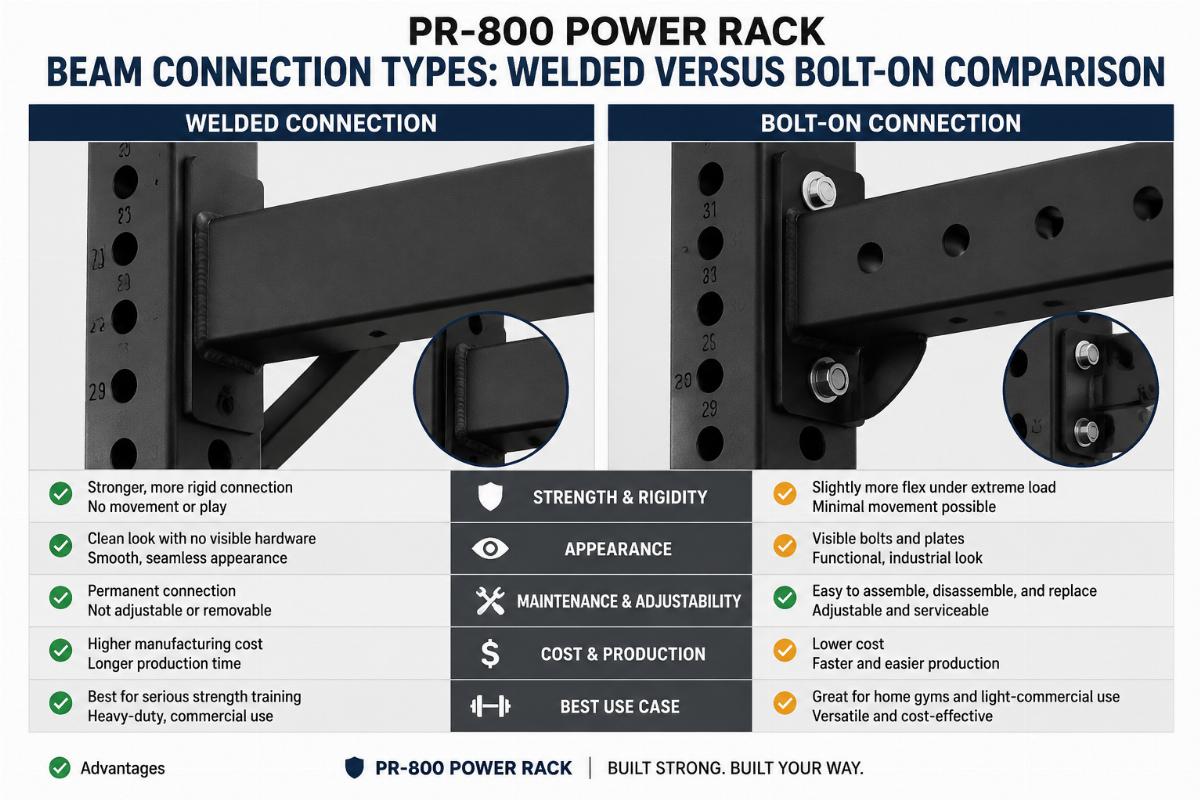
The beam — the horizontal member that holds J-hooks, safety straps, and accessory attachments — is where the PR-800 Power Rack technical data separates welding-based construction from bolt-on designs, and this choice directly affects dynamic load capacity.
There are two main beam types across the sub-series:
- Welded beam construction. The beam is permanently welded to a mounting plate that bolts to the upright. This design offers higher rigidity and is typically found on the heavier sub-series. It handles repeated dynamic loading — such as heavy rack pulls or missed squats — with less deflection over time.
- Bolt-on beam construction. The beam attaches to the upright with hardware, allowing reconfiguration of hole spacing or beam height. This design is common on mid-range and light-duty sub-series where floor layout flexibility matters more than maximum load.
[NEED_CITE: dynamic load testing methodology for power rack beam-to-upright connections per ASTM F355]
The load rating gap between these two beam types is significant. A welded beam sub-series can sustain dynamic loads that are substantially higher than a comparably sized bolt-on beam sub-series — the difference is not marginal, it is the kind of gap that matters when a lifter is working near their one-rep max.
A CrossFit gym owner in Latin America once ordered what he thought was a heavy-duty configuration. The quotation, however, referenced a bolt-on beam sub-series. When the racks arrived and his coaches started programming heavy eccentric drops onto the safety straps, the beam mounting hardware showed visible deformation within weeks. The root cause was not a defect — it was a specification mismatch. The bolt-on beam was rated for the intended use class, but the use class itself was wrong for that training environment.
When reviewing the PR-800 Power Rack technical data, always check three things about the beam:
- Connection type — welded or bolt-on.
- Hole spacing pattern — Westside hole spacing versus standard spacing affects attachment compatibility.
- Declared dynamic load rating — not just static load, but the rating under repeated impact conditions.
[NEED_CITE: Westside vs standard hole spacing compatibility chart for power rack attachments]
How Can Buyers Verify PR-800 Specs Before Placing an Order?
The single most effective step a buyer can take is to request the sub-series-specific technical data sheet before signing the purchase order — not the generic series brochure, but the document that names the exact upright dimension, wall thickness, beam type, and declared load rating for the SKU being quoted.
Here is a practical verification sequence I recommend, built from hard-earned experience:
- Request the sub-series technical data sheet. The document should list the upright outer dimension, wall thickness, available heights, beam type, and load rating for the exact SKU. If the supplier can only provide a general "PR-800 series" brochure, treat the quotation as incomplete. [NEED_CITE: required technical documentation checklist for commercial strength equipment procurement]
- Cross-check the load rating against your intended use. Light accessory work, moderate barbell training, and heavy competitive lifting each sit in different load envelopes. Match the sub-series to the heaviest planned movement, not the average.
- Ask for the third-party test report or in-house test summary. Reputable manufacturers test their racks against recognized standards and can provide documentation. The PR-800 Power Rack technical data should reference the test method used — static load, dynamic load, or impact load — because these are not interchangeable. [NEED_CITE: third-party load testing certification bodies for commercial fitness equipment]
- Confirm the coating specification. Powder coating thickness and corrosion resistance matter for long-term durability, especially in humid climates. The technical data should state the coating type and minimum thickness range.
- Verify before shipment. If possible, arrange a pre-shipment inspection that includes measuring upright wall thickness with a caliper or ultrasonic gauge and checking beam connection hardware against the spec sheet. A mid-six-figure gym fitout is not the place to discover a wall thickness discrepancy after the container has cleared customs.
I have seen buyers skip steps two and three to save time, only to spend far more time resolving disputes after delivery. The verification process is not bureaucratic — it is the cheapest insurance available on a strength equipment order.

What Are the Most Common Ordering Mistakes and How Can They Be Avoided?
The majority of PR-800 ordering problems trace back to the same root cause: the purchase order specifies the series name but not the sub-series configuration, leaving critical parameters undefined.
Here are the mistakes I see most often, and how to prevent each one:
- Writing "PR-800" or "PR series" on the contract without sub-series identification. This is the single most common error. The fix is simple: require the quotation to name the sub-series code, upright dimension, wall thickness, and beam type as separate line items.
- Assuming all sub-series share the same load rating. They do not. The PR-800 Power Rack technical data shows clear load capacity differences across sub-series. Always confirm the rated capacity for the specific sub-series being ordered.
- Selecting a sub-series based on footprint alone. A compact sub-series saves floor space but also reduces the load envelope. If the space allows, the mid-range sub-series often provides a better balance of footprint and capacity for mixed-use environments.
- Failing to separate sub-series on mixed-configuration containers. When a single container holds multiple sub-series for different end locations, each pallet or crate must be labeled with its sub-series code and configuration summary. Without this, the receiving team cannot distinguish them on arrival.
- Overlooking beam type compatibility with existing attachments. If the buyer already owns J-hooks, safety straps, or monolift arms from a previous rack system, the beam hole pattern and connection type must match. The PR-800 Power Rack technical data should confirm attachment compatibility before the order is placed.
A distributor in Africa once received a mixed container where three sub-series were loaded without clear separation. The warehouse team spent days sorting units by hand, measuring uprights, and matching them to the correct end-user sites. The cost of that sorting — in labor, delay, and reputational damage — far exceeded the ten minutes it would have taken to label each pallet correctly at the factory.

Conclusion
The PR-800 Power Rack technical data only becomes useful when it is read at the sub-series level. Upright wall thickness, column cross-section, and beam construction type vary meaningfully across sub-series, and these parameters — not the series name — determine whether a rack will perform safely in its intended environment. Lock the sub-series specification on the quotation, verify it against the intended training load, and confirm it before shipment. That discipline is what separates a smooth installation from an expensive lesson.