PR-800 Power Rack Sub-Series Wholesale Supplier & After-Sales Guide
Most buyers assume power racks within a series differ only in height or footprint. In reality, the sub-models are separated by tube wall thickness, welding methodology, and load-class engineering—differences that dictate which environment each variant can survive.
The PR-800 series is divided into light-commercial, standard-commercial, and heavy-commercial sub-models, each engineered for distinct usage intensity and user weight ranges. Selecting the correct sub-model before shipment—not negotiating price—is the single most effective way to control after-sales cost. A PR-800 power rack wholesale supplier who walks you through scenario-based selection, not just spec sheets, will save you from field failures that no spare-part shipment can quickly fix.
I still remember a commercial gym project in Lagos where three racks arrived on-site labeled as PR-800 units, yet the client had been quoted the light-commercial variant for a high-traffic squat zone. Within weeks, the safety arms showed visible deflection under repeated loading from users in the upper weight bracket. Local technicians had no replacement J-cups or safety straps on hand, and sourcing them internationally added weeks of downtime. The root cause was never material defect—it was a mismatch between the sub-model’s load class and the actual daily usage profile. [NEED_CITE: failure mode distribution in commercial strength equipment linked to specification mismatch] That incident reshaped how I approach every inquiry: scene first, spec second.

From that point forward, the conversation with every buyer begins with the same set of questions: What is the facility type? What is the expected daily usage duration? What is the typical user weight range? Only then does the correct PR-800 power rack wholesale supplier recommendation emerge.
What Sub-Models Exist Within the PR-800 Series, and How Do They Differ Structurally?
The PR-800 lineup is segmented into three load-class tiers, each defined by upright gauge, welding process, and attachment compatibility—not merely by outer dimensions.
Many importers request a "PR-800 quote" without realizing the series contains structurally distinct variants. The differences are not cosmetic. They determine whether a rack survives two years in a 24-hour commercial gym or begins showing weld fatigue in a hotel fitness corner within months.
| Structural Parameter | Light-Commercial Variant | Standard-Commercial Variant | Heavy-Commercial Variant |
|---|---|---|---|
| Upright Tube Wall Thickness | Thinner gauge, suited for controlled environments | Mid-range gauge for mixed-use facilities | Heaviest gauge for continuous high-load use |
| Welding Process | Standard MIG, adequate for moderate cycles | Enhanced MIG with reinforced joint zones | Full continuous weld with gusset reinforcement |
| Static Load Rating | Lower tier, aligned with ASTM light-use thresholds | Mid-tier, meeting standard commercial benchmarks | Highest tier, engineered for heavy dynamic loading |
| J-Cup & Safety Arm Compatibility | Basic attachment interface | Standard commercial interface with upgrade path | Heavy-duty interface with dual-pin safety systems |
| Typical Deployment Context | Boutique studios, hotel gyms, low-traffic zones | Mid-size commercial gyms, CrossFit boxes | High-traffic commercial gyms, institutional facilities |
[NEED_CITE: ASTM F3551 or equivalent commercial strength equipment load classification standards]
A distributor in Southeast Asia once placed a mixed-container order combining all three sub-models for resale across different client tiers. The mistake many make is assuming the attachment hardware is interchangeable across all three. It is not. The heavy-commercial variant uses a reinforced J-cup mounting pattern that does not align with the light-commercial upright hole spacing. Mixing spare parts across tiers creates a false sense of backup inventory.
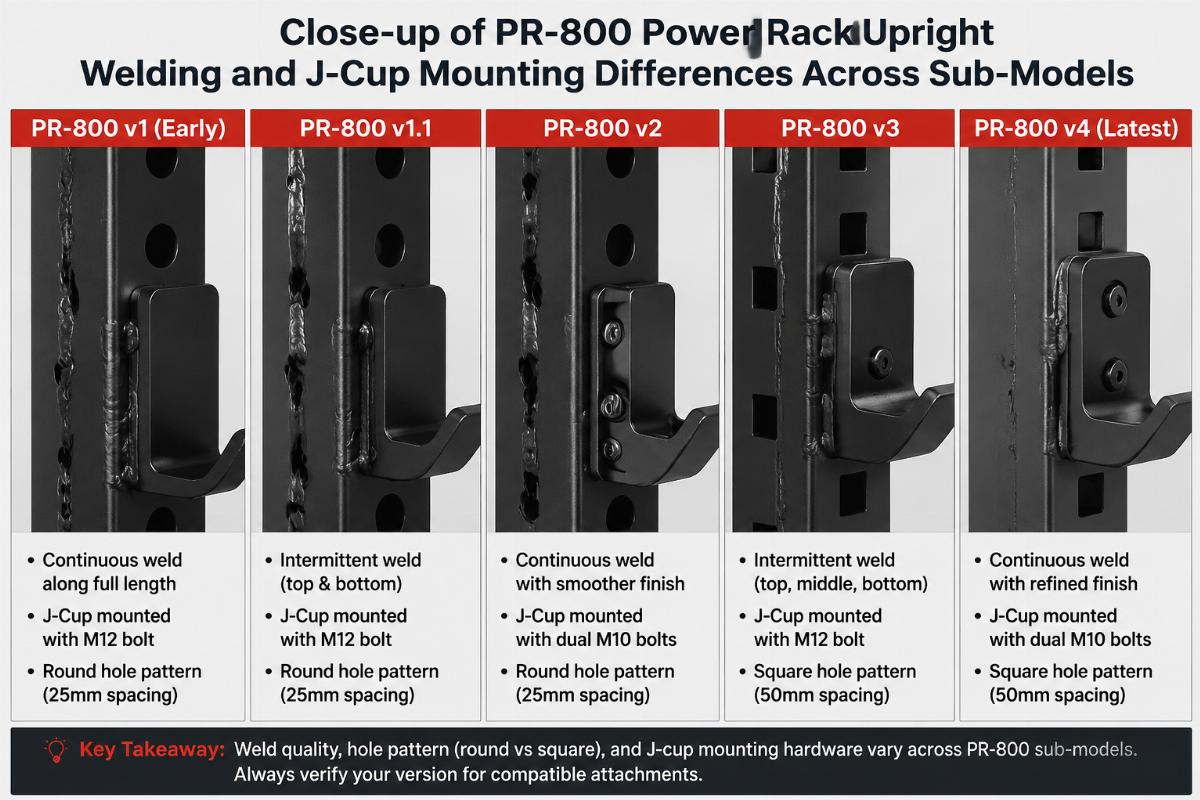
The takeaway: when sourcing from a PR-800 power rack wholesale supplier, request the structural parameter sheet for each sub-model, not just the exterior dimension drawing. The wall thickness and weld specification are what determine field longevity.
How Should Different Facility Types Match PR-800 Sub-Models?
Facility type alone does not determine the correct sub-model—daily usage hours combined with the user weight bracket does.
A common error is selecting the heavy-commercial variant for every scenario "just to be safe." This inflates unit cost, increases shipping weight per container, and can reduce the total unit count per shipment without adding measurable value in low-intensity environments.
Consider a hotel fitness center in the Middle East. The space is compact, usage peaks during morning and evening hours, and the typical guest profile falls within a moderate weight range. The standard-commercial PR-800 variant handles this load cycle comfortably. Upgrading to heavy-commercial here adds cost and weight to the shipment without extending service life in any meaningful way. [NEED_CITE: equipment utilization rate benchmarks in hospitality fitness environments]
Conversely, a commercial gym in West Africa operating extended hours with a user base that regularly exceeds typical weight thresholds demands the heavy-commercial variant. The light-commercial unit in this context will experience accelerated wear on safety arms, J-cup deformation, and potentially weld stress at the base plate junction.
| Facility Type | Recommended Sub-Model | Key Selection Rationale |
|---|---|---|
| Hotel / Resort Fitness Center | Light-Commercial or Standard-Commercial | Moderate daily hours, controlled user profile, space constraints favor compact footprint |
| Boutique Studio / PT Clinic | Light-Commercial | Lower daily cycle count, supervised usage, lighter average user load |
| Mid-Size Commercial Gym | Standard-Commercial | Balanced usage intensity, diverse user weight range, cost-efficiency priority |
| High-Traffic Commercial Gym / Institutional Facility | Heavy-Commercial | Extended operating hours, high user weight bracket, maximum durability requirement |
[NEED_CITE: commercial gym equipment duty cycle classification by facility type]
A buyer in East Africa once ordered the light-commercial variant for a facility that later transitioned into a 24-hour operational model. The safety arms began showing deflection within months. The replacement cost—including international shipping of structural components—far exceeded the initial price difference between sub-models. This is the hidden economics of under-specification.

When consulting with a PR-800 power rack wholesale supplier, provide the operational profile, not just the floor plan. The correct match prevents field failures that no warranty claim can fully compensate for.
How Do Warranty Terms and Spare Parts Supply Work Across the PR-800 Series?
The warranty structure is tiered: the frame and structural welds carry long-term coverage, while wearable attachments such as J-cups, safety straps, and cable accessories fall under shorter-term or consumable classifications.
This distinction matters enormously for importers who assume a single warranty blanket covers everything. It does not. A J-cup is a wear component. Its deformation under repeated barbell loading is a function of usage intensity, not a manufacturing defect. Classifying it as a warranty claim creates friction that could be avoided with proper spare parts planning at the ordering stage.
The recommended approach is to negotiate a spare parts package at the time of the initial container order. This typically includes a proportional quantity of J-cups, safety arm pads, spotter strap sets, and adjustment pin components relative to the number of racks purchased. The ratio depends on the facility type: high-traffic commercial gyms should carry a higher spare ratio than hotel installations. [NEED_CITE: spare parts provisioning ratios for commercial strength equipment by usage intensity]
| Component Category | Typical Warranty Classification | Spare Parts Recommendation |
|---|---|---|
| Frame & Structural Welds | Long-term coverage | Minimal spare need; structural failure is rare when sub-model is correctly matched |
| J-Cups & Attachment Interfaces | Short-term or consumable | Include proportional spares in initial order |
| Safety Arms & Spotter Straps | Short-term or consumable | Higher spare ratio for high-traffic environments |
| Cable & Pulley Accessories | Short-term or consumable | Stock based on attachment configuration |
| Adjustment Pins & Locking Mechanisms | Consumable | Small bulk quantity recommended |
A distributor in the MENA region learned this after a second container arrived without any spare J-cups. When the first set of racks showed cup wear within a year, they faced the choice of air-shipping small batches at high freight cost or waiting for the next sea shipment while customers complained. The lesson: spare parts planning is not optional—it is part of the procurement specification.

Working with a PR-800 power rack wholesale supplier who includes spare parts consultation in the quotation process—rather than treating it as an afterthought—reduces long-term operational disruption significantly.
What After-Sales Failures Result from Sub-Model Mismatch?
Nearly every structural after-sales complaint traceable to the PR-800 series originates from a specification-to-scenario mismatch, not from material or welding defects.
This is the counterintuitive reality. Buyers often receive a deformed safety arm or a cracked weld and assume product quality failure. In the majority of investigated cases, the root cause is that a light-commercial unit was deployed in a heavy-use environment, or a standard-commercial unit was subjected to user loads beyond its design bracket.
The failure patterns are consistent:
- Safety arm deflection: Occurs when the load class of the safety arm does not match the dynamic forces generated by users in the upper weight range performing failed lifts. The arm was not defective—it was under-specified for the application.
- J-cup deformation and hole elongation: Repeated barbell contact in a high-cycle environment wears the cup contact surface faster than the material was engineered to withstand in that specific duty class.
- Weld stress at base plate or gusset junctions: Visible in units where the light-commercial variant—designed for controlled, lower-cycle environments—faces continuous loading beyond its structural threshold. [NEED_CITE: weld fatigue failure analysis in light-duty vs heavy-duty gym equipment frames]
A gym owner in West Africa reported weld cracking at the upright-to-base junction on units that had been in service for a relatively short period. Investigation revealed the facility had transitioned from a supervised studio model to an open-access commercial model, tripling the daily cycle count. The light-commercial weld specification was never designed for that intensity.

The corrective action is never simply "replace the part." It is to re-evaluate whether the sub-model deployed matches the current operational reality. If it does not, no quantity of spare parts will prevent recurring failures. The PR-800 power rack wholesale supplier conversation must include scenario re-assessment, not just component reordering.
Conclusion
Selecting the correct PR-800 sub-model based on facility type, daily usage intensity, and user weight bracket is the most cost-effective form of after-sales risk management. Structural differences between sub-models are not marketing variations—they are engineering boundaries. Warranty coverage and spare parts planning should be negotiated at the ordering stage, not after the first field failure. A PR-800 power rack wholesale supplier who prioritizes scenario-based specification over unit price optimization will deliver lower total cost of ownership across the equipment lifecycle.