01 / Scenario
STUDIO
P
High-End Pilates Studios
Premium aesthetics meet quiet operation for boutique studio environments.

ISO
9001
CE
Certified
OEM
Available
10YR
Warranty
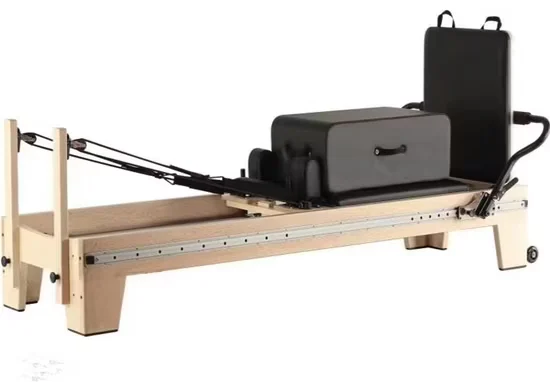
Aluminium Pilates Reformer, 2570×730×1100mm, 110kg Net Weight — aircraft-grade aluminium extrusion rail resists deflection under dynamic carriage loads, sealed bearing system maintains consistent glide through high-traffic studio cycles, integrated hard-points for long box, jump board, and platform attachment. Each unit undergoes carriage load testing before shipment with spring tension calibration documentation provided.
// Spec Highlights
• Direct from Manufacturer · No Middlemen · Worldwide Shipping
01
// Material
Imported Solid Wood
Premium hardwood frames sourced for density and visual warmth.
02
// Hardware
Medical-Grade Silent
Whisper-quiet pulleys and springs for clinical environments.
03
// Customization
Appearance OEM
Color, upholstery, and branding tailored to your studio.
04
// Service
Layout Design
Free venue planning for studios and rehab institutions.
Every component is selected for longevity, performance, and aesthetic harmony - from imported hardwood frames to silent medical-grade accessories.
// Features
Rigid Aluminium Extrusion — Aircraft-grade aluminium carriage rail resists deflection under repeated studio loads and dynamic jump board use.
| Parameter | Value |
|---|---|
| Product Type | Pilates Reformer |
| Model NO. | SRY-27 |
| Frame Material | Aluminium extrusion |
| Color | Black |
| Accessory | Long Box / Jump Board / Platform |
| Product Dimensions | 2570 × 730 × 1100 mm |
| Net Weight | 110 kgs |
| Warranty Time | 3 Years |
| Logo | Customized is allowed |
| Age | Adult |
| Gender | Unisex |
| Transport Package | Standard wood case |
| Facility Type | Typical Use |
|---|---|
| Commercial Pilates studio | Group reformer classes with continuous daily scheduling |
| Rehabilitation and conditioning center | Guided therapeutic movement and post-injury strength recovery |
| Boutique fitness and hotel wellness facility | Premium member experience with full accessory integration |
| Private training studio | One-on-one sessions using long box, jump board, and platform attachments |
Aluminium extrusion rails maintain alignment where thin-wall steel rails gradually warp under carriage loading.
Many studio owners have experienced the frustration of carriages that start binding within the first year. The root cause often traces back to rail material selection. Thin-wall steel rails, while initially straight, develop micro-deflections under the repeated lateral and vertical forces of daily reformer classes. Once the rail geometry shifts, the carriage wheels no longer track true, creating uneven wear on bearings and a noticeable drag that instructors and clients feel immediately. [NEED_CITE: material deflection standards for fitness equipment rails]
Aluminium extrusion offers a fundamentally different structural profile. The extrusion process produces a consistent cross-section with uniform wall thickness, meaning the rail resists bending along its entire length rather than flexing at stress concentration points. For a commercial aluminium pilates reformer operating across eight or more class sessions daily, this dimensional stability translates directly into fewer maintenance interventions and a consistently smooth carriage glide that holds up over years of studio scheduling.
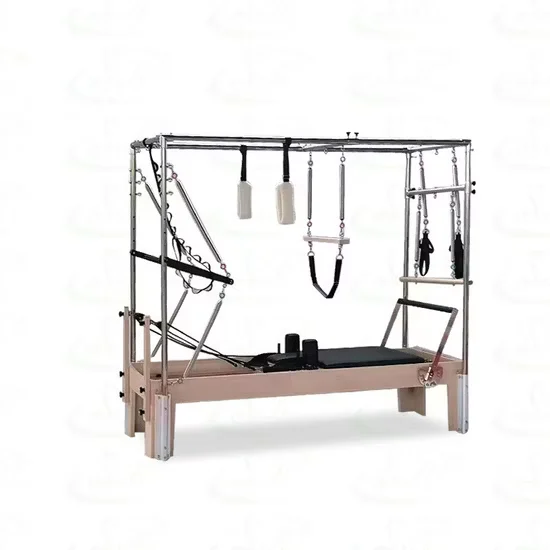
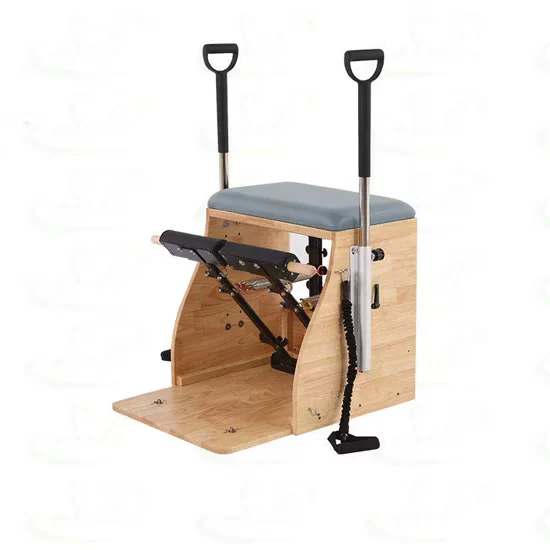
The reformer anchors the movement studio floor, serving as the primary apparatus for both group classes and private sessions. It covers the full spectrum of supine, prone, seated, and standing movement patterns, engaging the core stabilizers, hip complex, and spinal articulators through spring-loaded resistance. In a studio layout, it pairs with the cadillac for advanced decompression work and the chair for upright functional loading. This unit accommodates a wide range of practitioner body sizes through its full-length carriage travel and integrated accessory mounting points. Facilities running high-frequency group programming benefit from the commercial aluminium pilates reformer format because the standardized accessory set — long box, jump board, and platform — eliminates the need to source compatible add-ons separately.
Reformer loading is deceptively complex. The carriage experiences both static loads during held positions and sharp impact forces during jump board sequences, where the carriage reverses direction rapidly at the end of spring travel. Each reversal concentrates stress at the carriage end stops and the rail mounting points. [NEED_CITE: cyclic loading effects on aluminium extrusion joints] The sealed bearing carriage system absorbs these reversals without developing the lateral play that bushing-type systems exhibit after several months of heavy use. Spring tensioning components undergo thousands of stretch-release cycles per week in a busy studio, making spring fatigue and anchor point integrity critical inspection items. The aluminium frame itself resists the torsional forces generated during unilateral movements, where the practitioner loads one side of the carriage more heavily than the other. Surface coatings on the rail and frame must withstand constant contact with sweat, cleaning solutions, and the abrasion of carriage wheels over thousands of class hours.
The aluminium extrusion profile used in the SRY-27 rail is not simply a tube — its cross-section includes internal ribbing that increases the moment of inertia, meaning the rail resists bending far better than a hollow tube of equivalent weight. This is the same engineering principle used in aircraft structural members where weight savings cannot come at the cost of rigidity. The sealed bearing carriage system encloses the rolling elements behind protective seals, preventing studio dust, chalk residue, and cleaning fluid from entering the bearing race. Bushing-type carriages, by contrast, rely on a sleeve that wears against the rail surface directly, creating a maintenance cycle that shortens as particulate contamination increases. The industrial spring tensioning system uses calibrated steel springs rather than elastic cords, providing a linear resistance curve that does not drift as the spring accumulates cycles. Integrated accessory hard-points on the frame use reinforced mounting bosses designed for repeated attachment and detachment of the long box, jump board, and platform without stripping threads or loosening over time. [NEED_CITE: spring fatigue characteristics in commercial resistance equipment]
Studios that purchase reformers based on appearance alone often discover structural compromises only after the warranty period expires. Thin-wall rails that look identical in the showroom develop measurable deflection under loaded carriage travel, causing the carriage to drag and the bearings to wear asymmetrically. Non-sealed bearings require cleaning and re-lubrication on a cycle that busy studios rarely maintain, leading to noisy operation and eventual bearing seizure. Low-grade elastic cords lose tension unpredictably, creating inconsistent resistance that instructors must compensate for by adjusting class choreography. When accessory mounting points are not structurally reinforced, the jump board — which generates the highest impact forces on the frame — can loosen its attachment and create a safety concern during plyometric sequences. Powder coating applied without adequate surface preparation chips at contact points, exposing bare aluminium to oxidation and degrading the visual standard of the studio floor. [NEED_CITE: maintenance cost comparison between sealed and unsealed bearing systems]
Every SRY-27 unit undergoes carriage load testing before shipment, verifying that the rail and bearing system perform under stress rather than relying on sample-based quality checks. The aluminium extrusion stock is sourced with mill certification, providing traceability from raw material to finished frame. Robotic welding ensures continuous weld lines at structural joints, eliminating the weak points that spot welding introduces under cyclic loading. The 200μm industrial powder coating is applied over sandblasted surfaces for adhesion that withstands daily cleaning protocols without chipping at high-contact areas. [NEED_CITE: powder coating thickness and adhesion standards for commercial fitness equipment] The three-year warranty reflects confidence in the structural specification rather than a marketing concession. For studio operators planning floor layouts, the 2570 × 730 mm footprint allows precise spacing calculations that maintain safe clearance between adjacent reformers during group class choreography, and BICKFIT provides 2D-3D CAD planning support to optimize the room configuration. OEM customization including logo application is available for studios building a branded equipment identity.
Provide your studio floor dimensions and intended class capacity to receive a 2D-3D layout plan showing reformer spacing with safe clearance for group choreography. Specify your daily class schedule volume so the structural grade can be confirmed against your actual usage intensity. Indicate any branding requirements including custom logo application or color preferences to align the equipment with your studio identity. Share your practitioner demographic to confirm the accessory set and carriage travel accommodate your client body size range.
Q: How do I distinguish a commercial-grade Pilates reformer from a light-commercial one?
A: Commercial-grade reformers use extruded aluminium or heavy-gauge steel rails with sealed bearing carriages designed for continuous daily scheduling. Light-commercial units often rely on thin-wall tubing and bushing-type carriages that develop play under frequent use. Check whether the manufacturer provides per-unit load testing records and mill material certification, as these documents indicate structural verification beyond visual inspection. The warranty period and its specific coverage terms also reveal how the manufacturer rates the equipment for studio-intensity operation.
Q: What are the trade-offs between aluminium and steel reformer frames?
A: Aluminium extrusion frames offer high rigidity relative to their weight, making the reformer easier to reposition during studio layout changes while maintaining rail alignment under load. Steel frames can be equally durable if the wall thickness is adequate, but thin-wall steel rails are prone to gradual deflection. Aluminium also resists corrosion from sweat and cleaning chemicals without relying solely on surface coating. The deciding factor is whether the aluminium profile uses internal ribbing to achieve structural depth, not simply the material label alone.
Q: How does a sealed bearing carriage compare to a bushing system over time?
A: Sealed bearings enclose the rolling elements behind protective seals, preventing studio dust and cleaning residue from entering the race and degrading smooth travel. Bushing systems slide directly against the rail surface and wear progressively, requiring periodic cleaning, lubrication, and eventual replacement. In a high-traffic studio running multiple classes daily, sealed bearings maintain consistent glide performance with significantly less maintenance intervention, reducing both labor cost and equipment downtime across the reformer fleet.
Q: What should I verify about accessory compatibility and mounting integrity?
A: Confirm that the long box, jump board, and platform attach to structurally reinforced mounting points rather than simple bolt-through connections into thin frame walls. The jump board generates the highest impact forces during plyometric sequences, so its attachment must resist loosening over repeated use. Check whether replacement accessories and mounting hardware are available from the manufacturer as spare parts, ensuring that a damaged component does not render the entire reformer unavailable for studio scheduling.
Q: How often should springs be replaced in a high-traffic studio environment?
A: Spring replacement intervals depend on total stretch cycles rather than calendar time alone. In studios running group classes throughout the day, springs accumulate cycles rapidly and may lose calibrated tension before visible signs of fatigue appear. Establish a documented inspection schedule where spring resistance is measured against the manufacturer’s calibration specification. Keep replacement springs in stock so that any unit showing tension drift can be serviced immediately without removing the reformer from the class schedule for extended periods.
Premium aesthetics meet quiet operation for boutique studio environments.
Medical-grade silence and precision for sports & postpartum recovery.
Furniture-grade craftsmanship for premium residential installations.
Compact premium setups for one-on-one and small-group training.
Aesthetic Pilates integration for hybrid wellness studio programming.
Multi-unit deployment with instructor-grade reliability for certification programs.
Tell us about your project. Our team will respond within 24 hours with pricing, customization options, and shipping details.
// Sales Director
William
+86 132 2531 1800
// Export Manager
Bella
+86 198 5412 8032
william@bickfit.com