01 / Scenario
STUDIO
P
High-End Pilates Studios
Premium aesthetics meet quiet operation for boutique studio environments.

ISO
9001
CE
Certified
OEM
Available
10YR
Warranty
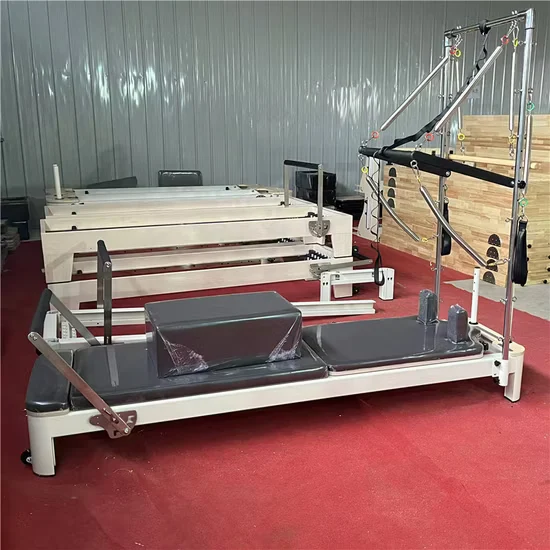
Pilates Reformer with Tower, Aluminium Alloy Frame, 2390×900×1960mm — full aluminium construction eliminates corrosion risk in humid studio environments while maintaining structural rigidity across reformer and Cadillac-style movements. Integrated tower shares load paths with the carriage rail for consistent stability during trapeze work. Supplied with long box, jump board, and platform for versatile programming. 120kg net weight supports commercial reconfiguration needs. Every unit undergoes 32-point inspection with full load testing before shipment.
// Spec Highlights
• Direct from Manufacturer · No Middlemen · Worldwide Shipping
01
// Material
Imported Solid Wood
Premium hardwood frames sourced for density and visual warmth.
02
// Hardware
Medical-Grade Silent
Whisper-quiet pulleys and springs for clinical environments.
03
// Customization
Appearance OEM
Color, upholstery, and branding tailored to your studio.
04
// Service
Layout Design
Free venue planning for studios and rehab institutions.
Every component is selected for longevity, performance, and aesthetic harmony - from imported hardwood frames to silent medical-grade accessories.
// Features
Aluminium Alloy Frame Integrity — Full aluminium alloy construction with continuous welds at tower junctions eliminates the corrosion and fatigue cracking common in mixed-metal studio reformers.
| Parameter | Value |
|---|---|
| Product Type | Pilates Reformer with Tower |
| Frame Material | Aluminium Alloy |
| Frame Color | Black (custom colors available) |
| Product Dimensions | 2390 × 900 × 1960 mm |
| Net Weight | 120 kg |
| Included Accessories | Long Box, Jump Board, Platform |
| Customization | Logo and color customization available |
| User Profile | Adult, Unisex |
| Warranty | 3 Years |
| Facility Type | Typical Use |
|---|---|
| Commercial Pilates Studio | Group reformer classes with tower-based Cadillac sequences |
| Boutique Fitness Studio | Semi-private and one-on-one reformer sessions combining mat and apparatus work |
| Hotel and Resort Wellness Center | Guest-accessible reformer stations for conditioning and flexibility work |
| Rehabilitation and Physical Therapy Clinic | Controlled resistance exercises for joint recovery and postural correction |
The frame must handle cyclic spring tension without developing play at the tower base.
Many studio-grade reformers use a steel bed frame bolted to an aluminium tower upright. The dissimilar metals expand at different rates under temperature swings and humidity, and the bolted junction becomes the first point of failure — operators notice rattle in the push-through bar and drift in the trapeze swing path before the first year of heavy rotation ends. A commercial aluminium pilates reformer with tower built entirely from aluminium alloy avoids the galvanic mismatch and keeps the load path uniform from carriage rail to tower crossbar. [NEED_CITE: EN 957 structural requirements for stationary training equipment]
This reformer covers the full spectrum of classical and contemporary Pilates repertoire — supine and prone carriage work, seated tower exercises with the push-through bar and roll-down bar, and overhead trapeze sequences for spinal decompression and shoulder mobility. In a studio layout, it pairs with dedicated Cadillac tables for advanced hanging work and mat stations for warm-up flows, forming a three-zone training circuit. The 2390 mm length and 900 mm width allow placement with standard studio spacing between units. The unisex frame and carriage load rating accommodate users across a broad range of body sizes, making it suitable for commercial environments where client demographics vary daily.
A reformer in a busy studio endures hundreds of spring-loaded carriage cycles per day, each generating lateral force at the rail-to-wheel contact point and vertical impulse through the tower uprights during trapeze hangs. The aluminium frame must absorb this cyclic loading without developing micro-cracks at the tower-to-bed junction — a zone where spot-welded connections fatigue rapidly. The carriage rail also faces continuous abrasion from wheel travel, and any rail surface irregularity accelerates wheel wear and degrades glide smoothness over months of use. Sweat and cleaning solvents further challenge the frame finish, making coating adhesion critical for long-term corrosion resistance in humid studio environments. [NEED_CITE: fatigue performance in cyclically loaded aluminium structures]
The aluminium alloy frame provides inherent corrosion resistance — a meaningful advantage over steel in studios where humidity from group classes and frequent mopping creates a moisture-rich environment. The 2390 × 900 mm footprint accommodates full-range carriage travel while fitting within standard studio bay widths. The integrated tower rises to 1960 mm, providing sufficient overhead clearance for trapeze and roll-down bar exercises without requiring ceiling modifications in typical commercial spaces. The 120 kg net weight reflects a frame substantial enough to resist tipping during aggressive trapeze work yet manageable for repositioning when the studio floor plan needs reconfiguration. The three-year warranty signals the manufacturer’s confidence in the structural assembly under commercial duty cycles.
A reformer built with thin-wall aluminium tubing may look identical in photographs but flexes noticeably under trapeze loading, causing the tower uprights to sway during overhead exercises and forcing instructors to restrict client movement range. Spot-welded joints at the tower base crack under repeated spring tension cycles, and repair requires pulling the unit off the floor for re-welding — lost class revenue compounds the welding cost. Non-sealed wheel bearings on the carriage accumulate dust and sweat residue, developing grinding noise and rough travel within months, demanding frequent bearing replacement. Low-density upholstery on the carriage and long box compresses and splits under daily client use, requiring reupholstering far sooner than expected. [NEED_CITE: maintenance cost comparison between sealed and unsealed bearings in fitness equipment]
Our 11-gauge steel fabrication discipline carries directly into how we engineer aluminium reformer frames — every tower-to-bed junction uses continuous welds rather than spot welds, ensuring the uprights resist torsional flex during trapeze sequences. Each unit undergoes load testing before crating, not sample-based batch testing, so the carriage rail alignment and tower rigidity are verified individually. The 200 μm powder coating process, developed for steel strength equipment, provides a scratch-resistant finish on the aluminium frame that withstands daily cleaning chemicals and client contact wear. Our floor planning team supplies 2D-3D CAD layouts that account for the 2390 × 900 mm footprint plus safe clearance zones for trapeze swing arcs, preventing the cramped layouts that force instructors to modify exercises. Logo and color customization integrate the reformer into your studio brand identity without compromising structural specifications.
Provide your studio floor dimensions and intended reformer count to receive a 2D-3D layout that accounts for safe trapeze clearance and instructor circulation paths. Specify expected daily class volume so we can confirm the frame and carriage specifications match your traffic density. Share your studio branding palette if custom frame colors or logo placement are part of your design plan. Indicate whether the reformer will serve group classes, semi-private sessions, or rehabilitation work so we can advise on accessory configuration.
Q: How do I tell a commercial-grade reformer from a light-commercial one by looking at the frame?
A: Inspect the tower-to-bed connection — commercial units use continuous welds or heavy through-bolts at the upright base, while light-commercial reformers often rely on spot welds or thin brackets. Check the carriage rail profile for thickness and surface finish; commercial rails are machined flat for consistent wheel tracking. Frame weight is also a reliable indicator — a 120 kg unit signals substantially more material than a sub-80 kg reformer marketed for the same studio environment.
Q: What are the practical differences between aluminium and steel reformer frames?
A: Aluminium frames resist corrosion inherently, making them better suited for humid studios and coastal locations where steel frames rust at joints and contact points. Steel frames are heavier and may feel more solid underfoot, but they require thorough powder coating to survive moisture exposure. Aluminium also weighs less per unit, simplifying floor reconfiguration. The trade-off is that aluminium requires proper alloy selection and welding technique to match steel’s fatigue resistance at structural junctions.
Q: What should I inspect on the carriage rail and wheels to predict long-term glide performance?
A: Run your finger along the rail surface — it should feel uniformly smooth with no ridges or pitting. Check whether the wheels use sealed bearings; open bearings attract dust and sweat residue that degrades smoothness rapidly. Roll the carriage back and forth by hand and listen for grinding or catching, which indicates rail irregularity or bearing wear. Ask the supplier for the wheel material specification, as harder wheel compounds last longer but require precisely machined rails.
Q: How often do springs need replacing on a commercial reformer?
A: Spring life depends on usage volume and how often clients stretch them to full extension. In a busy studio running six or more classes daily, springs typically show measurable tension loss within twelve to eighteen months. Inspect springs quarterly for visible stretching or deformation at the attachment hooks. Choose a reformer whose springs are user-replaceable without specialized tools, and confirm the supplier stocks compatible replacements so you are not locked into long lead times when maintenance is due.
Premium aesthetics meet quiet operation for boutique studio environments.
Medical-grade silence and precision for sports & postpartum recovery.
Furniture-grade craftsmanship for premium residential installations.
Compact premium setups for one-on-one and small-group training.
Aesthetic Pilates integration for hybrid wellness studio programming.
Multi-unit deployment with instructor-grade reliability for certification programs.
Tell us about your project. Our team will respond within 24 hours with pricing, customization options, and shipping details.
// Sales Director
William
+86 132 2531 1800
// Export Manager
Bella
+86 198 5412 8032
william@bickfit.com