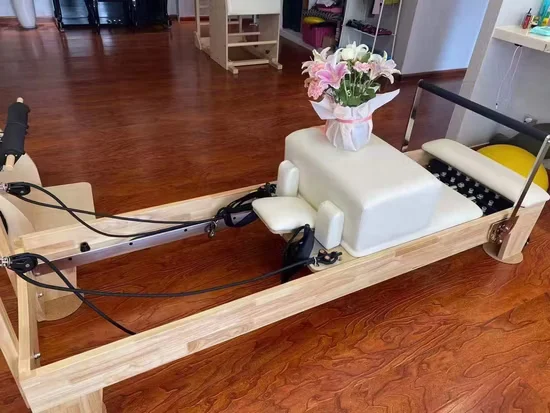
01 / Scenario
STUDIO
P
High-End Pilates Studios
Premium aesthetics meet quiet operation for boutique studio environments.

ISO
9001
CE
Certified
OEM
Available
10YR
Warranty
Commercial Aluminum Pilates Reformer Machine, 2400×600×380mm, 90kg Net Weight — engineered with aluminum alloy frame for high-traffic studio environments, featuring sealed carriage pulley system and complete accessory kit including long box, jump board, and platform. Available with 3-year warranty and custom logo options. Direct from manufacturer with 17 years of commercial equipment production, every unit undergoes load testing before shipment.
// Spec Highlights
• Direct from Manufacturer · No Middlemen · Worldwide Shipping
01
// Material
Imported Solid Wood
Premium hardwood frames sourced for density and visual warmth.
02
// Hardware
Medical-Grade Silent
Whisper-quiet pulleys and springs for clinical environments.
03
// Customization
Appearance OEM
Color, upholstery, and branding tailored to your studio.
04
// Service
Layout Design
Free venue planning for studios and rehab institutions.
Every component is selected for longevity, performance, and aesthetic harmony - from imported hardwood frames to silent medical-grade accessories.
// Features
Structural Precision Machined — Every aluminum extrusion joint on this commercial aluminum pilates reformer machine is CNC-machined for flush mating surfaces, eliminating the wobble that plagues bolted-together studio equipment after six months of daily carriage travel.
| Parameter | Value |
|---|---|
| Product Type | Pilates Reformer Machine |
| Frame Material | Aluminium Alloy |
| Specification | 2400 × 600 × 380 mm |
| Net Weight | 90 kg |
| Color Options | Black (custom colors available) |
| Included Accessories | Long Box, Jump Board, Platform |
| Customization | Available upon request |
| Logo Application | Customized logo allowed |
| Warranty | 3 Years |
| Facility Type | Typical Use |
|---|---|
| Commercial Pilates Studio | Group reformer classes with high daily turnover |
| Boutique Fitness Studio | Semi-private sessions blending reformer with mat work |
| Hotel Fitness Center | Guest-accessible Pilates zone with minimal supervision |
| Rehabilitation Center | Controlled resistance work for post-injury clients |
| Home Studio | Professional-grade equipment for dedicated practitioners |
When studio owners spec a commercial aluminum pilates reformer machine, the conversation almost always circles back to carriage smoothness and spring feel. But the real failure point in high-traffic environments is the frame-to-rail interface. Aluminum alloy extrusions, when properly machined, maintain rail alignment under thousands of carriage cycles. Steel frames in humid studio environments develop surface corrosion on guide rails, introducing drag that no amount of lubrication can permanently fix.
The issue we see repeatedly is studios purchasing equipment labeled "commercial" without requesting material certifications or alloy designation. Without that documentation, there is no way to verify fatigue performance over the equipment’s expected service life [NEED_CITE: material fatigue standards for repetitive-load fitness equipment]. A reformer used in a studio running eight group classes daily accumulates carriage cycles far beyond what residential-grade frames can sustain before rail play develops.
The frame either stays true or the entire movement quality degrades — there is no middle ground in daily commercial use.
This reformer addresses the full sagittal and frontal plane movement catalog that defines contemporary Pilates programming. The 2400 mm rail length accommodates supine, prone, seated, and standing work across a wide range of practitioner heights. In a studio layout, these units pair with Cadillac/Tower units and Wunda chairs to create a complete apparatus zone. For facilities running group reformer classes, the 600 mm width maintains adequate lateral clearance between adjacent units while preserving instructor walk-through space. The commercial aluminum pilates reformer machine serves practitioners from rehabilitation-stage clients through advanced-level work without requiring equipment swaps.
The dominant stress pattern on a reformer is not peak load — it is cycle count. A busy studio reformer endures thousands of carriage transitions daily, each generating micro-impact at the carriage stop and rail endpoints. The aluminum alloy frame handles these repetitive loads through its extrusion profile geometry rather than raw material thickness [NEED_CITE: cyclic loading behavior in extruded aluminum structural profiles]. The carriage wheel bearings represent the highest-wear consumable; sealed construction here determines whether maintenance happens annually or monthly. Spring anchor points concentrate stress where the coil terminates, and the aluminum mounting plate must resist pull-through fatigue across the full resistance range. Upholstery contact surfaces on the headrest and shoulder blocks face sweat exposure and compression cycles that demand high-density foam with commercial-grade vinyl or leather covering.
The 2400 × 600 × 380 mm footprint reflects a balance between rail travel length and studio floor efficiency. A 380 mm bed height positions the reformer for standing platform work without requiring excessive step-up, while keeping the carriage low enough for floor-transfer exercises. The 90 kg net weight indicates sufficient frame mass to resist walking during dynamic jump board work — lighter reformers migrate across the floor during plyometric sequences, requiring constant repositioning. Aluminum alloy as a frame material provides corrosion resistance that steel cannot match in studio environments where humidity and sweat exposure are constant. The accessory package — long box, jump board, platform — covers the three most common class-programming additions beyond basic carriage work. Spring resistance configuration determines whether the unit can serve both rehabilitation clients needing minimal load and advanced practitioners requiring heavy resistance, and this should be verified at procurement [NEED_CITE: spring rate standards for variable-resistance exercise equipment].
Studios that prioritize unit price over structural specification pay for it through downtime and client complaints. Thin-wall aluminum or mild steel frames deflect under heavy spring tension, causing the carriage to bind mid-trail. Non-sealed carriage bearings ingest chalk dust, hair, and cleaning solution residue, developing lateral play that manifests as a grinding sensation during footwork sequences. Low-density foam on the shoulder blocks and headrest compresses permanently within months, forcing upholstery replacement or client dissatisfaction. Undersized spring anchor plates pull through the frame material under repeated heavy-load cycling. These failures are not catastrophic — they are gradual degradations that erode class quality until the reformer is pulled from rotation, leaving a gap in the studio schedule and a replacement purchase cycle that was never budgeted.
The aluminum alloy frame selection addresses the corrosion problem that steel-framed reformers face in studio environments with high humidity and constant sweat exposure. CNC-machined rail mounting surfaces ensure parallel alignment that bolted assemblies cannot maintain after repeated disassembly for transport or maintenance. The 90 kg net weight provides stability during jump board sequences without making the unit immovable for studio reconfiguration. Every commercial aluminum pilates reformer machine leaving the Ningjin facility undergoes full-load carriage cycling before crating — not sample-based testing, but unit-level verification. The 200μm industrial powder coating applied to steel accessory components (spring anchors, foot bar hardware) prevents the surface rust that bleeds onto studio flooring. OEM customization including color-matched frames and branded logo application allows studio operators to maintain brand consistency across their apparatus fleet. Floor planning CAD support ensures proper unit spacing for instructor circulation and emergency egress in group class configurations.
Provide your studio floor dimensions and planned class capacity to receive a 2D-3D layout showing reformer placement with instructor circulation paths. Specify your expected daily class count so we can confirm the structural grade matches your usage intensity. Share your client demographic height and weight range to verify the rail length and spring resistance configuration covers your full user population. Detail any customization requirements including frame color, logo placement, and upholstery material selection so we can quote lead times accurately.
Q: What structural differences exist between aluminum alloy and steel-framed reformers?
A: Aluminum alloy frames resist corrosion in humid studio environments without requiring protective coatings on the main structure. Steel frames depend on powder coating integrity — once that coating chips at contact points, surface rust develops and transfers to rails. Aluminum extrusions also maintain tighter machining tolerances for rail mounting surfaces, which directly affects long-term carriage alignment and smoothness.
Q: How do I verify a reformer qualifies as commercial-grade?
A: Request the frame material certificate showing alloy designation, ask for load test records on the specific unit rather than sample-based reports, and verify that carriage bearings are sealed industrial specification rather than open consumer-grade components. Commercial-grade equipment documentation should trace material provenance and include per-unit inspection records, not just general product brochures.
Q: What maintenance does the carriage system require in a high-traffic studio?
A: Sealed carriage bearings require periodic inspection for lateral play but no lubrication. Rail surfaces need regular cleaning with pH-neutral solutions to remove sweat residue and chalk dust that accelerate wear. Spring coils should be visually inspected for permanent deformation, and anchor plate fasteners need torque verification. The maintenance interval depends on daily cycle count and environmental humidity levels.
Q: How should I plan spacing between reformers in a group class studio?
A: Standard practice requires minimum 800 mm between adjacent units for instructor access, with wider aisles at entry and exit points. Consider your tallest practitioner’s full range of motion when calculating longitudinal clearance — arms and legs extend beyond the 2400 mm frame during overhead and long-box sequences. Floor plan CAD support from the manufacturer helps optimize unit count against safe circulation requirements.
Premium aesthetics meet quiet operation for boutique studio environments.
Medical-grade silence and precision for sports & postpartum recovery.
Furniture-grade craftsmanship for premium residential installations.
Compact premium setups for one-on-one and small-group training.
Aesthetic Pilates integration for hybrid wellness studio programming.
Multi-unit deployment with instructor-grade reliability for certification programs.
Tell us about your project. Our team will respond within 24 hours with pricing, customization options, and shipping details.
// Sales Director
William
+86 132 2531 1800
// Export Manager
Bella
+86 198 5412 8032
william@bickfit.com