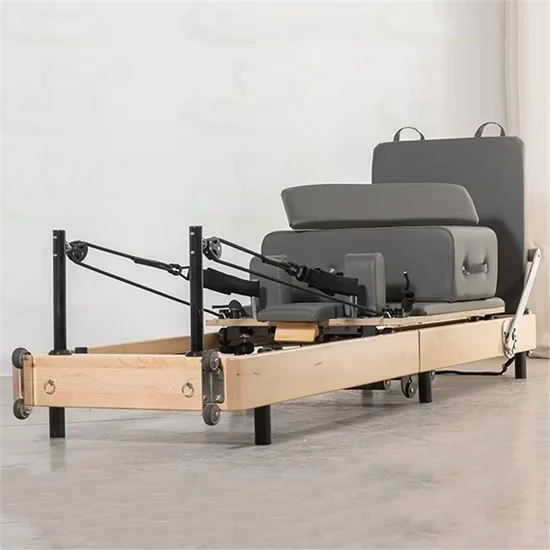
01 / Scenario
STUDIO
P
High-End Pilates Studios
Premium aesthetics meet quiet operation for boutique studio environments.

ISO
9001
CE
Certified
OEM
Available
10YR
Warranty
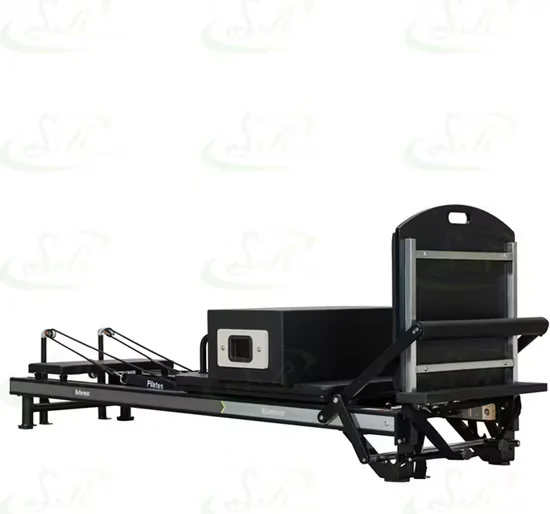
Pilates Reformer with Trapeze Tower, 2570×730×1850mm, 130kg Net Weight — engineered with aluminum frame construction for corrosion resistance and dimensional stability under cyclic spring tension, includes long box, jump board, and platform for full-range commercial studio and rehabilitation use. Every unit undergoes carriage load testing and spring fatigue verification before shipment, backed by a 3-year warranty and customized logo options.
Direct manufacturer pricing with OEM private label capability and full floor planning support for multi-unit studio deployments.
// Spec Highlights
• Direct from Manufacturer · No Middlemen · Worldwide Shipping
01
// Material
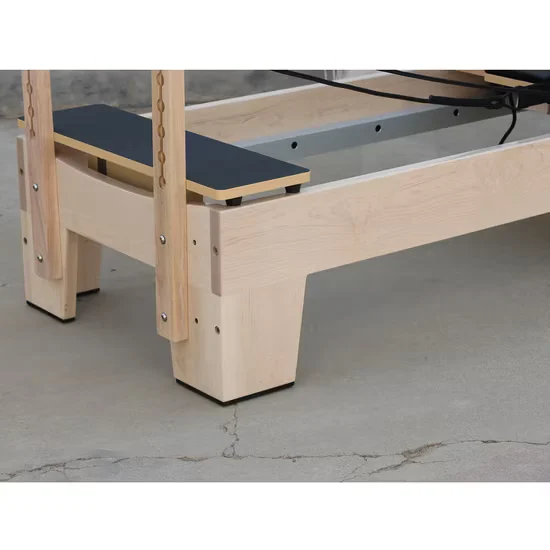
Imported Solid Wood
Premium hardwood frames sourced for density and visual warmth.
02
// Hardware
Medical-Grade Silent
Whisper-quiet pulleys and springs for clinical environments.
03
// Customization
Appearance OEM
Color, upholstery, and branding tailored to your studio.
04
// Service
Layout Design
Free venue planning for studios and rehab institutions.
Every component is selected for longevity, performance, and aesthetic harmony - from imported hardwood frames to silent medical-grade accessories.
// Features
Dimensional Stability Under Load — A 130kg net weight footprint keeps the aluminum carriage and tower base planted during high-tension spring work, preventing the frame shift that plagues lighter studio reformers.
| Parameter | Value |
|---|---|
| Product Type | Pilates Reformer with Tower |
| Model NO. | SRY-12A |
| Frame Material | Aluminum alloy construction |
| Product Dimensions | 2570 × 730 × 1850 mm |
| Net Weight | 130 kg |
| Included Accessories | Long Box, Jump Board, Platform |
| Finish Color | White (custom color options available) |
| Logo | Customized branding allowed |
| Transport Package | Standard wood case |
| Warranty | 3 Years |
| Facility Type | Typical Use |
|---|---|
| Commercial Pilates studio | Group reformer classes and private instruction sessions |
| Rehabilitation and physical therapy center | Post-injury recovery and corrective movement programming |
| Boutique fitness facility | Hybrid Pilates and functional training class formats |
| Sports performance center | Athlete mobility work and core stabilization training |
An aluminum Pilates reformer with trapeze tower must resist cyclic spring tension without developing carriage wobble or tower lean.
Studio owners replacing reformers every eighteen months share a common story: the frame was spec’d by weight rather than by section modulus. Thin-gauge aluminum extrusions flex under repeated spring anchoring, and once the carriage rail develops even slight deviation, the glide becomes uneven and noisy. The tower attachment point is where this shows first — lateral sway during hanging exercises or rollback work signals that the bed-to-tower joint is working under stress it was not built to absorb [NEED_CITE: structural fatigue in cyclically loaded aluminum extrusions]. We have seen facilities pull entire fleets off the floor because the tower interface loosened beyond field repair.
The commercial aluminum Pilates reformer with trapeze tower covers the full spectrum of classical and contemporary Pilates movement — supine footwork, seated arm work, prone pulling, and the full tower repertoire including roll-downs, hanging, and spring-assisted stretching. In a studio configuration, it pairs with mat stations and smaller apparatus like the Wunda Chair or Spine Corrector to fill a complete class rotation. The 2570mm bed length accommodates adult users across a broad height range, and the integrated long box and jump board expand the exercise catalog without requiring separate floor space. Facilities running eight or more classes daily benefit from having tower work built in rather than requiring a separate tower unit.
Every reformer spring cycle applies tension through the carriage, into the frame rails, and up through the tower base — hundreds of times per class, thousands per week. The aluminum frame must handle this without developing micro-deflection at the bolted joints. The carriage wheels and rail interface bear the most direct wear: sealed bearings resist dust and chalk ingress that accelerates play in bushing-based systems, while urethane wheels maintain their profile longer than nylon under continuous rolling load. The tower-to-bed junction faces compound stress — vertical loading from body weight during hanging exercises and lateral force during rotational movements. Coating durability matters here as well; sweat and cleaning solutions degrade thin finishes, exposing bare aluminum to oxidation that pits the surface and accelerates bearing wear [NEED_CITE: EN 957 structural requirements for stationary training equipment].
Aluminum alloy grade determines whether the frame holds its geometry or slowly deforms under spring tension. Mill-certified material traceable to the production batch provides confidence that the extrusion meets stated specifications rather than a generic commercial label. The welding method at the tower-to-bed interface is equally telling: continuous TIG welds distribute stress along the full joint, while intermittent tack welds create concentrated stress risers that crack under repeated loading. Carriage straightness tolerance — how true the rail sits to the frame axis — directly governs glide smoothness and the noise floor during use. Spring anchor hardware, the small clevis pins and carabiner attachment points, are failure-prone if undersized; they see thousands of attachment cycles and must resist elongation at the bore.
Lighter reformers ship cheaper and look identical in a catalog photo, but the savings disappear within the first year of studio traffic. Thin-wall aluminum extrusions develop visible flex under heavy spring configurations, and once the carriage rail bows, no field adjustment restores the original glide. Non-sealed bearings pack with dust and require frequent servicing or replacement, turning a low-maintenance apparatus into a recurring labor cost. Upholstery on the carriage and long box compresses quickly when low-density foam is used, leaving hard contact points that clients notice immediately. Hardware sourced from non-standard suppliers means replacement springs, wheels, and anchor pins become difficult to procure, forcing entire unit swaps instead of simple part replacements [NEED_CITE: total cost of ownership for commercial fitness apparatus].
Aluminum alloy sourcing with mill certification ensures the frame extrusion meets verified material standards rather than an unverified commercial claim. Continuous weld lines at every structural joint — particularly the tower base and carriage rail mounts — eliminate the weak points that spot welding introduces under cyclic loading. Every unit undergoes load testing before crating, confirming the carriage and tower hold rated forces without deflection beyond tolerance. The industrial-grade powder coating resists chipping at contact points where springs and hardware attach repeatedly. A 2D-3D floor planning service ensures the reformer is positioned with correct clearance around all sides, accounting for tower swing radius and jump board extension so that no station crowds another. OEM customization for color and logo lets the equipment match studio branding without aftermarket refinishing.
Share your studio floor area and planned reformer count to receive a scaled 2D-3D layout showing safe clearance zones around each station. Specify average daily class volume and session duration so the structural grade can be matched to your traffic intensity. Confirm the height range of your client population to verify the bed length and spring configuration cover full extension without compromise. Provide color, logo, and accessory preferences for custom branding alignment with your studio identity.
Q: How do you tell a commercial-grade reformer from a light-commercial one?
A: Check the frame material certification and net weight. Commercial units use verified aluminum alloy grades with mill documentation and carry enough mass to resist flex under maximum spring tension. Inspect the tower joint for continuous welding rather than spot tacks, and confirm the carriage uses sealed bearings rather than open bushings. Request a load test report for the specific unit, not a generic product-line statement.
Q: What are the trade-offs between aluminum and steel reformer frames?
A: Aluminum offers inherent corrosion resistance, lower overall weight for repositioning, and strong rigidity-to-weight ratio when properly engineered. Steel frames are heavier and can absorb vibration differently, but require powder coating or plating to prevent rust in humid studio environments. Both materials perform well commercially when the wall thickness, welding quality, and joint design match the intended daily use volume.
Q: What causes tower wobble and how is it prevented?
A: Tower sway originates from insufficient reinforcement at the bed-to-tower junction. Under lateral loading during hanging or rotational exercises, a poorly gusseted joint develops play over time. Prevention requires continuous welding at the interface, adequate bracket thickness, and bolted connections torqued to specification. If wobble appears in service, the joint has likely fatigued beyond simple tightening and requires structural inspection.
Q: How often should carriage wheels and rails be serviced?
A: In daily-use studios, inspect carriage wheels and rail surfaces every six months for debris buildup, flat-spotting, and bearing play. Sealed bearings require less frequent attention than open bushings but still need visual checks. Wipe rails with a dry cloth weekly to remove dust and chalk residue. Replace wheels when surface deformation creates audible noise or uneven glide during carriage travel.
Q: When do reformer springs need replacement?
A: Springs lose progressive resistance over thousands of stretch cycles, becoming noticeably softer and less predictable. Replace them when tension grading no longer matches the labeled resistance or when visible coil deformation appears. Use springs matched to the original anchor hardware specifications — third-party springs with different end-loop dimensions can damage the attachment points and void structural warranties.
Premium aesthetics meet quiet operation for boutique studio environments.
Medical-grade silence and precision for sports & postpartum recovery.
Furniture-grade craftsmanship for premium residential installations.
Compact premium setups for one-on-one and small-group training.
Aesthetic Pilates integration for hybrid wellness studio programming.
Multi-unit deployment with instructor-grade reliability for certification programs.
Tell us about your project. Our team will respond within 24 hours with pricing, customization options, and shipping details.
// Sales Director
William
+86 132 2531 1800
// Export Manager
Bella
+86 198 5412 8032
william@bickfit.com