01 / Scenario
STUDIO
P
High-End Pilates Studios
Premium aesthetics meet quiet operation for boutique studio environments.

ISO
9001
CE
Certified
OEM
Available
10YR
Warranty
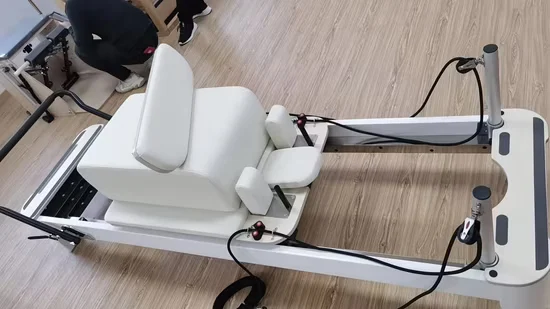
Folding Wood Pilates Reformer with Tower, 2400×600×350mm, 100kg Net Weight — solid wood frame with reinforced joinery and folding mechanism rated for repeated studio cycles; integrated long box, jump board, and platform maximize floor density in high-traffic environments. Direct manufacturer with 17 years of production heritage, 500+ commercial facilities equipped, and full customization on logo and color options.
// Spec Highlights
• Direct from Manufacturer · No Middlemen · Worldwide Shipping
01
// Material
Imported Solid Wood
Premium hardwood frames sourced for density and visual warmth.
02
// Hardware
Medical-Grade Silent
Whisper-quiet pulleys and springs for clinical environments.
03
// Customization
Appearance OEM
Color, upholstery, and branding tailored to your studio.
04
// Service
Layout Design
Free venue planning for studios and rehab institutions.
Every component is selected for longevity, performance, and aesthetic harmony - from imported hardwood frames to silent medical-grade accessories.
// Features
Structural Wood Joinery — solid hardwood frame with reinforced corner joints and cycle-tested folding hinges rated for daily studio reconfiguration.
| Parameter | Value |
|---|---|
| Product Type | Pilates Reformer |
| Frame Material | Solid Wood |
| Product Dimensions | 2400 × 600 × 350 mm |
| Net Weight | 100 kg |
| Accessory Package | Long Box, Jump Board, Platform |
| Tower Attachment | Included |
| Folding Mechanism | Integrated hinge and lock system |
| Color Options | Solid color range available |
| Logo | Customized logo allowed |
| Warranty | 3 Years |
| Facility Type | Typical Use |
|---|---|
| Commercial Pilates studio | Daily group and private reformer sessions with tower-based resistance work |
| Rehabilitation and conditioning center | Controlled movement therapy and post-injury strengthening with spring-loaded carriage |
| Boutique fitness studio | High-density floor layouts where folding capability clears space between class formats |
| Home and private practice | Compact storage after sessions in multi-use residential or office environments |
A Pilates reformer frame either holds square or it doesn’t — and wood species plus joinery method determine which outcome you get.
Many studio operators purchase reformers based on upholstery color and brand recognition, then discover within the first year that the carriage rail has drifted out of parallel, the tower mount develops lateral play, or the folding hinge no longer locks flush against the bed frame. These failures trace back to hollow-core or laminated wood construction that cannot resist the cyclical spring tension applied hundreds of times per day across multiple users [NEED_CITE: EN 957 structural requirements for stationary training equipment]. When a commercial folding wood Pilates reformer with tower is built from solid wood with proper mortise-and-tenon or doweled joinery at stress concentration points, the frame maintains dimensional stability through years of carriage travel and tower loading.
This commercial folding wood Pilates reformer with tower occupies a specific niche in studio programming: it bridges mat-based Pilates work and apparatus-driven resistance training. The tower attachment adds vertical spring vectors that target upper-body pulling patterns and spinal articulation sequences not achievable on a flat reformer alone. In a studio with limited square footage, the folding mechanism allows operators to transition a reformer zone into open floor space for group mat classes or functional movement sessions. The 2400 × 600 mm footprint accommodates users across a broad height range, and the integrated long box, jump board, and platform support the full exercise catalog without requiring separate accessory storage.
Every reformer session generates hundreds of carriage cycles — each one applying lateral force to the rail system and transferring reactive load through the frame joints to the floor contact points. The folding hinge mechanism introduces an additional stress concentration that non-folding reformers avoid entirely: each fold-unfold cycle loads the hinge pins and their wood-bearing surfaces. Over months of daily studio use, a hinge with insufficient bearing surface area will elongate its mounting holes, causing the frame to sit unevenly and the carriage to track off-center. Spring tension from the tower attachment compounds this when exercises load the carriage asymmetrically, pushing one rail harder than the other [NEED_CITE: fatigue performance of mechanical joints under cyclic loading]. The net weight of 100 kg indicates substantial material mass in the frame, which generally correlates with better resistance to resonance and vibration during jump board exercises.
The frame material listed as solid wood requires further specification to assess long-term performance: hardwood species such as maple or oak resist compression set at rail mounting points far better than softwood alternatives, and kiln-dried stock with moisture content controlled to equilibrium prevents seasonal warping that throws carriage alignment off true. The 350 mm frame height provides vertical clearance for jump board exercises and allows space beneath the carriage for spring attachment hardware. At 2400 mm length, the bed accommodates full-range leg press and long spine movements without the carriage reaching end-stops prematurely. The three-year warranty period signals manufacturer confidence in structural longevity, though operators should confirm whether this covers the folding mechanism, carriage wheels, and spring tension retention alongside the frame itself. The accessory package — long box, jump board, platform — arriving integrated with the reformer ensures mounting hole alignment rather than forcing retrofit solutions.
Reformers built from laminated particle board or thin-veneer-over-MDF construction present an attractive initial price point that erodes rapidly under studio traffic. The carriage rail surface on composite materials wears into grooves within the first year of heavy use, creating audible drag and requiring carriage wheel replacement at compressed intervals. Folding mechanisms mounted into composite frames strip their fastener holes under repeated fold cycles, eventually failing to lock securely — a liability exposure no studio operator needs. When tower attachment bolts thread into low-density core material rather than solid hardwood, lateral spring loads gradually widen the mounting interface, producing the wobble that forces exercises to be performed at reduced resistance [NEED_CITE: structural fastener performance in composite versus solid wood substrates].
The solid wood frame provides a substrate that accepts reinforced joinery at the tower mount and folding hinge — the two highest-stress nodes on a reformer of this configuration. Load testing on each unit before shipment confirms that carriage travel remains smooth and frame joints hold square under working spring tension, rather than relying on sample-batch testing that misses unit-to-unit variance. The integrated accessory package eliminates fit compatibility questions that arise when sourcing long boxes and jump boards from separate suppliers. Custom color and logo options allow studio branding consistency without compromising structural material selection. For operators planning multi-unit layouts, 2D-3D floor planning support ensures adequate clearance between reformers for safe carriage access and instructor circulation paths.
Provide your studio floor dimensions and class capacity targets to receive a 2D-3D layout showing how many folding reformers fit within safe instructor circulation corridors. Specify average daily session volume per unit so that spring tension grading and carriage wheel specification match your actual usage intensity. Communicate user height and weight ranges to confirm that the 2400 mm bed length and carriage travel accommodate your client population. Request color samples and logo placement proofs before committing to multi-unit orders for branded studio environments.
Q: How do I verify that a Pilates reformer frame is solid wood rather than laminated composite?
A: Request a cross-section photo or sample from the manufacturer showing end grain at a structural joint. Solid wood displays continuous grain running through the full thickness, while laminated or hollow-core construction reveals layered or voided internal structure. Ask for the wood species designation and moisture content report from kiln drying to confirm dimensional stability under your local humidity conditions.
Q: What cycle count should a commercial folding reformer’s hinge mechanism withstand?
A: Commercial-grade folding mechanisms must handle multiple fold-unfold cycles daily across years of studio operation. Request the manufacturer’s hinge cycle test documentation showing performance under load rather than an unloaded bench test. The lock mechanism should engage positively without increasing play over the tested cycle range, and hinge pins should show no measurable wear groove formation.
Q: How do I assess carriage smoothness and long-term rail maintenance needs on a wood frame reformer?
A: Evaluate wheel material — bearing-mounted wheels maintain consistent roll resistance far longer than bushing types in high-frequency studio environments. Ask for rail straightness tolerance data from the manufacturer and confirm whether the wood rail surface is sealed or treated to resist moisture absorption from cleaning and sweat contact during sessions.
Q: What space planning factors apply when configuring multiple folding reformers in a studio?
A: Beyond the 2400 × 600 mm footprint of each unit, account for instructor walking lanes between reformers, carriage access clearance at both ends, and adequate overhead height for tower-based exercises performed standing. The folding capability matters most for studios converting the same floor area between reformer classes and open-format movement sessions requiring clear space.
Premium aesthetics meet quiet operation for boutique studio environments.
Medical-grade silence and precision for sports & postpartum recovery.
Furniture-grade craftsmanship for premium residential installations.
Compact premium setups for one-on-one and small-group training.
Aesthetic Pilates integration for hybrid wellness studio programming.
Multi-unit deployment with instructor-grade reliability for certification programs.
Tell us about your project. Our team will respond within 24 hours with pricing, customization options, and shipping details.
// Sales Director
William
+86 132 2531 1800
// Export Manager
Bella
+86 198 5412 8032
william@bickfit.com