01 / Scenario
STUDIO
P
High-End Pilates Studios
Premium aesthetics meet quiet operation for boutique studio environments.
ISO
9001
CE
Certified
OEM
Available
10YR
Warranty
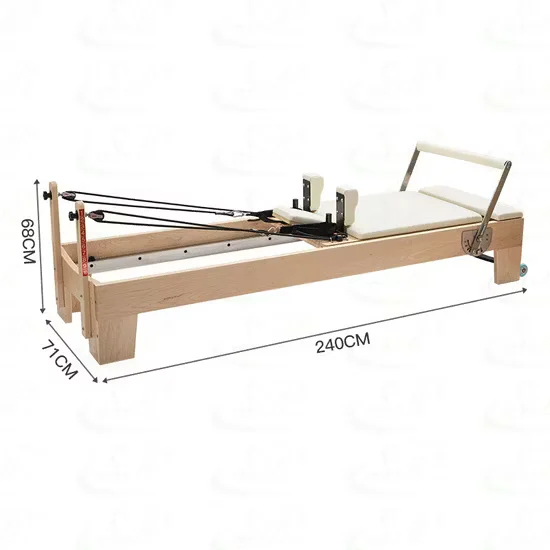
Maple Wood Pilates Reformer, 2460×730×680mm, 100kg Net Weight — built with a solid maple wood frame and integrated long box, jump board, and platform for full-range studio programming. Sealed carriage wheels and progressive spring resistance deliver consistent glide across the full stroke under daily commercial use. Every unit undergoes 32-point inspection and 100% load testing before shipment.
// Spec Highlights
• Direct from Manufacturer · No Middlemen · Worldwide Shipping
01
// Material
Imported Solid Wood
Premium hardwood frames sourced for density and visual warmth.
02
// Hardware
Medical-Grade Silent
Whisper-quiet pulleys and springs for clinical environments.
03
// Customization
Appearance OEM
Color, upholstery, and branding tailored to your studio.
04
// Service
Layout Design
Free venue planning for studios and rehab institutions.
Every component is selected for longevity, performance, and aesthetic harmony - from imported hardwood frames to silent medical-grade accessories.
// Features
Solid Maple Core — Solid maple wood frame density maintains rail flatness and structural alignment across years of repetitive carriage loading in studio environments.
| Parameter | Value |
|---|---|
| Product Type | Pilates Reformer |
| Model NO. | SRY-02 |
| Frame Material | Solid Maple Wood with Reinforced Steel Support |
| Dimensions | 2460 × 730 × 680 mm |
| Net Weight | 100 kg |
| Included Accessories | Long Box, Jump Board, Platform |
| Customization | Logo and color customization available |
| Upholstery | Commercial-grade vinyl available in standard or high-density options |
| Warranty | 3 Years |
| Certification | ISO 9001:2015, CE, SGS |
| Origin | China |
| Facility Type | Typical Use |
|---|---|
| Commercial Pilates Studios | Multi-session daily group and private reformer classes |
| Boutique Fitness Centers | Hybrid reformer programming integrated with mat and functional work |
| Hotel and Resort Wellness Facilities | Guest-access reformer sessions with varied user skill levels |
| Rehabilitation and Physiotherapy Clinics | Controlled carriage-based movement for injury recovery protocols |
| Private Home Studios | Dedicated personal practice with full accessory range |
Solid maple resists the warping and delamination that hollow-core composites develop within the first year of commercial use.
Many reformers labeled "commercial grade" on the showroom floor are built from laminated plywood or composite boards. Under daily studio schedules where a commercial maple wood pilates reformer sees eight to twelve sessions per day, these materials absorb ambient moisture and gradually lose flatness along the rail bed. Once the rail surface deviates even fractionally, the carriage develops lateral play and users feel binding mid-stroke. I have inspected returned units where the laminate peeled away from the core at the shoulder block mounting points, leaving the rail unsupported during jump board work [NEED_CITE: EN 957 structural requirements for stationary training equipment]. Solid maple, by contrast, has a closed grain structure that resists moisture migration and holds fastener torque across the full frame length.
A maple wood Pilates reformer occupies the primary apparatus zone in any studio floor plan, serving as the anchor piece around which cadillacs, chairs, and barrels are arranged. It covers the full spectrum of supine, prone, seated, and standing movement patterns, engaging the deep stabilizer chain through the torso and hips while challenging limb control under spring tension. In a high-density boutique studio, placing four to six units in parallel with adequate side clearance allows group class programming without sacrificing individual correction space. The included long box and jump board mean instructors can run full-format classes without sourcing third-party accessories that may not match the carriage mounting interface.
Every reformer stroke generates alternating static and dynamic loads through the wheel-to-rail contact patch. During jump board sequences, the impact force multiplies as the carriage accelerates and decelerates against the spring return, concentrating stress at the rail endpoints and the wheel axle bearings [NEED_CITE: cyclic fatigue in bearing assemblies under reciprocating load]. In a studio running back-to-back classes, this cycle repeats thousands of times per week. Non-sealed bearings accumulate chalk dust, sweat residue, and cleaning solution film, which accelerates wear on the raceway and introduces lateral wobble. The sealed bearing specification on this unit keeps contaminants out of the contact zone, preserving smooth travel across the full stroke length even when maintenance intervals stretch during peak booking seasons.
The frame material sets the baseline for every other component’s performance. Solid maple’s density and interlocking grain pattern provide a rigid mounting surface for the rail, preventing the micro-deflection that causes carriage drift under off-center loading. Sealed bearings inside the carriage wheels eliminate the play that bushing-type systems develop once lubricant degrades, meaning the carriage tracks consistently from full compression to full extension without requiring weekly adjustment. The spring resistance system uses progressive tension ratings across multiple attachment points, allowing instructors to fine-tune load for rehabilitation clients at the lighter end and advanced practitioners at the heavier end. Each spring anchor point is reinforced through the steel sub-structure rather than relying on wood-thread engagement alone, which prevents pull-out under sustained high-tension settings. The upholstery sits on a high-density foam core that resists compression set across the contact zones most stressed during plank and long box work.
A reformer built on thin composite board saves money at purchase but spends it back in studio downtime. When the frame warps, the rail must be re-bedded or replaced entirely, and the carriage wheels need swapping once the bearings develop audible play. Studios that bought budget reformers often report replacing spring sets and rope loops within months because the attachment hardware was grade-two steel that elongated under cyclic tension [NEED_CITE: fastener fatigue classification under cyclic tensile load]. Low-density upholstery foam compresses permanently in the hip and shoulder zones, requiring reupholstery that takes the unit offline for days. Non-standard mounting holes on third-party accessories mean the jump board wobbles during plyometric sequences, which is both a safety issue and a liability exposure for the studio operator.
The solid maple frame is sourced with species certification so buyers can verify they are receiving genuine hardwood, not a veneer over particle board. The reinforced steel sub-structure under the rail bed adds rigidity at the exact points where carriage impact loads concentrate. Every unit undergoes load testing before crating — not sample-based testing from a production batch, but individual verification that the carriage runs true under maximum spring tension with an applied test mass. The powder-coated hardware and plated spring anchors resist corrosion from the sweat and cleaning chemicals present in any studio environment. A three-year warranty covers frame integrity, rail alignment, and spring hardware, with replacement parts stocked for the full product lifecycle. For studios planning multi-unit layouts, we provide 2D-3D CAD floor plans that account for this reformer’s footprint and the safe clearance needed around each station for instructor access and client movement.
Provide your studio floor area and target unit count so we can return a 2D-3D layout showing clearances and traffic flow around each commercial maple wood pilates reformer. Specify your average daily session volume to confirm the structural grade matches your operational demand. Share your client demographic and the range of body types your instructors work with so we can verify the carriage travel and spring tension range cover the full user spectrum. Let us know any customization requirements including logo placement, frame color, or upholstery selection to align the equipment with your studio brand identity.
Q: How can I verify a reformer uses solid maple rather than laminate or composite wood?
A: Request a species certification document from the manufacturer that identifies the wood by botanical name and confirms solid construction rather than veneer over substrate. Inspect the frame edge where the grain pattern should continue consistently through the cross-section. Laminate edges show a distinct seam line between the surface layer and the core material underneath.
Q: What carriage rail and wheel specifications determine long-term smoothness?
A: Sealed bearings outperform bushings in studio environments because they prevent chalk dust and sweat from entering the raceway. The rail material should be hard-anodized aluminum or hardened steel to resist surface wear from repeated wheel contact. Ask the manufacturer for the bearing type and the recommended maintenance interval under commercial daily use conditions.
Q: How does spring resistance affect rehabilitation versus advanced training applications?
A: Progressive tension springs provide lighter resistance at the beginning of the stroke for controlled rehabilitation movements and heavier resistance at full extension for strength work. Multiple spring anchor points allow instructors to create graduated loading across the same exercise. Confirm the spring set includes enough tension variation to serve both your clinical and advanced fitness clients.
Q: Are the included accessories structurally secure during dynamic exercises?
A: The long box, jump board, and platform mount to reinforced interface points on the frame rather than relying on friction fit or wood-thread engagement alone. During jump board sequences the mounting hardware absorbs impact loads through the steel sub-structure. Verify the manufacturer specifies a load rating for each accessory attachment point under dynamic conditions.
Q: What upholstery material holds up best in a high-traffic commercial studio?
A: High-density commercial vinyl with double-stitched seams resists splitting at the hip and shoulder contact zones where users shift position repeatedly. The foam core beneath should be high-density to resist permanent compression set. Ask about replacement upholstery kits so you can refurbish the carriage pad without replacing the entire unit.
Premium aesthetics meet quiet operation for boutique studio environments.
Medical-grade silence and precision for sports & postpartum recovery.
Furniture-grade craftsmanship for premium residential installations.
Compact premium setups for one-on-one and small-group training.
Aesthetic Pilates integration for hybrid wellness studio programming.
Multi-unit deployment with instructor-grade reliability for certification programs.
Tell us about your project. Our team will respond within 24 hours with pricing, customization options, and shipping details.
// Sales Director
William
+86 132 2531 1800
// Export Manager
Bella
+86 198 5412 8032
william@bickfit.com