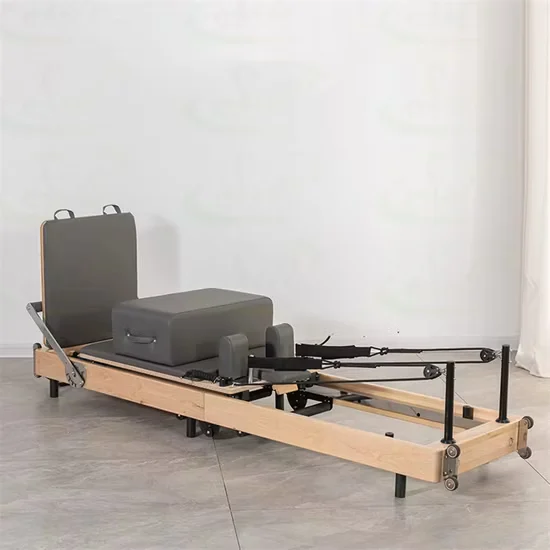
01 / Scenario
STUDIO
P
High-End Pilates Studios
Premium aesthetics meet quiet operation for boutique studio environments.

ISO
9001
CE
Certified
OEM
Available
10YR
Warranty
Maple Wooden Pilates Ladder Barrel, 1100×770×980mm, 50kg Net Weight — solid maple frame with dense grain structure prevents warping and rung looseness under daily studio loading. Precision-machined mortise-and-tenon joints distribute shear force across the grain for long-term structural rigidity. Sealed hardwax oil finish resists moisture and barefoot abrasion. Each unit undergoes 32-point inspection with full static and dynamic load testing before shipment.
// Spec Highlights
• Direct from Manufacturer · No Middlemen · Worldwide Shipping
01
// Material
Imported Solid Wood
Premium hardwood frames sourced for density and visual warmth.
02
// Hardware
Medical-Grade Silent
Whisper-quiet pulleys and springs for clinical environments.
03
// Customization
Appearance OEM
Color, upholstery, and branding tailored to your studio.
04
// Service
Layout Design
Free venue planning for studios and rehab institutions.
Every component is selected for longevity, performance, and aesthetic harmony - from imported hardwood frames to silent medical-grade accessories.
// Features
Solid Maple Frame Integrity — single-piece grain continuity eliminates the delamination risk inherent in laminated plywood barrels under daily studio loading.
| Parameter | Value |
|---|---|
| Product Type | Pilates Ladder Barrel |
| Frame Material | Solid Maple Wood |
| Product Dimensions | 1100×770×980mm |
| Net Weight | 50kgs |
| Joinery Method | Mortise-and-Tenon / Dowel-Reinforced |
| Surface Finish | Sealed Hardwax Oil or Lacquer (options available) |
| Upholstery | Standard or High-Density options available |
| Color / Finish | Solid Color, Custom options available |
| Logo | Customized branding allowed |
| Warranty | 3 Years |
| Production Capacity | 800 Pieces/Month |
| Facility Type | Typical Use |
|---|---|
| Pilates and Movement Studio | Spinal articulation, flexibility, and core conditioning sequences |
| Rehabilitation and Physiotherapy Clinic | Post-injury mobility work and supervised therapeutic exercise |
| Boutique Fitness and Personal Training Facility | Small-group Pilates sessions and one-on-one flexibility programming |
| Hotel and Resort Wellness Center | Guest self-service stretching and guided recovery sessions |
Solid maple resists the layered failure that ends the service life of most plywood barrels.
Many commercial studios discover too late that a laminated or veneer-faced barrel will begin to delaminate at the rung-to-frame joint within the first year of repetitive flexion loading. The adhesive bond between plies degrades under the cyclical shear forces generated when users mount, dismount, and shift their weight across the ladder rungs day after day. Once a single ply lifts, moisture from bare feet and studio cleaning chemicals penetrates the exposed end grain, accelerating failure across the entire rung bank. A commercial maple wood pilates ladder barrel machined from solid stock eliminates these layered fault lines entirely — the grain runs continuously through the rail and rung, so shear loads are distributed along the fiber rather than concentrated at a glue interface [NEED_CITE: wood species structural performance under cyclic loading].
The Pilates ladder barrel serves a distinct role: it is the primary apparatus for spinal flexion, extension, and lateral flexion sequences that cannot be replicated on a reformer or cadillac. It complements mat zones by providing fixed-geometry support for users who need tactile feedback during deep stretching and articulation work. In a high-traffic studio layout, this commercial maple wood pilates ladder barrel occupies a dedicated footprint where practitioners can work independently without monopolizing spring-loaded equipment, improving overall floor throughput during peak hours.
Every time a user steps onto or shifts across a ladder rung, the joint where that rung meets the vertical rail absorbs a concentrated shear load. In a busy studio running eight or more classes daily, those rung joints experience thousands of stress cycles per week. Mortise-and-tenon joinery addresses this by embedding the rung deep into the rail, distributing force across a broad grain-to-grain contact area rather than relying on surface adhesive or shallow dowels. The barrel’s curved rail adds another complexity: any unevenness in the curvature radius changes the user’s spinal support geometry and can concentrate load asymmetrically on one side of the frame [NEED_CITE: EN 957 structural requirements for stationary training equipment].
The choice of solid maple over birch, ash, or softwood composites matters for a specific mechanical reason: maple’s dense, tight grain structure provides high resistance to surface indentation and rung wobble under repeated barefoot contact. A sealed hardwax oil or lacquer finish is not merely cosmetic — it controls moisture absorption that causes dimensional swelling and grain raising, which in a humid studio environment can degrade grip and tactile feel within weeks. The joinery specification is equally critical: mortise-and-tenon or doweled joints that penetrate deeply into the rail ensure the rung resists rotational force, whereas surface-glued or stapled rungs depend entirely on adhesive shear strength, which degrades with humidity cycling and cleaning chemical exposure. Product dimensions of 1100×770×980mm define a barrel curvature and ladder height that accommodate a broad range of adult body sizes without requiring mechanical adjustment.
Studios that source barrels built from laminated plywood or softwood composites often see the first signs of structural compromise within months. Rung wobble develops as surface adhesive bonds weaken, creating an audible and tactile rattle that signals joint looseness and a potential safety concern. Veneer-faced frames can chip at high-contact edges, exposing engineered wood core material that absorbs moisture and swells irreversibly. A barrel with a poorly controlled curvature radius forces users into non-neutral spinal positions, undermining the therapeutic intent of the apparatus. Once these failures begin, repair is rarely viable — the barrel is replaced entirely, and the downtime disrupts scheduled classes and client retention [NEED_CITE: lifecycle cost comparison of solid wood versus composite fitness equipment].
The solid maple selection for this barrel is paired with joinery methods that match the load profile of daily commercial use. The wood is sourced with mill documentation confirming species and grade, preventing the substitution of lower-density hardwoods that pass visual inspection but lack long-term structural stability. Each barrel’s curvature is machined to a consistent radius, verified against template gauges, so spinal support geometry remains uniform across production batches. The surface finish is applied in multiple coats to achieve moisture resistance appropriate for barefoot studio environments and repeated chemical cleaning. Custom branding — including logo engraving and color matching — integrates the barrel into a studio’s visual identity without compromising structural specifications. A three-year warranty backs the frame and joinery against manufacturing defects, and facility planning support ensures the barrel’s footprint and safety clearances are properly accounted for in the studio layout.
Provide your studio floor area and existing equipment list to receive a 2D-3D layout that integrates the barrel with proper safety clearances. Specify expected daily class volume so the structural grade and finish specification can be confirmed against your traffic level. Share your client demographic to verify that the barrel dimensions accommodate your typical user body-size range. Detail any customization requirements including logo placement, upholstery color, and finish tone for branding alignment.
Q: How can I verify the barrel is made from solid maple rather than laminate or composite wood?
A: Request mill documentation from the manufacturer that specifies wood species, grade, and origin. Solid maple has a continuous, tight grain pattern visible on cut edges and end grain, whereas laminated products show distinct ply lines. A reputable supplier will provide this certification as part of the standard quality record package accompanying each production batch.
Q: What joinery method should I look for to ensure rung stability over years of daily use?
A: Mortise-and-tenon or deep-set dowel-reinforced joints are the standard for commercial-grade barrels. These methods embed the rung structurally within the rail, distributing shear forces across the wood grain. Avoid barrels where rungs are attached with surface adhesive, shallow dowels, or mechanical fasteners alone, as these are the first points of failure under repeated cyclical loading in a busy studio environment.
Q: How does the barrel curvature radius affect which users can train on it safely?
A: The curvature determines the spinal support geometry and the range of motion available during flexion and extension exercises. A radius designed around average adult anthropometrics accommodates most users, but extremes of height may find the curve either too aggressive or insufficiently supportive. Providing your client demographic when ordering allows the manufacturer to confirm dimensional suitability for your specific population.
Q: What surface finish is appropriate for barefoot contact and frequent studio cleaning?
A: A sealed hardwax oil or multi-coat lacquer provides moisture resistance while maintaining a tactile surface suitable for barefoot use. The finish must withstand pH-neutral cleaning agents used between classes without degrading, raising the grain, or becoming slippery. Confirm with the manufacturer the coating type, number of application coats, and recommended maintenance protocol to preserve both grip and appearance over time.
Q: Can the barrel be customized to match studio branding without affecting structural quality?
A: Yes — customization options include logo engraving or application, upholstery color selection, and finish tone adjustment. These modifications are applied at the finishing stage and do not alter the solid maple frame, joinery method, or load-bearing geometry. Specify all branding requirements during the inquiry phase so production scheduling accounts for custom finish drying and curing times.
Premium aesthetics meet quiet operation for boutique studio environments.
Medical-grade silence and precision for sports & postpartum recovery.
Furniture-grade craftsmanship for premium residential installations.
Compact premium setups for one-on-one and small-group training.
Aesthetic Pilates integration for hybrid wellness studio programming.
Multi-unit deployment with instructor-grade reliability for certification programs.
Tell us about your project. Our team will respond within 24 hours with pricing, customization options, and shipping details.
// Sales Director
William
+86 132 2531 1800
// Export Manager
Bella
+86 198 5412 8032
william@bickfit.com