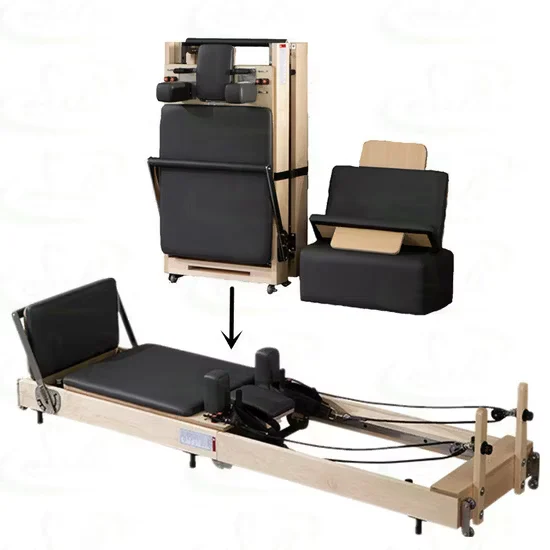
01 / Scenario
STUDIO
P
High-End Pilates Studios
Premium aesthetics meet quiet operation for boutique studio environments.

ISO
9001
CE
Certified
OEM
Available
10YR
Warranty
Balance Half Ball, 58×25cm, 3kg Net Weight — engineered with high-density PVC shell and reinforced base platform for commercial Pilates and functional training environments. Customizable logo and color options available for facility branding. Backed by BICKFIT's 17-year manufacturing heritage and 500+ commercial gym installations for reliable accessory supply.
// Spec Highlights
• Direct from Manufacturer · No Middlemen · Worldwide Shipping
01
// Material
Imported Solid Wood
Premium hardwood frames sourced for density and visual warmth.
02
// Hardware
Medical-Grade Silent
Whisper-quiet pulleys and springs for clinical environments.
03
// Customization
Appearance OEM
Color, upholstery, and branding tailored to your studio.
04
// Service
Layout Design
Free venue planning for studios and rehab institutions.
Every component is selected for longevity, performance, and aesthetic harmony - from imported hardwood frames to silent medical-grade accessories.
// Features
Heavy-Duty Base Platform — A reinforced foundation prevents bottoming-out under repeated dynamic loading in high-traffic studio environments.
| Parameter | Value |
|---|---|
| Product Type | Balance Half Ball |
| Specification | 58 × 25 cm |
| Net Weight | 3 kg |
| Color | Red (custom color available) |
| Logo | Customized logo allowed |
| Base Platform | Reinforced high-density PVC |
| Shell Material | High-density PVC |
| Surface Texture | Non-slip base and grip surface |
| Target User | Adult |
| MOQ | 2 PCS |
| Facility Type | Typical Use |
|---|---|
| Pilates studio | Balance and stability training in group class settings |
| Commercial gym functional training zone | Core conditioning and proprioception drills |
| Yoga studio | Standing and kneeling stability exercises |
| Rehabilitation and physical therapy center | Low-impact core strengthening and ankle stabilization |
Most balance trainers spec’d into commercial floors use retail-grade shells that warp under daily foot traffic and repeated compression cycles.
When a Pilates studio runs six classes a day, every balance half ball on the floor takes hundreds of compression cycles before the week is out. Thin PVC shells develop micro-tears around the base seam, and low-density bases flatten permanently — turning a stability tool into a slip hazard. Facility managers end up replacing units every few months, which costs more than specifying a commercial pilates balance half ball stability trainer built for that load profile from the start. [NEED_CITE: EN 957 structural requirements for stationary training equipment]
A balance half ball occupies the proprioception and core activation tier of a functional training zone. It pairs with suspension trainers and cable columns — members move from loaded strength work to unloaded stability drills, rounding out a session without switching stations. For studios running group classes, the 58 × 25 cm footprint allows tight floor spacing while maintaining safe lateral clearance between users. The platform accommodates barefoot and shod use, making it suitable for both Pilates reformer-adjacent work and high-intensity interval circuits where members transition quickly between stations. A commercial pilates balance half ball stability trainer earns its floor space by serving multiple class formats without requiring dedicated storage between sessions.
Every time a member steps onto a half ball, the PVC shell absorbs a dynamic impact load — not just body weight, but the multiplied force of a step-up or lateral hop. Over hundreds of daily cycles, the material fatigues at the base-to-shell junction, which is where most failures originate. A high-density PVC shell resists that fatigue curve longer, maintaining dome shape and rebound characteristics. The non-slip base texture also degrades under shoe friction and cleaning chemicals; commercial environments demand a texture depth that survives daily wipe-downs without going smooth. Sweat exposure and rubber-floor contact accelerate breakdown in units with thin coatings or poorly bonded base layers. [NEED_CITE: material fatigue performance in PVC under cyclic compression loading]
The 58 × 25 cm dimension defines the usable dome diameter and the base contact area — a wider base spreads load over more floor surface, reducing point pressure on rubber matting. Net weight at 3 kg indicates a denser internal structure; lighter half balls typically sacrifice base thickness to cut shipping cost, which means the platform deforms before the dome does. High-density PVC as a shell material resists puncture from dropped dumbbells or kettlebell contact during circuit training. The reinforced base platform is the structural element that prevents bottoming-out — when a member lands mid-jump, the base must absorb the impulse without flattening against the floor. Non-slip surface engineering matters on both sides: the top grip keeps bare feet planted, and the base texture prevents lateral creep on smooth studio flooring. Custom color and logo options allow facility branding without requiring a separate cover or sleeve that could shift during use.
A retail-grade half ball saves money on the purchase order but enters a replacement cycle that compounds quickly in a busy studio. Thin PVC shells tear at the seam, creating sharp edges that can scratch skin during floor transitions. Low-density bases compress permanently, eliminating the instability that makes the tool useful in the first place — members are then training on a flat disc without realizing the dome has collapsed. Facilities that standardize on light-duty units often end up purchasing three sets in the time one commercial-rated set would have lasted, and the downtime between orders leaves gaps in class programming. Non-standard sizing also means replacement units from different suppliers do not match, creating visual inconsistency across the studio floor. [NEED_CITE: total cost of ownership comparison for commercial vs retail fitness accessories]
The 17-year manufacturing heritage behind BICKFIT means functional training accessories are spec’d with the same structural discipline applied to plate-loaded frames — if the base platform cannot withstand repeated dynamic loading, it does not enter the configuration sheet. Every accessory in the lineup is validated against commercial use cycles, not retail display standards. The 2D and 3D CAD layout support extends to functional training zones, ensuring balance trainers are positioned with safe clearance from rigs and free-weight areas. OEM customization for logo and color lets operators match facility branding across the entire equipment package. The supply chain that delivers 11-gauge steel frames to 45+ export countries also ensures consistent PVC sourcing and QC for accessories, so batch-to-batch density remains uniform across orders.
Provide your functional training area dimensions and class capacity to receive a 2D or 3D floor layout with balance trainer placement and safe clearance mapping. Specify daily user volume and class format — high-impact interval programming demands different base density thresholds than low-impact rehabilitation sessions. Confirm branding requirements including logo placement, Pantone color matching, and any facility-specific sizing needs for integration with existing equipment layouts.
Q: How do I tell a commercial-grade balance half ball from a retail version?
A: Check the base platform density and shell PVC grade. Commercial units use high-density PVC that resists permanent deformation under repeated step-on cycles, while retail versions compress and flatten within months of daily use. Weight is also an indicator — a heavier unit typically signals a thicker base and denser shell construction designed for sustained studio traffic.
Q: What material specs matter for long-term studio durability?
A: Shell PVC density, base platform thickness, and seam bonding method are the three critical factors. High-density PVC resists puncture and tearing at the base junction, and a reinforced platform prevents bottoming-out. Ask the supplier for material density certificates and dynamic load test data rather than relying on visual inspection alone.
Q: Can I customize logo and color without affecting structural performance?
A: Yes, when customization is applied during the molding process rather than as an aftermarket print. Factory-integrated logo and color options maintain the PVC shell integrity, while surface-applied decals or paints can peel and compromise the non-slip texture over repeated cleaning cycles.
Q: What is the replacement cycle for balance trainers in a commercial Pilates studio?
A: Commercial-grade units with reinforced bases and high-density shells typically remain functional across multiple membership cycles when cleaned and rotated regularly. Light-duty retail alternatives may require replacement within months under the same traffic, making the per-unit savings irrelevant once replacement labor and class disruption are factored in.
Premium aesthetics meet quiet operation for boutique studio environments.
Medical-grade silence and precision for sports & postpartum recovery.
Furniture-grade craftsmanship for premium residential installations.
Compact premium setups for one-on-one and small-group training.
Aesthetic Pilates integration for hybrid wellness studio programming.
Multi-unit deployment with instructor-grade reliability for certification programs.
Tell us about your project. Our team will respond within 24 hours with pricing, customization options, and shipping details.
// Sales Director
William
+86 132 2531 1800
// Export Manager
Bella
+86 198 5412 8032
william@bickfit.com