01 / Scenario
STUDIO
P
High-End Pilates Studios
Premium aesthetics meet quiet operation for boutique studio environments.
ISO
9001
CE
Certified
OEM
Available
10YR
Warranty
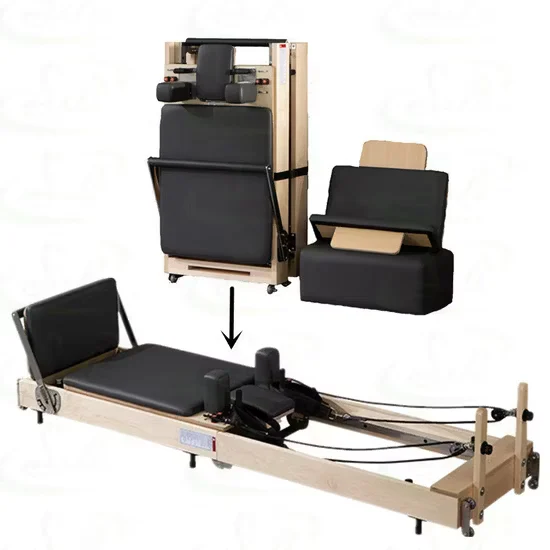
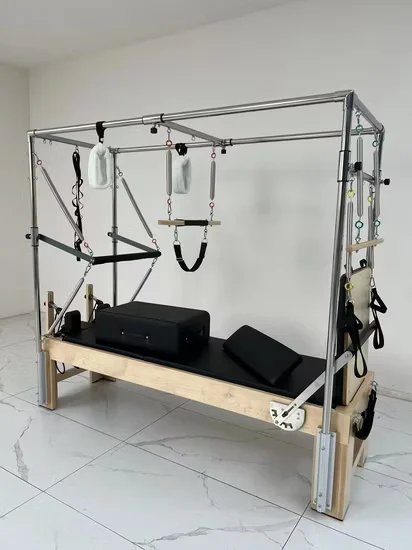
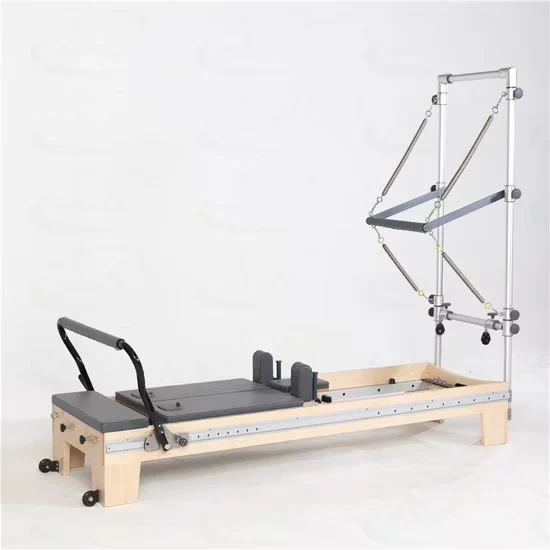
Pilates Reformer, Double Track Sliding System, Core Alignment Ladder Bed — solid wood frame engineered for low-friction carriage movement across 2460×730×1900mm footprint, with sealed bearings and progressive spring resistance for studio and rehabilitation environments. Modular accessories include long box, jump board, and platform for full-spectrum programming. Backed by 3-year warranty and ISO 9001 certified manufacturing.
// Spec Highlights
• Direct from Manufacturer · No Middlemen · Worldwide Shipping
01
// Material
Imported Solid Wood
Premium hardwood frames sourced for density and visual warmth.
02
// Hardware
Medical-Grade Silent
Whisper-quiet pulleys and springs for clinical environments.
03
// Customization
Appearance OEM
Color, upholstery, and branding tailored to your studio.
04
// Service
Layout Design
Free venue planning for studios and rehab institutions.
Every component is selected for longevity, performance, and aesthetic harmony - from imported hardwood frames to silent medical-grade accessories.
// Features
Traceable Wood Construction — Every timber member is species-documented and joint-verified before assembly begins.
| Parameter | Value |
|---|---|
| Product Type | Pilates Reformer |
| Frame Material | Solid Wood |
| Loading Type | Double Track Sliding System |
| Carriage System | Dual-Rail Sliding Carriage |
| Included Accessories | Long Box / Jump Board / Platform |
| Product Dimensions | 2460 × 730 × 1900 mm |
| Net Weight | 150 kg |
| Color Options | Solid Color (custom finishes available) |
| Logo | Customized |
| Certification | ISO 9001 (manufacturer level) |
| Warranty | 3 Years |
| Facility Type | Typical Use |
|---|---|
| Pilates Studio | Private and group reformer classes, apparatus-based conditioning |
| Rehabilitation Center | Post-injury mobility work, spinal articulation protocols |
| Boutique Fitness Facility | Small-group functional Pilates sessions |
| Commercial Gym Functional Zone | Core training complement to free weight and cardio areas |
Lateral drift on a reformer is a tolerance failure, not a wear failure — dual rails eliminate it by design.
Most studio operators have seen it: a reformer carriage that tracked perfectly for the first few months gradually develops side-to-side play. Users feel it during unilateral leg work and oblique-dominant exercises where any lateral deviation breaks the movement pattern. The root cause is almost always a single-track system where one rail carries both the vertical load and the lateral constraint. Over hundreds of cycles under dynamic spring tension, the single rail’s guide surface wears unevenly and the carriage begins to wander.
A double-track sliding system separates these two jobs. Each rail handles vertical load while the paired geometry resists lateral forces in both directions simultaneously. The result is a carriage that maintains its centerline position regardless of whether the user is performing symmetrical footwork or single-leg long box work where off-center loading is the norm. [NEED_CITE: EN 957 structural requirements for stationary training equipment]
When sourcing a commercial pilates core alignment double track reformer, the track system is the first specification to verify — because once a single-track carriage develops play, no amount of bearing replacement will restore the original tracking accuracy.
The reformer’s core alignment ladder bed enables controlled spinal articulation across full flexion and extension ranges, targeting deep stabilizers including transversus abdominis, multifidus, and pelvic floor musculature. In a studio layout, this apparatus anchors the reformer zone and pairs with cadillacs and wunda chairs to cover the complete Pilates apparatus progression. The 2460 mm length and 730 mm width require a dedicated footprint with clearance on at least two sides for instructor access during private sessions. It accommodates adult users across a wide anthropometric range, with the ladder bed geometry supporting both supine and seated work without reconfiguration. Studios running high-frequency class rotations benefit from the double-track system’s resistance to lateral drift, meaning less mid-session adjustment between users of different body weights.
The reformer frame endures a specific loading profile that differs fundamentally from a static weight bench. Each spring-loaded repetition generates cyclic tensile and compressive forces transmitted through the carriage into the frame rails and end stops. Over a typical studio schedule — eight or more hours of daily use across multiple instructors — these cycles accumulate into the thousands per week. The solid wood frame’s natural damping characteristics absorb vibration differently than welded steel, reducing transmitted noise to the studio floor. [NEED_CITE: cyclic fatigue behavior in solid timber structural members]
The joint construction where rails meet the headboard and footboard is the critical stress path. Any fastener or joint method that relies solely on adhesive bonding without mechanical interlock will eventually loosen under the repeated eccentric loading that occurs during jump board work and advanced ladder exercises. The carriage wheels and their bearings represent the second wear point — sealed bearings maintain smooth travel in an environment where chalk dust, sweat residue, and cleaning chemicals are constant contaminants, whereas open bushings degrade noticeably within the first year of commercial use.
The double-track sliding system’s performance depends on three interconnected parameters: rail material and surface treatment, wheel diameter, and bearing specification. Hardened steel or anodized aluminum rails with a consistent surface finish maintain dimensional tolerance across years of carriage travel, while untreated or thinly coated rails develop grooves that accelerate wheel wear. Larger-diameter wheels distribute load across a greater contact area and roll over minor surface imperfections without transmitting vibration to the user. Sealed bearings prevent contaminant ingress and eliminate the lubrication schedule that open bushings demand in a busy studio.
The wood frame’s species and joinery method determine long-term rigidity under spring tension. Dense hardwoods with mortise-and-tenon or doweled joints resist the racking forces generated during asymmetric exercises far better than laminated softwood assembled with pocket screws. Spring resistance grading — the number of springs available and their tension calibration — defines the apparatus’s usable range from gentle rehabilitation protocols to advanced athletic conditioning. A reformer with a narrow spring range forces instructors to compromise on exercise selection for different client populations, limiting the equipment’s scheduling flexibility across class types.
Studios that select reformers based on initial cost without scrutinizing track and frame construction pay the difference within eighteen months. A single-track system that develops lateral play requires carriage wheel replacements at accelerating intervals, and the track surface itself eventually needs refinishing or replacement — downtime that removes the apparatus from revenue-generating class schedules. Thin frame joinery that loosens under cyclic loading cannot simply be re-tightened; the fastener holes elongate and the joint requires disassembly, re-drilling, and larger hardware to restore structural integrity.
Springs from unverified manufacturers lose calibration tolerance unpredictably, meaning instructors cannot trust that a red spring on one reformer matches the same color on another — a problem that disrupts class flow and forces manual testing before every session. Upholstery on the carriage and long box that uses low-density foam compresses permanently under daily use, requiring re-covering that takes the apparatus offline and incurs both material and labor cost. [NEED_CITE: maintenance cost escalation in commercial fitness equipment under deferred service] Non-standard hardware and proprietary accessory mounts mean that when a platform bracket or jump board fitting fails, the only replacement source is the original supplier — if they still stock the part.
Our shop floor approach to a commercial pilates core alignment double track reformer starts with the same discipline applied to our strength equipment lines. The solid wood frame is species-documented at intake, and every joint is mechanically verified before the frame moves to finishing — the same traceability principle we apply to steel coil certification on our plate-loaded and selectorized lines. The double-track rails are checked for parallelism and surface consistency before carriage assembly, because a track that is fractionally out of alignment will bind under the eccentric loading of advanced Pilates work.
Each unit undergoes loaded carriage cycling before packaging, confirming smooth travel across the full stroke length with lateral resistance measured at multiple carriage positions. The powder-coated or lacquered frame finish is applied at sufficient thickness to resist sweat and cleaning chemical exposure through years of studio use. We provide 2D-3D layout CAD support so studio operators can plan reformer placement with correct instructor clearance zones and ADA-compliant access paths, avoiding the dead space and unsafe gaps that occur when apparatus is ordered without floor planning. OEM customization — frame color, logo placement, and accessory configuration — is available for studios building a branded environment across multiple locations.
Provide your reformer zone dimensions and total apparatus count to receive a scaled 2D-3D layout showing placement, instructor circulation paths, and accessory storage walls. Specify your average daily class volume and client profile — rehabilitation-focused, athletic conditioning, or mixed population — so we can confirm spring configuration and accessory package alignment. Communicate any custom finish, logo, or upholstery requirements early in the procurement cycle to coordinate with production scheduling.
Q: How do I evaluate whether a Pilates reformer is genuinely built for commercial studio use versus home use?
A: Examine three construction details. First, confirm the track system is dual-rail rather than single-rail, as dual rails resist lateral carriage drift under repeated off-center loading. Second, verify the frame joinery uses mechanical interlock such as mortise-and-tenon rather than adhesive-only or pocket screw assembly. Third, check that carriage wheels use sealed bearings rated for continuous rotation, not open bushings that degrade in chalk and sweat environments.
Q: What is the practical difference between double-track and single-track sliding systems on a reformer?
A: A single-track system uses one rail to support vertical load and resist lateral movement simultaneously, which causes uneven wear and progressive carriage play under commercial use volumes. A double-track system distributes vertical load across two rails while the paired geometry constrains lateral movement from both sides. This means the carriage maintains its centerline tracking accuracy over a meaningfully longer service life, requiring less maintenance intervention between users.
Q: Should I choose a wood-frame or steel-frame reformer for a commercial studio?
A: Wood frames provide natural vibration damping that reduces transmitted noise to studio floors and deliver the aesthetic warmth clients expect in boutique Pilates environments. Steel frames offer higher absolute load ratings and may suit rehabilitation centers with bariatric protocols. Both can perform well commercially when their respective construction standards are met — solid hardwood with mechanical joinery for wood, and properly gauged tube with continuous welds for steel. The decision typically comes down to studio design intent and client expectation.
Q: How do spring resistance options affect the reformer’s usefulness across different client levels?
A: A reformer with multiple spring tension levels and consistent color-coded calibration allows instructors to progress a client from gentle rehabilitation loading through advanced athletic resistance without switching apparatus. If springs vary between machines of the same model, instructors lose confidence in prescribed resistance settings and must manually test each unit before class. Specify that your supplier guarantees calibration tolerance across all units in a multi-reformer order.
Q: How are the long box, jump board, and platform mounted, and does this affect long-term serviceability?
A: Accessories should mount via standardized bracket systems with mechanical fasteners rather than proprietary friction-fit or adhesive attachments. Standardized brackets allow replacement if a fitting wears or breaks, and they enable the studio to add or swap accessories as programming evolves. Verify with your supplier that accessory mounting hardware is documented and that replacement brackets remain available as spare parts beyond the initial warranty period.
Premium aesthetics meet quiet operation for boutique studio environments.
Medical-grade silence and precision for sports & postpartum recovery.
Furniture-grade craftsmanship for premium residential installations.
Compact premium setups for one-on-one and small-group training.
Aesthetic Pilates integration for hybrid wellness studio programming.
Multi-unit deployment with instructor-grade reliability for certification programs.
Tell us about your project. Our team will respond within 24 hours with pricing, customization options, and shipping details.
// Sales Director
William
+86 132 2531 1800
// Export Manager
Bella
+86 198 5412 8032
william@bickfit.com