01 / Scenario
STUDIO
P
High-End Pilates Studios
Premium aesthetics meet quiet operation for boutique studio environments.

ISO
9001
CE
Certified
OEM
Available
10YR
Warranty
100kg net weight ensures structural integrity for adult commercial use across Pilates studios, yoga centers, and rehabilitation facilities.
// Spec Highlights
• Direct from Manufacturer · No Middlemen · Worldwide Shipping
01
// Material
Imported Solid Wood
Premium hardwood frames sourced for density and visual warmth.
02
// Hardware
Medical-Grade Silent
Whisper-quiet pulleys and springs for clinical environments.
03
// Customization
Appearance OEM
Color, upholstery, and branding tailored to your studio.
04
// Service
Layout Design
Free venue planning for studios and rehab institutions.
Every component is selected for longevity, performance, and aesthetic harmony - from imported hardwood frames to silent medical-grade accessories.
// Features
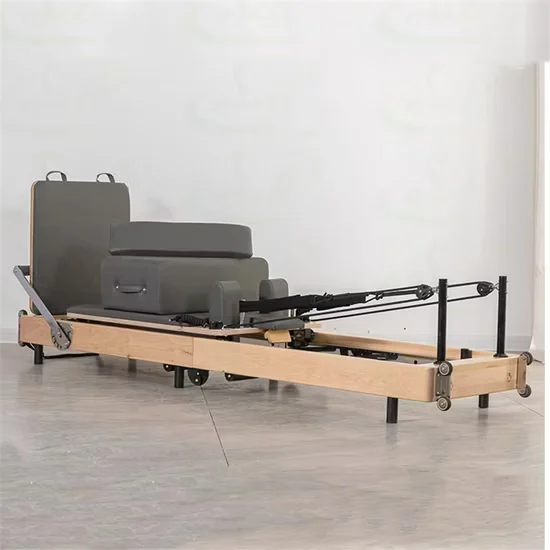
Structural Integrity — Every commercial pilates reformer machine leaves our Ningjin facility only after passing full-load carriage testing under maximum spring tension, not sample-based inspection.
| Parameter | Value |
|---|---|
| Product Type | Pilates Reformer |
| Frame Material | Solid Wood |
| Product Dimensions | 2460 × 730 × 680 mm |
| Net Weight | 100 kg |
| Included Accessories | Long Box, Jump Board, Platform |
| Color Options | Solid color, customizable |
| Logo | Customized logo allowed |
| Warranty | 3 Years |
| Target User | Adult, Unisex |
| Facility Type | Typical Use |
|---|---|
| Pilates studio | Daily group and private reformer classes |
| Yoga and movement training center | Flexibility and core conditioning sessions |
| Rehabilitation and physiotherapy clinic | Guided recovery and low-impact resistance work |
| Boutique fitness studio | Small-group reformer training programs |
| Hotel and resort wellness center | Guest-access Pilates and stretching stations |
Solid wood resists the deflection that hollow and laminated frames surrender to within months.
Most reformer beds marketed for studio use rely on thin laminated panels or hollow-core construction. Under multi-spring tension during loaded carriage work, these frames flex at the rail mounting points. That flex introduces lateral carriage wobble, accelerates uneven rail wear, and forces studio owners into premature equipment rotation. A commercial pilates reformer machine built on a solid wood platform eliminates that failure path by maintaining rail alignment under sustained tension cycles [NEED_CITE: structural deflection thresholds in laminated versus solid wood under cyclic loading].
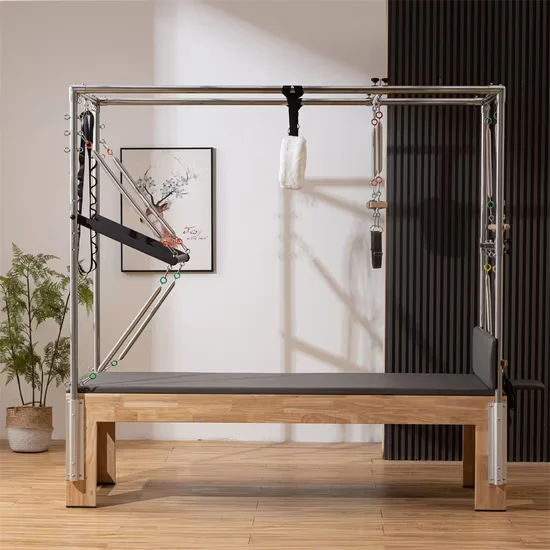
The Pilates reformer occupies the center of any dedicated reformer studio layout, covering supine, prone, seated, and standing movement planes across the full body. In a mixed-modality studio, it pairs with Cadillac and Wunda Chair stations to create progressive resistance sequences without equipment redundancy. For boutique and rehabilitation facilities running high-frequency class schedules, the accessory-inclusive configuration — long box, jump board, and platform — eliminates separate procurement gaps. The 2460 × 730 mm footprint suits both open-floor group layouts and partitioned private training rooms, accommodating users across a wide range of body proportions.
A reformer in a commercial studio endures hundreds of carriage cycles daily, each generating lateral and longitudinal forces through the wheel-to-rail interface. Spring tension at full extension produces sustained static load on the frame’s mounting anchors, while jump board exercises introduce impact spikes through the platform attachment points. The accessory mounting interfaces — whether bolt-on or slide-in — face repeated shear stress during loaded long box and jump board work. Rail surface degradation, carriage wheel bearing wear, and spring attachment hardware fatigue all follow predictable paths tied directly to material grade and assembly precision [NEED_CITE: fatigue classification for cyclically loaded wood and metal interface joints].
Solid wood frame construction sets the baseline for carriage stability. Unlike laminated alternatives that delaminate at the glue lines under humidity and tension cycling, solid stock maintains dimensional consistency across the rail mounting zone. The rail and carriage wheel interface dictates glide smoothness and maintenance intervals — sealed bearings resist dust and sweat intrusion far better than open bushings in a studio environment. Spring attachment hardware must withstand thousands of extension cycles without thread stripping or anchor plate deformation. Accessory compatibility is equally structural: a jump board that mounts rigidly under impact loading prevents the frame racking that loosens fasteners over time. Color and logo customization options allow studio branding without compromising the underlying frame specification.
A reformer built on thin laminated or hollow-core framing may pass initial inspection but begins showing carriage drift within the first year of daily studio use. Rail misalignment forces wheel replacement at accelerated intervals. Non-sealed carriage bearings accumulate particulate and require frequent servicing or full replacement. Low-grade spring anchors strip under repeated tension cycling, creating both downtime and liability exposure in a supervised class environment. When accessory mounting points lack structural reinforcement, jump board and long box attachments develop play that compromises exercise precision and accelerates fastener wear [NEED_CITE: maintenance cost escalation in light-duty versus commercial-grade studio equipment].
Our manufacturing approach addresses the failure points that surface first in daily-use studios. The solid wood frame is selected for dimensional stability under multi-spring tension, not simply appearance. Robotic MIG welding is applied at every metal-to-metal joint in the carriage and spring assembly for continuous weld lines rather than spot-weld weak points. Every unit undergoes load testing before shipment — carriage loaded to maximum spring tension, full travel cycle verification, and accessory mounting stress checks. The industrial-grade powder coating on all metal components resists sweat corrosion and cleaning agent exposure across years of studio use. Facility planning support includes 2D and 3D CAD layouts that account for reformer footprint, instructor walkway clearance, and adjacent equipment spacing to maintain safe operating zones. OEM customization covers color matching and logo application for studio identity consistency across the equipment floor.
Provide your studio floor dimensions and class capacity targets to receive a 2D or 3D layout incorporating reformer spacing, instructor circulation, and accessory storage zones. Specify your average daily session count so we can confirm the frame and carriage specification matches your operational intensity. Communicate any branding requirements — custom color finishes and logo placement — at the inquiry stage for integrated production scheduling.
Q: How should I evaluate wood frame quality for a commercial reformer?
A: Inspect the frame cross-section for solid stock rather than laminated layers or hollow-core construction. Solid wood maintains dimensional stability under repeated spring tension cycles, preventing rail misalignment and carriage drift. Ask the supplier for material grade documentation and verify that the rail mounting zone uses continuous fastening rather than adhesive-only bonding.
Q: What is the difference between solid wood and laminated frames under daily studio use?
A: Laminated frames rely on glue lines that can delaminate under sustained tension and humidity variation, introducing flex at critical rail anchor points. Solid wood distributes spring tension loads through continuous grain structure, maintaining rail alignment and carriage smoothness across thousands of cycles without glue-line degradation.
Q: Which accessories should a commercial Pilates reformer include?
A: A complete commercial configuration includes a long box for supine and seated exercises, a jump board for plyometric and cardiovascular intervals, and a platform extension for standing work. These three accessories cover the full reformer exercise repertoire without requiring separate purchases or compatibility verification from third-party suppliers.
Q: How do I maintain the rail and carriage system for long-term smooth operation?
A: Wipe rails after each session to remove sweat and particulate buildup. Inspect carriage wheel bearings quarterly for play or grinding and replace sealed units when wear indicators appear. Check spring attachment anchors for thread integrity monthly, particularly if jump board work is part of your regular class programming.
Q: Can the reformer be customized for my studio branding?
A: Yes. Color customization is available for the frame finish, and logo application can be integrated during production. Specify your brand color references and logo artwork at the inquiry stage so that finish matching and placement are confirmed before the coating and assembly stages begin.
Premium aesthetics meet quiet operation for boutique studio environments.
Medical-grade silence and precision for sports & postpartum recovery.
Furniture-grade craftsmanship for premium residential installations.
Compact premium setups for one-on-one and small-group training.
Aesthetic Pilates integration for hybrid wellness studio programming.
Multi-unit deployment with instructor-grade reliability for certification programs.
Tell us about your project. Our team will respond within 24 hours with pricing, customization options, and shipping details.
// Sales Director
William
+86 132 2531 1800
// Export Manager
Bella
+86 198 5412 8032
william@bickfit.com