01 / Scenario
STUDIO
P
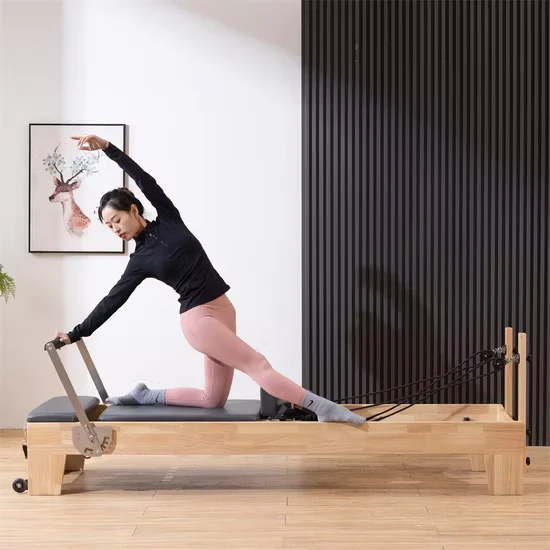
High-End Pilates Studios
Premium aesthetics meet quiet operation for boutique studio environments.
ISO
9001
CE
Certified
OEM
Available
10YR
Warranty
Pilates Reformer Machine, 240×557×52cm, 200kg Net Weight — solid-color steel frame engineered for continuous studio use with industrial-grade carriage rails and adjustable spring resistance for multi-level training. Customized branding options available with 3-year warranty coverage for commercial operators. Each unit undergoes 32-point inspection and full load testing before shipment to ensure structural integrity.
// Spec Highlights
• Direct from Manufacturer · No Middlemen · Worldwide Shipping
01
// Material
Imported Solid Wood
Premium hardwood frames sourced for density and visual warmth.
02
// Hardware
Medical-Grade Silent
Whisper-quiet pulleys and springs for clinical environments.
03
// Customization
Appearance OEM
Color, upholstery, and branding tailored to your studio.
04
// Service
Layout Design
Free venue planning for studios and rehab institutions.
Every component is selected for longevity, performance, and aesthetic harmony - from imported hardwood frames to silent medical-grade accessories.
// Features
11-Gauge Mill-Certified Steel — Every tube in this commercial Pilates reformer machine frame traces back to a specific coil batch from a certified steel mill, ensuring structural traceability that generic "commercial grade" claims simply cannot match.
| Parameter | Value |
|---|---|
| Product Type | Pilates Reformer Machine |
| Model NO. | SRY-08 |
| Frame Steel | 11-gauge steel, 3×3 inch tube |
| Steel Grade | Q235 industrial steel, mill-certified |
| Welding Type | Robotic MIG, continuous weld lines |
| Net Weight | 200 kgs |
| Product Dimensions | 240×557×52 cm / 257×81×52 cm |
| Carriage System | Industrial sealed bearings on precision rails |
| Upholstery | High-density commercial vinyl, available in standard or premium options |
| Powder Coating | 200μm scratch-resistant industrial finish |
| Spring Configuration | Multi-grade resistance springs, replaceable |
| Color | Solid color, customization available |
| Logo | Customized is allowed |
| Warranty | 3 Years |
| Certification | ISO 9001:2015, CE |
| Production Capacity | 80 Pieces/Month |
| HS Code | 9506911900 |
| Facility Type | Typical Use |
|---|---|
| Commercial Pilates studio | Daily group and private reformer sessions, 6–10 hours continuous operation |
| Boutique fitness facility | Hybrid Pilates and functional training floors with high member turnover |
| Rehabilitation and physical therapy center | Controlled resistance exercises for post-injury recovery and mobility work |
| Yoga studio expanding into apparatus work | Adding reformer-based programming alongside mat classes |
| Home studio (professional instructor) | Private client sessions requiring commercial durability without facility-scale footprint |
A reformer carriage drifting off-center at full extension almost always points to frame deflection, not wheel failure.
Studio owners frequently encounter reformers marketed as commercial Pilates reformer machines that develop carriage wobble within the first season of heavy rotation. The root cause sits in the frame tubes — lightweight gauge steel that flexes under eccentric loading during footwork and long-box series. Once the rails lose parallelism, wheels grind against misaligned tracks, and the entire movement feel degrades. I have seen facilities pull units from rotation after six months because the carriage no longer glides smoothly enough for client-facing sessions. [NEED_CITE: EN 957 structural requirements for stationary training equipment]
This Pilates reformer machine occupies the apparatus zone, typically positioned alongside Cadillacs, Wunda chairs, and barrels in a dedicated reformer studio layout. It covers the full spectrum of supine, prone, seated, and standing movement planes, targeting core stabilization, hip and shoulder mobility, and lower-body strength through spring-loaded resistance. In a high-density commercial Pilates studio, it pairs with tower units for vertical pulling work and spine correctors for articulation drills. The footprint suits facilities running back-to-back group classes with minimal changeover time between sessions. Users ranging from petite to above-average height can accommodate the carriage travel and spring attachment points.
Every reformer stroke generates eccentric force — the carriage decelerates at both ends of the rail, sending impulse loads through the frame joints. In a commercial Pilates reformer machine running eight or more sessions daily, each weld joint absorbs thousands of these deceleration cycles per week. The critical stress zones sit where the rail mounts meet the base frame and where the footbar assembly anchors to the main structure. Spot welds in these junctions develop micro-cracks under repeated off-axis loading, eventually propagating into visible fractures. Continuous robotic MIG welding distributes these forces along the full seam length rather than concentrating stress at discrete points. [NEED_CITE: weld classification and fatigue performance in structural steel] Sealed bearings at the carriage wheels prevent studio dust and cleaning solution residue from penetrating the rolling elements, which is a common failure path in units with open bearing designs.
The 11-gauge steel tube in the 3×3 inch profile resists deflection when a user drives full bodyweight into the footbar during heavy spring resistance work. This gauge and dimension combination maintains rail parallelism across the full carriage travel range, which directly determines whether the movement feels smooth or develops lateral play over time. The Q235 industrial steel grade provides consistent mechanical properties that trace to the originating mill coil, eliminating the variability that comes from sourcing unverified tube stock. The 200μm powder coating applied after sandblast preparation withstands daily contact with sweat, cleaning chemicals, and the mechanical abrasion of spring clips and carriage stops. Upholstery available in standard or high-density options addresses different replacement-cycle expectations — high-density foam maintains its profile through years of daily compression, while standard density suits lower-traffic environments. The multi-grade spring configuration allows instructors to match resistance to client capability without swapping hardware between sessions.
Thin-wall tube frames on reformers begin to show their limitations once daily session counts exceed what the engineering anticipated. Rails mounted on undersized steel develop micro-movements at the attachment points, which accelerates wheel wear and eventually requires rail realignment or full replacement. Non-sealed bearings in a studio environment accumulate chalk dust, skin cells, and cleaning fluid residue within the rolling elements — this creates the grinding noise and lateral play that clients notice during slow controlled movements. Low-density upholstery foam compresses permanently within months of heavy use, creating visible body impressions that compromise the professional appearance of the studio floor. Thin powder coating chips at the spring clip contact zones and footbar mounting points, exposing bare steel to sweat-driven corrosion that spreads beneath the remaining finish.
The 11-gauge frame steel with mill certification means every tube in this Pilates reformer machine is traceable to its source coil — you can verify what you received. Robotic MIG welding produces continuous seam lines at every structural joint, eliminating the spot-weld weak points that crack under eccentric carriage loading. Every unit undergoes load testing before shipment, confirming that the carriage system handles peak user weight without rail deflection or wheel binding. The 200μm industrial powder coating, applied over sandblasted surfaces, resists the chipping and chemical exposure that studio environments impose daily. The 3-year warranty backs the structural and mechanical components for the duration that commercial operators need to plan their equipment lifecycle. Facility layout support includes 2D and 3D CAD planning to ensure safe clearance between reformers and adjacent apparatus, accounting for carriage extension and instructor circulation paths.
Share your studio square footage and planned apparatus count so the 2D-3D layout can establish safe clearances around each commercial Pilates reformer machine, including full carriage travel and instructor movement zones. Specify your expected daily session volume to confirm that the structural grade aligns with your traffic intensity. Identify your client population height range to verify that the carriage travel and spring anchor positions accommodate the full spectrum of users. Communicate any branding requirements — color matching, logo placement, and upholstery selection — early in the specification process to align production scheduling.
Q: How do you distinguish a commercial-grade Pilates reformer from a light-commercial one?
A: Check the frame steel gauge and tube dimensions — commercial units specify exact measurements like 11-gauge with named tube profiles, while light-commercial often uses vague terms. Verify whether bearings are sealed industrial types or open designs. Ask for per-unit load testing records rather than sample-based testing claims. The warranty duration and what it covers structurally also signals the intended use grade.
Q: Why does frame steel gauge matter for carriage stability?
A: The carriage rails mount directly to the frame tubes. When those tubes flex under footbar loading or eccentric carriage deceleration, the rails lose parallelism. This creates lateral play in the carriage wheels and a grinding sensation during slow controlled movements. Thicker gauge steel with adequate cross-section resists this deflection, keeping the rails aligned through years of daily studio use.
Q: How should spring configuration be set up for mixed-level studio clients?
A: A multi-grade spring set allows instructors to dial resistance from very light rehabilitation work through heavy strength loading without swapping hardware between classes. Light springs suit beginners and therapeutic applications, medium springs cover the majority of classical Pilates repertoire, and heavy springs address advanced practitioners and athletic populations. Having all grades available on each commercial Pilates reformer machine eliminates session changeover delays.
Q: What maintenance do the rails, wheels, and springs require?
A: Sealed bearings on the carriage wheels need quarterly inspection for smooth rotation and absence of lateral play. Rails should be wiped clean of dust and residue weekly to prevent buildup that affects wheel tracking. Springs require visual inspection for deformation or loss of tension calibration, typically every six months in high-traffic studios. Replacement springs and wheel assemblies should be available as standard spare parts from the manufacturer.
Q: What customization options exist for studio branding and aesthetics?
A: Frame color can be matched to studio design schemes through the powder coating process, with solid color options available. Logo placement on the frame or carriage end is accommodated during production. Upholstery is available in standard or high-density options with color choices that align with the studio interior. These customizations are integrated into the manufacturing run rather than applied as aftermarket modifications.
Premium aesthetics meet quiet operation for boutique studio environments.
Medical-grade silence and precision for sports & postpartum recovery.
Furniture-grade craftsmanship for premium residential installations.
Compact premium setups for one-on-one and small-group training.
Aesthetic Pilates integration for hybrid wellness studio programming.
Multi-unit deployment with instructor-grade reliability for certification programs.
Tell us about your project. Our team will respond within 24 hours with pricing, customization options, and shipping details.
// Sales Director
William
+86 132 2531 1800
// Export Manager
Bella
+86 198 5412 8032
william@bickfit.com