01 / Scenario
STUDIO
P
High-End Pilates Studios
Premium aesthetics meet quiet operation for boutique studio environments.

ISO
9001
CE
Certified
OEM
Available
10YR
Warranty
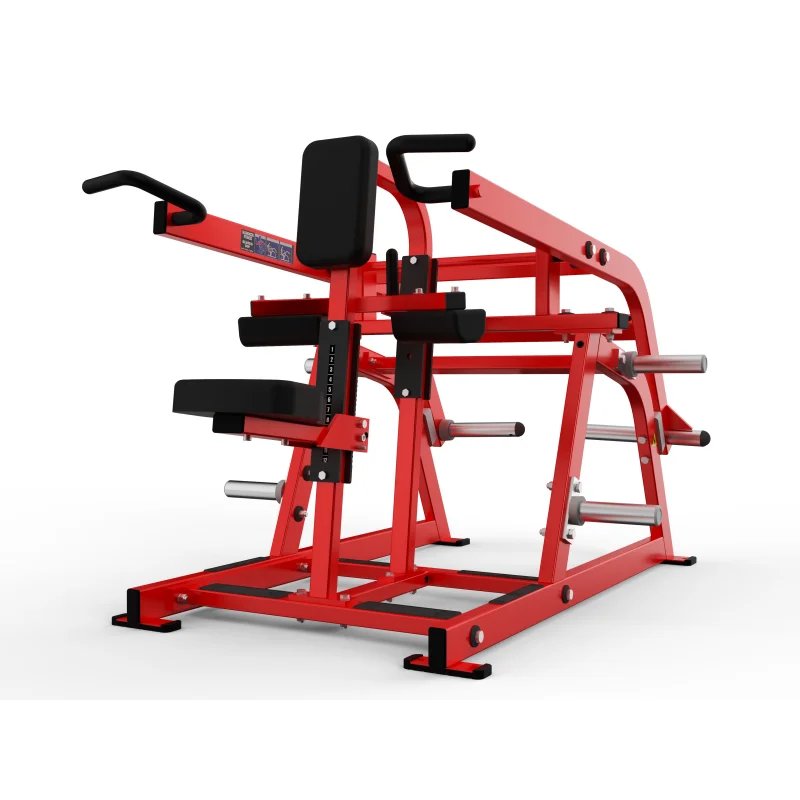
Commercial Plate Loaded Total Leg Press Machine, 1750×890×1580mm, 165kg Net Weight — engineered with industrial-grade steel frame construction for high-traffic commercial fitness facilities, featuring plate-loaded resistance system and ISO9001/CE certified manufacturing standards. Every unit undergoes rigorous load testing before shipment, backed by 10-year frame warranty and professional floor planning support for optimal gym layout.
// Spec Highlights
• Direct from Manufacturer · No Middlemen · Worldwide Shipping
01
// Material
Imported Solid Wood
Premium hardwood frames sourced for density and visual warmth.
02
// Hardware
Medical-Grade Silent
Whisper-quiet pulleys and springs for clinical environments.
03
// Customization
Appearance OEM
Color, upholstery, and branding tailored to your studio.
04
// Service
Layout Design
Free venue planning for studios and rehab institutions.
Every component is selected for longevity, performance, and aesthetic harmony - from imported hardwood frames to silent medical-grade accessories.
// Features
Robotic Continuous Welds — Every joint on this commercial plate loaded leg press machine is welded using robotic MIG with continuous seams, eliminating the cold joints and spot-weld weak points that fail under repeated heavy loading.
| Parameter | Value |
|---|---|
| Product Type | Plate Loaded Leg Press Machine |
| Frame Tube Size | 3×3 inch |
| Steel Grade | Q235 / Q345 industrial steel, mill-certified |
| Welding Type | Robotic MIG, continuous welds |
| Loading Type | Plate loaded |
| Product Dimensions | 1750 × 890 × 1580 mm |
| Net Weight | 165 kg |
| Certification | ISO 9001:2015, CE |
| OEM/ODM | Available |
| Facility Type | Typical Use |
|---|---|
| Commercial gym strength floor | High-volume plate loaded lower-body training during peak hours |
| Hotel and resort fitness center | Durable, low-maintenance leg press for diverse guest fitness levels |
| University strength and conditioning room | Heavy loading for athletic performance programs |
| Community fitness center | Reliable daily use across a broad user demographic |
Continuous robotic welds distribute stress across the full joint length, whereas spot welds create isolated stress concentrations that crack under cyclic loading.
Many manufacturers label their frames as "commercial grade" without disclosing actual steel gauge or wall thickness. Under sustained heavy use, vague specifications translate into frame flex at the carriage interface, carriage wobble at the guide rods, and eventually weld failure at the base-to-upright junction. A commercial plate loaded leg press machine that leaves these variables undefined is a liability waiting to surface during a peak-hour session. [NEED_CITE: weld classification and fatigue performance in structural steel]
This plate loaded leg press machine targets the sagittal-plane pressing pattern, engaging the quadriceps, gluteals, and hip extensors through a fixed convergence path. In a well-configured strength zone, it complements free-weight squat stations and functional rigs by offering a stable, high-load alternative that does not require a spotter. The fixed movement arc makes it suitable for facilities serving a wide range of user experience levels, from recreational members to competitive athletes. Its 1750 × 890 mm footprint allows dense placement on a commercial gym strength floor while maintaining safe clearance for plate loading and user egress.
A leg press endures a distinct combination of static compression, eccentric loading during the return phase, and lateral forces when users load plates unevenly. Over thousands of daily cycles, these forces concentrate at the carriage-to-frame interface, the guide rod mounting points, and the base welds. Unsealed bearings allow sweat, chalk dust, and rubber debris to infiltrate the bearing race, accelerating wear and introducing play that degrades movement smoothness. The powder coating at plate-loading contact points faces repeated impact from iron plates, testing adhesion and chip resistance far beyond what a thin decorative finish can withstand. [NEED_CITE: bearing seal classification and contamination resistance in fitness equipment]
The 3×3 inch frame tube cross-section provides a bending resistance profile that resists deflection under off-center plate loading — a scenario that occurs routinely when users load one side before the other. Robotic MIG welding with continuous seams ensures that stress is transferred uniformly along the joint rather than concentrating at discrete spot-weld locations. Sealed industrial bearings maintain lubrication integrity in environments where sweat aerosol and rubber floor debris are constant contaminants, extending service intervals compared to open or unsealed alternatives. The 200μm powder coating, applied after sandblast surface preparation, creates a film thickness that resists chipping at high-contact zones such as plate horns and footplate mounting areas.
Switching from 11-gauge to thinner-walled tubing reduces material cost per unit but introduces measurable frame deflection under loads that commercial users apply routinely. Spot welding is faster and cheaper than continuous welding, yet the resulting joint has a fraction of the fatigue life — and the defect remains invisible until a crack propagates through the base metal. Unsealed bearings that develop play within the first year force facility managers into reactive maintenance cycles, pulling equipment off the floor for service. Thin powder coating that chips at plate-loading contact points exposes bare steel to sweat and humidity, initiating corrosion that spreads beneath the surrounding finish. Non-standard hardware dimensions mean replacement parts are unavailable once the original supplier discontinues the model. [NEED_CITE: powder coating adhesion testing standards for fitness equipment frames]
Every frame on this commercial plate loaded leg press machine is built from mill-certified Q235 or Q345 steel with traceable coil origin, ensuring the gauge and grade match the engineering specification rather than a supplier’s verbal claim. Robotic MIG welding produces continuous seams on every structural joint, removing the variability inherent in manual spot welding. Each unit undergoes individual load testing before shipment — not a sample-batch audit — verifying that the assembled machine performs within structural tolerance. The 200μm industrial powder coating, applied over sandblasted steel, provides chip and corrosion resistance appropriate for high-contact commercial environments. A 10-year frame warranty backs the structural integrity of the steel and welds. For facility planners, 2D-3D CAD layout support ensures this leg press is positioned with correct clearance for plate loading, user access, and emergency egress paths. OEM private-label and custom color options are available for operators building a cohesive brand identity across their equipment fleet.
Provide your strength zone floor plan dimensions and current equipment list to receive a 2D-3D CAD layout showing optimal placement of this commercial plate loaded leg press machine with correct safety clearances. Specify your average daily user volume so the structural grade can be matched to your traffic intensity. If your facility requires custom frame color, private-label branding, or specific upholstery density, include those parameters in the inquiry to receive an accurate configuration quote.
Q: How can I verify that a leg press frame meets genuine commercial-grade structural requirements?
A: Request mill-certified steel documentation showing the specific gauge, tube dimensions, and steel grade with traceable coil origin. Confirm that welding is robotic continuous MIG rather than manual spot welding, and verify that each unit — not just a production sample — undergoes load testing before shipment. These three elements together distinguish a structurally rated commercial plate loaded leg press machine from one that merely carries a commercial label.
Q: What is the difference between plate loaded and selectorized leg press machines for a commercial facility?
A: Plate loaded machines accept standard Olympic plates, offering unlimited load progression and lower long-term cost since there are no weight stacks to replace. Selectorized machines use pin-select stacks for faster user transitions between loads. For high-traffic commercial gyms where users train at widely different resistance levels, plate loaded configurations provide greater flexibility and eliminate the weight-stack capacity ceiling that limits advanced lifters.
Q: How does frame tube size affect the structural performance of a leg press under heavy loading?
A: The 3×3 inch tube cross-section provides a higher moment of inertia compared to smaller profiles, meaning it resists bending under the eccentric and lateral forces generated during heavy leg pressing. When plates are loaded unevenly — a common occurrence in busy facilities — a larger tube cross-section prevents asymmetric frame deflection that would otherwise cause guide rod binding and uneven carriage travel.
Q: What maintenance intervals should a commercial facility plan for a plate loaded leg press machine?
A: Sealed industrial bearings require visual and functional inspection quarterly, with replacement only if play or roughness is detected. Structural bolts should be re-torqued after the first 50 operating hours and then annually. Powder-coated surfaces need routine cleaning with non-abrasive, pH-neutral products to preserve the 200μm film. Upholstery should be inspected monthly and replaced when compression affects user positioning or comfort.
Q: Can this leg press be customized for a private-label commercial gym brand?
A: OEM and ODM configurations are available, including custom frame powder coating color, private-label branding placement, and upholstery color or density selection. Provide your brand specifications and target facility environment details so the configuration can be matched to your operational requirements and aesthetic standards.
Premium aesthetics meet quiet operation for boutique studio environments.
Medical-grade silence and precision for sports & postpartum recovery.
Furniture-grade craftsmanship for premium residential installations.
Compact premium setups for one-on-one and small-group training.
Aesthetic Pilates integration for hybrid wellness studio programming.
Multi-unit deployment with instructor-grade reliability for certification programs.
Tell us about your project. Our team will respond within 24 hours with pricing, customization options, and shipping details.
// Sales Director
William
+86 132 2531 1800
// Export Manager
Bella
+86 198 5412 8032
william@bickfit.com
![[WARN] draft identifier mismatch Commercial ISO-Lateral Lateral Raise Machine for Gym Fitness](https://bickgym.com/wp-content/uploads/2026/08/warn-draft-identifier-mismatch-commercial-iso-lateral-lateral-raise-machine-for-gym-fitness-a8a9ac.webp)