01 / Scenario
STUDIO
P
High-End Pilates Studios
Premium aesthetics meet quiet operation for boutique studio environments.
ISO
9001
CE
Certified
OEM
Available
10YR
Warranty
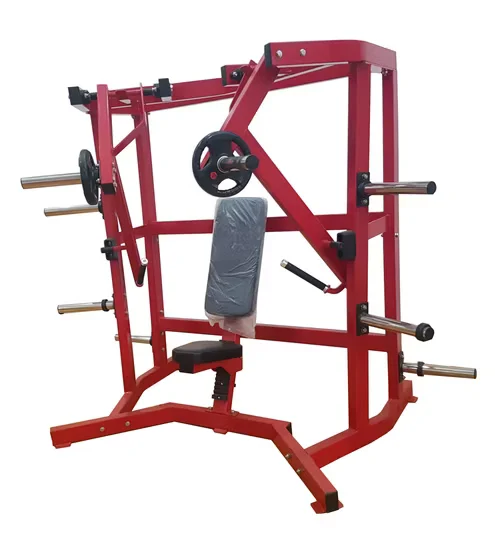
Plate Loaded Wide Chest Press, 3×3 Inch Frame Steel, 141kg Net Weight — engineered with robotic MIG continuous welding and 200μm industrial powder coating to eliminate cold joints and coating chips under heavy daily loading. Sealed bearings and aircraft-cable pulley systems maintain smooth operation across high-traffic commercial environments. Every unit undergoes full load testing before shipment, backed by a 10-year frame warranty and factory-direct floor planning support.
// Spec Highlights
• Direct from Manufacturer · No Middlemen · Worldwide Shipping
01
// Material
Imported Solid Wood
Premium hardwood frames sourced for density and visual warmth.
02
// Hardware
Medical-Grade Silent
Whisper-quiet pulleys and springs for clinical environments.
03
// Customization
Appearance OEM
Color, upholstery, and branding tailored to your studio.
04
// Service
Layout Design
Free venue planning for studios and rehab institutions.
Every component is selected for longevity, performance, and aesthetic harmony - from imported hardwood frames to silent medical-grade accessories.
// Features
Mill-Certified 11-Gauge Frame — Every 3×3 inch steel tube on this press traces back to its originating coil, eliminating the guesswork that leaves commercial operators exposed when unverified "commercial grade" claims fail under load.
| Parameter | Value |
|---|---|
| Product Type | Plate Loaded Chest Press |
| Frame Tube Size | 3×3 inch (76×76 mm) |
| Steel Grade | Q235 industrial steel, mill-certified |
| Welding Type | Robotic continuous MIG, full-penetration |
| Loading Type | Plate loaded |
| Upholstery | Available in standard or high-density options |
| Powder Coating | 200μm scratch-resistant, sandblast pretreatment |
| Product Dimensions | 1343×1981×1761 mm |
| Net Weight | 141 kg |
| Certification | ISO 9001, CE |
| Warranty | 10-year frame |
| Facility Type | Typical Use |
|---|---|
| Commercial gym strength floor | Primary pressing station for high-traffic member use |
| Hotel and resort fitness center | Durable chest training option with low maintenance requirements |
| University strength and conditioning room | Heavy-load pressing for athletic development programs |
| Rehabilitation and performance center | Controlled iso-lateral pressing for return-to-play protocols |
The pivot arm bracket is where most plate loaded wide chest press machines begin to fail, and the failure almost always starts at a spot weld.
Facilities running heavy-member-volume strength floors see these machines loaded and unloaded through hundreds of cycles daily. The pivot arms carry not just the plate weight but the dynamic shock of each rep’s deceleration phase. A spot weld creates a discrete fusion zone surrounded by heat-affected material that becomes brittle over repeated thermal and mechanical cycling. Within months, microscopic cracks propagate from the weld boundary, and what began as a minor tolerance issue becomes visible play in the pressing arm — the kind of play that shifts the movement path away from the intended biomechanical track and places uneven shear across the user’s shoulder joint [NEED_CITE: weld classification and fatigue performance in structural steel].
This machine targets the horizontal pressing plane, engaging the pectoralis major as the primary mover with secondary recruitment through the anterior deltoids and triceps. On a configured strength floor, it sits alongside incline and decline variants to give members a complete pressing spectrum without requiring free-weight spotter supervision. The iso-lateral converging movement path accommodates users ranging from smaller-framed individuals to large-build athletes, and the independent arm design allows single-arm work for corrective or rehabilitation purposes. A commercial plate loaded wide chest press occupies a dedicated footprint that should account for plate-loading clearance on both sides and safe passage behind the seat.
Static load tells only part of the story. Each repetition introduces an impact component at the bottom of the press where the loaded arms reverse direction, and that eccentric deceleration sends stress waves through the pivot hardware and into the main upright welds. In an eight-hour operating day with steady traffic, those fatigue cycles accumulate into thousands per week. The sealed bearings at each pivot point must maintain alignment without developing radial play, because any bearing degradation shifts load onto adjacent structural members not designed to carry it. The powder coating at contact zones — where plates scrape during loading and where adjustment pins seat — faces constant abrasion that thinner finishes cannot survive beyond the first year of commercial service [NEED_CITE: EN 957 structural requirements for stationary training equipment].
The 3×3 inch tube cross-section matters because torsional rigidity scales with the cube of the wall thickness dimension — meaning marginal reductions in gauge produce disproportionate losses in resistance to twisting forces during uneven plate loading. Continuous MIG welding produces a fusion line that distributes stress across the entire joint length rather than concentrating it at discrete points, which is where fatigue cracks initiate in spot-welded assemblies. The 200μm powder coating thickness, applied over a sandblasted surface, provides a mechanical bond that resists chipping at impact zones, whereas thinner coatings applied over inadequately prepared surfaces delaminate under the same conditions. Upholstery density directly determines how quickly the seat pad compresses into a concave shape that forces the user’s spine out of the intended support curve, which is why high-density options carry meaningful value in facilities where the machine sees constant rotation.
A thinner frame tube may hold its shape through the warranty period, but the progressive deformation under load changes the geometry of the pressing path in ways that are subtle until they become sudden. Spot-welded joints that pass visual inspection on delivery day carry no reserve capacity for the cyclic loading that defines commercial use, and the liability exposure when a pivot arm develops play mid-rep falls entirely on the facility operator. Non-sealed bearings accumulate sweat and cleaning chemical residue in their raceways, producing the grinding noise that signals imminent replacement — and if the bearing is not a standard industrial part, replacement becomes a custom-order delay that takes the machine offline. Low-density upholstery that compresses within months requires re-covering at a frequency that erases any initial cost saving, while exposed bare steel from coating failures accelerates corrosion at structural contact points [NEED_CITE: powder coating thickness standards for commercial fitness equipment].
The 11-gauge frame steel on this plate loaded wide chest press arrives with documentation tracing it to the producing mill, which is the difference between a verifiable material claim and a marketing statement. Robotic MIG welding eliminates the variability that comes from manual operators making real-time decisions about bead placement, ensuring the pivot arm brackets receive the same full-penetration weld pattern on every unit. Each machine undergoes load testing before it leaves the factory, meaning the structural assembly has been proven under force before it reaches your floor. The 200μm powder coating provides a wear surface that maintains appearance through years of plate contact and cleaning chemical exposure. A 10-year frame warranty backed by the manufacturing source — not a distributor with limited liability — changes the risk equation for long-term fleet planning. Facility layout CAD support ensures this machine’s footprint, plate-loading clearance, and adjacent-station spacing are resolved before installation rather than discovered after.
Provide the square footage of your pressing zone along with adjacent station selections to receive a scaled 2D-3D layout that resolves clearance and traffic flow around this machine. Specify expected daily user volume so the structural grade and upholstery density can be matched to actual operating conditions. Indicate the body-size range of your primary user population to confirm the seat and arm adjustment travel covers the necessary envelope. Detail any finish customization — frame color, logo placement, or upholstery material — at the inquiry stage so production scheduling accounts for the additional lead time.
Q: How can a facility operator verify that a plate loaded chest press frame meets true commercial specifications?
A: Request the mill certificate for the frame steel, which traces the material to its producing coil and confirms gauge and grade. Ask whether welding is continuous MIG or spot-welded, and request weld inspection records. Require evidence that each individual unit was load-tested before shipment, not just a sample batch. These three documents separate verified structural claims from generic commercial-grade descriptions that offer no traceability.
Q: What determines whether a plate loaded or selectorized chest press is the correct choice for a given facility?
A: Plate loaded machines suit environments where users load and unload their own weight, requiring no weight stack mechanism and its associated maintenance. Selectorized machines serve facilities prioritizing quick adjustment for high-turnover group training or supervised sessions. Plate loaded options typically carry lower lifetime maintenance costs, while selectorized options reduce the time between users. The decision rests on operational model and staffing rather than training effectiveness alone.
Q: How does equipment spacing affect safety and usability around a plate loaded wide chest press?
A: Inadequate spacing forces users to navigate around loaded plates and reduces clearance for spotter intervention during heavy sets. The machine footprint must account for the full range of plate diameters that will be loaded, plus passage width that meets accessibility standards. A scaled floor plan resolves these clearances before installation, preventing the situation where a correctly specified machine becomes operationally constrained by its placement relative to adjacent stations.
Q: What is the expected service life of upholstery on a commercial chest press in high-traffic conditions?
A: Upholstery lifespan depends on foam density, cover material grade, and daily usage volume rather than a fixed timeline. High-density foam options resist the concave compression that renders seats unsupportable, and commercial-grade covers resist splitting at stress points. Facilities should inspect pad condition during regular maintenance cycles and plan replacement based on observed compression rather than elapsed time, as usage patterns vary significantly between locations.
Premium aesthetics meet quiet operation for boutique studio environments.
Medical-grade silence and precision for sports & postpartum recovery.
Furniture-grade craftsmanship for premium residential installations.
Compact premium setups for one-on-one and small-group training.
Aesthetic Pilates integration for hybrid wellness studio programming.
Multi-unit deployment with instructor-grade reliability for certification programs.
Tell us about your project. Our team will respond within 24 hours with pricing, customization options, and shipping details.
// Sales Director
William
+86 132 2531 1800
// Export Manager
Bella
+86 198 5412 8032
william@bickfit.com