01 / Scenario
STUDIO
P
High-End Pilates Studios
Premium aesthetics meet quiet operation for boutique studio environments.
ISO
9001
CE
Certified
OEM
Available
10YR
Warranty
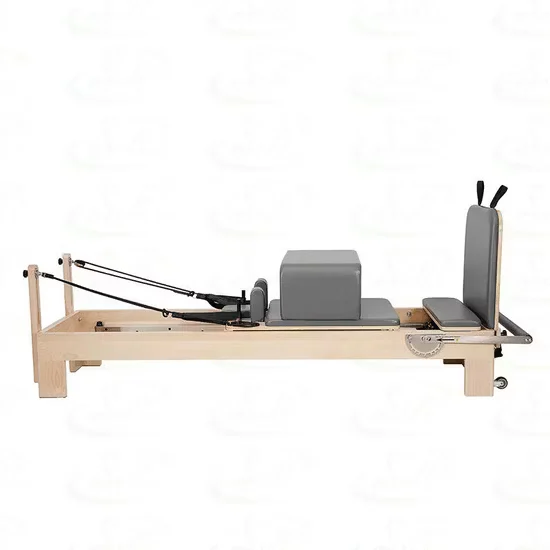
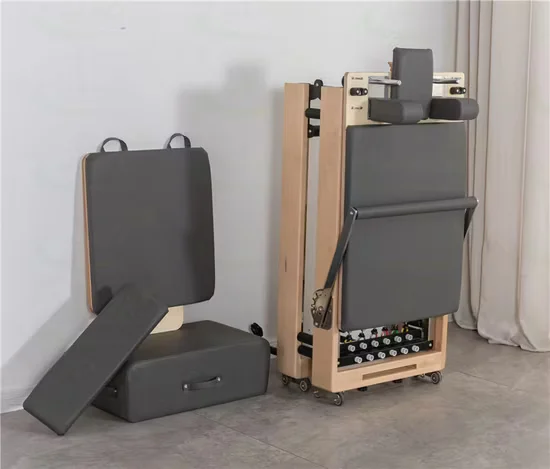
Portable Foldable Pilates Reformer, 2400×600×350mm, 100kg Net Weight — solid-wood carriage frame with foldable chassis, equipped with long box, jump board, and platform accessory set. CE certified with 3-year structural warranty and OEM private-label customization available. Direct from a 15,000㎡ vertically integrated plant with 17-year manufacturing heritage and 3-stage QC load testing on every unit before shipment.
// Spec Highlights
• Direct from Manufacturer · No Middlemen · Worldwide Shipping
01
// Material
Imported Solid Wood
Premium hardwood frames sourced for density and visual warmth.
02
// Hardware
Medical-Grade Silent
Whisper-quiet pulleys and springs for clinical environments.
03
// Customization
Appearance OEM
Color, upholstery, and branding tailored to your studio.
04
// Service
Layout Design
Free venue planning for studios and rehab institutions.
Every component is selected for longevity, performance, and aesthetic harmony - from imported hardwood frames to silent medical-grade accessories.
// Features
Solid-Wood Carriage Build — Each foldable Pilates reformer undergoes factory load testing to confirm frame and hinge integrity before shipment.
| Parameter | Value |
|---|---|
| Product Type | Pilates Reformer |
| Model NO. | SRY-20B |
| Specification | 2400×600×350mm |
| Net Weight | 100kgs |
| Carriage Material | Solid Wood |
| Accessory | Long Box / Jump Board / Platform |
| Color | Solid Color |
| Logo | Customized Is Allowed |
| Certification | CE (HS Code 9506911900) |
| Warranty | 3 Years |
| Facility Type | Typical Use |
|---|---|
| Pilates Studio | Daily group reformer classes with high-frequency carriage cycling |
| Boutique Fitness Studio | Hybrid classes blending reformer sequences with floor-based work |
| Home Gym | Space-efficient setups where the foldable chassis reclaims floor area |
| Rehabilitation Center | Controlled-range movement therapy with adjustable spring resistance |
| Hotel Fitness Room | Compact wellness facilities requiring equipment that stores vertically |
Solid wood outperforms laminated composites under cyclic spring tension and humidity swings.
Many portable foldable Pilates reformer units marketed as studio-grade arrive with plywood or MDF carriages that appear stable during the first weeks. Once exposed to daily class schedules — the constant spring loading and unloading, the sweat and humidity from back-to-back sessions — engineered composites begin to delaminate at the edges. The carriage develops lateral play on the rails, glide noise increases, and the movement quality degrades in ways that clients notice immediately [NEED_CITE: material fatigue behavior of engineered wood under cyclic tensile loading]. This is why carriage wood species and grade verification should be the first checkpoint on any procurement list. When we built our first reformer prototypes, the difference between solid-wood and laminated carriages became obvious within months of simulated studio use — one held dimensional stability, the other required replacement.
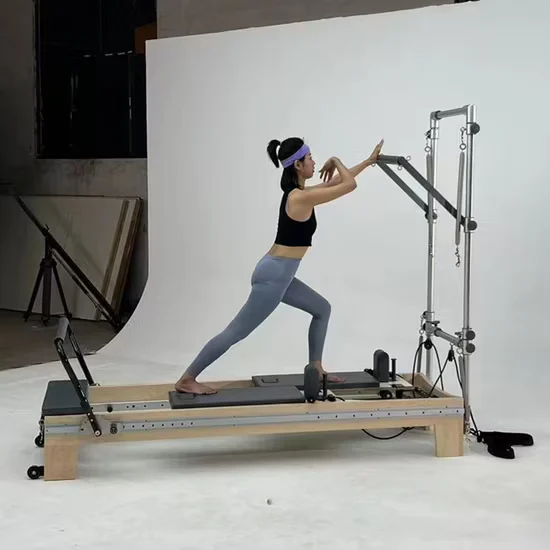
The portable foldable Pilates reformer commercial wood platform covers the full sagittal plane — spinal articulation, hip flexion and extension, leg press patterns — while the long box opens transverse and frontal plane work for rotational core sequences and lateral hip stabilization. In a studio layout, reformers typically occupy the primary class zone, and spacing between units must account for both the extended footprint and the instructor walkway. This reformer pairs with mat stations for warm-up sequences and with functional rig zones for standing accessory work. The adjustable spring resistance accommodates users from post-rehabilitation populations through advanced practitioners, meaning a single fleet serves mixed-level class rosters without equipment swaps.
Every reformer session generates hundreds of carriage cycles, each one a load-reverse-load event on the rail-wheel interface and the spring anchoring points. The carriage wheels absorb impact at each direction change, and unsealed bearings accumulate dust and fiber debris that increases rolling friction over time [NEED_CITE: bearing contamination and friction increase in cyclic linear motion systems]. The folding hinge mechanism faces a different challenge — it must bear the full structural load of the frame when deployed while also surviving thousands of fold-unfold cycles without developing joint play. Spring anchors undergo constant tension cycling, and any inconsistency in anchor geometry leads to uneven resistance curves that trained instructors detect within the first few repetitions. The solid-wood carriage frame resists warping under these combined stresses better than composite alternatives, maintaining rail alignment through seasonal humidity shifts.
The solid-wood carriage frame is the central structural decision. Solid timber maintains consistent grain continuity, which means the rail mounting surfaces stay flat and true — no delamination risk, no moisture-induced swelling that throws off wheel-to-rail clearance. The foldable hinge mechanism requires load-bearing joint design rather than simple pin hinges; the locking system must engage positively without wobble, and the hinge pins must be sized for the full equipment weight plus dynamic user load. Spring specification matters beyond just color-coding — progressive resistance calibration and fatigue life determine whether the resistance curve stays consistent through a 50-minute class or goes dead on the later exercises. The CE certification confirms conformity with European safety directives for stationary training equipment, covering structural load testing and mechanical safety requirements [NEED_CITE: EN 957 structural requirements for stationary training equipment].
Thin-wall aluminum extrusion rails on budget reformers develop visible wear grooves within the first year of commercial use, and replacement rails are often unavailable from the original supplier. Non-sealed carriage wheels require monthly cleaning and bearing swaps in studio environments — downtime that compounds across a fleet of ten or more units. Plywood carriages with veneer finishes chip at the contact edges, exposing the composite core to moisture ingress and accelerating delamination. Undersized spring anchors with poor surface finish create friction hotspots that wear through spring loops prematurely, and proprietary spring dimensions lock studios into single-supplier replacement chains. When hinge mechanisms use light-duty hardware, the frame develops a perceptible sway during dynamic exercises, and instructors lose confidence in the equipment’s stability for standing and kneeling work.
Our portable foldable Pilates reformer commercial wood construction starts with wood species selection verified at the incoming material stage — no engineered composites enter the carriage production line. The foldable chassis undergoes cycle testing at the hinge points to confirm joint integrity under repeated deployment, and every unit receives a structural load test before it leaves the factory floor. The powder-coated steel hardware throughout the frame is finished to a scratch-resistant industrial standard that holds up against daily cleaning agents and perspiration exposure. Three-stage quality inspection covers dimensional accuracy of the carriage and rails, spring resistance calibration, and hinge locking engagement — each stage logged per unit. OEM private-label capability allows studios to align equipment branding with their visual identity, from logo engraving on the carriage to custom upholstery on the long box and platform.
Provide your studio floor dimensions and planned reformer count to receive a 2D-3D layout showing unit spacing, instructor walkways, and storage zones for the folded units. Specify your daily class volume and user population — rehabilitation-focused facilities and advanced-athlete studios need different spring calibration ranges. Indicate any custom branding or upholstery color requirements so these are built into the production specification rather than applied after assembly.
Q: How do I verify that a reformer carriage is solid wood rather than engineered composite?
A: Request a material certificate specifying wood species and grade from the manufacturer. Inspect the carriage end grain — solid wood shows continuous grain patterns through the full thickness, while engineered composites display layered or particle-based internal structure. Solid wood also has consistent density across the section, whereas MDF and plywood have visible density transitions at the core.
Q: What structural points should I inspect on a foldable reformer’s hinge mechanism?
A: Examine the hinge pin diameter relative to the joint load rating, check that the locking mechanism engages with positive detent rather than friction fit, and look for reinforced gusseting around the hinge mounting area. After repeated folding cycles, any lateral play at the joint indicates pin or bushing wear that will worsen under class-load conditions and affect carriage stability.
Q: How often do carriage wheels and rails need maintenance in a commercial studio environment?
A: In high-frequency studio use, inspect wheels monthly for flat spots and bearing noise. Clean rails weekly to remove dust and skin particulate buildup that accelerates wheel wear. Unsealed bearings typically require replacement within the first year of daily class scheduling, while sealed units extend maintenance intervals significantly. Rail surface condition directly determines carriage glide quality and should be checked for scoring or groove formation.
Q: How should I calibrate spring resistance levels for different class formats?
A: Match spring tension to the movement patterns in your programming — lighter springs for spinal articulation and control-focused sequences, heavier springs for leg press and hip-dominant strength work. Confirm that the manufacturer’s spring color coding corresponds to documented resistance values at specific carriage positions, and request progressive resistance curves rather than single-point force measurements for accurate class planning.
Q: What customization options are available for studio branding and upholstery?
A: Logo engraving on the solid-wood carriage, custom upholstery colors on the long box and platform padding, and frame color options allow studios to match equipment to interior design. Confirm that customization is applied during manufacturing rather than retrofitted, as post-production modifications can compromise surface integrity and void structural warranty coverage on affected components.
Premium aesthetics meet quiet operation for boutique studio environments.
Medical-grade silence and precision for sports & postpartum recovery.
Furniture-grade craftsmanship for premium residential installations.
Compact premium setups for one-on-one and small-group training.
Aesthetic Pilates integration for hybrid wellness studio programming.
Multi-unit deployment with instructor-grade reliability for certification programs.
Tell us about your project. Our team will respond within 24 hours with pricing, customization options, and shipping details.
// Sales Director
William
+86 132 2531 1800
// Export Manager
Bella
+86 198 5412 8032
william@bickfit.com