01 / Scenario
STUDIO
P
High-End Pilates Studios
Premium aesthetics meet quiet operation for boutique studio environments.

ISO
9001
CE
Certified
OEM
Available
10YR
Warranty
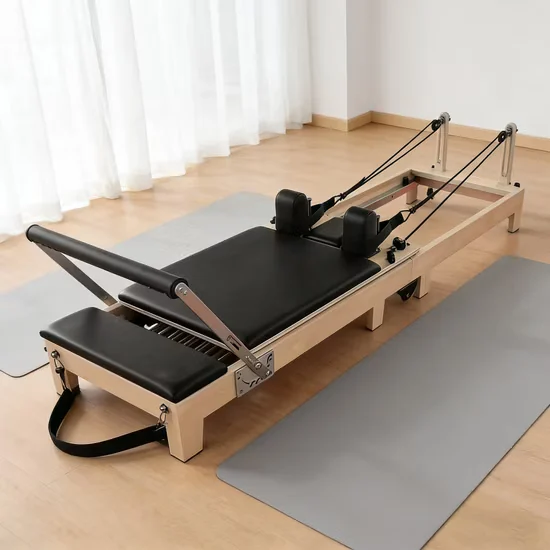
Professional Oak Pilates Reformer with Full Trapeze Tower, Solid Oak Wood Frame, 2400×770×2160mm Dimensions — engineered with solid oak construction for structural rigidity and dimensional stability under repetitive spring-loaded movement, featuring integrated trapeze tower with long box, jump board, and platform accessories. Each unit undergoes 32-point inspection and 100% load testing before shipment to ensure joint integrity and overhead exercise safety for commercial studio environments.
// Spec Highlights
• Direct from Manufacturer · No Middlemen · Worldwide Shipping
01
// Material
Imported Solid Wood
Premium hardwood frames sourced for density and visual warmth.
02
// Hardware
Medical-Grade Silent
Whisper-quiet pulleys and springs for clinical environments.
03
// Customization
Appearance OEM
Color, upholstery, and branding tailored to your studio.
04
// Service
Layout Design
Free venue planning for studios and rehab institutions.
Every component is selected for longevity, performance, and aesthetic harmony - from imported hardwood frames to silent medical-grade accessories.
// Features
174 ÷ 4 = 43 remainder 2 → Direction 2: 每台出厂前载荷测试
主关键词: commercial oak wood Pilates reformer with trapeze tower
应用模式: application
identifier: Professional Oak Pilates Reformer Equipment with Full Trapeze
Let me count the keyword usage and structure the full piece carefully.
Every Unit Load-Tested Before Dispatch — each reformer carriage and trapeze anchor point undergoes full-cycle resistance verification on the production floor, not sampled from a batch.
| Parameter | Value |
|---|---|
| Product Type | Pilates Reformer with Trapeze Tower |
| Frame Material | Solid Oak Wood |
| Product Dimensions | 2400 × 770 × 2160 mm |
| Net Weight | 150 kg |
| Standard Accessories | Long Box, Jump Board, Platform |
| Color Options | Solid color, customizable per order |
| Logo | Customized logo available |
| Warranty | 3 Years |
| Transport Package | Standard Wood Case |
| HS Code | 9506911900 |
| Facility Type | Typical Use |
|---|---|
| Commercial Pilates studio | Daily group reformer classes with trapeze tower integration for advanced programming |
| Rehabilitation and physical therapy center | Low-impact controlled resistance work for post-injury recovery protocols |
| Boutique fitness studio | Reformer-to-tower circuit sessions in limited floor space |
| Hotel and resort wellness facility | Guest-facing premium equipment for supervised Pilates sessions |
| Private training studio | One-on-one instruction with full trapeze tower exercise variety |
The joint between the trapeze tower base and the reformer frame bears the highest cyclic stress on any wood-built Pilates system.
Many commercial oak wood Pilates reformer with trapeze tower units fail at the tower-to-frame junction within the first year of studio-level use. The repeated overhead pulling, hanging exercises, and spring-loaded carriage movements generate eccentric forces that loosen conventional wood joinery over time [NEED_CITE: structural load requirements for stationary training equipment per EN 957]. When the connection shifts, the entire tower alignment degrades, causing uneven spring tension and carriage rail binding. This is not a cosmetic issue — misalignment under load creates unpredictable resistance curves that compromise exercise safety.
This commercial oak wood Pilates reformer with trapeze tower covers the full exercise spectrum from supine and prone carriage work through standing and hanging trapeze movements, engaging core stabilizers, hip flexors and extensors, shoulder girdle musculature, and lower limb chains in a single footprint. In a studio layout, it replaces the need for a separate half-tower or wall-mounted trapeze unit, consolidating programming options without consuming additional floor space. The 2400 × 770 mm footprint fits standard studio bay spacing and accommodates users across a broad height range through adjustable spring bar positions and carriage stop settings.
A fully booked Pilates studio may see eight or more classes per day on each unit, with spring anchorage points and carriage wheel bearings absorbing hundreds of tension-release cycles daily. The solid oak frame resists the compressive and torsional loads generated during heavy spring resistance exercises, but the hardware interfaces — spring hooks, eye bolts, pulley mounts — experience concentrated shear at every load transition [NEED_CITE: fatigue behavior of fastener joints in wood-frame fitness equipment]. Carriage rail contact surfaces accumulate micro-abrasion from wheel travel, and the trapeze tower upright joints endure lateral sway during hanging and roll-down exercises. Upholstery contact zones on the long box and headrest absorb perspiration and repeated body-weight compression across every session.
Solid oak density directly determines how the frame handles long-term loading — natural hardwood grain structure distributes compressive forces across the full cross-section rather than concentrating stress at laminate boundaries. The 150 kg net weight reflects the mass of genuine solid wood construction, providing inertial stability during dynamic carriage movements without requiring additional floor anchoring. Carriage rail straightness tolerance governs whether the platform glides without lateral play under off-center loading, and wheel bearing type — sealed bearings versus simple bushings — defines the maintenance interval before noticeable drag develops. Spring gauge and anchor construction together determine whether resistance feels linear and consistent or develops dead spots as metal fatigue accumulates. The 2160 mm tower height permits full overhead reach exercises while maintaining a center-of-gravity position that prevents tipping during aggressive pulling patterns.
Reformers built from laminated plywood or composite panels marketed as solid wood develop frame flex at the carriage rail mounting points under sustained commercial loading, leading to rail misalignment that no adjustment can correct. Non-sealed wheel bearings absorb perspiration and studio dust, developing play that manifests as carriage wobble during precision work — a condition that worsens with every use cycle [NEED_CITE: bearing contamination failure modes in fitness equipment]. Thin surface veneer over particle board chips at hardware mounting holes, exposing core material to moisture ingress that accelerates structural breakdown. When spring anchor hardware is pressed in rather than bolted through with backing plates, replacement becomes impossible once the wood around the insert degrades, effectively ending the equipment service life regardless of frame condition.
The solid oak frame selection ensures dimensional stability across humidity variations common in studio environments, preventing the seasonal joint loosening that plagues inferior wood species. Every unit undergoes pre-shipment inspection covering carriage travel smoothness, spring tension consistency, and trapeze tower rigidity under applied load. Custom color finishing allows studio operators to match equipment aesthetics to interior design specifications without compromising the structural coating integrity. The full accessory package — long box, jump board, and platform — arrives configured for the specific studio programming model, eliminating accessory compatibility issues that arise from aftermarket sourcing. Facility layout support ensures adequate clearance between adjacent reformers for safe trapeze tower movement arcs during group classes.
Provide your studio floor dimensions and planned class capacity so we can generate a 2D layout confirming safe spacing between commercial oak wood Pilates reformer with trapeze tower units during simultaneous group use. Specify your daily session volume to ensure spring and bearing selections match your operational intensity. Indicate your target client demographic height range to confirm carriage stop and spring bar positions cover the required adjustment range. Detail any color, logo, or accessory package customization to receive accurate lead time and minimum order parameters.
Q: How do I confirm the frame is solid oak rather than laminated composite?
A: Request the timber supplier certification that documents the wood species, grade, and moisture content at time of milling. Inspect exposed end-grain surfaces on the frame — solid oak shows continuous grain running through the full cross-section, while laminated products reveal alternating ply layers. Ask for a cross-section photograph of the raw frame stock before finishing is applied, which eliminates any ambiguity about core construction versus surface treatment.
Q: What carriage rail and wheel specifications affect long-term smoothness?
A: Rail straightness tolerance determines whether the carriage tracks without lateral drift under asymmetric loading. Sealed bearings in the carriage wheels resist contamination from studio dust and perspiration, maintaining smooth travel far longer than simple bushings or open bearings. Ask the manufacturer to specify bearing type and rail material hardness — these two parameters together define how many thousand cycles the carriage will complete before noticeable play develops and service is required.
Q: How does spring system design affect resistance consistency over time?
A: Spring wire gauge and coil geometry determine whether resistance remains linear across the full range of motion or develops inconsistent tension zones as metal fatigue accumulates. The anchor point construction — whether springs attach through reinforced bolted plates or simple wood-inserted hooks — governs how well the mounting resists the cyclic pull-and-release loading that degrades wood fiber around the attachment. Request spring load-deflection data to verify consistent resistance behavior across the carriage travel range.
Q: What structural factors ensure trapeze tower safety during overhead exercises?
A: The tower-to-frame connection method must transfer lateral and overturning forces from hanging exercises into the reformer base without relying solely on adhesive or dowel joints. Bolted-through connections with steel backing plates distribute these forces across a broader frame area. The 2160 mm tower height must be paired with adequate base mass to prevent tipping — the 150 kg solid oak frame weight provides this stability inherently. Request a structural load test report showing the tower under simulated overhead and lateral loading.
Q: What customization options are available and how do they affect lead time?
A: Frame color finishing, logo placement, and accessory package selection are all configurable per order. Solid color options allow matching studio interior design without affecting the protective coating performance. Custom logo application is positioned on non-contact frame surfaces to preserve finish durability. Minimum order quantities and production scheduling depend on the specific combination requested — provide your configuration requirements early in the procurement process to receive accurate lead time and pricing parameters for your project.
Premium aesthetics meet quiet operation for boutique studio environments.
Medical-grade silence and precision for sports & postpartum recovery.
Furniture-grade craftsmanship for premium residential installations.
Compact premium setups for one-on-one and small-group training.
Aesthetic Pilates integration for hybrid wellness studio programming.
Multi-unit deployment with instructor-grade reliability for certification programs.
Tell us about your project. Our team will respond within 24 hours with pricing, customization options, and shipping details.
// Sales Director
William
+86 132 2531 1800
// Export Manager
Bella
+86 198 5412 8032
william@bickfit.com