
01 / Scenario
STUDIO
P
High-End Pilates Studios
Premium aesthetics meet quiet operation for boutique studio environments.
ISO
9001
CE
Certified
OEM
Available
10YR
Warranty
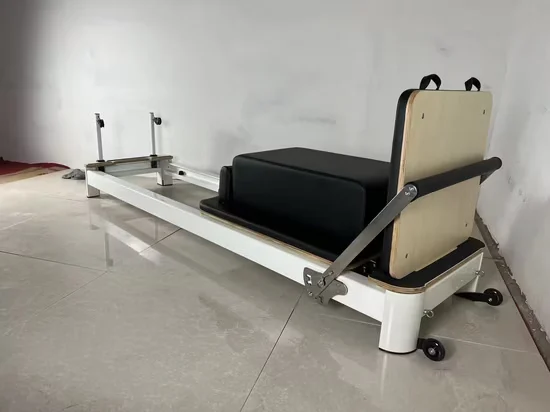
Pilates Reformer Machine, White Aluminum Alloy Frame, 2570×730mm Dimensions, 70kg Net Weight — engineered for high-traffic commercial studios with sealed carriage bearings and progressive spring tension calibration across full travel range. Includes long box, jump board, and platform accessories with high-density foam upholstery and reinforced seam construction. Backed by 3-year warranty and available logo/color customization for studio branding.
Every unit undergoes load testing before shipment to ensure structural integrity for daily commercial use.
// Spec Highlights
• Direct from Manufacturer · No Middlemen · Worldwide Shipping
01
// Material
Imported Solid Wood
Premium hardwood frames sourced for density and visual warmth.
02
// Hardware
Medical-Grade Silent
Whisper-quiet pulleys and springs for clinical environments.
03
// Customization
Appearance OEM
Color, upholstery, and branding tailored to your studio.
04
// Service
Layout Design
Free venue planning for studios and rehab institutions.
Every component is selected for longevity, performance, and aesthetic harmony - from imported hardwood frames to silent medical-grade accessories.
// Features
Material Traceability — Every aluminum extrusion batch carries mill certification traceable to the alloy coil, eliminating the guesswork in commercial studio procurement.
| Parameter | Value |
|---|---|
| Product Type | Pilates Reformer Machine |
| Frame Material | White Aluminum Alloy |
| Color Options | White (custom colors available) |
| Product Dimensions | 2570 × 730 × 350 mm |
| Net Weight | 70 kg |
| Accessories | Long Box / Jump Board / Platform |
| Customization | Logo and color available |
| Production Capacity | 80 Pieces/Month |
| Warranty | 3 Years |
| Facility Type | Typical Use |
|---|---|
| Commercial Pilates Studio | High-frequency group reformer classes with minimal equipment downtime |
| Rehabilitation and Physical Therapy Center | Controlled resistance protocols for patient recovery programs |
| Hotel and Resort Wellness Facility | Premium aesthetic equipment maintaining finish under intensive cleaning |
| University Athletic Training Room | Functional movement assessment and athlete recovery sessions |
Corrosion resistance and dimensional stability under cyclic spring loading define the service gap between reformer frame materials.
Reformer frames marketed as commercial grade often rely on thin-gauge steel tubing that develops micro-deformation along the carriage rail after repeated spring tension cycles. In humid studio environments where sweat aerosol and cleaning chemicals are constant, uncoated or poorly finished steel rails oxidize at contact points, accelerating carriage wheel wear. [NEED_CITE: EN 957 structural requirements for stationary training equipment] An aluminum alloy track resists this degradation path entirely, maintaining rail straightness through thousands of carriage travel cycles without the surface treatment failures that plague steel alternatives.
This reformer addresses the sagittal plane across full-body resistance training, targeting core stabilization, lower limb alignment, and spinal articulation through carriage-based exercises. In a commercial Pilates studio layout, it pairs with Cadillac towers and Wunda chairs to complete the apparatus ecosystem. The 730 mm width permits side-by-side placement with adequate instructor clearance for hands-on cueing. The commercial white aluminum pilates reformer machine accommodates users across a broad anthropometric range, with carriage travel sufficient for full-extension movements by taller practitioners.
Carriage springs impose repeated eccentric loading on the frame rail and end-stop anchors during group class sequences. At high-frequency studios running back-to-back sessions, the carriage wheel bearings endure continuous dust and fiber ingress from studio flooring. [NEED_CITE: bearing fatigue classification under cyclic radial loading] The aluminum frame’s welded joints at the foot bar mount and shoulder rest anchor experience concentrated stress during jump board exercises, where impact forces multiply beyond static spring tension. Upholstery contact surfaces on the carriage and headrest compress and release hundreds of times daily, demanding foam density that resists permanent set over months of commercial rotation.
The aluminum alloy frame eliminates the corrosion vulnerability that compromises steel reformers in climate-controlled studios with elevated humidity from group classes. Sealed carriage wheel bearings prevent particulate accumulation that causes track play and uneven resistance feel within the first year of studio use. The spring tension mechanism delivers progressive resistance calibrated to maintain consistent load across the full carriage travel distance, avoiding the dead spots that develop when springs lose tension uniformity. High-density upholstery with reinforced seam construction resists the compression set and edge splitting that forces studios into premature reupholstery cycles. The 2570 mm overall length provides carriage travel adequate for full-range exercises while the 350 mm height positions the work surface at an ergonomic working level for instructor adjustments. Powder coating thickness on the aluminum frame determines whether the white finish survives daily contact with cleaning solvents and sweat residue without chalking or discoloration.
Thin-walled aluminum or downgraded steel rails flex under spring tension, producing carriage drift that instructors compensate for by reducing exercise difficulty. Non-sealed bearings require scheduled lubrication and develop lateral play, generating maintenance labor that compounds across a studio’s reformer fleet. [NEED_CITE: maintenance interval cost modeling for commercial fitness equipment] Low-density foam carriage padding compresses permanently within months, creating an uneven surface that compromises exercise precision and forces upholstery replacement. Insufficient powder coating thickness allows oxidation to begin at wear points, producing surface roughness that accelerates carriage wheel degradation and degrades the visual standard clients expect from a premium studio environment.
The aluminum alloy frame material carries mill certification documenting alloy composition and mechanical properties, providing studios with verifiable specifications rather than generic grade claims. Robotic MIG welding produces continuous weld lines at structural joints, eliminating the incomplete fusion points that manual welding introduces at carriage rail anchors. Every unit undergoes load testing before shipment, verifying carriage travel smoothness and spring calibration against production tolerance rather than relying on sample-based batch inspection. The 200μm industrial powder coating resists chipping at contact points where carriage stops and spring hooks concentrate mechanical wear. The three-year warranty reflects structural confidence backed by facility planning support, including 2D layout CAD files that map reformer spacing and instructor circulation clearances for group class configurations. OEM customization for color and logo application integrates with studio branding without compromising the structural finish specification.
Provide your studio floor area and intended reformer count to receive a 2D-3D layout plan with instructor circulation paths and safety clearances mapped. Specify your daily class volume and average user profile to confirm the structural grade matches your operational intensity. Detail any branding requirements including custom color matching or logo placement to align equipment aesthetics with your studio identity.
Q: How do commercial-grade reformers differ structurally from home-use models?
A: Commercial reformers use thicker frame extrusions, sealed bearings rated for continuous operation, and higher-density upholstery designed for daily class rotation. Home models prioritize cost reduction with thinner materials and open bearings that develop play under frequent use. The gap appears within months when home-spec equipment enters a studio environment.
Q: What maintenance does the aluminum alloy frame require compared to steel?
A: Aluminum frames resist corrosion from studio humidity and cleaning chemicals without the surface treatment degradation that affects steel. Maintenance focuses on carriage bearing inspection and spring calibration rather than rust prevention. The aluminum surface maintains its finish under intensive cleaning schedules typical in commercial wellness facilities.
Q: How does carriage wheel bearing design affect long-term studio operation?
A: Sealed bearings prevent dust and fiber ingress from studio floors, maintaining smooth carriage travel without scheduled lubrication. Open bearings accumulate particulate matter that creates lateral play and uneven resistance feel, requiring regular maintenance that adds labor cost across a studio’s full reformer fleet over time.
Q: What clearance spacing should studios plan between reformers?
A: Adequate lateral clearance allows instructors to move between stations for hands-on cueing during group classes. The reformer footprint and accessory deployment zones must account for jump board extension and long box placement. A detailed floor plan prevents unusable gaps while maintaining safe circulation paths for both practitioners and instructors.
Premium aesthetics meet quiet operation for boutique studio environments.
Medical-grade silence and precision for sports & postpartum recovery.
Furniture-grade craftsmanship for premium residential installations.
Compact premium setups for one-on-one and small-group training.
Aesthetic Pilates integration for hybrid wellness studio programming.
Multi-unit deployment with instructor-grade reliability for certification programs.
Tell us about your project. Our team will respond within 24 hours with pricing, customization options, and shipping details.
// Sales Director
William
+86 132 2531 1800
// Export Manager
Bella
+86 198 5412 8032
william@bickfit.com


