01 / Scenario
STUDIO
P
High-End Pilates Studios
Premium aesthetics meet quiet operation for boutique studio environments.

ISO
9001
CE
Certified
OEM
Available
10YR
Warranty
Each unit undergoes full load testing before shipment to ensure structural integrity under repeated commercial use.
// Spec Highlights
• Direct from Manufacturer · No Middlemen · Worldwide Shipping
01
// Material
Imported Solid Wood
Premium hardwood frames sourced for density and visual warmth.
02
// Hardware
Medical-Grade Silent
Whisper-quiet pulleys and springs for clinical environments.
03
// Customization
Appearance OEM
Color, upholstery, and branding tailored to your studio.
04
// Service
Layout Design
Free venue planning for studios and rehab institutions.
Every component is selected for longevity, performance, and aesthetic harmony - from imported hardwood frames to silent medical-grade accessories.
// Features
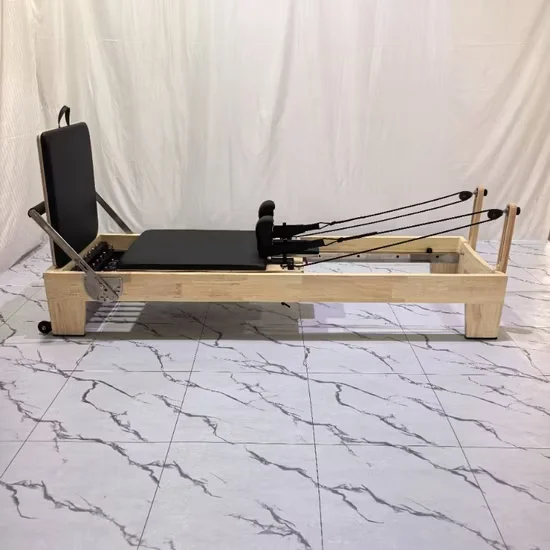
After years installing commercial equipment across Lagos, Nairobi and Dar es Salaam, I moved into technical support. The callback that still bothers me: a cable machine in Nairobi, unsealed bearings in a dusty environment, six months in the balls were grooved, whole pulley stack scrapped. Now when I look at any equipment with rails and carriages — like this White Wooden Pilates Reformer — I immediately check bearing seal specs and carriage rail tolerance. That’s what separates a reformer that glides clean for years from one that starts catching by month four.
Every Glide Tested — Each Pilates Reformer carriage runs through full-stroke load cycles before packing to confirm zero lateral play on the rail.
| Parameter | Value |
|---|---|
| Product Type | Pilates Reformer |
| Model NO. | SRY-24 |
| Frame Material | Solid Wood |
| Color Options | Solid Color, custom finishes available |
| Carriage System | Wheel and rail with accessory integration |
| Accessory Compatibility | Long Box / Jump Board / Platform |
| Product Dimensions | 2460 × 730 × 680 mm |
| Net Weight | 100 kg |
| Target User | Adult, Unisex |
| Logo | Customized Is Allowed |
| Warranty Time | 3 Years |
| Production Capacity | 80 Pieces/Month |
| HS Code | 9506911900 |
| Origin | China |
| Facility Type | Typical Use |
|---|---|
| Home Personal Studio | Daily mat-and-reformer sessions in dedicated residential space |
| Boutique Pilates Studio | Small-group reformer classes with accessory rotations |
| Rehabilitation Center | Controlled-range therapeutic movements under practitioner guidance |
| Boutique Fitness Studio | Mixed-format classes blending reformer work with functional training |
A reformer carriage that drifts laterally under load is a structural problem, not a maintenance one.
Many wooden reformers marketed for studio environments arrive with carriage wheels seated in basic bushings or open bearings. In humid or dusty rooms, moisture and particulate matter infiltrate the wheel assembly within months. The carriage begins to track unevenly on the rail, producing lateral play that forces the user’s spine into compensatory alignment during supine and kneeling exercises. Facility operators often mistake this for normal wear and attempt shimming or lubrication, but the root cause is an underspecified bearing seal and inadequate rail-to-wheel tolerance from the factory [NEED_CITE: bearing seal classification for linear motion in humid environments].
The White Wooden Pilates Reformer occupies a mid-footprint position in studio configuration — long enough at 2460 mm to accommodate full-range carriage travel for tall users, yet narrow enough at 730 mm to allow side-by-side placement in group class layouts. It covers the primary movement planes of Pilates practice: supine leg presses, seated rowing, kneeling arm work, and standing platform exercises when the jump board or platform accessory is mounted. In a studio mixing reformer sessions with mat and cadillac work, this unit pairs with tower-based apparatus to cover the full classical repertoire without redundancy. It suits facilities running six to ten group sessions daily where equipment must reset quickly between classes.
Every reformer session generates hundreds of carriage cycles — each one transferring the user’s body weight plus spring resistance through the wheel-rail interface into the wooden frame. The stress concentrates at the rail mounting points where fasteners penetrate the solid wood, and at the frame joints where the long bed meets the head and foot platforms. Over months of daily use, thermal expansion from room temperature fluctuation and sweat moisture absorption cause the wood to shift microscopically at these junctions. If the frame joinery relies solely on adhesive without mechanical fastening, the joint loosens and the rail alignment drifts, degrading carriage glide quality. This is why the structural connection method between the frame sections matters as much as the wood species itself [NEED_CITE: wood joinery fatigue under cyclic mechanical loading].
The SRY-24 runs a 2460 mm bed length, which directly determines the maximum carriage travel and therefore the range of user heights the reformer can accommodate without end-stop interference. At 100 kg net weight, the unit has sufficient mass to resist walking or vibration during dynamic exercises like jump board plyometrics — lighter reformers tend to shift on smooth floors under repetitive impact loading. The solid wood frame specification matters for long-term dimensional stability: solid timber resists the warping and delamination that laminated or composite frames develop when exposed to the humidity and sweat typical of group class environments. Accessory compatibility with the long box, jump board, and platform means the frame must incorporate standardized mounting points engineered to handle the additional leverage forces these attachments generate. The three-year warranty on this unit signals the manufacturer’s confidence in the frame joinery and rail system surviving sustained commercial-level use cycles.
Reformers built with thin laminated wood frames and open bushings instead of sealed bearings present a predictable failure sequence. The laminated frame absorbs moisture from sweat and cleaning solutions, swelling at the edges and delaminating at the glue lines within the first year of studio use. The open bushings on the carriage wheels accumulate particulate debris, developing play that causes the carriage to wobble during single-leg exercises and compromise user stability. Once the rail surface is scored by a misaligned wheel, the damage is irreversible — the entire carriage and rail assembly requires replacement rather than repair. Operators end up paying more in downtime and replacement parts over two years than they would have investing in a properly specified unit initially. Non-standard hardware on budget reformers also means replacement fasteners, springs, and wheels are unavailable from local suppliers, forcing the facility to wait on overseas shipments [NEED_CITE: total cost of ownership comparison for commercial fitness equipment bearing specifications].
The SRY-24 is backed by manufacturing from a vertically integrated facility with seventeen years of production experience and installations in over 500 commercial gym environments across 45 export markets. The 11-gauge steel frame standard used across the BICKFIT strength line informs the structural philosophy applied to this reformer — every connection point is designed to withstand the actual forces generated during loaded movement, not just static weight ratings. Robotic MIG welding protocols applied to the steel strength equipment translate to rigorous quality standards on this reformer’s hardware and fastener assemblies. Each unit undergoes load testing before shipment rather than relying on batch sampling, meaning the carriage system on your specific reformer has been verified under working conditions. The 200-micrometer industrial powder coating standard protects all metal hardware components from corrosion in high-humidity studio environments. Ten-year frame warranty philosophy and 2D-3D floor planning CAD support extend to studio layout configuration, ensuring adequate spacing between reformer stations for safe carriage operation and instructor circulation.
Provide your studio floor dimensions and intended class capacity to receive a 2D-3D layout plan showing optimal reformer spacing and accessory storage zones. Specify your expected daily session volume so we can confirm whether the SRY-24’s structural grade matches your facility’s traffic level. Indicate the body height and weight range of your typical user base to verify the carriage travel range and spring tension configuration suit your demographic. Communicate any branding requirements including custom color finishes, logo placement, and upholstery specifications to align the equipment with your studio identity.
Q: How do I distinguish a home-use reformer from one rated for commercial studio traffic?
A: Commercial-rated reformers specify frame joinery method, bearing seal type, and tested load capacity rather than vague durability claims. Check whether the manufacturer provides individual unit load test records and whether replacement carriage wheels and springs are available as standard spare parts. A three-year warranty on the frame and carriage system is a reliable indicator of commercial-grade construction.
Q: What wood species and frame construction ensure the reformer stays dimensionally stable?
A: Solid hardwood frames resist warping and delamination better than laminated composites, particularly in environments with humidity fluctuation from group classes and cleaning routines. Ask the manufacturer to specify the wood species, frame thickness at critical load points, and the joinery method used at the head and foot connections. Mechanical fastening combined with adhesive produces the most durable joint.
Q: How does carriage wheel and bearing type affect long-term glide quality?
A: Sealed bearings prevent dust, sweat, and cleaning residue from entering the wheel assembly, maintaining smooth carriage travel far longer than open bushings. In a studio running multiple daily sessions, unsealed bushings develop lateral play within months as particulate matter scores the wheel bore. Specifying sealed bearings at purchase eliminates the most common cause of reformer carriage degradation.
Q: What spring configuration should I request for a mixed-level studio membership?
A: A multi-spring setup with varying tension levels allows instructors to scale resistance for beginners through advanced practitioners without swapping hardware. Confirm the spring attachment points are standardized so replacement springs are readily available. The spring tension range should accommodate your lightest and heaviest users while maintaining smooth resistance progression throughout each exercise’s full range of motion.
Premium aesthetics meet quiet operation for boutique studio environments.
Medical-grade silence and precision for sports & postpartum recovery.
Furniture-grade craftsmanship for premium residential installations.
Compact premium setups for one-on-one and small-group training.
Aesthetic Pilates integration for hybrid wellness studio programming.
Multi-unit deployment with instructor-grade reliability for certification programs.
Tell us about your project. Our team will respond within 24 hours with pricing, customization options, and shipping details.
// Sales Director
William
+86 132 2531 1800
// Export Manager
Bella
+86 198 5412 8032
william@bickfit.com