01 / Scenario
STUDIO
P
High-End Pilates Studios
Premium aesthetics meet quiet operation for boutique studio environments.

ISO
9001
CE
Certified
OEM
Available
10YR
Warranty
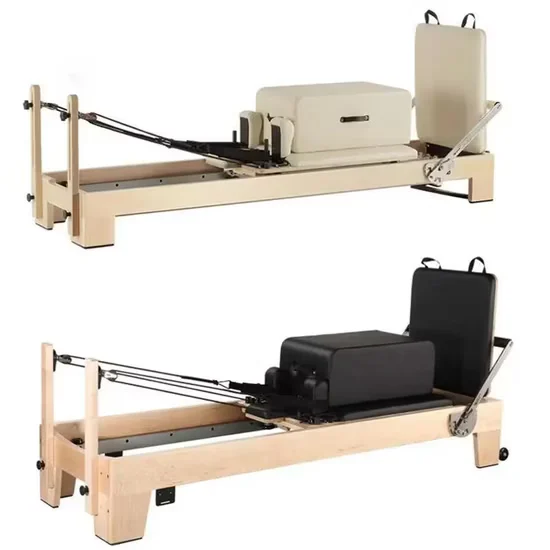
Commercial Pilates Reformer Machine, 2460×730×680mm, 100kg — engineered with a solid steel frame and industrial-grade powder coating to resist torsion under asymmetric spring loads, featuring continuous welding at high-stress joints for long-term fatigue resistance. Includes long box, jump board, and platform for full-range training, backed by ISO 9001:2015, CE, and SGS certifications. Each unit undergoes 100% load testing before shipment to ensure structural integrity under daily commercial use.
// Spec Highlights
• Direct from Manufacturer · No Middlemen · Worldwide Shipping
01
// Material
Imported Solid Wood
Premium hardwood frames sourced for density and visual warmth.
02
// Hardware
Medical-Grade Silent
Whisper-quiet pulleys and springs for clinical environments.
03
// Customization
Appearance OEM
Color, upholstery, and branding tailored to your studio.
04
// Service
Layout Design
Free venue planning for studios and rehab institutions.
Every component is selected for longevity, performance, and aesthetic harmony - from imported hardwood frames to silent medical-grade accessories.
// Features
Continuous Weld Lines — Robotic MIG welding eliminates spot-weld weak points at high-stress carriage joints.
| Parameter | Value |
|---|---|
| Product Type | Pilates Reformer |
| Model NO. | SRY-19 |
| Overall Dimensions | 2460 × 730 × 680 mm |
| Net Weight | 100 kg |
| Frame Construction | Heavy-duty steel frame, continuous MIG welded |
| Carriage System | Sealed bearing track with smooth-gliding carriage |
| Included Accessories | Long Box / Jump Board / Platform |
| Upholstery | Commercial-grade vinyl, available in standard or high-density options |
| Finish | Scratch-resistant powder coating |
| Spring System | Heavy-duty tension springs, multiple resistance levels |
| Pulley and Rope System | Industrial-grade pulleys with reinforced ropes |
| Certification | ISO 9001:2015 / CE / SGS |
| Warranty | 3 Years |
| Color | Solid Color (custom color options available) |
| Logo | Customized Is Allowed |
| Origin | China |
| Facility Type | Typical Use |
|---|---|
| Commercial Pilates Studio | Daily group and private reformer sessions |
| Boutique Fitness Facility | Mixed-format classes integrating reformer work |
| Rehabilitation Center | Controlled movement therapy and post-injury recovery |
| Home Fitness (Dedicated Space) | Personal training and daily practice for serious practitioners |
A reformer’s frame either holds alignment under hundreds of daily spring-tension cycles, or it doesn’t — wall thickness decides which side you’re on.
The commercial pilates reformer machine market is flooded with units labeled "commercial grade" that offer no verifiable steel specification. Thin-wall tubing may pass a visual inspection, but under repeated asymmetric spring loading and dynamic carriage movement, torsional flex accumulates until the carriage track drifts and the pulley anchors shift. I once supplied a reformer to a studio where the buyer insisted on thin-wall square tube to cut cost — within six months, the carriage slid off-axis and a spring seat weld tore clean through, rendering the entire unit scrap [NEED_CITE: structural fatigue in welded thin-wall tube assemblies]. That experience locked my position: frame specs must be documented and weld lines must be continuous.
A commercial pilates reformer machine anchors the controlled-resistance zone of any serious studio layout. It trains the full sagittal plane through spring-loaded pushing and pulling, covering lower-body, spinal articulation, and upper-body work in a single station. In a mixed-equipment floor, it pairs with the Cadillac for vertical-plane work and the Wunda Chair for weight-bearing stability challenges. Studios running eight or more classes per day need reformers that tolerate constant carriage traffic without track wear or spring fatigue. The SRY-19 accommodates a wide range of user heights through its platform and long box configurations, making it practical for group classes where client body types vary session to session.
A reformer in a busy studio endures thousands of carriage cycles daily — each one an eccentric load event where spring tension pulls against the carriage bearings and track. The highest stress concentrates at the spring anchor plate and the carriage end-stops, where sudden deceleration generates impact forces through the weld joints. Over months, spot welds at these junctions develop micro-cracks that propagate under continued cycling [NEED_CITE: weld classification and fatigue performance in structural steel]. Pulley ropes abrade against guide surfaces with every pull, and non-sealed bearings accumulate chalk dust and sweat residue that accelerates track wear. Upholstery on the carriage and long box compresses under body weight hundreds of times per day, and low-density foam flattens within months, exposing the rigid substrate beneath.
Frame wall thickness determines the threshold at which torsional flex appears under uneven spring tension — when a client pulls from one side, the frame must resist twisting or the carriage track deforms and binding follows. Continuous MIG welding produces uniform penetration along the full joint length, unlike spot welds that leave unwelded gaps where stress concentrates and cracks initiate. Sealed bearings on the carriage track prevent contamination from studio dust and cleaning chemicals, maintaining smooth travel over years rather than months. The powder coating must be applied at sufficient thickness to resist chipping at contact points where metal hardware meets the frame — thin coatings expose bare steel to sweat and humidity, starting corrosion that spreads under the finish. Spring tension ratings and pulley diameter together determine whether the rope system delivers smooth, predictable resistance or develops stutter and play.
Thin-wall tube saves weight and material cost upfront, but under daily studio traffic, it deflects under load and fatigues at weld points far earlier than heavier-gauge steel. Spot welds that pass a quick visual check fail unpredictably under cyclic spring loading, creating both a safety liability and a reputation risk for the studio. Non-sealed bearings require frequent cleaning and eventual replacement — a maintenance burden that compounds across a floor of twenty reformers. Low-density upholstery foam compresses permanently within months, forcing costly reupholstering or full carriage replacement [NEED_CITE: EN 957 structural requirements for stationary training equipment]. Thin powder coating chips at bolt holes and hardware contact points, leaving bare steel exposed to corrosion in a high-humidity studio environment.
The steel used in the SRY-19 frame is sourced with mill certification traceable to the coil, so the material spec is documented rather than vaguely labeled. Robotic MIG welding produces continuous weld lines at every structural joint — no spot-weld shortcuts at spring anchors or carriage stops. Every unit undergoes load testing before shipment, not sample-based batch inspection. The industrial powder coating is applied at 200μm thickness, providing scratch and corrosion resistance at high-wear contact points. The three-year warranty covers the frame under commercial use conditions. For studio buildouts, 2D and 3D CAD layout support is available to plan reformer spacing — ensuring safe clearance between units for instructor movement and client access. OEM color and logo customization is available for studios building a branded equipment identity.
Provide your studio floor area and target reformer count to receive a 2D-3D layout plan with proper spacing between units. Specify your expected daily class volume and average client profile so the structural grade and upholstery density can be matched to your traffic. Confirm your branding requirements — custom frame color, logo placement, and upholstery selection — to align the equipment with your studio identity.
Q: How can I tell if a reformer is truly built for commercial studio use?
A: Request the mill-certified steel specification for the frame tubing and verify the welding method at load-bearing joints. Commercial-grade units use continuous welds rather than spot welds, and the frame wall thickness should be documented. Inspect the carriage bearing type — sealed bearings resist contamination in a high-traffic studio environment where dust and cleaning agents are constant.
Q: What frame specifications ensure the reformer will hold alignment over years of daily use?
A: The frame tube gauge and wall thickness determine resistance to torsional flex under asymmetric spring loads. Heavier-gauge steel with a documented cross-section maintains track alignment far longer than thin-wall tubing. Continuous MIG welds at spring anchors and carriage stops prevent the micro-crack propagation that spot welds develop under thousands of daily tension cycles.
Q: How should I maintain the pulley and spring systems for consistent performance?
A: Inspect pulley ropes monthly for fraying at guide contact points and replace before strand failure. Clean carriage bearings on a regular schedule to remove accumulated studio dust and sweat residue that causes track roughness. Verify spring tension quarterly — springs that have lost their rated resistance should be replaced as a set to maintain balanced loading across the carriage.
Q: What accessories are essential for a fully equipped reformer studio?
A: A long box enables seated and supine pulling exercises that expand the exercise library significantly. A jump board converts the reformer into a plyometric platform for athletic conditioning. An extended platform supports standing work and client mounting. Including these accessories at purchase avoids the cost and logistics of retrofitting individual units later.
Q: How should I plan studio layout spacing between reformers?
A: Each reformer requires the full footprint plus clearance on all sides for instructor access and safe client mounting. Plan for lateral clearance between units so clients can mount and dismount without contacting adjacent equipment. A professional 2D or 3D CAD layout accounts for these clearances against your actual floor dimensions, preventing unusable gaps or unsafe crowding.
Premium aesthetics meet quiet operation for boutique studio environments.
Medical-grade silence and precision for sports & postpartum recovery.
Furniture-grade craftsmanship for premium residential installations.
Compact premium setups for one-on-one and small-group training.
Aesthetic Pilates integration for hybrid wellness studio programming.
Multi-unit deployment with instructor-grade reliability for certification programs.
Tell us about your project. Our team will respond within 24 hours with pricing, customization options, and shipping details.
// Sales Director
William
+86 132 2531 1800
// Export Manager
Bella
+86 198 5412 8032
william@bickfit.com