01 / Scenario
STUDIO
P
High-End Pilates Studios
Premium aesthetics meet quiet operation for boutique studio environments.
ISO
9001
CE
Certified
OEM
Available
10YR
Warranty
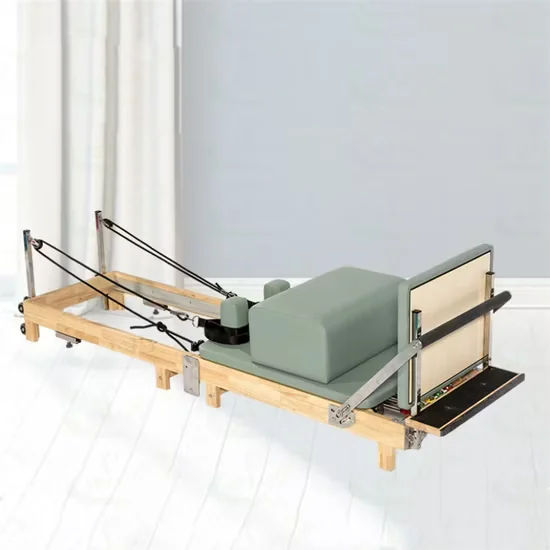
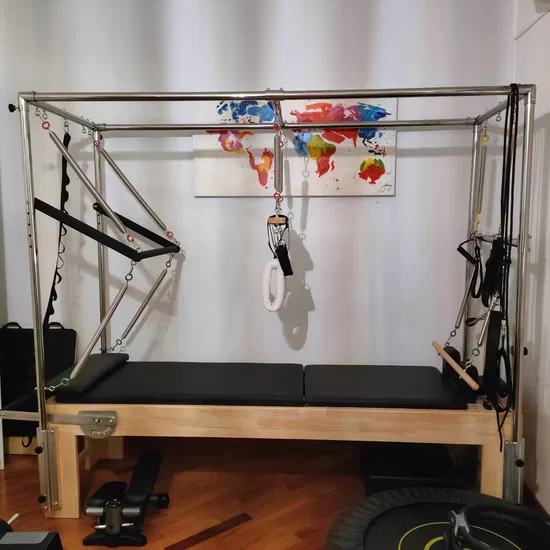
Pilates Reformer Cadillac with Tower, 2400×770×2160mm, 150kg Net Weight — reinforced steel frame with integrated tower, jump board, and long box for full-body resistance training. Precision-machined carriage rail and sealed pulley system ensure smooth operation under repeated spring-loaded cycles. 3-year warranty with factory-direct support for commercial studio deployment.
// Spec Highlights
• Direct from Manufacturer · No Middlemen · Worldwide Shipping
01
// Material
Imported Solid Wood
Premium hardwood frames sourced for density and visual warmth.
02
// Hardware
Medical-Grade Silent
Whisper-quiet pulleys and springs for clinical environments.
03
// Customization
Appearance OEM
Color, upholstery, and branding tailored to your studio.
04
// Service
Layout Design
Free venue planning for studios and rehab institutions.
Every component is selected for longevity, performance, and aesthetic harmony - from imported hardwood frames to silent medical-grade accessories.
// Features
Continuous MIG Weld Lines — robotic arc welding eliminates cold joints on every load-bearing carriage rail and tower upright of this Pilates Reformer Cadillac with Tower.
| Parameter | Value |
|---|---|
| Product Type | Pilates Reformer Cadillac with Tower |
| Frame Construction | Reinforced steel frame |
| Product Dimensions | 2400 × 770 × 2160 mm |
| Net Weight | 150 kg |
| Upholstery | Commercial-grade, solid color options |
| Powder Coating | Scratch-resistant industrial finish |
| Accessories Included | Long Box, Jump Board, Platform |
| Logo Customization | Available on request |
| Target User | Adult, Unisex |
| Warranty | 3 Years |
| Facility Type | Typical Use |
|---|---|
| Boutique Pilates Studio | Daily group reformer and tower-based classes with repeated spring cycling |
| Hotel & Resort Wellness Center | Guest-accessible full-body Pilates sessions in low-to-moderate traffic environments |
| Rehabilitation & Physiotherapy Clinic | Controlled spring-loaded resistance for joint mobility and post-injury conditioning |
A Pilates frame either resists torsional flex or it doesn’t — there is no middle ground under spring tension.
When a Pilates Reformer Cadillac with Tower is built around thin-wall tubing, the first failure rarely shows up on day one. It surfaces months later, when a practitioner loads the tower for overhead trapeze work or attaches the jump board for repetitive plyometric rebounds. The uprights begin to deflect under eccentric loading, and the carriage rail interface develops micro-play that translates into lateral drift during footwork sequences. Studios that purchase equipment marketed loosely as "studio grade" without verifying wall thickness often find themselves replacing pulleys and realigning rails within the first year of commercial use [NEED_CITE: structural deflection thresholds in tubular steel frames under cyclic loading].
This commercial pilates reformer cadillac with tower occupies a central role in any studio layout, covering supine, prone, seated, and standing movement planes through the integrated tower and reformer carriage combination. It pairs naturally with dedicated mat zones and smaller apparatus like stability chairs, allowing a studio to cycle clients through varied resistance modalities without redundant equipment. The full-length carriage accommodates a wide range of user heights, making it suitable for facilities serving diverse clientele from rehabilitation patients to advanced practitioners.
Every reformer session generates hundreds of spring tension cycles through the carriage and tower anchor points. These are not static loads — they involve rapid eccentric release and re-engagement that concentrate stress at weld joints where the tower uprights meet the base frame. Over months of daily studio scheduling, fatigue accumulates at these junctions, particularly where spot welding leaves discontinuous bond lines. The pulley routing on the tower section also endures continuous directional changes, meaning bearing surfaces experience multidirectional wear rather than simple axial rotation [NEED_CITE: fatigue performance in welded tubular structures under cyclic tensile loading]. Upholstery contact points on the carriage platform face compression and shear from body weight shifts, requiring material that resists permanent deformation across thousands of sessions.
The frame dimensions of this unit at 2400 × 770 × 2160 mm create a large-format structure where torsional rigidity depends entirely on steel wall thickness and joint integrity. A thicker tube wall raises the threshold before elastic deformation becomes permanent — critical when the tower supports hanging exercises or when the jump board generates impact rebound through the carriage. Continuous robotic MIG welding produces uniform penetration along the full joint length, avoiding the cold-start weaknesses inherent in manual spot welding where each arc initiation creates a potential crack nucleation site. Powder coating applied at sufficient thickness over properly prepared steel surfaces prevents moisture ingress at contact points where springs anchor and where the carriage wheels interface with the rail system.
When manufacturers reduce tube wall thickness to lower shipping weight, the frame may pass initial static load tests but will progressively deflect under the dynamic spring cycles of daily commercial use. Spot-welded joints that appear solid on visual inspection can develop hairline fractures at load-bearing tower connections, creating liability exposure for studio operators. Unsealed pulley bearings accumulate dust and moisture from the studio environment, leading to grinding resistance that degrades the smooth cable travel essential for controlled Pilates movements. Insufficient powder coating thickness at spring anchor points and rail contact zones chips away under mechanical abrasion, exposing bare steel to oxidation that spreads beneath adjacent coating layers [NEED_CITE: coating failure mechanisms in fitness equipment under mechanical abrasion]. Low-density upholstery compresses permanently within months of heavy scheduling, forcing studios into costly reupholstery cycles or full pad replacements.
Every frame begins with steel sourced against mill certification, ensuring material composition is traceable rather than assumed. Robotic MIG welding runs continuous bead lines on all structural joints of this commercial pilates reformer cadillac with tower, eliminating the weak points where manual spot welds create discontinuous bonds. Each unit undergoes load testing before crating — not sample-based batch testing, but individual verification under loaded conditions. Industrial powder coating at 200μm thickness protects the large-format frame surface against chipping at high-contact zones like spring anchors and carriage rail edges. The three-year warranty on this unit backs structural claims with enforceable coverage. Facility operators can request 2D or 3D CAD layouts that account for the 2400 × 770 mm footprint plus the safe clearance zones needed around the tower for overhead and hanging exercises.
Share your studio floor dimensions and intended class capacity so we can generate a 2D-3D layout that positions this unit with proper clearance zones for tower-based overhead work and jump board rebound sequences. Specify your expected daily session volume so we can confirm the structural grade matches your traffic profile. Communicate any custom color, logo placement, or upholstery density preferences early to align production scheduling with your facility opening or renovation timeline.
Q: How do I tell if a Pilates reformer is truly built for commercial studio use?
A: Request the frame steel specification including wall thickness and ask for mill certification rather than accepting vague "studio grade" claims. Inspect weld lines on load-bearing joints — continuous robotic MIG welds outperform spot welds under repetitive spring tension cycles. Verify the warranty covers structural frame failure, not just cosmetic defects. Commercial units also use sealed bearings in pulleys to withstand dust and moisture accumulation over extended daily use.
Q: What role does frame tube gauge play in long-term structural rigidity?
A: Thicker tube walls raise the deformation threshold when the tower supports hanging exercises or when the carriage absorbs jump board impact. Thin-wall tubing may pass initial static tests but progressively deflects under thousands of dynamic spring cycles, leading to rail misalignment and lateral carriage drift. The relationship between tube gauge and frame rigidity is not linear — a small reduction in wall thickness disproportionately reduces the structure’s resistance to torsional flex during asymmetric loading patterns.
Q: What tower attachment options affect exercise versatility on this unit?
A: The integrated tower on this commercial pilates reformer cadillac with tower supports spring-loaded arm and leg work at multiple height positions, trapeze and roll-down bar attachments for spinal articulation sequences, and overhead cable routing for standing resistance exercises. The range of available attachment points determines how many movement patterns a single unit can accommodate, reducing the need for supplementary apparatus in space-constrained studio environments.
Q: What is the typical spring replacement schedule for high-traffic studios?
A: Springs in daily commercial use gradually lose their calibrated tension rating as the metal fatigues through repeated extension and compression cycles. Studios scheduling multiple classes per day should inspect spring tension quarterly and plan replacement based on observable elongation or inconsistent resistance feedback. Tower springs and carriage springs experience different load profiles, so replacement intervals may differ between the two systems depending on which exercise patterns dominate your class programming.
Premium aesthetics meet quiet operation for boutique studio environments.
Medical-grade silence and precision for sports & postpartum recovery.
Furniture-grade craftsmanship for premium residential installations.
Compact premium setups for one-on-one and small-group training.
Aesthetic Pilates integration for hybrid wellness studio programming.
Multi-unit deployment with instructor-grade reliability for certification programs.
Tell us about your project. Our team will respond within 24 hours with pricing, customization options, and shipping details.
// Sales Director
William
+86 132 2531 1800
// Export Manager
Bella
+86 198 5412 8032
william@bickfit.com