Roman Chair Multi-Site Gym Equipment Manufacturer for Sale
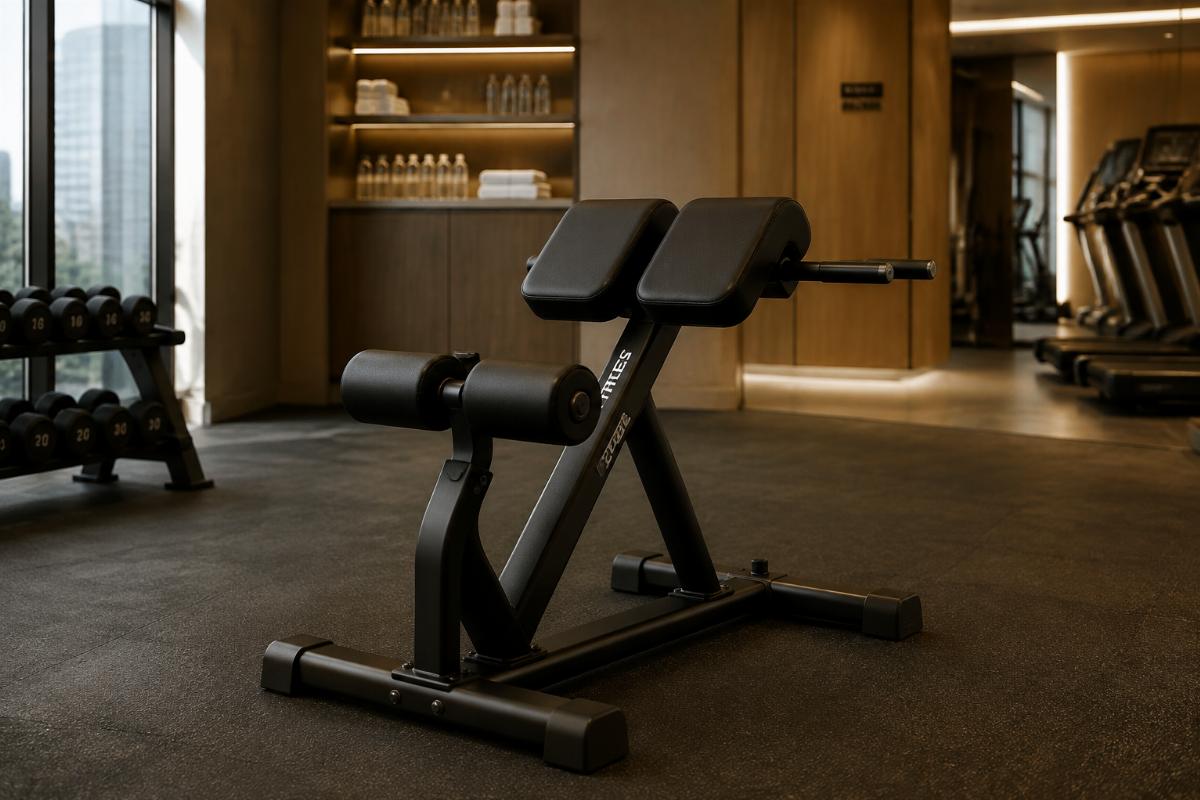
Most buyers think a Roman chair is just a simple back-extension bench. The truth is, tube wall thickness and welding quality decide whether it survives three months in a commercial gym or lasts five years.
When deploying Roman Chair across hotel fitness centers, commercial chains, and boutique studios, the single most important decision is not price—it is whether you spec commercial-grade or light-commercial-grade tube gauge, and whether you standardize that spec across every site in the rollout. A Shandong-based Roman Chair multi-site gym equipment manufacturer for sale that understands this difference will save you from warranty claims, weld failures, and mid-project spec changes.
I spent an afternoon in the back storage room of a five-star hotel in Riyadh a few years ago. Two Roman chairs were lying on the floor, the welds under the back pad cracked clean through, and the steel tube was visibly bent. That project had been completed only months earlier. The buyer had chosen a light-commercial spec to keep the per-unit cost down, and the hotel’s maintenance team was already filing claims. From that day on, whenever I review a spec sheet for a Roman Chair multi-site gym equipment manufacturer for sale order, the first thing I pull up is the tube wall thickness and the load test report. In the Middle East, where gym rooms run hot and usage frequency is high, anything below commercial-grade tube gauge simply does not hold up.
Let me walk you through what actually separates a deployable commercial unit from a liability, and how multi-site buyers should think about standardization.
Why Roman Chair Is a Must-Have Across Multi-Site Gym Rollouts?
Roman Chair sits at the intersection of posterior chain training, rehabilitation, and functional movement—three zones that nearly every gym layout needs to cover, regardless of whether the site is a flagship commercial club or a compact hotel fitness room.
In multi-site gym rollouts, operators tend to focus budget discussions on treadmills, cable crossovers, and Smith machines. The Roman Chair often gets treated as an afterthought, sometimes swapped for a cheaper alternative or dropped from the list entirely to save container space. That is a mistake. The Roman Chair is one of the few pieces of equipment that serves both the bodybuilding crowd and the physiotherapy-oriented user. It covers lumbar extension, glute-ham work, hip flexor stretching, and controlled eccentric loading for the erector spinae [NEED_CITE: biomechanical role of Roman Chair in posterior chain rehabilitation protocols]. In a commercial setting, it also doubles as a station for assisted hamstring curls and side-bend oblique work.
When I review floor plans for a hotel fitness center in Doha or a commercial chain rollout in Southeast Asia, the Roman Chair typically lands in the functional training zone or the free-weight area. It occupies a small footprint but handles high daily traffic because it is one of the first stations members reach for during warm-ups and cool-downs. That means the unit sees more cycles per day than a leg press or a pec deck, even though it looks simpler.
For a Roman Chair multi-site gym equipment manufacturer for sale, the implication is clear: this is not a low-priority accessory. It is a high-cycle station that needs to be specced at commercial grade from day one, especially when the rollout spans multiple sites with different usage profiles.

What Separates Commercial-Grade from Light-Commercial Roman Chairs?
The gap between commercial-grade and light-commercial Roman Chair comes down to three things: tube wall thickness, welding process, and load-bearing certification. Everything else is padding preference and cosmetic finish.
Here is what I have seen repeatedly across projects: a buyer receives two quotes for a Roman Chair multi-site gym equipment manufacturer for sale order. One quote is noticeably lower. The spec sheet looks similar at first glance—same dimensions, same pad material, same adjustment range. But when you dig into the tube specification, the cheaper unit uses a thinner gauge wall, often in the light-commercial range, while the commercial-grade unit runs a heavier gauge that can handle repeated dynamic loading without fatigue cracking at the weld joints [NEED_CITE: tube wall gauge standards for commercial strength equipment per EN and ASTM guidelines].
| Factor | Commercial Grade | Light-Commercial Grade | Home Grade |
|---|---|---|---|
| Tube Wall Thickness | Heavy gauge, commercial-rated | Mid-range gauge | Thin gauge |
| Weld Integrity | Full penetration, stress-tested | Standard weld, spot-checked | Basic weld, no structural test |
| Load Capacity Rating | Verified dynamic and static load | Static load only | User-weight estimate |
| Pad Foam Density | High-density, slow-rebound | Medium density | Soft consumer foam |
| Frame Fatigue Resistance | Robust under high-cycle use | Moderate under moderate use | Vulnerable under frequent use |
| Adjustment Mechanism Durability | Heavy-duty pin and plate | Standard pin | Lightweight pin |
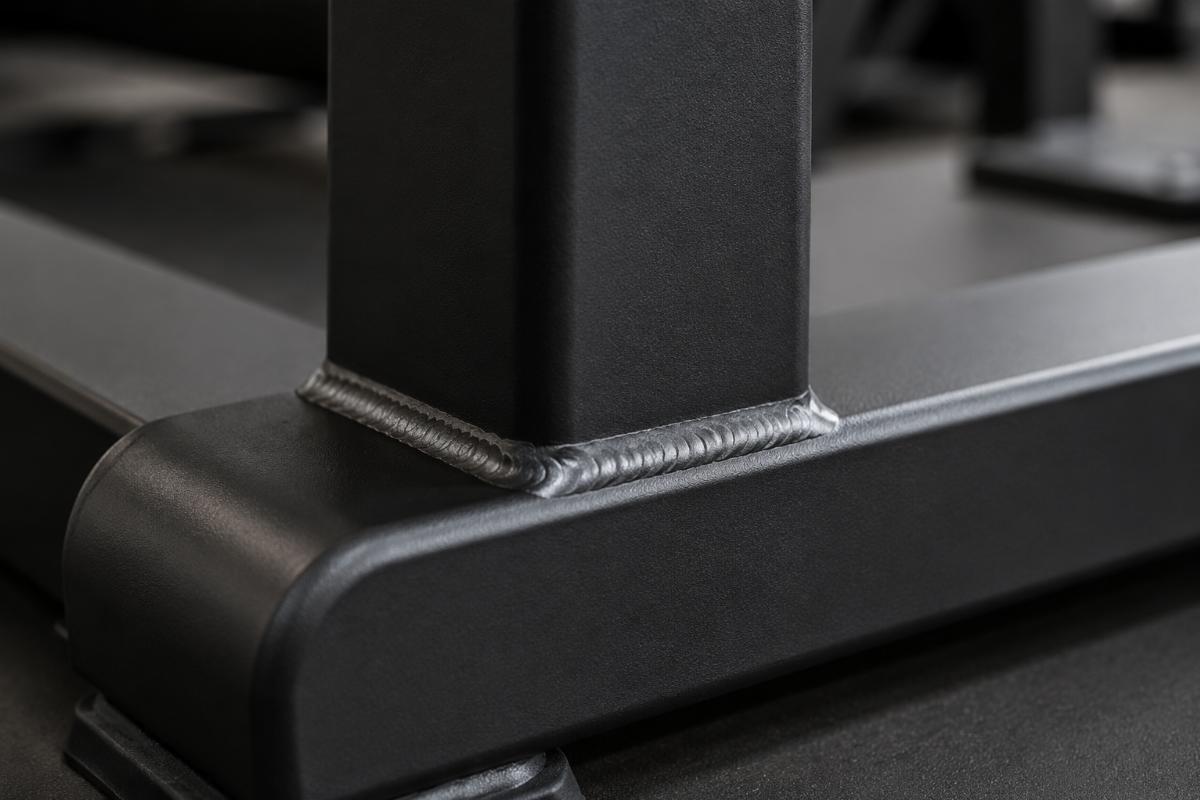
The welding point is where most failures actually originate. A commercial-grade Roman Chair should have full-penetration welds at every structural joint, especially where the hip pad bracket meets the main frame and where the foot retention roller mounts. Light-commercial units often use partial-penetration welds that look fine on the surface but develop micro-cracks under repeated loading. In a hotel gym environment with high ambient temperature and humidity, those micro-cracks propagate faster.
I once reviewed a batch of Roman chairs destined for a chain of fitness centers in the Gulf region. The buyer had initially approved a light-commercial spec based on a sample unit that felt solid during a single test session. But when we pulled the production samples and ran a load-cycle test, the weld joints on the hip pad bracket showed early-stage cracking well before reaching the expected commercial-cycle threshold. The entire batch had to be reworked. That delay cost the buyer far more than the per-unit price difference would have saved.
For any buyer evaluating a Roman Chair multi-site gym equipment manufacturer for sale, the rule is simple: ask for the tube wall thickness in gauge or millimeter, ask for the weld process specification, and ask for a load test report. If the supplier cannot provide those, walk away.
How to Standardize Roman Chair Specs Across Multiple Gym Locations?
The most cost-efficient approach to multi-site deployment is not negotiating each site individually—it is locking a single commercial-grade spec, consolidating container loads, and shipping in phased batches to match each site’s opening schedule.
When a buyer is outfitting a chain of gyms, a hotel group with multiple properties, or a distributor stocking for several regional markets, the instinct is often to customize the spec for each location. A flagship club might get the premium version, a mid-tier hotel might get a lighter spec, and a boutique studio might get a compact variant. In practice, this creates three problems: procurement complexity multiplies, spare parts inventory becomes a nightmare, and the per-unit cost stays high because no single SKU reaches volume threshold.
A better approach, which I have seen work well across Middle East and Southeast Asia rollouts, is to pick one commercial-grade Roman Chair spec and deploy it across all sites. The tube gauge, the weld standard, the pad density, and the adjustment mechanism all stay identical. The only variable is quantity per site and delivery timing.
This standardization strategy works in your favor in several ways:
- Container consolidation becomes efficient. A single SKU packs more predictably. You can fill a container with a mix of Roman Chair units and other strength equipment without worrying about conflicting dimensions or pallet configurations [NEED_CITE: container load optimization strategies for mixed strength equipment shipments].
- Spare parts are interchangeable. When a hip pad needs replacement at Site A, the same pad fits Site B, Site C, and any future Site D. You hold one spare part number instead of several.
- Quality control is streamlined. The factory runs one production setup, one weld fixture, and one QC checklist. Batch consistency improves, and the risk of spec drift between sites drops to near zero.
- Per-unit cost drops. Volume on a single SKU is higher, which gives the Roman Chair multi-site gym equipment manufacturer for sale a reason to offer a better unit price than fragmented small-batch orders.
I worked with a buyer who was rolling out fitness centers across a chain of upscale hotels in the Gulf. Initially, they wanted three different Roman Chair specs for three tiers of properties. After reviewing the logistics and spare-parts implications, they switched to a single commercial-grade spec. The container load plan became cleaner, the spare parts order shrank to one set of pads and one set of adjustment pins, and the factory delivered the full order in two phased shipments aligned with each hotel’s opening date.

What Should Buyers Verify Before Placing a Multi-Site Order?
Before committing to a multi-site Roman Chair order, the buyer must verify four things: tube wall thickness by actual measurement, load test documentation, weld quality by sample inspection, and spare parts availability with a written commitment.
These are not optional checks. They are the difference between a rollout that runs smoothly for years and one that generates warranty claims within months.
Tube wall thickness. Do not accept a spec sheet that says "heavy-duty steel frame." Ask for the actual gauge or millimeter measurement, and verify it on a production sample with a caliper. Light-commercial and home-grade units often use tube walls that are visibly thinner, but the difference is hard to spot by eye alone once the pad and shrouding are in place.
Load test documentation. A credible Roman Chair multi-site gym equipment manufacturer for sale should be able to provide a load test report covering both static and dynamic loading. Static load confirms the frame can hold a specified weight without permanent deformation. Dynamic load confirms the frame and welds can withstand repeated loading cycles that simulate actual gym usage [NEED_CITE: dynamic load testing methodology for commercial strength training equipment]. If the supplier only offers a static load number, that is a red flag.
Weld quality by sample inspection. Request a pre-shipment sample from the production batch, not a pre-production prototype. Inspect the weld joints at the hip pad bracket, the foot roller mount, and the main frame junctions. Look for consistent bead width, full penetration, and no visible porosity or undercut. A commercial-grade weld should look uniform and smooth, not patchy.
Spare parts commitment. For a multi-site rollout, you need a written agreement on spare parts availability—pads, adjustment pins, roller covers, and any wear components. The Roman Chair multi-site gym equipment manufacturer for sale should commit to keeping those parts available for a defined period after delivery, ideally matching the expected service life of the equipment in a commercial environment.
I have seen buyers skip the sample inspection step because they trusted the supplier’s reputation or because they were under time pressure. In one case, a distributor in North Africa received a full container of Roman chairs without inspecting a production sample. When the units arrived and were assembled at multiple gym sites, the weld quality was inconsistent across the batch. Some units were fine; others showed visible weld defects at the hip bracket. The cost of sorting, replacing, and managing member complaints far exceeded what a pre-shipment inspection would have cost.

Conclusion
A Roman Chair is not a simple bench. It is a high-cycle posterior chain station that demands commercial-grade tube thickness, full-penetration welding, and verified load capacity—especially when deployed across multiple gym sites. Standardizing the spec, consolidating container loads, and verifying production samples before shipment are the three practices that separate a successful multi-site rollout from a warranty nightmare. Choose a Roman Chair multi-site gym equipment manufacturer for sale that can back up its spec with measurable data, not marketing language.