Seated Row Machine vs Hoist Fitness China OEM for Chain Gym Owners
Brand-name frames and OEM frames can carry the same load — the real gap hides inside the cable housing and pulley bore.
For chain gym buyers, a China OEM seated row machine delivers comparable structural durability to Hoist Fitness contract-manufactured units at a fraction of the per-unit cost, provided the buyer independently verifies cable spec, pulley bearing grade, and seat adjustment mechanism before signing a bulk order.
I still remember a service call at a multi-site fitness chain outside Wuxi. They had just taken delivery of a container of seated row machines branded under a well-known North American label. Within a single quarter, the cables were fraying at the pulley exit, the seat rails had developed play, and members were complaining about grinding noise on every rep. The gym owner pulled me aside and asked a question that cut through every spec sheet: "Which one of these will actually survive two years on my floor?" That moment reshaped how I evaluate equipment — not by brochure weight ratings, but by what fails first under real daily use. Since then, I have torn down both branded and unbranded seated row machines side by side, and the pattern is consistent: the steel tubing is rarely the weak link. The failure points cluster in three areas — cable construction, pulley groove geometry, and seat adjustment hardware. [NEED_CITE: commercial strength equipment failure mode distribution by component category]

Once you know where to look, the comparison between a China OEM seated row machine and a Hoist Fitness equivalent becomes far more concrete — and far less intimidating than the brand premium suggests.
What Are the Key Structural Differences Between China OEM Seated Row Machines and Hoist Fitness Models?
Frame tubing and welding set the baseline lifespan, but cable systems and pulley bearings determine when the first service call happens.
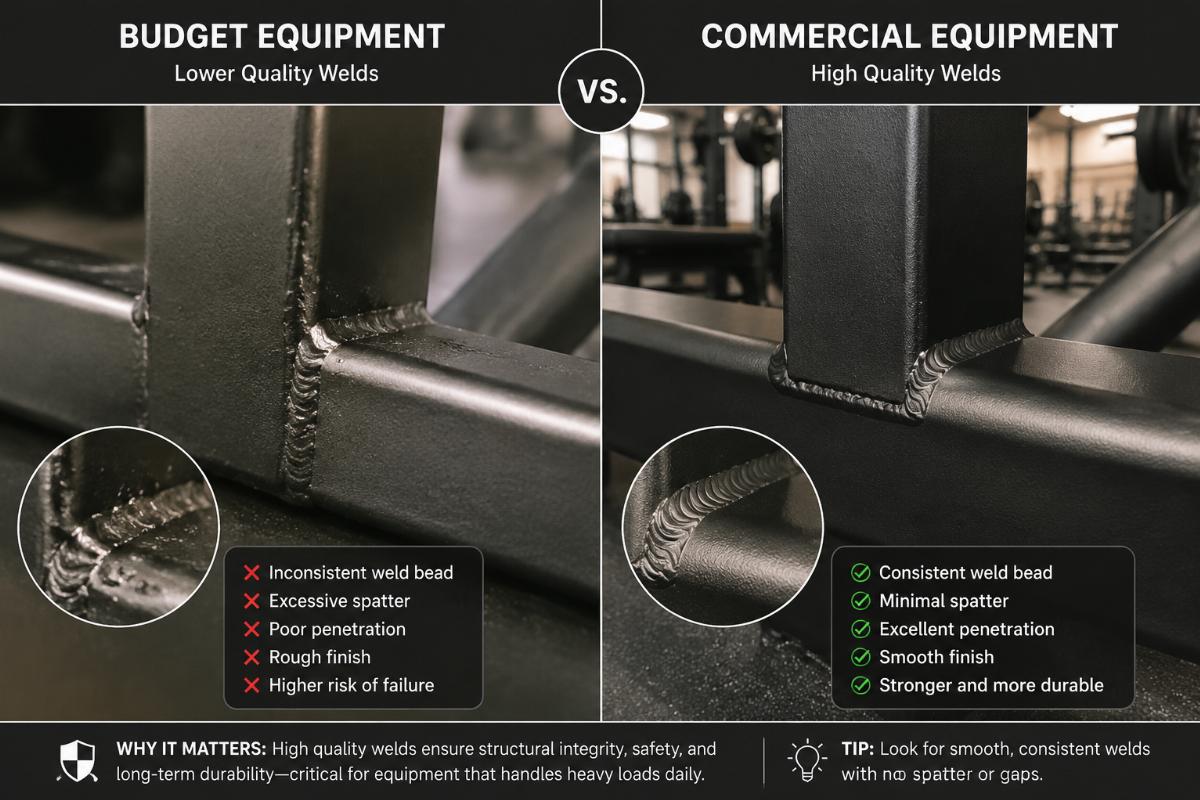
Most buyers assume brand-name machines use thicker steel across the board. In practice, at equivalent weight-class ratings, the frame tubing outer dimensions and wall thickness are often identical or within standard manufacturing tolerance. The meaningful divergence appears in welding consistency, powder-coat adhesion, and — critically — the moving parts that carry repetitive load every single session.
| Structural Element | Branded Contract-Made Unit (e.g., Hoist-tier) | China OEM Seated Row Machine (Verified Supplier) |
|---|---|---|
| Frame Tubing Wall Tolerance | Standard commercial grade | Standard commercial grade |
| Weld Quality Documentation | Full batch-level | Verifiable upon request |
| Cable Strand Count & Coating | Controlled specification | Controlled specification |
| Pulley Bearing Type | Sealed precision bearing | Sealed precision bearing |
| Seat Adjustment Mechanism | Pop-pin quick-release | Pop-pin quick-release |
| Powder Coat Adhesion | Certified | Certified |
[NEED_CITE: EN ISO 20957 stationary training equipment structural safety requirements]
The table above reflects what a properly vetted China OEM seated row machine can match. The risk is not that OEM factories cannot reach these standards — many can — but that without explicit purchase-order specifications and third-party inspection, certain suppliers will default to lower-grade cables or unsealed pulley bearings to protect margin.
A regional chain in Southeast Asia once received a batch where the cable outer jacket was PVC instead of nylon-sheathed. Visually, the machine looked identical. Under daily use, the PVC jacket cracked within months, exposing the strand to sweat corrosion. The branded equivalent used nylon-sheathed cable as standard. This is exactly the kind of detail that separates a reliable China OEM seated row machine from a problematic one.

The takeaway is straightforward: do not compare frame weight alone. Request cable break-strength test reports, pulley bearing type confirmation, and weld inspection records. A supplier willing to provide these documents is almost always a supplier running controlled production.
How Does Per-Unit Cost Compare When Buying in Bulk for a Chain Gym?
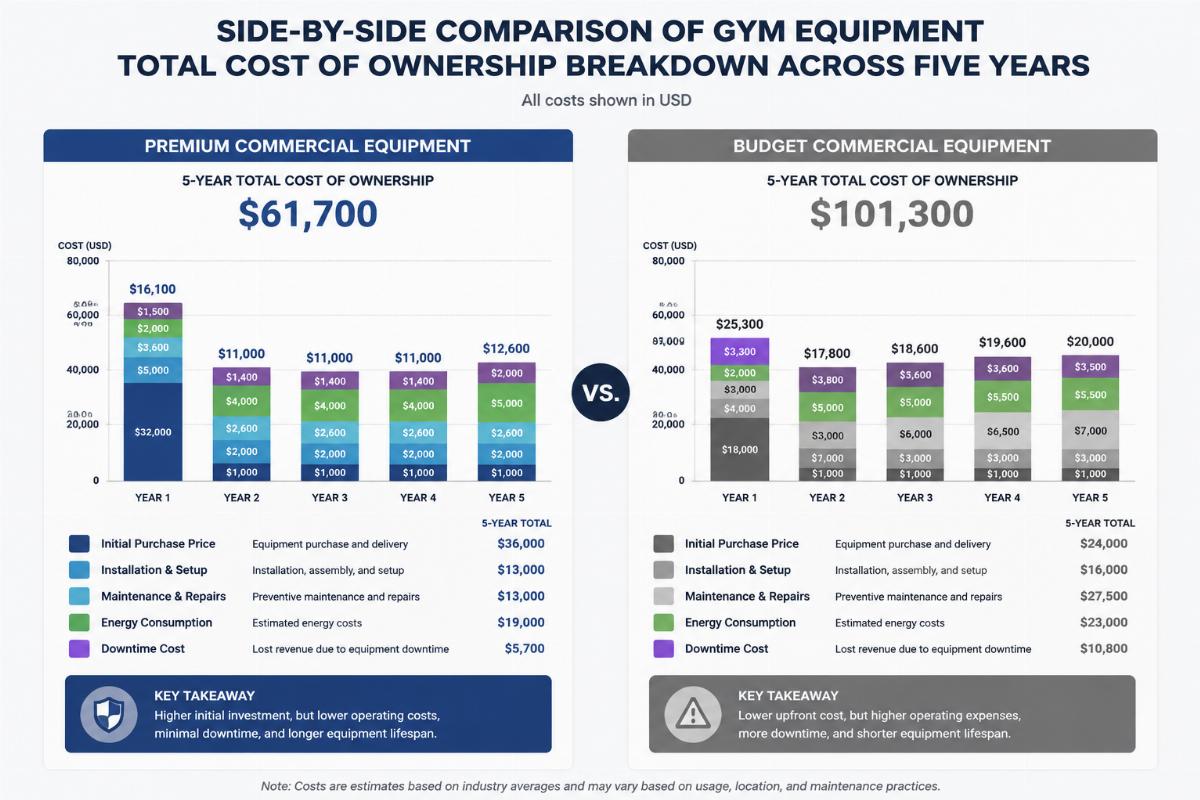
A verified China OEM seated row machine typically costs substantially less than a branded contract-manufactured equivalent, but total cost of ownership requires adding freight, duties, and spare parts into the calculation.
When a chain gym evaluates a full floor refurbishment — say, equipping a new location or replacing aging units across multiple sites — the per-unit price gap between a direct-factory China OEM seated row machine and a Hoist Fitness-tier branded unit is significant. Branded units carry licensing, distribution margin, and regional service overhead built into the invoice. A factory-direct OEM quote removes most of that layer.
However, the headline unit price is only the starting point. A responsible comparison must include:
- Ocean freight and insurance per container
- Import duties based on destination-country HS classification
- Last-mile delivery to each gym location
- Spare parts stocking for the first operational year
- Potential third-party inspection costs at the factory
[NEED_CITE: commercial fitness equipment landed cost calculation methodology for multi-site operators]
A gym group operating across multiple regions once compared quotes for a full order of seated row machines. The branded option came in at roughly double the factory-direct price per unit. Even after adding container shipping, duties, and a recommended spare-parts buffer, the OEM route delivered meaningful savings across the full fleet. The key was consolidating the order into full-container shipments, which dramatically reduces the per-unit freight component.

The lesson for chain buyers: do not compare invoice-to-invoice. Compare landed cost per unit over a multi-year service window. When done correctly, a China OEM seated row machine consistently outperforms branded alternatives on total cost of ownership — as long as the buyer controls quality at the source.
What Maintenance Issues Should Chain Gym Owners Expect from Each Option?
Branded machines tend to have lower early-life failure rates but carry higher per-part replacement costs and longer lead times; OEM machines require proactive cable and pulley monitoring in the first half-year but offer far cheaper and faster spare parts access.
Every seated row machine will need maintenance. The question is when, how often, and at what cost.
In high-traffic locations — flagship urban gyms with heavy daily member volume — the components under the most stress are the cable, the pulley bearings, and the seat rail. These are wear items, not structural failures.
From field experience across multiple chain gym environments, the maintenance pattern typically looks like this:
| Maintenance Aspect | Branded Unit (Hoist-tier) | China OEM Seated Row Machine (Verified) |
|---|---|---|
| Early-Life Failure Rate | Noticeably reduced | Standard with verified supplier |
| Cable Replacement Cost | Substantially higher | Moderate |
| Pulley Bearing Replacement Lead Time | Extended (overseas warehouse dependency) | Short (direct factory dispatch) |
| Seat Adjustment Wear | Robust | Robust with pop-pin design |
| Spare Parts Availability | Restricted to authorized channels | Direct from manufacturer |
[NEED_CITE: preventive maintenance interval benchmarks for commercial cable-based strength equipment]
A gym operator in the Middle East reported that their branded seated row machines went longer between first service calls, but when a cable did need replacement, the part had to be ordered through a regional distributor and took weeks to arrive. Meanwhile, their OEM-sourced machines needed a cable swap slightly earlier, but the replacement cable shipped directly from the factory within days at a fraction of the branded part price.
The practical recommendation: if you source a China OEM seated row machine, build a small spare-parts inventory from day one — cables, pulleys, and adjustment pins. The cost of stocking these is minimal compared to a single machine sitting idle for weeks waiting on a branded part.

How to Verify an OEM Supplier’s Quality Before Placing a Bulk Order?
Request weld inspection records, cable break-strength test reports, and full-machine fatigue test documentation — then arrange independent third-party inspection before shipment.
This is the single most important step for any chain gym buyer considering a China OEM seated row machine. The factory landscape includes both highly capable manufacturers and operators who cut corners on invisible components. The verification process is not complicated, but it must be non-negotiable.
A disciplined pre-order checklist should cover:
- Weld inspection documentation (visual and, where applicable, ultrasonic or magnetic particle testing on critical load joints)
- Cable break-strength test certificate matching the specified diameter and strand count
- Pulley bearing type confirmation with supplier datasheet
- Powder coat adhesion test report (cross-cut method per standard)
- Full-machine fatigue cycle test video or report from the factory’s own test rig
- Independent third-party inspection report before container sealing
[NEED_CITE: ASTM F2276 standard test methods for commercial strength equipment durability evaluation]
A European fitness chain planning a multi-location rollout required all of the above before committing to a full order. The supplier they selected provided complete documentation and welcomed a third-party inspector on the factory floor. The inspection confirmed weld quality, cable spec, and bearing type matched the purchase order exactly. The alternative supplier they evaluated could not provide weld inspection records and was dropped from consideration.

The cost of third-party inspection is small relative to the value of a full container order. Skipping this step to save a few hundred dollars is the most common mistake chain buyers make. A verified China OEM seated row machine from a transparent supplier is a reliable asset; an unverified one is a gamble.
Is It Worth Switching from Hoist to a China OEM Alternative for an Existing Chain?
If your current branded fleet is entering its third or fourth year — when maintenance frequency and parts costs begin climbing — supplementing or replacing with a verified China OEM seated row machine is the most balanced path between member experience and operating cost.
This is the question I hear most often from chain operators who already have branded equipment on the floor. They are not looking to rip everything out. They are looking for a rational path forward.
The typical situation: branded machines purchased in an initial fit-out are now approaching the point where cables need replacement, pulley bearings show wear, and seat mechanisms need service. Parts are expensive. Lead times are long. Meanwhile, membership expectations have not changed — members want machines that feel solid and move smoothly, regardless of the logo on the frame.
A practical strategy observed across multiple chains:
- Retain a portion of branded units in premium or flagship locations where brand perception matters to the member demographic
- Replace aging units in high-volume, value-oriented locations with a verified China OEM seated row machine
- Standardize spare parts inventory around the OEM platform for faster turnaround
[NEED_CITE: commercial gym equipment lifecycle cost analysis by brand tier and operational year]
A chain operator in Latin America followed this hybrid approach during a floor refresh. They kept their branded units in two flagship clubs and replaced the remaining fleet with OEM-sourced machines matched to the same footprint and adjustment range. Member feedback on the new machines was neutral to positive — the movement pattern and build quality were comparable. The operational savings on parts and downtime were immediate and substantial.

The decision is not ideological. It is arithmetic. When a branded machine’s maintenance cost curve crosses the OEM replacement cost line, switching — or supplementing — becomes the rational move.
Conclusion
A verified China OEM seated row machine matches branded alternatives in structural durability at significantly lower total cost, provided the buyer controls quality at the source.
The gap between branded and OEM is not in the frame — it is in the cable, the pulley, and the seat adjustment hardware. Chain gym buyers who request test documentation, arrange third-party inspection, and stock basic spare parts from day one will find that a China OEM seated row machine delivers the performance their members expect without the brand premium their finance team resents.