Tricep Extension Machine Selection Guide for Professional Sports Facilities
The cheapest unit price rarely equals the lowest total cost — transit damage, premature wear, and downtime routinely erase factory-direct savings within the first year.
For professional sports team facilities, tricep extension machine selection must prioritize structural durability under high-frequency daily use, biomechanical precision for progressive overload, and container consolidation integrity — not just per-unit pricing. The right selectorized or plate-loaded configuration depends on daily athlete volume, maintenance capability, and the specific loading patterns of team-based strength programs.
I still remember the first time a South American client sent me a video of a brand-new tricep extension machine pulled out of a shipping container — the weight stack guide rails were bent like spaghetti. They had ordered a trial batch, and the forwarder had stacked the machines under a pallet of treadmills to "optimize space." Forty days of ocean transit later, the damage was irreversible. That shipment taught me more about tricep extension machine selection than any catalog ever could: the selection process does not end at the factory gate. It ends when the equipment is bolted to the gym floor and fully operational. [NEED_CITE: common transit damage patterns in commercial fitness equipment logistics]

From that point on, every conversation about tricep extension machine selection started with the same question: how will this equipment survive the journey and the daily abuse that follows?
What Makes Tricep Extension Machines Different for Professional Sports Facilities vs. Regular Gyms?
Professional sports facilities operate on a fundamentally different usage cycle than commercial fitness centers — and equipment selection must reflect that reality.
In a typical commercial gym, a tricep extension machine might see thirty to fifty users per day, each performing a few sets before moving on. In a professional sports team facility, that same machine can be subjected to continuous back-to-back loading by athletes who train in organized waves — morning strength blocks, afternoon conditioning, evening recovery sessions. The cumulative weekly volume is multiples higher, and the loading patterns are more aggressive. [NEED_CITE: usage intensity comparison between commercial gyms and professional sports training facilities per IHRSA data]
The frame construction requirements diverge accordingly. A standard commercial selectorized tricep extension may use a frame built from moderate-gauge steel tubing, adequate for the turnover rate of a health club. A unit destined for a professional sports facility needs a heavier-gauge main frame with reinforced gusset plates at high-stress junctions — particularly where the pivot arm meets the upright and where the seat adjustment rail connects to the base. These are the points where micro-flex develops first under repetitive high-load use, and where weld integrity becomes the defining factor in long-term service life.
Pulley systems face a similar divergence. In a regular gym, cable-driven tricep extensions experience moderate cyclic loading. In a team training environment, the same pulleys may undergo thousands of additional load cycles per week, often with athletes who generate higher peak forces during explosive concentric movements. The pulley bearing type, cable diameter, and cable routing angle all directly influence fatigue life. A nylon-lined pulley that performs acceptably in a boutique studio will develop groove wear and cable fraying noticeably faster under professional sports conditions.
Seat and pad adjustment mechanisms also warrant closer scrutiny. Professional athletes span a wider range of body dimensions than the general gym population, and they adjust equipment between sets more frequently. Adjustment pins, pop-detent systems, and rail surfaces must tolerate repeated insertion and removal without developing play. Loose adjustment mechanisms do not just annoy users — they introduce alignment drift that shifts the biomechanical axis of the exercise, reducing training effectiveness and increasing injury risk over time.

When I walk through a sports facility for the first time, I always check the adjustment mechanisms on the most-used machines first. That tells me more about the selection quality than any spec sheet.
Selectorized vs. Plate-Loaded vs. Cable Attachment — Which Type Fits Your Facility?
There is no universally superior tricep extension configuration — the correct choice depends on daily usage intensity, maintenance team capability, and the training philosophy of the sports performance staff.
Selectorized tricep extension machines offer the fastest weight changes and the most intuitive user experience. Athletes move a pin, and the load is set. For facilities where multiple athletes rotate through the station in rapid succession — such as during circuit-based team conditioning — selectorized units minimize transition time and reduce the cognitive load on users. The enclosed weight stack also presents a cleaner aesthetic and reduces the risk of loose plates becoming a floor hazard. However, the selectorized mechanism introduces additional wear points: the selector pin, the weight stack guide rods, and the internal cable routing all require periodic inspection and replacement. In high-volume environments, guide rod bushings can develop play, and selector pins can bend if athletes slam the stack aggressively. [NEED_CITE: maintenance frequency comparison between selectorized and plate-loaded strength equipment in high-use facilities]
Plate-loaded tricep extension machines eliminate the weight stack entirely. Athletes load Olympic plates directly onto a horn or peg. This design removes the selectorized mechanism’s wear components, leaving a simpler structure with fewer failure points. For facilities with dedicated equipment maintenance staff who can manage plate inventory and inspect load collars regularly, plate-loaded machines often deliver longer service intervals. The trade-off is slower weight transitions — athletes must physically add or remove plates, which can disrupt training flow during time-sensitive team sessions. Additionally, plate-loaded machines require a supply of calibrated plates, which adds to the facility’s initial outfitting cost.
Cable attachment configurations — where a tricep extension handle is integrated into a multi-function cable crossover or functional trainer — offer maximum spatial efficiency. A single cable station can serve tricep pushdowns, overhead extensions, and rope press-downs by simply swapping handles. For facilities with constrained floor space, this approach consolidates multiple movement patterns into one footprint. However, cable attachments lack the fixed biomechanical path of a dedicated tricep extension machine. The athlete must stabilize the movement independently, which shifts emphasis from pure tricep isolation to a more compound pressing pattern. For sports performance programs that prioritize functional carryover over strict isolation, this can be an advantage. For rehabilitation or targeted hypertrophy protocols, it may be a limitation.
| Configuration | Weight Change Speed | Maintenance Complexity | Biomechanical Precision | Spatial Efficiency |
|---|---|---|---|---|
| Selectorized | Fastest | Moderate — guide rods, selector pins, internal cables | High — fixed cam path | Low — dedicated footprint |
| Plate-Loaded | Slowest — manual plate loading | Low — fewer internal wear parts | High — fixed lever arm | Low — dedicated footprint plus plate storage |
| Cable Attachment | Fast — handle swap | Moderate — cable and pulley wear | Variable — user-dependent stabilization | High — multi-exercise consolidation |
A Middle East sports academy client initially specified selectorized tricep extensions for their entire strength zone. After reviewing their daily training schedule — which included back-to-back squad sessions with minimal rest between groups — we recommended splitting the configuration: selectorized units for the high-turnover warm-up zone, and plate-loaded units for the dedicated strength development area where athletes spent longer on each station and maintenance staff could manage plate logistics. The result was a noticeable reduction in selectorized mechanism service calls within the first year of operation.
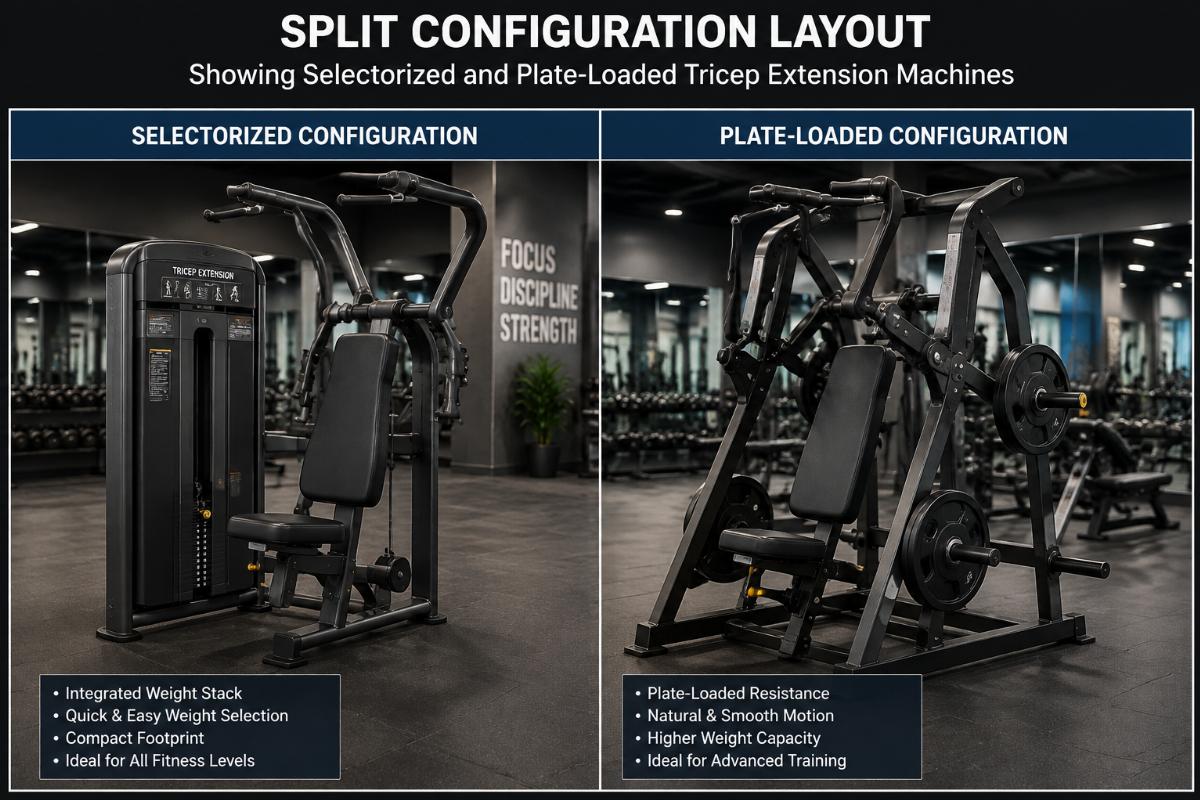
The decision is never about which type is "better" in absolute terms. It is about matching the configuration to the specific operational rhythm of the facility.
Key Specs to Verify Before Ordering — Frame, Pulley, and Weight Stack
Steel gauge, pulley bearing construction, and weight stack increment precision are the three specifications most commonly compromised by cost-cutting suppliers — and they are the three that determine whether a tricep extension machine survives its first year in a professional sports facility.
Frame steel thickness is the most visible differentiator between commercial-grade and light-commercial-grade equipment. A professional sports facility tricep extension should be built from main frame tubing with a wall thickness that meets commercial durability benchmarks — typically in the range of heavy-gauge rectangular steel, with reinforced welding at all primary load-bearing joints. The critical inspection points are the base-to-upright junction, the pivot arm mounting plate, and the seat rail attachment. These areas experience the highest cyclic stress, and inadequate wall thickness or incomplete weld penetration will manifest as frame flex or crack initiation within months of heavy use. [NEED_CITE: commercial strength equipment frame steel thickness standards per EN 957]
Pulley systems deserve equal attention. The pulley wheel material should be cast iron or machined aluminum with a precision-molded cable groove — not stamped sheet metal with a painted surface. The bearing inside the pulley should be a sealed ball bearing rated for continuous cyclic loading, not a simple bushing or sleeve. Cable diameter should match the load capacity: a thicker cable with a higher strand count provides greater fatigue resistance under the repetitive loading patterns of professional sports training. The cable routing path should minimize sharp bends — each additional direction change introduces friction and accelerates cable wear.
Weight stack increment design directly affects the usefulness of the equipment for progressive overload programming. Professional strength coaches program tricep work with precise load progressions — often in small increments to manage tendon loading and avoid overuse injuries. A weight stack with coarse increments forces athletes to jump loads that may be too aggressive for upper-body isolation work. The ideal stack offers fine-grained increments in the lower weight range, where most tricep extension work occurs, and allows micro-loading if the facility’s programming demands it. Additionally, the weight stack plates should be securely guided on hardened steel rods with low-friction bushings — not sliding on bare steel shafts that will develop corrosion and binding over time.
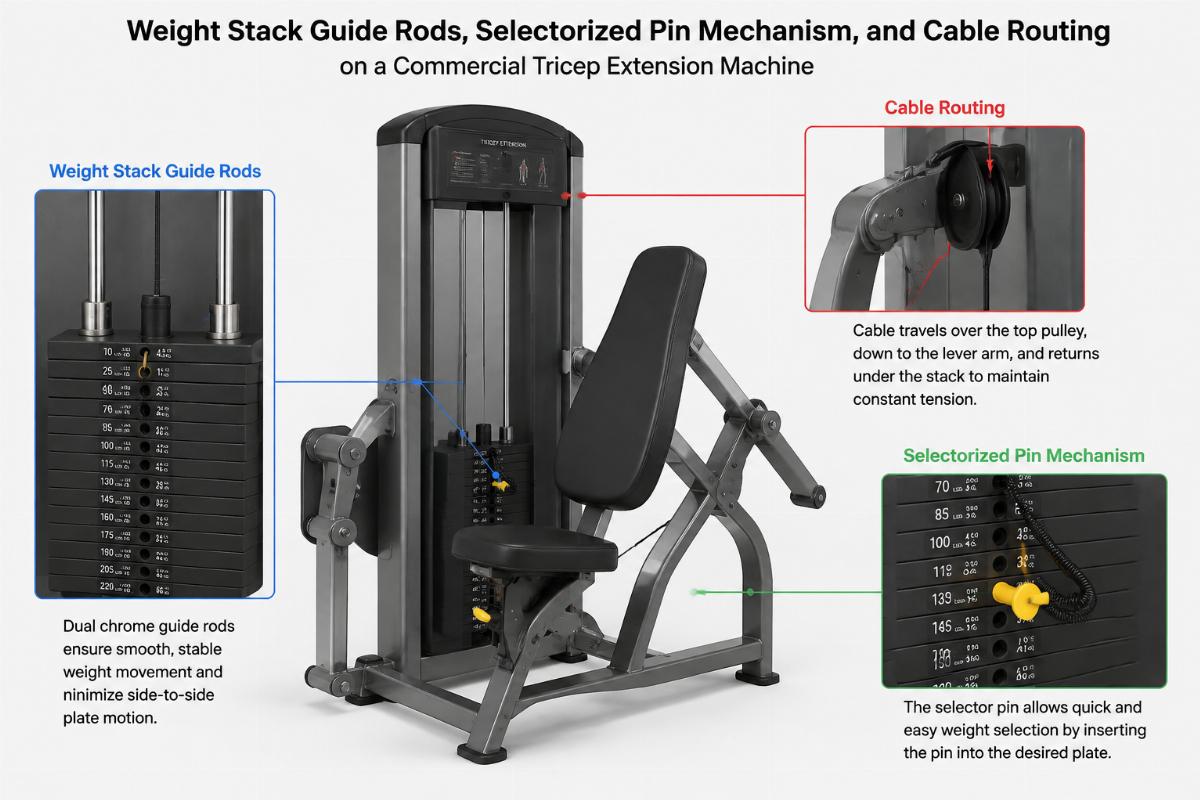
When evaluating a supplier’s tricep extension machine selection options, I always request cross-section photos of the frame tubing at the welded joints, a close-up of the pulley bearing assembly, and a detailed weight stack increment chart. Suppliers who hesitate to provide these details are typically hiding cost compromises that will surface as warranty claims within months.
How to Avoid Transit Damage — Container Loading Lessons from Real Shipments
A tricep extension machine that arrives at the facility with bent guide rails or a cracked frame is a total loss — and the majority of transit damage to selectorized machines is preventable with proper container loading protocols.
The most common and most devastating form of transit damage to selectorized tricep extension machines is weight stack guide rail deformation. The mechanism is straightforward: during ocean freight, containers experience vertical and lateral forces from vessel motion, port handling, and truck transport. If the weight stack remains installed inside the machine during transit, the stack plates shift and slam against the guide rods under these forces. Over a multi-week ocean voyage, this repeated impact bends the guide rods — often beyond straightening — and renders the selectorized mechanism inoperable.
The solution is non-negotiable: weight stacks must be removed from the machine before container loading and packed separately on a pallet, wrapped and secured independently. This adds a step to the packing process and slightly increases the pallet count, but it eliminates the single largest source of transit damage to selectorized equipment. The cost of a few extra pallets is trivial compared to the cost of replacing a bent weight stack assembly at the destination — which typically involves air-freighting replacement parts, paying local technicians for installation, and leaving the machine out of service for weeks.
Beyond the weight stack, the container loading pattern itself requires careful planning. Machines should never be stacked directly on top of each other without protective interleaving. The standard approach is to position the heaviest and most structurally rigid items — typically plate-loaded machines and free weight storage units — on the container floor as a base layer. Lighter selectorized machines are loaded on top, with cardboard or foam separators between units to prevent surface scratching and point-loading. The load must be secured with internal lashing straps anchored to the container’s internal tie-down points — not just blocked with wooden braces that can shift during transit.
A South American professional sports club learned this lesson the hard way on their first equipment order. They received a trial shipment where the forwarder had compressed the container to maximize volume, stacking tricep extensions beneath a heavy cardio unit. The ocean transit took over a month, and when the container was opened at the destination port, the guide rails on multiple selectorized machines were visibly deformed. The club had to source replacement weight stacks from a local supplier at a premium, and the machines were out of service for an extended period. The additional cost — including air freight for parts, local labor, and lost training time — was multiples of what proper palletizing would have cost at origin.

Since that incident, every container I oversee follows a strict loading protocol: weight stacks off and palletized, machines interleaved and strapped, and a photographic record taken before the container doors are sealed. The protocol adds a small amount of time at the loading stage, but it has reduced transit damage claims to near zero across subsequent shipments. For any buyer evaluating tricep extension machine selection from an overseas supplier, asking for the supplier’s container loading standard operating procedure is one of the most practical due diligence steps available.
Sourcing from Shandong — What to Expect on MOQ, Lead Time, and OEM Options
Shandong Province has developed into one of China’s most concentrated commercial fitness equipment manufacturing clusters — and understanding the region’s sourcing dynamics is essential for buyers building professional sports facility packages.
The Shandong fitness equipment industry offers a range of capabilities, from small workshops producing basic plate-loaded machines to large-scale factories with full OEM and ODM capacity, in-house powder coating lines, and certified quality management systems. For professional sports facility buyers, the key is distinguishing between suppliers who can deliver commercial-grade durability at scale and those whose cost advantages come from material or process compromises that will not survive the usage demands of a team training environment.
Minimum order quantity flexibility varies significantly across the region. Some factories require full-container orders of a single product line, while others accommodate mixed-container configurations that allow buyers to combine tricep extensions with other strength machines, cardio equipment, and free weight items in a single shipment. For buyers outfitting a complete sports facility, the ability to consolidate a full gym package into one or two containers — rather than managing dozens of separate LCL shipments — is a major logistical and cost advantage. [NEED_CITE: container consolidation best practices for commercial gym equipment procurement from China]
Lead times for custom or OEM orders typically depend on the complexity of the specification changes requested. Standard catalog models with minor branding modifications — such as custom color powder coating and logo application — can be produced within a relatively short cycle. Fully customized frames, proprietary weight stack configurations, or integrated technology features require longer development and production timelines. Buyers should request a detailed production schedule before placing orders, with clear milestones for frame fabrication, welding, surface treatment, assembly, and pre-shipment inspection.
OEM and ODM capabilities are a critical differentiator for distributors and facility brands looking to build a proprietary equipment identity. A capable Shandong supplier should be able to work from the buyer’s technical drawings or performance specifications to produce tricep extension machines that meet the buyer’s brand standards — including custom frame geometry, pad upholstery specifications, and weight stack increment patterns. The buyer should verify the supplier’s capability through factory audits, sample evaluation, and reference checks with existing international clients.

The most effective approach to tricep extension machine selection from Shandong is to treat the sourcing process as a partnership rather than a transaction. Suppliers who invest in understanding the buyer’s facility usage patterns, maintenance capabilities, and long-term equipment roadmap will deliver better-matched solutions than those who simply quote the lowest per-unit price on a standard catalog item.
Conclusion
Tricep extension machine selection for professional sports facilities is an engineering and logistics decision — not a price-comparison exercise.
The correct configuration balances frame durability, pulley and cable system fatigue resistance, weight stack precision, and container loading integrity against the specific daily usage volume and maintenance capacity of the facility. Whether the optimal choice is selectorized, plate-loaded, or cable-attached depends entirely on the operational rhythm of the sports performance program. And regardless of configuration, the equipment must survive the ocean transit intact — because a damaged machine on a gym floor generates zero training value, no matter how competitive the factory price was.