
40HQ Gym Equipment Container Deal: Maximum Value Wholesale Supplier
Filling every cubic meter is not the same as maximizing every dollar of landed cost.
The real value of a 40HQ gym equipment container deal is determined by three variables working in concert: the volumetric utilization rate of the loading plan, the profit structure created by the product mix, and the factory’s ability to consolidate an entire container from a single source. A buyer who focuses solely on the lowest unit price will almost always pay more per square meter of usable gym floor space than a buyer who optimizes the container as a system.
I spent years handling shipping documents at a forwarding company near Ningbo Beilun port, staring at loading plans and packing lists day in and day out, before moving to the fitness equipment export side. One time, a Middle East buyer ordered a full container — treadmills, Smith machines, dumbbells, weight plates, all crammed in without a real plan. When the doors closed, nearly a third of the space was still empty. The ocean freight alone wasted was equivalent to a mid-four-figure sum in dead air. From that point on, I started treating every 40HQ as a puzzle where heavy items ballast the bottom, mid-size equipment fills the middle layer, and light bulky goods seal the top. The first thing I do now when a buyer sends a product list is calculate the volumetric weight of every item and squeeze maximum commercial value out of every cubic meter. [NEED_CITE: standard internal dimensions and usable volume range of a 40HQ dry container per ISO shipping norms]

Getting the product mix right is where most first-time buyers leave money on the table. Let me walk through how the right combination transforms a 40HQ gym equipment container deal from a simple shipment into a margin engine.
What Products Should You Mix in a 40HQ Gym Equipment Container?
The highest-value container is never a single-product shipment — it is a deliberate blend of high-freight-cost items and low-freight-cost items that offset each other’s landed cost.
A common mistake among distributors in emerging markets is ordering a full container of one category, usually strength machines or free weights, because those are the fastest sellers. But the math does not work that way. Cardio equipment like commercial treadmills and ellipticals carries a heavy freight burden per unit because of its size and weight. A standalone treadmill order in a 40HQ gym equipment container deal will fill the space quickly but leave the per-unit freight cost punishingly high. On the other hand, rubber weight plates and competition bumper plates are extremely dense — they hit the weight limit of the container long before they fill the volume. Neither extreme is efficient.
| Product Category | Volumetric Profile | Weight Profile | Freight Cost Behavior |
|---|---|---|---|
| Commercial Treadmills & Ellipticals | High volume | High weight | Highest per-unit freight |
| Smith Machines & Power Racks | Medium-high volume | Medium weight | Moderate per-unit freight |
| Plate-Loaded & Selectorized Machines | Medium volume | High weight | Moderate-to-high per-unit freight |
| Free Weights (Plates, Dumbbells, Barbells) | Low volume | Very high weight | Weight-limited; volume wasted |
| Functional Training Accessories (Ropes, Boxes, Bands) | High volume | Low weight | Lowest per-unit freight |
| Gym Flooring Rolls & Mats | High volume | Medium weight | Volume-filling; moderate freight |
[NEED_CITE: volumetric weight coefficient comparison across fitness equipment categories per industry logistics benchmarks]
A distributor in West Africa initially ordered half-container trial shipments of plate-loaded machines only. The containers consistently hit the payload limit before reaching full volume, meaning the buyer was paying for unused cubic space on every shipment. After switching to a full container gym equipment container deal with a mixed load — plate-loaded machines on the bottom tier, a set of cable crossovers and functional trainers in the middle, and battle ropes, plyo boxes, and gym flooring stuffed into the remaining gaps — the per-unit freight分摊 dropped noticeably. The same ocean freight bill now covered a wider revenue base across multiple product lines.
The principle is straightforward: heavy, dense items serve as ballast at the container floor; mid-size framed equipment occupies the structural middle; and light, bulky accessories fill every remaining void at the top. [NEED_CITE: three-tier loading logic for mixed cargo in international shipping containers]
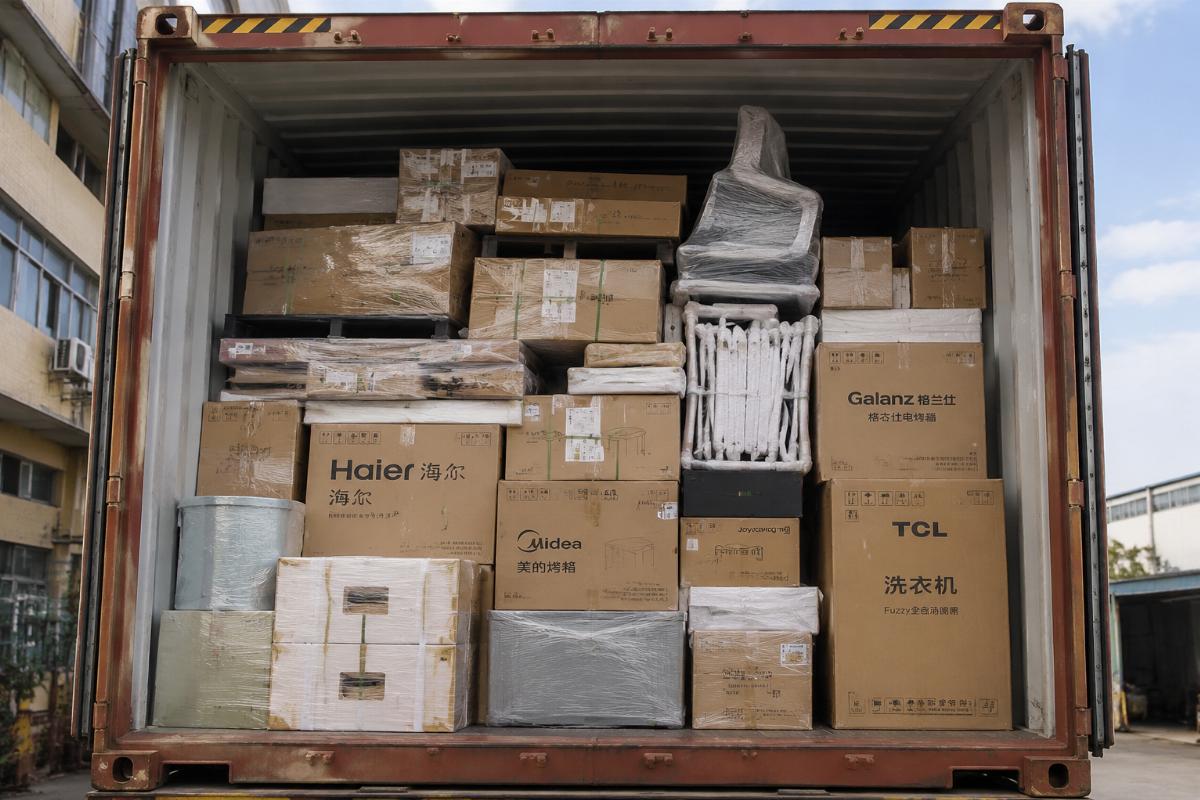
How Does Loading Plan Design Affect Your Per-Unit Landed Cost?
The loading plan is not a packing afterthought — it is the single largest controllable variable in your per-unit landed cost for a 40HQ gym equipment container deal.
Consider two scenarios with the same total invoice value. In the first, a buyer loads a container with fully assembled commercial treadmills and pre-welded power racks. The treadmills consume massive floor footprint because the running deck and console cannot be separated from the frame. The power racks ship as welded units, taking up rigid cubic space with zero compression. The container reaches physical capacity at roughly seventy percent of its theoretical volume.
In the second scenario, the same buyer sources treadmill models with detachable consoles and foldable running decks, plus power racks designed for knock-down assembly with removable cross-members and J-cups packed separately. The same container now holds substantially more sellable units within the same freight bill. The per-unit landed cost drops because the fixed ocean freight and port charges are distributed across a larger number of revenue-generating items.
| Loading Approach | Volume Utilization | Per-Unit Freight Impact |
|---|---|---|
| Fully assembled, non-detachable equipment | Low — significant void space | High per-unit cost |
| Knock-down design with nested packaging | High — components interlock | Noticeably lower per-unit cost |
| Mixed heavy-ballast and light-fill strategy | Optimized — weight and volume balanced | Lowest blended per-unit cost |
[NEED_CITE: impact of knock-down packaging design on container utilization rate for fitness equipment]
A hotel group developer in Southeast Asia needed to outfit fitness centers across multiple apartment projects. Their initial specification called for fifteen different SKUs per container. After working through a detailed loading plan with the factory — switching to detachable-frame cardio units, nesting adjustable benches inside power rack frames, and stacking rubber flooring rolls vertically along the container walls — the SKU count per container rose to over twenty distinct items. Each additional SKU added without additional freight cost meant the blended landed cost per product fell further.
This is where the factory’s role becomes critical. A supplier that only quotes unit price without offering loading plan optimization is leaving margin on the table for the buyer. The best outcomes come from factories that provide a detailed loading diagram before production begins, showing exactly how many units of each SKU fit, in what sequence, and with what packaging adjustments. [NEED_CITE: container loading optimization methodology for multi-SKU fitness equipment orders]

What Packaging and Design Features Maximize Container Space?
Detachable structures and nested packaging are the two non-negotiable design features that separate a high-value 40HQ gym equipment container deal from a wasteful one.
The packaging engineering behind fitness equipment directly determines how many sellable units share a single container’s freight cost. Equipment designed for domestic retail display — with full assembly, decorative shrouds, and oversized cartons — is packaging-engineered for the showroom, not the container. Export-grade fitness equipment meant for wholesale container shipments requires a fundamentally different packaging philosophy.
Detachable design means the console, uprights, and running deck of a commercial treadmill ship as separate components within a single carton or adjacent cartons that stack tightly. The frame of a power rack ships flat, with cross-members, safety bars, and attachment hardware packed in dedicated compartments that fill voids rather than create them. Adjustable benches fold flat and stack vertically. Cable crossover machines detach into frame sections that nest inside each other.
| Packaging Feature | Effect on Container Loading |
|---|---|
| Detachable console and frame on cardio units | Substantially increases units per container |
| Knock-down power rack with nested hardware packs | Eliminates rigid void space |
| Fold-flat adjustable benches | Enables vertical stacking |
| Nested cable machine frame sections | Reduces per-unit cubic footprint |
| Custom carton dimensions matched to container width | Minimizes aisle waste between cartons |
[NEED_CITE: packaging design standards for export fitness equipment maximizing container cube utilization]
A buyer in the Middle East initially received gym equipment in retail-grade packaging — thick foam surrounds, decorative outer cartons sized for shelf appeal. The first container arrived with nearly a quarter of its volume wasted in packaging air. After switching to export-optimized packaging with tighter carton dimensions matched to the container’s internal width and detachable components replacing pre-assembled frames, the next container carried a full order’s worth of equipment with no residual void. The freight cost per sellable unit dropped by a meaningful margin without any change in product quality or ocean freight rate.
The key insight is that packaging optimization is not something the buyer can fix after ordering. It must be engineered into the product specification at the factory level. This is why choosing a 40HQ gym equipment container deal partner that controls its own packaging design process — rather than sourcing from trading companies that inherit the manufacturer’s default packaging — makes a measurable difference in landed economics. [NEED_CITE: relationship between factory-controlled packaging design and container load efficiency in fitness equipment exports]

How to Evaluate a Supplier’s Container Consolidation Capability?
A supplier’s ability to consolidate a full container across multiple product categories is a far stronger predictor of your final margin than any single product’s unit price in a 40HQ gym equipment container deal.
Most buyers evaluate suppliers by requesting quotes on individual SKUs and comparing unit prices. This approach misses the structural advantage that a consolidated factory source provides. When a buyer sources cardio from one factory, strength equipment from another, and free weights from a third, each partial container carries its own freight bill, its own port charges, and its own customs clearance cost. The blended landed cost across the full gym setup is significantly higher than if a single factory could supply the entire product range in one consolidated container.
A supplier with genuine container consolidation capability demonstrates several concrete attributes. First, the product range covers the full spectrum — commercial cardio, plate-loaded and selectorized strength, free weights, functional training accessories, and flooring — under one roof or within one coordinated production network. Second, the factory provides a detailed loading plan before order confirmation, showing the exact product mix, unit counts, and packaging configuration that fills the container to optimal capacity. Third, the factory supports OEM branding across the entire product range, so the buyer receives a consistent brand identity rather than mismatched labels from multiple sources. Fourth, the factory offers flexible minimum order quantities that accommodate mixed-SKU container loads rather than forcing single-product bulk orders.
| Evaluation Criterion | Weak Supplier | Strong Consolidation Supplier |
|---|---|---|
| Product range coverage | Single category only | Full cardio + strength + free weight + accessories |
| Loading plan provided | None or generic | Detailed pre-order diagram with SKU counts |
| OEM branding scope | Single product line | Full range private-label capability |
| MOQ flexibility | High minimum per SKU | Mixed-SKU container with low per-SKU minimums |
| Pricing structure | Highest unit price, no volume logic | Factory-direct pricing with container-level optimization |
[NEED_CITE: supplier evaluation criteria for full-container gym equipment consolidation]
A commercial gym owner in Latin America was initially sourcing treadmills from one country, power racks from another, and dumbbells from a third. Each shipment was a less-than-container load, and the cumulative freight and handling costs were eroding margins to the point where the retail pricing could not compete with local suppliers. After consolidating the entire order — cardio, strength, free weights, functional gear, and flooring — into a single 40HQ gym equipment container deal from one factory source, the total landed cost for the full gym setup dropped noticeably. The per-unit pricing across all categories was competitive because the factory priced at the container level, optimizing the product mix to maximize value per cubic meter rather than maximizing margin on individual SKUs.
This is the structural advantage that separates a transactional supplier from a consolidation-capable factory partner. The factory that can plan, produce, brand, pack, and load an entire gym’s worth of equipment into one container — and price it so the buyer captures maximum margin on every cubic meter — delivers a fundamentally different economic outcome than a collection of single-product vendors.

Conclusion
A 40HQ gym equipment container deal is a system optimization problem, not a unit price comparison. The buyer who treats the container as a single economic unit — balancing heavy ballast items with light fill products, specifying detachable packaging at the factory level, and consolidating the full product range from one source — will achieve a per-unit landed cost that no single-product, single-supplier approach can match. The factory that plans the load before production begins, not after, is the partner that turns a shipping container into a margin engine.


