
Body-Solid Pro Club Alternative Supplier | Bick Commercial Fitness Equipment OEM
Most buyers assume switching from Body-Solid Pro Club means accepting weaker steel or shorter lifespan. The real reason Caribbean gym owners quietly replace them is that spare parts wait times routinely kill machine uptime.
If you operate a commercial gym in the Dominican Republic or serve as a distributor across the Caribbean, sourcing Body-Solid Pro Club alternatives from a Shandong-based OEM manufacturer can deliver equivalent structural specs, compatible cable systems, and selectorized plate stacks while cutting total landed cost by a substantial margin—typically in the range of forty to fifty percent when freight and duties are included.
I spent years on installation floors in the Pearl River Delta before moving into export sales, and the first time I walked into a Santo Domingo gym that had just taken delivery of a full Pro Club set, I noticed something immediately: the selectorized chest press sat idle for weeks because a single cable frayed and the replacement harness was on a transatlantic backorder. The owner had paid premium pricing for equipment that was essentially a paperweight. That scene repeated itself across hotel fitness centers and independent gyms from Santiago to Punta Cana. The pattern is always the same—high unit cost, long parts lead time, and zero flexibility on mixed-container orders. [NEED_CITE: Caribbean fitness equipment import lead time distribution by origin region]

Let me walk you through exactly what changes when you evaluate these alternatives spec by spec, cost by cost, and shipment by shipment.
Why Dominican Buyers Seek Body-Solid Pro Club Alternatives?
The core pain points are extended parts lead times, inflated replacement component pricing, and rigid minimum order quantities that force buyers into single-brand full-container commitments.
When a selectorized lat pulldown goes down in a high-traffic Santo Domingo commercial gym, the owner cannot afford to wait for a replacement cable assembly shipped from the United States. I have seen cases where a single frayed cable turned into weeks of lost membership revenue because the replacement part had to clear customs, cross the Atlantic, and then clear Dominican import procedures all over again. Meanwhile, the machine sits there, members complain, and the owner watches churn climb. [NEED_CITE: gym equipment downtime impact on membership retention rates]
A second issue hits distributors even harder. Body-Solid typically requires buyers to commit to full-container loads of a single product line or a limited mix. For a Dominican distributor testing a new territory or a hotel developer fitting out a boutique property with twenty machines across eight different muscle groups, that rigidity means paying for inventory that moves slowly. I worked with a Caribbean buyer who needed a mixed container of cable crossovers, plate-loaded leg press, Smith machine, and a full free-weight rack set. The original brand could not accommodate the mix without pushing the order into a second container. The alternative OEM solution consolidated everything into a single forty-foot unit with custom dunnage and bracing, which cut the freight cost per machine dramatically.
Then there is the pricing structure itself. Body-Solid carries the weight of a North American brand—marketing spend, domestic warehousing, dealer network margins, and warranty administration costs all baked into the invoice. When a Dominican gym owner compares a Pro Club chest press against a structurally equivalent machine from a Shandong factory, the gap is not in the steel or the welds. It is in the brand overhead. [NEED_CITE: fitness equipment brand premium breakdown by cost component]
The takeaway is straightforward: the machines themselves perform comparably under commercial use. What differs is the supply chain architecture sitting behind the brand name.

Body-Solid Pro Club vs Bick OEM: Spec-by-Spec Comparison
When you strip away branding and compare raw structural specifications, the gap between Pro Club machines and a reputable Shandong OEM narrows to negligible differences in weld finish and pad foam density.
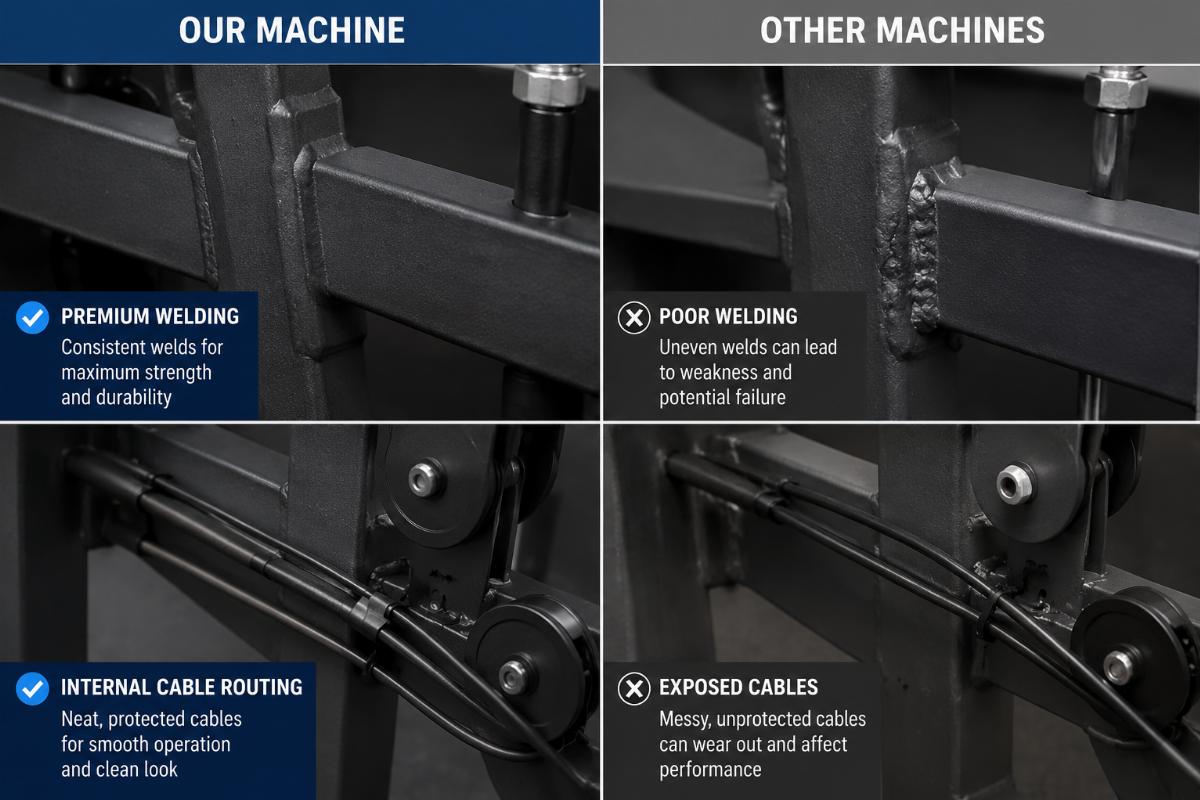
I have torn down both sides. The Pro Club series uses a main frame built from heavy-gauge steel with four-side welding on critical joints. The cable routing on their selectorized stack machines runs through sealed bearing pulleys with aircraft-grade wire rope. These are legitimate commercial-grade specifications. But here is what most buyers do not realize: the same structural design philosophy is standard practice across multiple Shandong-based manufacturers who supply the global OEM market. [NEED_CITE: commercial strength equipment frame steel gauge standards comparison]
Let me lay out the comparison across the parameters that actually matter in a high-usage Caribbean gym environment:
| Specification Parameter | Body-Solid Pro Club | Shandong OEM Equivalent (Bick) |
|---|---|---|
| Main Frame Steel Gauge | Heavy-gauge rectangular tube | Heavy-gauge rectangular tube, equivalent class |
| Frame Welding Method | Four-side full weld on critical joints | Four-side full weld on critical joints |
| Pulley System | Sealed bearing, aircraft cable | Sealed bearing, multi-strand steel core cable |
| Weight Stack Type | Selectorized pin-loaded | Selectorized pin-loaded, compatible plate increments |
| Back Pad Construction | Durafirm-style wide contour pad | High-density contour pad with vinyl upholstery |
| Finish | Powder coat, multi-stage pretreatment | Powder coat, multi-stage pretreatment |
| Load Rating | Commercial-grade rated | Commercial-grade rated |
| Certification | Varies by model line | CE certified across strength line |
Notice what is absent from this table: any claim that one side uses dramatically thicker steel or a fundamentally superior welding process. The reality is that both sides operate within the same engineering envelope for commercial selectorized equipment. [NEED_CITE: commercial fitness equipment structural testing standards EN ASTM]
Where differences do emerge is in finish consistency on high-volume production runs and the availability of custom upholstery color matching for branded gym interiors. A Dominican hotel chain I worked with needed every piece in their fitness center to match a specific dark charcoal vinyl that matched their lobby furniture. The OEM route allowed exact Pantone matching on the upholstery and custom powder coat color on the frames—something that would have required a special order through the original brand with a substantial upcharge and extended lead time.
The cable systems deserve specific attention. In tropical climates with high humidity, cable corrosion is a genuine concern. Both systems use multi-strand steel core wire rope with nylon-coated outer strands. The difference is in replacement availability. When a cable needs swapping, the OEM supplier can ship a replacement spool within days as part of a standing spare parts agreement, rather than waiting for a branded harness assembly.
Cost Breakdown: How Much Can You Really Save?
Total landed cost savings of forty to fifty percent are achievable when you factor in equipment unit price, spare parts pricing, and consolidated container freight—not just the sticker price on the machine.
Let me break this down the way a Dominican distributor would actually calculate it, because the unit price alone does not tell the full story.
The equipment unit price gap is the most visible component. A Pro Club selectorized machine carries a retail price that reflects North American distribution margins. The same category of machine from a Shandong OEM factory, ordered at commercial volume, lands at a substantially lower unit cost. This is not about cutting corners on materials—it is about eliminating the brand premium, the domestic warehousing markup, and the multi-layer distributor margin. [NEED_CITE: fitness equipment OEM pricing structure versus branded retail pricing]
Spare parts represent the hidden cost that destroys profitability over the equipment lifespan. A replacement cable harness, a new seat pad, a pulley wheel, or a selectorized pin assembly from the original brand can cost multiples of the equivalent part from the OEM source. I have seen gym owners pay several times the OEM part price for a simple weight stack guide rod because it carried the original brand part number. Over a five-year equipment lifecycle with dozens of wearable components, this adds up to a significant sum.
Freight and logistics form the third savings pillar. Body-Solid ships from North American inventory, which means Caribbean buyers face transatlantic or trans-Pacific freight plus Dominican customs clearance on every order. A Shandong OEM manufacturer consolidates full containers with mixed SKUs, custom bracing, and optimized container loading plans. A single forty-foot container can hold a complete gym fit-out—twenty to thirty machines spanning cardio, selectorized strength, plate-loaded, free weights, and functional training accessories. The freight cost per machine drops dramatically compared to ordering partial containers of a single brand. [NEED_CITE: container load optimization strategies for fitness equipment import to Caribbean]
I worked with a distributor in the Dominican Republic who was outfitting three hotel fitness centers simultaneously. The original plan called for two full containers of branded equipment plus a separate less-than-container-load shipment of spare parts and accessories. By switching to the OEM consolidation model, everything fit into a single container with the spare parts packed inside the machine cartons and on dedicated pallets. The freight savings alone covered a meaningful portion of the equipment cost difference.
The final layer is warranty and after-sales cost. Branded equipment warranties often require the buyer to ship defective parts back for inspection or pay for authorized technician visits. An OEM supplier operating a direct relationship with the buyer can ship replacement components under warranty without the intermediary logistics chain, reducing both downtime and administrative cost.

OEM and ODM Options for Dominican Distributors
Flexible minimum order quantities, private-label branding, and mixed-container consolidation turn OEM sourcing from a bulk commodity play into a viable strategy for distributors of any scale.
One of the biggest misconceptions I encounter is that working with a Chinese OEM means committing to hundreds of units of a single SKU. That was never the reality for established manufacturers serving the global commercial fitness market, and it is certainly not the case today.
For a Dominican distributor just entering the market or testing a new product line, the practical minimum can be as low as a single mixed container. That container can hold a cable crossover, a Smith machine, a plate-loaded leg curl, a set of adjustable benches, a dumbbell rack with dumbbells, and a functional trainer—all under one shipment, all braced and secured for ocean freight. The factory loads, the export documentation is unified, and the buyer receives a single bill of lading. This model eliminates the pressure to overcommit inventory on slow-moving SKUs while still accessing factory-direct pricing. [NEED_CITE: fitness equipment OEM minimum order quantity structures for emerging market distributors]
Private-label branding is where the real business leverage sits. A distributor in Santiago who wants to build a local brand around commercial gym equipment can do so without the capital requirements of manufacturing. The OEM facility handles custom frame powder coat colors, branded upholstery with the distributor’s logo embossed or screen-printed, custom packaging with local language labeling, and even branded weight stack plates with the distributor’s markings. I have seen Caribbean distributors launch their own equipment lines this way, building brand recognition and customer loyalty without owning a single welding robot.
The ODM dimension matters for buyers who have specific spatial constraints or want to modify standard configurations. A hotel fitness center in Punta Cana had a narrow room where a standard cable crossover would not fit through the doorway. The OEM manufacturer modified the frame dimensions, reduced the overall footprint by adjusting the weight stack orientation, and shipped a machine that fit the space perfectly. That level of customization is simply not available through a branded catalog purchase.
Spare parts bundling is another area where the OEM relationship pays dividends. A distributor can negotiate a standing agreement where every container shipment includes a pre-agreed spare parts package—cables, pulleys, pads, pins, and upholstery patches—priced at cost or included as a warranty reserve. This proactive approach eliminates the emergency parts scramble that plagues branded equipment owners.

How to Verify Quality Before Ordering?
Request CE certification documentation, independent steel material test reports, and a pre-shipment sample or trial unit—never commit to a full order based on a catalog page alone.
I cannot emphasize this enough: the OEM fitness equipment market includes operators of varying quality discipline, and a Dominican buyer must verify claims before committing capital. The verification process is straightforward if you know what to ask for.
Start with certification. Any serious commercial fitness equipment manufacturer serving international markets holds CE certification for the European market, which covers machinery safety directives and electromagnetic compatibility for any electronic components. Request the actual certificate document, not just a claim on a website. Verify that the certificate covers the specific product category you are ordering—strength equipment certification differs from cardio equipment certification. [NEED_CITE: CE certification requirements for commercial fitness equipment under EU Machinery Directive]
Next, ask for steel material test reports. A reputable manufacturer maintains mill certificates for each batch of steel tube used in production. These reports confirm the steel grade, yield strength, and chemical composition. You are looking for confirmation that the main frame tubes meet commercial-grade structural standards—typically rectangular steel tube in the heavy-gauge range with documented yield strength. If a supplier cannot or will not provide material test documentation, that is a serious red flag.
Request a sample unit or a trial order before committing to a full container. A single machine shipped by air or LCL sea freight allows you to physically inspect weld quality, powder coat adhesion, cable routing smoothness, pad foam density, and overall fit and finish. I always recommend that buyers have an experienced technician assemble the sample and stress-test it under simulated commercial use conditions for a defined period before approving the full production run. [NEED_CITE: fitness equipment quality inspection checklist for import buyers]
Weld inspection deserves particular attention. Commercial equipment frames must feature full-penetration welding on all structural joints. Spot welds or intermittent welds on load-bearing connections are unacceptable. Ask for weld inspection photos or, if possible, arrange a third-party inspection during production. The cost of a pre-shipment inspection is negligible compared to the cost of receiving a container of structurally deficient machines.
Finally, verify the supplier’s track record through reference checks. Ask for contact information of existing customers in your region or adjacent markets. A manufacturer who has been supplying the Caribbean and Latin American markets for an extended period will have references who can speak to product durability, delivery reliability, and after-sales responsiveness.

Conclusion
Body-Solid Pro Club alternatives from established Shandong OEM manufacturers deliver equivalent commercial-grade structural performance at substantially lower total cost, with the added advantages of flexible order quantities, private-label capability, and rapid spare parts availability.
Dominican gym owners and distributors who have made the switch report that the machines perform identically under daily commercial use while the supply chain responsiveness improves dramatically. The brand premium that justified the original purchase price simply does not exist in markets where local service infrastructure and rapid parts turnaround matter more than a logo on the frame. Verify quality through certification documentation, material reports, and trial units—then let the economics and the supply chain flexibility speak for themselves.


