BP-Bench Press Sub-Series UAE Manufacturer: Availability Guide
Most buyers assume all BP bench press sub-series are interchangeable across markets. They are not. The UAE’s extreme heat, high humidity, and intense daily usage demand specific steel thickness upgrades, anti-corrosion treatments, and reinforced packaging that standard global versions lack.
For UAE commercial gyms and distributors, BP bench press availability depends on three factors: wall thickness suited for high-frequency use (minimum 2.5mm for main frames), salt-spray tested finishes for coastal humidity, and container-ready packaging that survives Jebel Ali port handling. Standard versions work for hotel or low-traffic setups, but commercial gym buyers must request UAE-spec configurations from Shandong manufacturers.
When I first started sourcing strength equipment for Dubai fitness centers, the most common complaint wasn’t about design or comfort—it was about wobble. A flat bench press that felt solid during the first week would develop lateral shake within months. The root cause? Suppliers shipped the same 2.0mm wall thickness frames used in European boutique studios, completely ignoring that UAE commercial gyms run 80+ users per day on a single unit. [NEED_CITE: equipment failure patterns in high-temperature high-humidity gym environments]. After switching to factory-direct sourcing from Shandong manufacturers who understood regional demands, the callback rate dropped dramatically. The difference wasn’t marketing—it was 0.5mm of steel and proper powder coating cure cycles.

Understanding these distinctions separates buyers who receive equipment that lasts from those who face mid-warranty structural issues.
Which BP Bench Press Sub-Series Fits UAE Commercial Gyms?
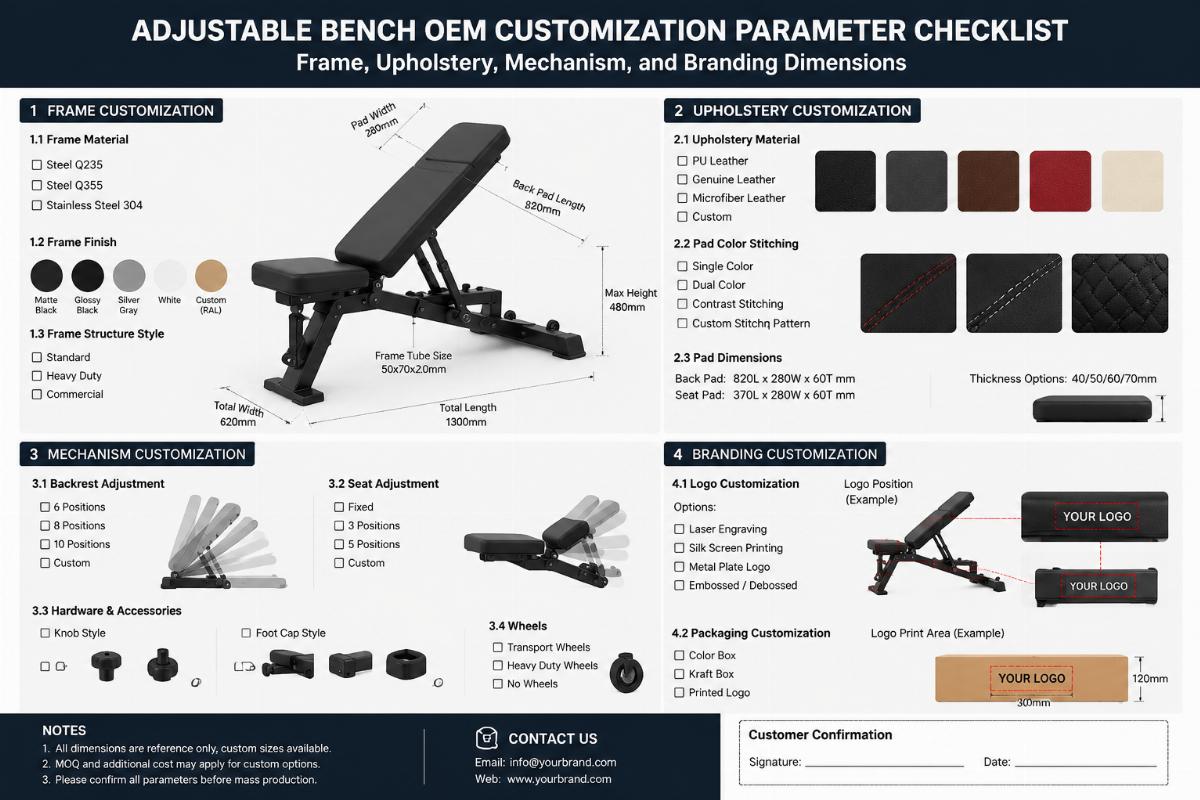
The BP bench press sub-series available for UAE buyers splits into two main categories: standard-duty frames with 2.0mm wall thickness for hotel and residential fitness rooms, and heavy-duty commercial frames with 2.5mm or thicker walls designed for high-traffic gym floors.
The confusion arises because catalog listings often show identical external dimensions across sub-series. A 50x50mm main frame tube looks the same whether it’s 2.0mm or 2.5mm wall thickness. But under EN ISO 20957 load testing protocols, the difference becomes critical when equipment faces continuous daily use. [NEED_CITE: EN ISO 20957 stationary training equipment safety requirements for structural integrity].
| Specification | Standard Hotel Version | Commercial Gym Version |
|---|---|---|
| Main Frame Wall Thickness | 2.0mm | 2.5mm minimum |
| Load Capacity Rating | Suitable for moderate use | Engineered for heavy continuous use |
| Frame Tube Dimensions | 50x50mm or 50x100mm | 50x100mm or 60x120mm |
| Weld Reinforcement | Standard single-pass | Double-pass with gusset plates |
| Adjustment Mechanism | Basic pin-lock | Heavy-duty pop-pin with safety sleeve |
| Foot Plate | Standard rubber pad | Extended rubber with leveling bolt |
A Middle East gym chain once ordered what they believed was commercial-grade BP bench press units, only to discover the supplier had shipped hotel-spec frames. Within months, the J-hooks showed deformation, and the uprights developed visible flex under heavy loads. The replacement cost exceeded the original order value because return shipping from the UAE runs substantially higher than the equipment cost itself.
For distributors planning container loads, requesting the commercial-spec sub-series from the start avoids this scenario. Shandong manufacturers like Bick maintain separate production lines for these variants, and the price differential is marginal compared to the risk of field failures.

How Do Climate and Usage Intensity Affect BP Series Longevity in the UAE?
UAE’s coastal humidity and extreme summer temperatures accelerate corrosion on inadequately treated steel surfaces, making anti-rust treatment quality the second most critical factor after structural thickness.
Indoor gym environments in Dubai and Abu Dhabi maintain air conditioning, but the microclimate around equipment still faces humidity spikes when doors open, sweat accumulation on contact points, and temperature differentials that promote condensation inside frame tubes. [NEED_CITE: corrosion acceleration factors in air-conditioned gym environments near coastal areas].
The powder coating process matters as much as the coating itself. Standard electrostatic spray application without proper surface preparation leads to adhesion failure within extended service periods. Manufacturers serving the UAE market should employ:
- Zinc-rich primer base coat for corrosion resistance
- Minimum 60-micron topcoat thickness
- Full curing cycle at controlled temperatures
- Salt-spray tested finishes meeting extended endurance thresholds
A distributor in the Gulf region reported that units with basic powder coating showed rust spotting along weld seams within the first year, while units with proper surface preparation and primer remained clean even in beachfront fitness facilities. The difference wasn’t the coating material—it was the preparation process and primer layer.
Usage intensity compounds these environmental factors. Commercial gyms in UAE urban centers operate with peak-hour traffic that would be considered exceptional in European markets. Equipment rated for moderate use cycles fatigues faster when subjected to continuous loading patterns. [NEED_CITE: usage frequency impact on strength equipment structural fatigue in commercial settings].

What Are the Real Differences Between Trial Orders and Container Loads?
The gap between a five-unit trial order and a full container load extends far beyond unit price—packaging method, freight cost ratio, quality inspection depth, and risk exposure all shift significantly.
First-time buyers often assume that ordering a full container immediately demonstrates commitment and secures better pricing. While volume pricing exists, skipping the trial phase introduces risks that can cost several times the savings. A US-based fitness equipment importer learned this when their first full container of bench presses arrived with weld defects on multiple units. Without a trial batch to establish quality baselines, they faced the choice of accepting substandard inventory or absorbing return logistics costs.
| Order Type | Packaging Method | Freight Cost Ratio | QC Depth | Risk Profile |
|---|---|---|---|---|
| Trial Order (5-20 units) | Individual wooden crate, fully assembled or semi-knocked down | Substantially higher per unit | Full inspection on each unit | Low—issues caught early |
| Container Load (40-80 units) | Compressed flat-pack, nested components | Noticeably lower per unit | Sampling-based inspection | Higher—defects multiply |
The packaging difference directly affects landed cost. Trial orders ship in protective wooden crates with foam padding on all contact points. Container loads use compressed packaging to maximize container utilization, which means more assembly work at destination but lower freight per unit. [NEED_CITE: packaging optimization strategies for fitness equipment international shipping].
For UAE buyers, the trial order serves another purpose: verifying that the supplier can actually produce UAE-spec equipment. Some manufacturers claim capability but default to standard specifications when production pressure mounts. A small initial order tests this commitment without financial exposure.
Shandong manufacturers experienced with Middle East distribution understand this dynamic. Bick, for instance, structures trial orders with the same QC protocols as full production runs, ensuring that the five units you inspect represent what the full container will contain. This transparency reduces the need for third-party inspection services on subsequent orders.

How Does Lead Time Vary for Standard vs Rushed BP Series Orders?
Standard production cycles for BP bench press sub-series run substantially longer than rushed timelines, but the quality difference between the two becomes visible in weld integrity and coating durability.
UAE project timelines often create pressure for accelerated delivery. Hotel fitness center openings, gym chain expansion schedules, and distributor inventory planning all generate requests for faster turnaround. However, compressing production schedules affects specific quality checkpoints that cannot be rushed without consequence.
The welding stage requires proper cooling intervals between passes. Rushing this process leads to heat-affected zone brittleness, which manifests as crack propagation under repeated loading. [NEED_CITE: welding quality impact on structural integrity in fitness equipment manufacturing]. Standard production allows proper interpass temperature control; rushed production skips these intervals.
Similarly, powder coating requires complete curing cycles. Shortening oven time or reducing cure temperature compromises coating adhesion and corrosion resistance—exactly the properties UAE conditions demand.
| Production Phase | Standard Timeline | Rushed Timeline | Quality Impact |
|---|---|---|---|
| Material Preparation | Controlled | Compressed | Minimal if sourced properly |
| Welding | Full interpass cooling | Reduced cooling intervals | Noticeably reduced fatigue resistance |
| Surface Treatment | Complete preparation cycle | Shortened preparation | Vulnerable to early corrosion |
| Powder Coating | Full cure cycle | Reduced cure time or temperature | Substantially reduced adhesion |
| Final QC | Comprehensive inspection | Sampling only | Higher defect escape rate |
A European distributor working with UAE projects learned to build accelerated timelines into their planning rather than requesting rushed production from manufacturers. By ordering earlier and accepting standard lead times, they avoided the quality compromises that rushed orders inevitably introduce.
Manufacturers like Bick maintain transparent production scheduling that shows buyers exactly where their order sits in the queue. This visibility allows realistic project planning without the false promise of impossible timelines.

How to Verify Supplier Claims Before Placing a UAE-bound Order?
Before committing to a BP bench press order for UAE delivery, request verifiable documentation that proves specification compliance rather than accepting catalog claims at face value.
The fitness equipment manufacturing sector includes suppliers who excel at marketing but cut corners on production. Protecting your investment requires due diligence that goes beyond website claims and sales representative assurances.
Essential verification documents include:
- Wall thickness measurement reports from third-party inspection or calibrated gauge readings on actual production samples
- Salt-spray test certificates showing corrosion resistance performance, not just coating thickness claims
- Weld procedure specifications documenting materials, techniques, and quality standards
- Previous UAE shipment records demonstrating experience with regional requirements
[NEED_CITE: supplier verification documentation requirements for fitness equipment importers].
A Gulf region distributor developed a supplier qualification checklist that includes factory video tours showing actual production processes, not just showroom displays. They request to see welding stations, surface treatment lines, and QC inspection areas in real-time video calls. Suppliers who cannot provide this transparency typically cannot support the claims they make.
Material certifications should trace back to recognized steel grades, not proprietary names that cannot be independently verified. Reputable Shandong manufacturers source from established mills and provide mill test certificates upon request.
For UAE-specific requirements, ask about:
- Humidity-resistant packaging options for sea freight
- Experience with Jebel Ali port handling procedures
- Spare parts availability and warranty support infrastructure
- References from existing UAE customers who can speak to long-term performance
Bick maintains documentation packages that address these verification needs, including third-party test reports and customer reference lists. This transparency reflects confidence in production capabilities rather than marketing positioning.

Conclusion
BP bench press availability in the UAE market requires matching equipment specifications to local conditions, not simply selecting from global catalog options. Commercial gym buyers need heavy-duty frames with enhanced wall thickness, corrosion-resistant finishes, and packaging designed for regional logistics. Trial orders validate supplier capability before committing to container loads, while standard production timelines protect quality from rushed compromises. Verification through documentation and transparent manufacturing processes separates reliable suppliers from those who cannot support their claims.