Bulk Prone Leg Curl Machine from China | OEM Factory Direct
Paying in full upfront is not the safest option — it is often the most expensive mistake.
Standard payment terms for bulk prone leg curl orders from China follow a 30% T/T deposit with the 70% balance paid before shipment or against the B/L copy. For orders exceeding a certain threshold, L/C at sight becomes available, though bank charges and document processing time must be factored into the timeline.
I still remember a mixed container we loaded in Qingdao a few seasons back — prone leg curl units, plate-loaded rows, and a pallet of adjustable benches all heading to a distributor in the Gulf. The buyer insisted on full prepayment because he "didn’t trust anyone overseas." We warned him that a 30% deposit structure actually protects both sides better, but he wouldn’t budge. Three months later, when he wanted to add a second container, he asked for revised terms. The lesson? Trust in international trade is built through structured milestones, not blind prepayment. [NEED_CITE: risk distribution analysis in T/T milestone payment structures per ICC guidelines]
Let me walk you through what actually works when you are structuring payment terms for fitness equipment imports from Shandong.
What Are the Standard Payment Terms for Bulk Prone Leg Curl Orders from China?
Most bulk prone leg curl orders from China operate on a 30% T/T deposit with the remaining 70% settled before the container is sealed or against a copy of the Bill of Lading. This structure has become the industry norm across strength equipment manufacturing in Shandong and beyond, and it exists for a reason — it balances cash flow needs on the factory floor with buyer protection at destination.
The deposit triggers raw material procurement and production scheduling. Steel prices fluctuate, and manufacturers need working capital to lock in coil and tube inventory. The balance payment, timed against shipment documentation, ensures the buyer retains leverage until goods are actually moving. [NEED_CITE: standard deposit-to-balance ratio practices in Chinese fitness equipment export contracts]
Here is how the milestone breakdown typically works:
- Deposit (30%): Paid upon contract signing or proforma invoice confirmation. Production lead time begins only after funds clear the manufacturer’s account.
- Mid-Production Update: Some manufacturers provide photo or video progress reports. This is not a payment trigger, but a trust-building checkpoint.
- Balance (70%): Due before container sealing (EXW/FOB basis) or upon presentation of B/L copy (for buyers who prefer to verify shipment first).
A commercial gym developer in the Middle East once ordered a full container of strength machines — prone leg curl, hack squat, cable crossover, and a complete free weight set. The initial discussion centered on a 50% deposit because the order included custom upholstery colors and branded weight stacks. After negotiation, both sides settled on the standard 30/70 split, with the customization premium absorbed into the unit price rather than the deposit ratio. [NEED_CITE: deposit ratio negotiation dynamics for OEM-branded fitness equipment orders]
The key takeaway: the 30/70 structure is not arbitrary. It reflects years of trade practice where neither party carries disproportionate risk.
When Should Buyers Choose L/C Over T/T for Fitness Equipment Imports?
L/C at sight is appropriate for first-time large-volume orders, government-tender projects, or buyers operating under institutional procurement rules — but for repeat bulk orders, T/T remains faster and significantly cheaper.
Credit sounds secure on paper. A bank guarantees payment upon presentation of compliant documents. But here is what most first-time importers do not realize: L/C processing adds days to the timeline, bank charges eat into margins, and any discrepancy in documentation — even a typo on the commercial invoice — can trigger rejection or amendment fees. [NEED_CITE: documentary discrepancy rates and amendment costs under UCP 600]
I worked with a hotel chain developer in the Gulf who needed to procure turnkey gym packages across multiple properties. The procurement department mandated L/C at sight for all international purchases above a certain value. The prone leg curl units were part of a larger package including cardio equipment and flooring. The L/C process added roughly two weeks to the production-to-shipment window, and the bank charges were split between buyer and seller as stipulated in the credit terms.
The document checklist for L/C in fitness equipment trade typically includes:
- Commercial Invoice (matching the L/C description exactly)
- Packing List (with net weight, gross weight, and CBM)
- Full set of clean on-board Bill of Lading
- CE Certificate (mandatory for EU and many MENA markets)
- Certificate of Origin (for preferential tariff treatment where applicable)
For a repeat buyer ordering a second or third container of prone leg curl machines, switching back to T/T makes practical sense. The relationship is established, product quality is verified, and the cost savings from avoiding L/C bank fees can be redirected toward spare parts or additional accessories. [NEED_CITE: comparative cost analysis of L/C versus T/T in mid-value machinery trade]
What Documents Are Required to Align with Payment Terms and Ensure Smooth Customs Clearance?
Payment terms and customs clearance are linked by one thread: documentation accuracy. A mismatch between the commercial invoice, packing list, and certificate of origin can freeze your cargo at the destination port regardless of how cleanly the payment was structured.
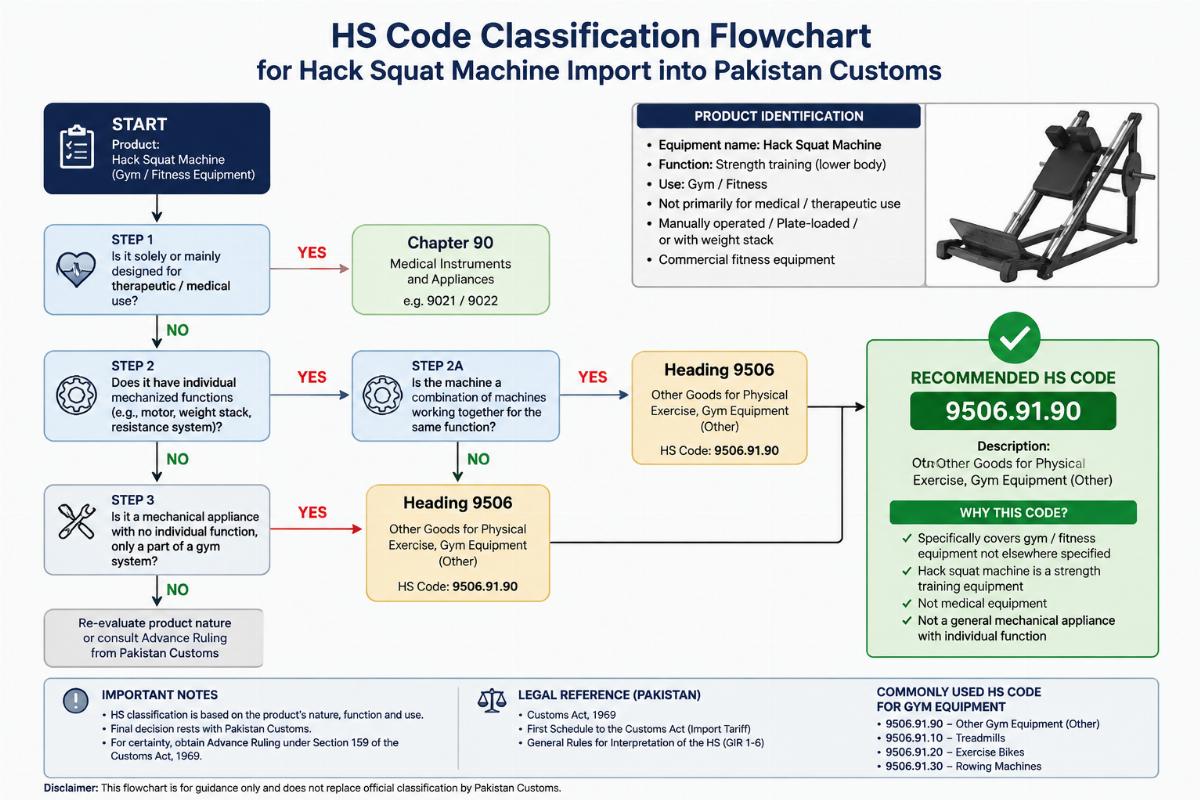
I have seen containers held at Jebel Ali for weeks because the packing list showed a different HS code than what was declared on the CE certificate. The prone leg curl was classified under a general strength training equipment code, but the certificate referenced a more specific subcategory. Customs officials flagged the inconsistency, and the demurrage charges ended up costing more than the freight. [NEED_CITE: HS code classification disputes for plate-loaded and selectorized strength equipment at GCC ports]
The critical documents that must align with your payment-triggered shipping paperwork include:
- CE Declaration of Conformity: Must reference the exact product model and applicable harmonized standards. For prone leg curl machines, this typically covers the Machinery Directive and relevant EN standards for stationary training equipment.
- Certificate of Origin: Required for preferential duty treatment in many importing countries. Ensure the issuing chamber matches what your customs broker expects.
- Packing List: Must detail every item in the container — not just the prone leg curl units but also any accessories, hardware packs, and spare parts. Weight and dimension figures must match the B/L.
- Bill of Lading: The payment trigger document in many T/T structures. The consignee and notify party fields must match your import license and customs registration.
A West African importer learned this the hard way. His first trial order — a single prone leg curl unit shipped via LCL — cleared without issue. When he scaled to a full container with mixed equipment, the packing list was prepared by a forwarder who had never handled fitness machines before. The descriptions were generic. Customs at the destination port demanded a revised manifest, and the delay cascaded into missed gym opening deadlines. [NEED_CITE: documentation error impact on fitness equipment import clearance timelines in West Africa]
How Do Deposit Ratios Change Based on Order Size and Customization Level?
Standard catalog-model orders at MOQ level typically accept a 30% deposit, but full OEM branding, custom colorways, or turnkey gym packages may require 40% to 50% upfront to cover committed material and tooling costs.
The deposit ratio is not a fixed number — it scales with the manufacturer’s exposure. If you are ordering a single prone leg curl unit in standard black upholstery with no branding changes, the factory’s risk is minimal. They can resell that unit to another buyer if you default. But if you request custom powder coating in a specific RAL color, branded weight stacks with your logo, and proprietary upholstery patterns, the manufacturer is producing goods that have no secondary market.
Here is how deposit expectations typically shift:
- Single-unit or sample orders: 30% deposit is standard. Some manufacturers may accept lower for established buyers.
- Mixed container loads (multiple SKUs, standard specs): 30% deposit remains the norm.
- Full OEM branding (logo on frames, custom colors, branded packaging): 40% deposit is common, as material procurement and production scheduling carry higher commitment.
- Turnkey gym packages (complete facility outfitting with design input): 40-50% deposit, sometimes with milestone payments tied to production phases.
A distributor in Southeast Asia started with a single prone leg curl sample to evaluate build quality and weld finish. Satisfied with the result, he placed a mixed container order — prone leg curl, leg extension, chest press, and a set of dumbbells. The deposit stayed at 30%. By the third order, when he requested full private-label branding across the entire strength line, the deposit moved to 40%. This was not a penalty — it reflected the factory’s commitment to custom tooling and exclusive color matching. [NEED_CITE: deposit scaling rationale for OEM customization in fitness equipment manufacturing]
The lesson: deposit ratio is a negotiation variable, but it is anchored to real cost exposure. Understanding this helps buyers frame requests reasonably rather than treating it as a purely commercial power play.
What Common Payment Mistakes Cause Delays or Disputes in Fitness Equipment Trade?
Mismatched invoice values, unclear currency clauses, and ignoring bank charge allocation are the top three causes of payment-related shipment holds in fitness equipment imports from China.
These are not theoretical risks. They happen regularly, and they are almost entirely preventable.
Mismatched invoice values: A buyer requests a lower invoice value for customs purposes, but the L/C or T/T transfer references the actual contract value. Banks flag the discrepancy. Customs at destination flag the undervaluation. Both sides are exposed. The solution: keep invoice values consistent across all documents, and address duty optimization through proper HS classification rather than value manipulation. [NEED_CITE: customs valuation dispute triggers under WTO Valuation Agreement for fitness equipment]
Unclear currency clauses: The contract is quoted in USD, but the buyer’s bank processes the transfer in local currency. Exchange rate fluctuations between contract signing and payment date create a shortfall. The manufacturer receives less than expected, and production halts until the gap is covered. Always specify the settlement currency explicitly in the proforma invoice and confirm the exchange rate mechanism for L/C-denominated orders.
Ignoring bank charge allocation: In L/C transactions, bank charges are typically split — the buyer’s bank charges are for the buyer’s account, the seller’s bank charges are for the seller’s account. But if the credit does not specify this clearly, disputes arise over who bears intermediary bank fees. For a full container of prone leg curl machines and complementary equipment, intermediary charges can add up to a meaningful sum. Clarify this in the L/C application, not after the fact.
A MENA distributor once had a container of strength equipment — including a full set of prone leg curl units — held at the port because the T/T balance payment was sent in EUR while the contract specified USD. The manufacturer’s bank received the funds but could not apply them to the correct invoice without buyer authorization. The container sat for days, accruing storage fees. The fix was simple — a currency clause in the contract — but it was missing. [NEED_CITE: currency mismatch payment failure cases in China fitness equipment export trade]
Conclusion
Structured payment terms protect both buyer and manufacturer — the 30/70 T/T model remains the practical standard for bulk prone leg curl orders from China, with L/C reserved for specific institutional or first-time large-volume scenarios. Documentation accuracy, currency clarity, and realistic deposit ratios based on customization level are what separate smooth shipments from port delays. Understand the mechanics, negotiate the milestones fairly, and the transaction will reflect the trust both sides are building.