CC-800 Cable Crossover Sub-Series OEM Manufacturer Customization
Most buyers assume heavier weight stacks are universally better — they’re not. Stack weight must match the actual strength profile of your target market’s end users, or you’ll ship machines that sit unused.
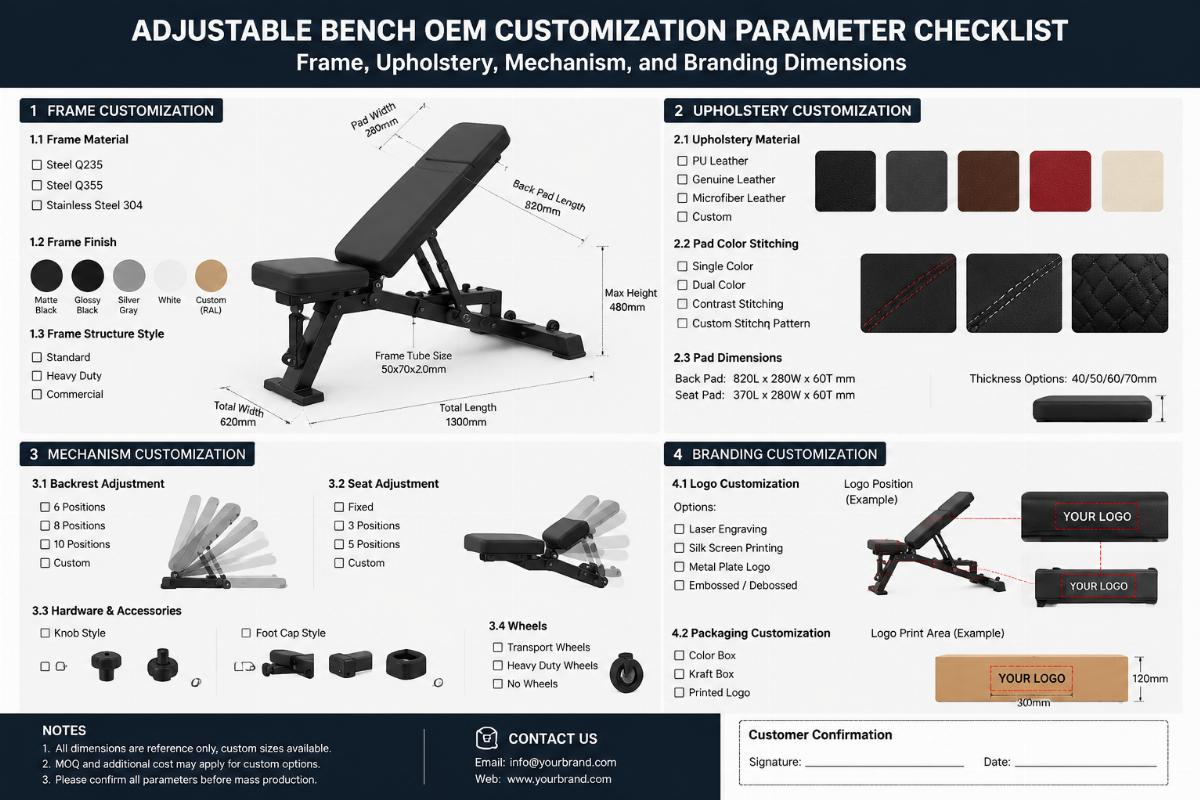
CC-800 cable crossover customization covers five core modules: stack weight increments, cable pulley ratio, upholstery color and material, frame powder-coat finish, and branding placement. Buyers sourcing for commercial gym projects, distributor inventory, or turnkey fitness packages must align each option with local user demographics, port clearance requirements, and container loading logic to avoid costly delays.
I still remember a shipment bound for West Africa that got held at the port because the bill of lading said "fitness equipment" while the actual cargo was a mixed container of selectorized machines with very specific frame structures. The customs officer wanted a product breakdown matching the physical goods, not a generic category. That hold cost the client days of demurrage and nearly derailed a gym opening. Since then, I’ve built every export file around exact product descriptions tied to HS codes, and I treat customization specs the same way — every option has a downstream consequence on paperwork, loading, and end-user satisfaction. [NEED_CITE: HS code classification principles for strength training equipment per WCO guidelines]

Let me walk through each customization layer and the decisions that actually matter when you’re buying factory-direct.
What Customization Options Are Available for CC-800 Cable Crossover?
The CC-800 cable crossover supports five independent customization modules that can be mixed based on order scope: weight stack configuration, cable ratio tuning, upholstery selection, frame finish, and branding application.
Each module operates on a standardized interface, which is what allows flexible combinations without re-engineering the base frame. Here’s how they break down:
| Module | Standard Config | Customization Range | Lead-Time Impact |
|---|---|---|---|
| Weight Stack | Single stack per side | Incremental plate sizing, total stack mass | Moderate if non-standard increments requested |
| Cable Ratio | Fixed pulley arrangement | Adjustable ratio for speed vs. resistance feel | Minimal with standard pulley library |
| Upholstery | Black synthetic leather | Color match to brand palette, material grade | Noticeable if custom colorway requires new batch |
| Frame Finish | Electrostatic powder coat | Color and texture per RAL reference | Minimal within standard color library |
| Branding | Factory logo | Silk-screen or engraved client logo, nameplate language | Noticeable for non-Latin scripts |
A distributor in Southeast Asia once ordered a full batch with a specific brand color that didn’t exist in our standard RAL library. The upholstery supplier had to run a dedicated dye batch, which added time — but the result matched the client’s studio interior perfectly. The key is communicating color references early, ideally with Pantone or RAL codes rather than photos, because screen colors lie. [NEED_CITE: powder coating color matching standards per RAL Classic system]
For branding, silk-screen works well for large logo areas on the frame shroud, while engraved metal nameplates handle multilingual text cleanly. I’ve seen Arabic, Spanish, and French nameplates ship without issue, but non-Latin character sets do require a separate artwork confirmation cycle.

How to Choose the Right Stack Weight for Your Target Market?
Stack weight should reflect the median strength level of the end users in your market, not the maximum possible load — overspecifying wastes material cost and reduces usable range for typical users.
This is where a lot of first-time importers get it wrong. They assume the heaviest stack is the safest bet, but a commercial gym in Scandinavia and a hotel fitness corner in West Africa have very different user profiles. The goal is to cover the working range of the majority, not chase the top-end outlier.
| Market Profile | Typical User Strength | Recommended Stack Range | Rationale |
|---|---|---|---|
| Mature fitness markets (Europe, North America, developed MENA) | Higher baseline strength | Upper-mid to high stack range | Users expect progressive overload capacity |
| Emerging fitness markets (parts of Africa, SE Asia, Latin America) | Moderate baseline, growing segment | Mid stack range | Avoids intimidating beginners, matches actual usage |
| Boutique studio / hotel gym | Mixed, often lower frequency | Mid stack range with smooth incremental feel | Prioritizes accessibility over max load |
The incremental step between plates matters as much as the total stack. A market with more beginner users benefits from smaller increments, because the jump between adjacent plates feels less jarring on cable exercises like flyes or tricep pushdowns. [NEED_CITE: resistance progression principles in selectorized strength equipment design]
I worked with a client importing into East Africa who initially wanted the maximum stack option. After discussing the actual member profile of their gym chain — largely new-to-training users with a growing intermediate segment — we spec’d a mid-range stack with finer increments. The machines saw higher utilization in the first year because the resistance steps matched what members could actually handle.
When you’re building a gym package that mixes the CC-800 cable crossover with Smith machines and free weight stations, the stack weight decision should be consistent across selectorized pieces. Mismatched increments across machines in the same facility create a fragmented user experience.

What Is the MOQ and Lead Time for OEM Orders?
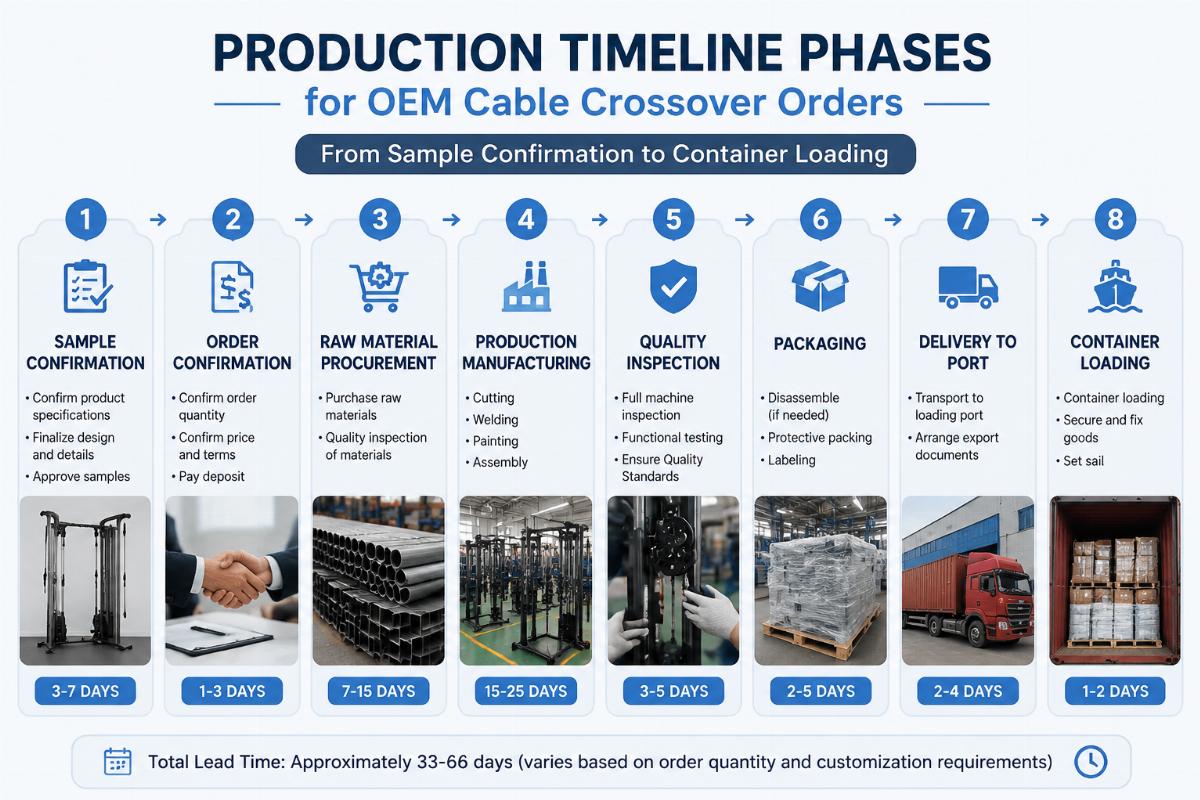
Standard configurations can ship from single-unit quantities, while full OEM customization — including custom stack increments, branded upholstery, and client-specific nameplates — typically requires a minimum batch in the low double-digit range, with total lead time running from order confirmation through final loading.
The lead time breaks into distinct phases, and understanding each one helps you plan around vessel schedules and gym opening dates:
- Artwork and sample confirmation — This covers upholstery color swatches, logo file approval, and nameplate language proof. Expect this phase to involve at least one round of physical sample review before bulk production begins. [NEED_CITE: OEM sample approval workflow in commercial fitness equipment manufacturing]
- Frame fabrication and welding — The base frame is produced from standard tube stock, cut, welded, and ground. This phase runs on a fixed production schedule regardless of customization depth.
- Powder coating and curing — Custom colors within the standard library slot into existing coating lines without delay. Non-standard colors require a dedicated batch run.
- Assembly and stack loading — Weight stacks are assembled with the specified plate increments, cables are routed through the configured pulley system, and upholstery is fitted.
- Final inspection and packing — Each unit is functionally tested, then packed for container loading with protective framing.
A gym owner in the Middle East once needed a mixed container of cable crossovers, Smith machines, and plate-loaded equipment for a new facility opening. By aligning the customization specs across all pieces — same frame color, same upholstery tone, same branding style — we consolidated production into a single scheduling window. The container loaded cleanly, and the gym opened on schedule.
The critical point: customization depth directly determines how far in advance you need to place the order. If your project timeline is tight, lock in standard finishes and focus branding customization on the elements with the shortest confirmation cycle, like nameplate language and logo placement.
How to Avoid Customs Clearance Delays with Customized Equipment?
The single most common cause of port delays for customized fitness equipment is a mismatch between the bill of lading description and the physical product structure — not the customization itself, but the paperwork failing to reflect it.
Customs authorities at destination ports require the product description on shipping documents to match what’s physically in the container. When you order customized cable crossovers, the product may have non-standard features — different stack weights, unique branding, modified frame dimensions — that need to be accurately reflected in the documentation.
Here’s what I check on every export file before the container leaves the port:
- Product description on the bill of lading must specify the actual equipment type. Writing a generic term that doesn’t match the physical goods invites inspection and holds. [NEED_CITE: WCO guidelines on accurate goods description on transport documents]
- HS code classification must correspond to the product’s actual function and structure. Strength training equipment falls under specific headings, and the code must match the machine’s primary design purpose, not a broader category.
- Certificate of origin must correctly state the manufacturing country, especially when the destination port applies preferential tariff rates under trade agreements.
- Packing list must itemize each unit with its specific configuration, so customs officers can verify the cargo against the documents without opening every box.
I once saw a full container of selectorized equipment held because the packing list described "gym machines" without breaking down the specific types and configurations. The destination customs office required a revised document set, which took days to process and nearly missed the vessel window for the return documentation.
For mixed containers — which are common when buyers combine cable crossovers with Smith machines, functional trainers, and free weight equipment in a single shipment — the packing list must clearly separate each product type with its own line item. Customs officers inspect by document line, and a vague lumped description creates friction at every checkpoint.

What Are the Cost Advantages of Factory-Direct OEM vs. Branded Alternatives?
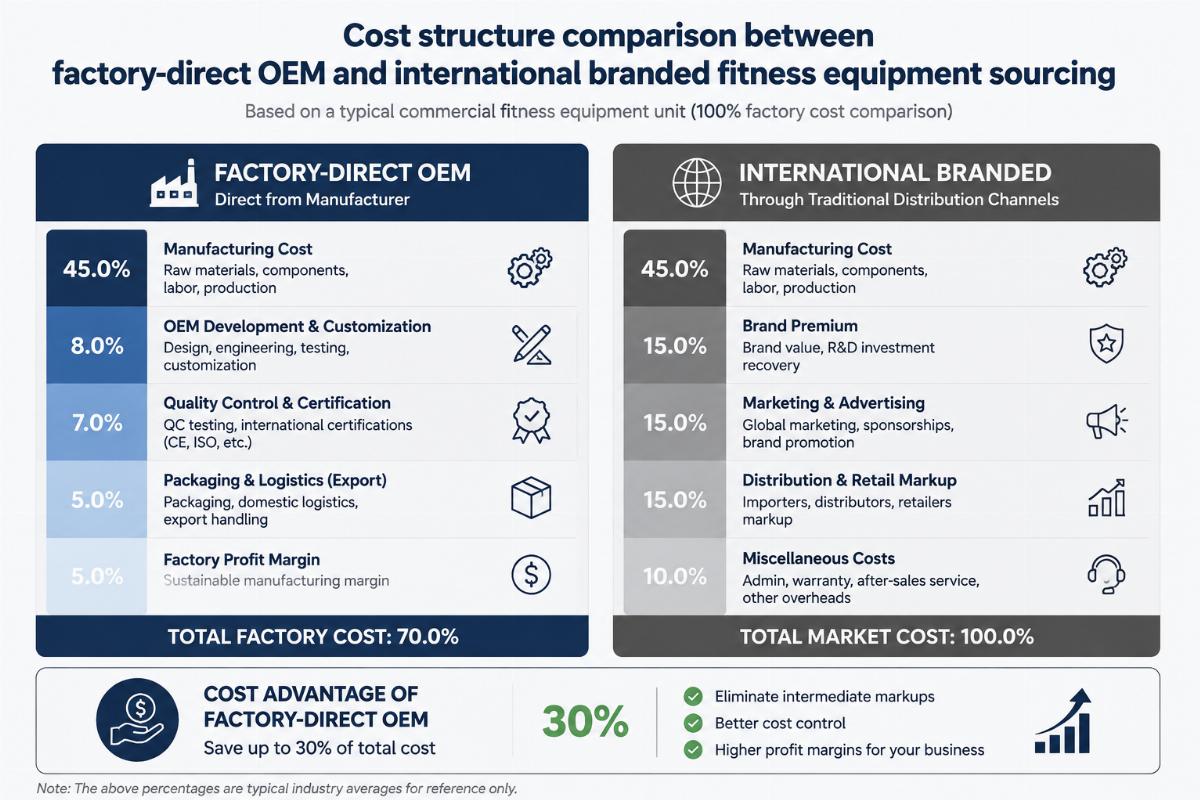
Sourcing CC-800 cable crossover customization directly from the manufacturing facility delivers a meaningful cost advantage over purchasing equivalent-spec equipment from international brands, primarily by eliminating brand markup and distribution layer margins.
The price gap between factory-direct OEM and branded alternatives comes from structural differences in how each supply chain is built:
| Cost Component | Factory-Direct OEM | International Branded |
|---|---|---|
| Manufacturing margin | Single-layer, transparent | Multi-layer with brand premium |
| Distribution markup | None — direct to buyer | Regional distributor + dealer margin |
| Customization cost | Priced at actual production delta | Bundled into premium tier pricing |
| Shipping optimization | Buyer controls container loading | Pre-set packaging and routing |
| After-sales structure | Spare parts supply with technical support | Branded service contracts at premium |
The total cost of ownership picture shifts further when you factor in customization. International brands typically offer limited configuration options at fixed price tiers, meaning buyers pay for features they don’t need or can’t get the exact spec they want. Factory-direct OEM lets you build the machine to the exact specification your market requires, paying only for the actual customization delta.
A distributor in Latin America compared the landed cost of a container-load order of cable crossovers — including customization for local branding and market-appropriate stack weights — against sourcing the same spec from a well-known international brand. The factory-direct route delivered the exact configuration at a substantially lower total cost, even after accounting for ocean freight and import duties. The savings allowed the distributor to expand the order and add complementary strength equipment to the same container.
For buyers planning turnkey gym projects, the cost advantage compounds when you consolidate multiple equipment categories — cardio, selectorized strength, functional training, and free weights — into a single sourcing relationship. Container loading efficiency improves, documentation simplifies, and the customization consistency across the facility creates a cohesive brand experience for the end user.
Conclusion
CC-800 cable crossover customization is a modular system — stack weight, cable ratio, upholstery, finish, and branding each operate independently, and the buyer’s job is to align each module with the actual conditions of the target market and the logistics chain. Match stack weight to user strength profiles, lock customization specs early to protect project timelines, and make sure every document reflects the physical product exactly. Get those three things right, and the rest of the process runs smoothly from factory floor to gym floor.