Chin-Up Station Pre-Shipment Inspection | Third-Party QC Supplier
Most buyers think a clean visual finish means a chin-up station is ready to ship. The real failures hide inside weld seams and thread fits — invisible until the first heavy user hangs on it.
A complete chin-up station pre-shipment inspection must cover five non-negotiable checkpoints: structural welding integrity (visual plus non-destructive testing), static load verification at rated safety factor, powder coating film thickness and salt-spray resistance, thread assembly fit using go/no-go gauges, and export packaging durability — skipping any single step risks field failure within months, especially in humid tropical climates.
I still remember a container that came back from Jakarta. A Southeast Asian gym chain had ordered a batch of pull-up rigs, and by the time the doors opened at the port, the main upright weld on one unit had cracked clean through during a basic static load check on their floor. The return freight, demurrage, and replacement shipping cost several times the original margin on that order. The root cause was not poor design — it was porosity trapped inside the weld bead that no visual inspection could catch. [NEED_CITE: weld porosity as root cause of structural failure in tubular fitness frames] After that, I stopped treating inspection as a final walkthrough and started treating it as a process that runs from the welding bay to the container door.
Now every batch going out gets walked through a structured chin-up station pre-shipment inspection before the container seal is applied. What follows is the checklist I use, built from repeated lessons in the field.
How to Verify Welding Quality on Pull-Up Racks?
Visual inspection alone is not enough — internal porosity and incomplete fusion are the silent killers of load-bearing tubular frames.
Pull-up stations are built from welded steel tubes, typically rectangular or round hollow sections joined at high-stress nodes: the base-to-upright joint, the pull-up bar mounting bracket, and the dip station arm connection. These joints carry the full dynamic load of a user performing kipping pull-ups or muscle-ups. [NEED_CITE: critical weld joint locations in commercial fitness equipment frames]
The chin-up station pre-shipment inspection starts with a visual pass under adequate lighting. The inspector looks for surface cracks, undercut, spatter, and inconsistent bead profile. But visual inspection only catches what is on the surface. For structural joints, magnetic particle testing or dye penetrant testing should be applied on a sampled basis — especially on the main upright-to-base weld and the pull-up bar bracket. [NEED_CITE: NDT methods applicable to welded tubular fitness equipment]
A Southeast Asian distributor once received a full container of chin-up stations that looked perfect on the outside. During on-site assembly, their technician noticed a slight wobble on one unit. Under magnification, the pull-up bar bracket weld showed a line of subsurface porosity — the joint had never fully fused. That single defect meant the entire batch needed re-inspection, and the supplier had to send a second QC team at their own cost.
Risk checklist for weld quality:
- Surface cracks or undercut on any load-bearing joint
- Inconsistent bead width or incomplete fusion at tube intersections
- Spatter buildup inside tube ends that blocks threaded inserts
- Absence of NDT sampling on critical structural nodes
What Load Test Protocol Should Be Applied?
Static load testing at the rated safety factor is the only way to confirm that the frame will not deflect or fail under real-world use.
Commercial chin-up stations are typically rated for a user weight capacity, and industry practice requires testing at a multiple of that rated load — held for a defined dwell time — with no permanent deformation, cracking, or joint loosening afterward. [NEED_CITE: static load test standards for commercial strength equipment]
During a chin-up station pre-shipment inspection, the load test is performed on a sampled basis from the finished, fully assembled batch. Sandbags or calibrated weights are applied to the pull-up bar center point and the dip station arms simultaneously. The inspector measures deflection at the bar center and checks all weld joints and fastener connections afterward for any sign of yielding.
A gym equipment importer in the Middle East learned this the hard way. They skipped the static load test on a batch of combination pull-up and dip stations to save a day of inspection time. Two months after installation, a CrossFit-affiliated box reported a pull-up bar bracket bending under repeated kipping use. The replacement and air-freight cost wiped out the profit on the entire order.
Load test parameters to verify:
- Test load applied as a defined multiple of rated user capacity
- Dwell time held long enough to reveal creep or slow deformation
- Deflection measured at bar center and compared against acceptable limits
- Post-test inspection of all weld joints and fasteners for permanent set
How to Check Coating Durability for Tropical Climates?
Film thickness and salt-spray resistance determine whether the frame survives a humid gym environment or starts rusting at the weld toes within months.
Most commercial chin-up stations use electrostatic powder coating over a phosphated or sandblasted steel substrate. The coating must be thick enough to resist chipping from barbell contact and user grip, and the underlying pretreatment must resist corrosion creep if the coating is scratched. [NEED_CITE: powder coating film thickness and adhesion standards for fitness equipment]
In the chin-up station pre-shipment inspection, film thickness is measured with a calibrated coating thickness gauge at multiple points on each sampled unit — uprights, pull-up bar, dip arms, and base plates. Readings are compared against the specified range. Too thin, and the coating will not survive transport abrasion; too thick, and it beco*d internal tube ends are especially vulnerable. In tropical climates, any bare steel exposed inside a tube will rust outward and push the coating off from the inside. I have seen pull-up bars where the external finish looked perfect, but the threaded insert for the J-cup mount was already corroding from the inside because the internal tube end had not been coated or sealed.
Coating inspection points:
- Film thickness measured on flat surfaces, tube corners, and weld toes
- Adhesion tested by cross-hatch method on sampled panels or hidden frame areas
- Internal tube ends and threaded inserts checked for bare metal or inadequate coverage
- Salt-spray test report reviewed for substrate pretreatment quality
What Thread Fit and Assembly Checks Are Required?
Thread assembly fit determines whether the unit can be installed cleanly on-site or whether bolts cross-thread, strip, or loosen under vibration.
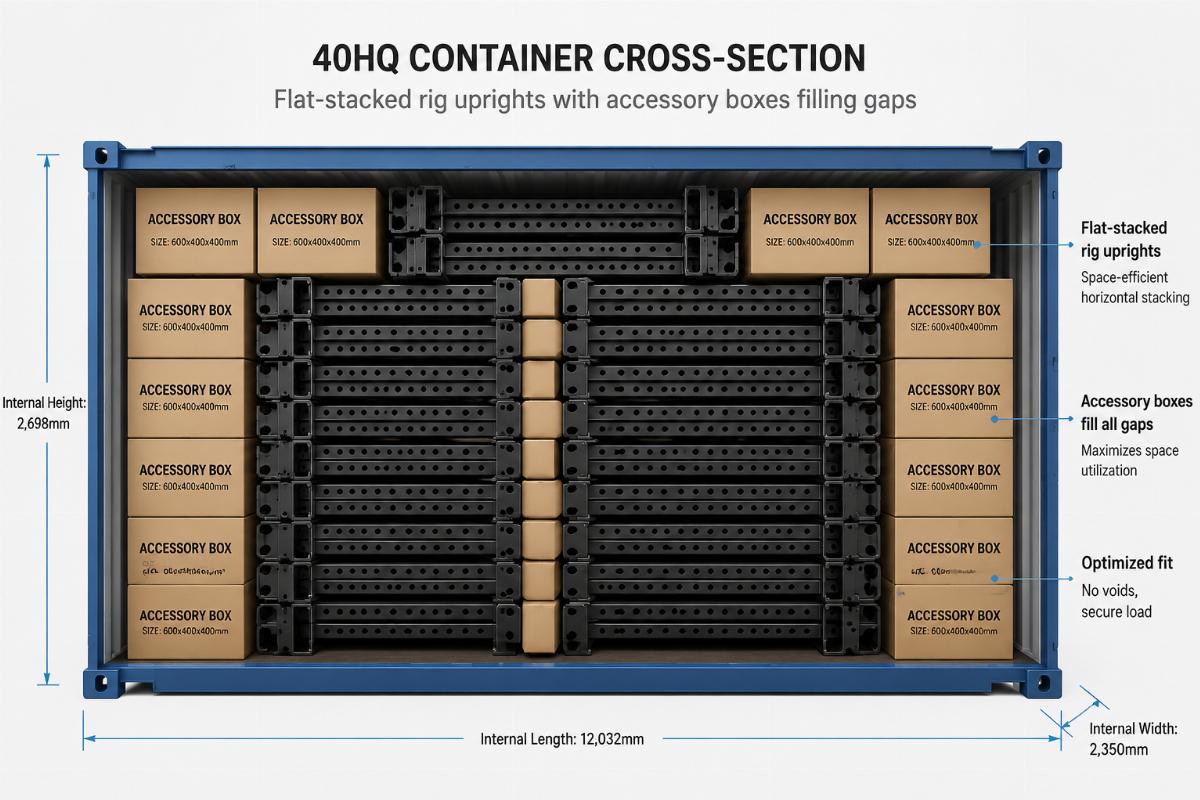
A chin-up station ships partially disassembled to fit the container efficiently. The end user or installer must bolt the pull-up bar to the uprights, attach the dip arms, and secure the base plates. If the threaded inserts are out of tolerance, or if the bolts are the wrong class, the installer will struggle — and a struggling installer often forces the thread, damaging it permanently.
During the chin-up station pre-shipment inspection, every threaded insert on sampled units is checked with a go/no-go thread gauge. The go end must pass freely; the no-go end must not enter more than a defined fraction of a turn. Fasteners are then hand-torqued to verify smooth engagement and checked for clamp force with a torque wrench.
A buyer in Latin America received a batch where the pull-up bar mounting bolts were metric coarse thread, but the inserts had been tapped to a slightly different pitch due to a tooling mix-up at the factory. The bolts went in by force during assembly, stripped under the first week of gym use, and the buyer had to source replacement inserts locally — at a cost that far exceeded the original inspection fee they had declined.
Thread and assembly checks:
- Go/no-go gauge check on every threaded insert on sampled units
- Fastener class and length verified against the bill of materials
- Hand-torque and torque-wrench check for smooth engagement and correct clamp load
- Alignment of mating holes verified with assembly pins before final bolting
What Packaging Standards Prevent Transit Damage?
Proper packaging is the last line of defense — a dented upright or a scratched powder coat on arrival will cost more in rework than the entire packing material.
Chin-up stations are heavy, with long tubular sections that can bend if unsupported, and powder-coated surfaces that will chip if they rub against bare steel during ocean transit. In humid port environments, condensation inside the container can also cause surface rust on any uncoated metal.
For the chin-up station pre-shipment inspection, packaging is checked against a defined standard: corner protectors on all frame edges, foam or EPE wrapping on powder-coated surfaces, steel banding or wooden crating for heavy uprights, and desiccant or VCI paper inside sealed poly bags for moisture protection. [NEED_CITE: export packaging standards for heavy fitness equipment]
A buyer in Southeast Asia once consolidated a container of pull-up stations with other gym equipment from multiple suppliers. The pull-up stations were not crated — just stretch-wrapped. During transit, a shifting pallet of weight plates pressed against the uprights, bending two of them and scraping the powder coat off three others. The rework and touch-up painting at destination cost a noticeable portion of the container’s total value.
Packaging inspection points:
- Corner protectors and edge guards on all frame sections
- Foam or EPE wrap on all powder-coated surfaces, secured against shifting
- Wooden crate or steel frame support for long uprights to prevent bending
- Desiccant or VCI protection inside sealed poly bags for moisture-sensitive components
- Container loading plan reviewed to prevent heavy items shifting against finished goods
Conclusion
A chin-up station pre-shipment inspection that only checks appearance will miss the defects that cause field failures. Weld integrity, static load performance, coating durability, thread fit, and packaging protection must all be verified before the container is sealed — especially when the destination climate is hot, humid, and unforgiving to any exposed steel or marginal weld.