
Commercial Fitness Equipment Supplier from China Factory Direct
Most buyers assume a low quote means cutting corners on steel. The real cost gap sits in brand markup, not build quality.
Netherlands gym and hotel procurement teams sourcing from a Shandong China factory can secure CE-compliant cardio, strength, free-weight, and functional training equipment at pricing roughly 40-50% below premium European brands — provided they match specs to Dutch training habits and calculate container loading by volume-to-weight ratio, not by unit count. [NEED_CITE: price differential analysis between Chinese factory-direct and European premium commercial fitness equipment]
I spent years handling export documents at Qingdao port, watching container after container of fitness machines roll through. Then I moved into direct sales, working with gym owners and hotel developers across multiple regions. One project in Lagos still makes me wince — a comprehensive strength facility where the buyer assembled a shopping list online. The Smith machine cross-member couldn’t hold the loads their coaches programmed, the squat rack spacing didn’t match local training patterns, and the flooring dimensions didn’t align with the room layout once crates were opened. Air-freighting replacement parts cost a mid-four-figure sum and delayed opening by weeks. Since then, my first step on any order is requesting floor plans and movement-flow diagrams before discussing a single SKU. Equipment procurement isn’t about filling a spreadsheet — it’s about matching steel to how people actually train.
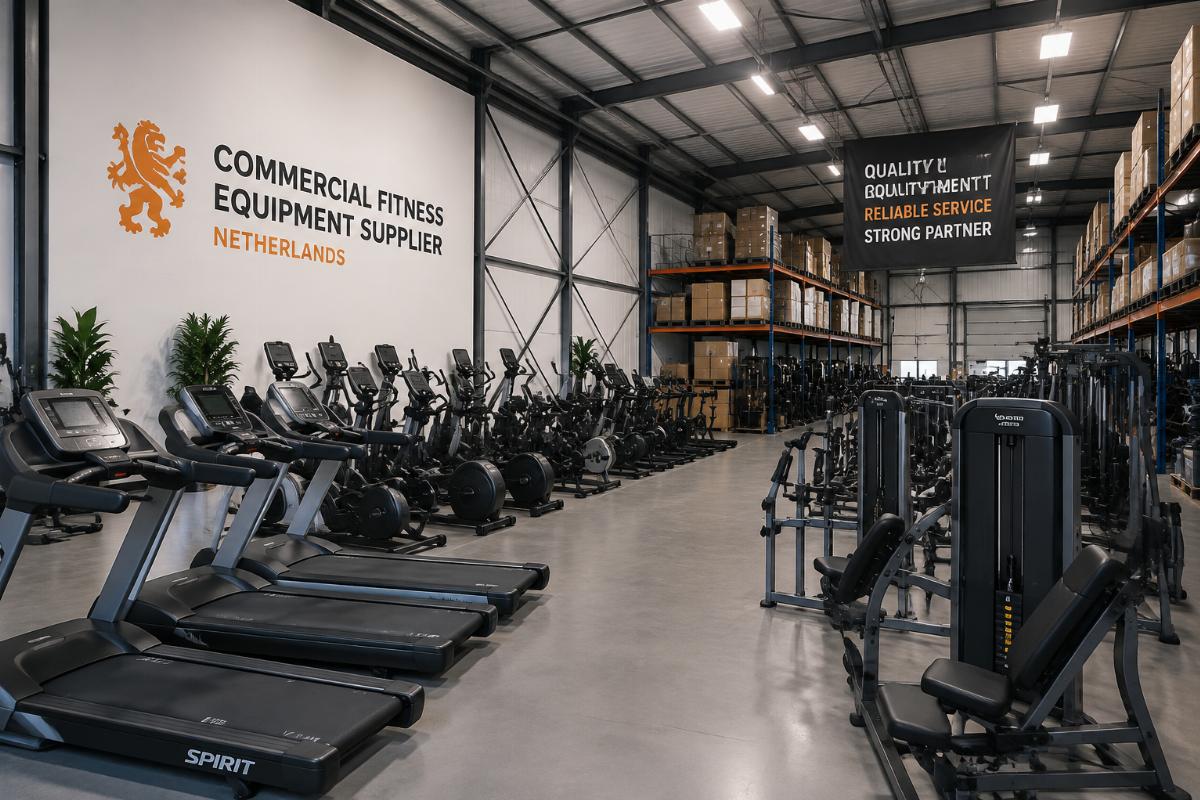
Let’s walk through what Dutch buyers actually need to know when sourcing from a Chinese fitness equipment supplier.
What Equipment Categories Should Netherlands Gyms Source from China?
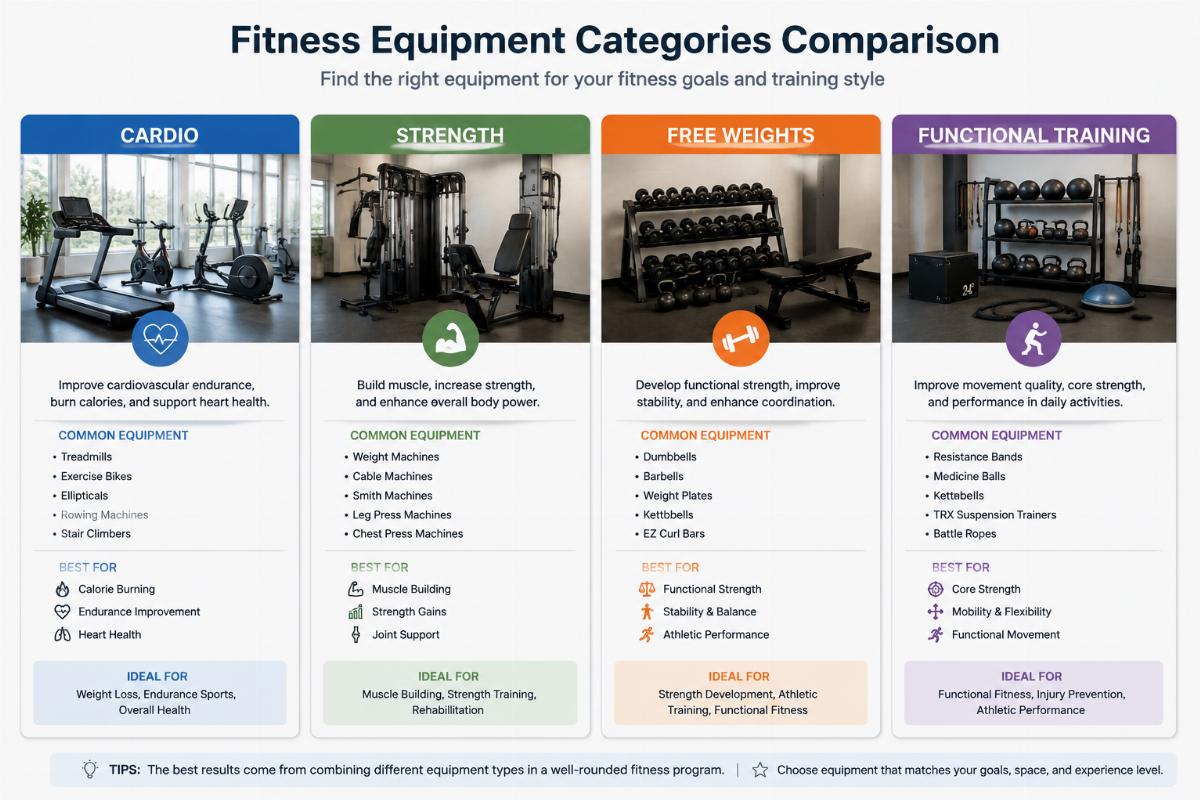
All four major categories — cardio, strength, free weights, and functional training — are viable for direct factory sourcing, as long as specifications align with Dutch user training preferences and spatial constraints. [NEED_CITE: European commercial gym equipment category demand distribution]
Cardio equipment dominates the conversation first. Commercial treadmills from Shandong factories typically run deck thicknesses and motor outputs comparable to mid-tier European offerings. The key specification to verify is the running board thickness paired with motor horsepower — these two together determine long-term durability under high-traffic conditions. Ellipticals and spin bikes follow similar logic: frame weight and flywheel mass matter more than exterior styling.
Strength machines require closer attention to tube wall thickness and load-rated welding points. A Smith machine destined for a Dutch boutique studio needs a cross-member rated for heavy eccentric loading, because European coaching styles tend to emphasize controlled negatives. Cable crossover units should be checked for pulley smoothness and stack weight increments — Dutch users often prefer finer adjustment steps.
Free weights are where factory-direct sourcing delivers the most obvious value. Dumbbells, barbells, plates, and kettlebells are commodity-grade products where Chinese manufacturing scale drives pricing well below European equivalents. The specification to watch is rubber coating durability on bumper plates and knurling aggressiveness on barbells — these are tactile preferences that vary by market.
Functional training gear — battle ropes, plyo boxes, medicine balls, turf rolls — rounds out the package. These items are low-complexity, high-margin for distributors, and straightforward to spec.
| Category | Key Spec to Verify | Dutch Market Preference |
|---|---|---|
| Cardio Treadmills | Deck thickness, motor HP | Heavy-duty deck, quiet motor for multi-story hotels |
| Strength Machines | Tube wall thickness, weld rating | High cross-member load capacity for eccentric training |
| Free Weights | Rubber coating durability, knurling pattern | Moderate knurling, premium-feel rubber plates |
| Functional Gear | Rope density, box joint reinforcement | Compact footprint for studio-format layouts |
A buyer in Amsterdam once ordered a full cardio range without checking motor voltage compatibility for Dutch three-phase power. The machines arrived, plugged in, and tripped breakers across the entire floor. Retrofitting motor controllers cost more than the original freight. [NEED_CITE: electrical compatibility requirements for imported fitness equipment in EU markets]
How Do China Factory Prices Compare to European Brands for Dutch Buyers?
At identical specifications, factory-direct pricing from Shandong runs 40-50% below premium European and American brands — the gap reflects brand positioning and distribution margins, not manufacturing cost differences. [NEED_CITE: commercial fitness equipment pricing structure breakdown brand premium vs manufacturing cost]
Here’s what the price stack actually looks like. A premium European commercial treadmill retails at a price that includes design amortization, European labor for final assembly, multi-layer distributor margins, and brand marketing spend. The core components — steel frame, running deck, motor, electronics — are sourced from the same global supply chain that feeds Chinese factories. The manufacturing cost difference between a Shandong-built unit and a European-branded unit, at the same spec, is relatively narrow.
Where the real savings emerge is in strength equipment and free weights. A plate-loaded machine from a European brand carries pricing that reflects decades of brand equity and a dealer network that needs margin at every tier. The same machine spec — same tube dimensions, same seat adjustment mechanism, same pin-loaded stack weight range — from a Shandong factory arrives at a fraction of that price because it bypasses the brand premium layer entirely.
| Cost Component | European Premium Brand | China Factory Direct |
|---|---|---|
| Raw materials and manufacturing | Standard | Standard |
| Brand design amortization | Substantial | Minimal |
| Distribution tier margins | Multi-layer | Single-layer or direct |
| Marketing and showroom | Significant | Negligible |
| Final price to buyer | Full retail | Noticeably reduced |
A Dutch distributor I worked with was purchasing selectorized machines from a well-known European brand. When he requested a quote for the same spec from our factory, the per-unit price dropped by nearly half. His concern wasn’t quality — he’d inspected our tube welding and powder-coating process — it was whether his existing clients would accept a non-EU origin. The answer came when he ran a blind material test: same tube thickness, same weld penetration, same finish durability. His clients couldn’t tell the difference. [NEED_CITE: fitness equipment buyer perception study on country-of-origin bias in commercial procurement]
The lesson: price comparison must be spec-to-spec. A lower quote on a machine with thinner tube walls isn’t a deal — it’s a different product. But when specs match, the savings are structural, not cosmetic.

What Certifications and Quality Standards Apply to Netherlands Imports?
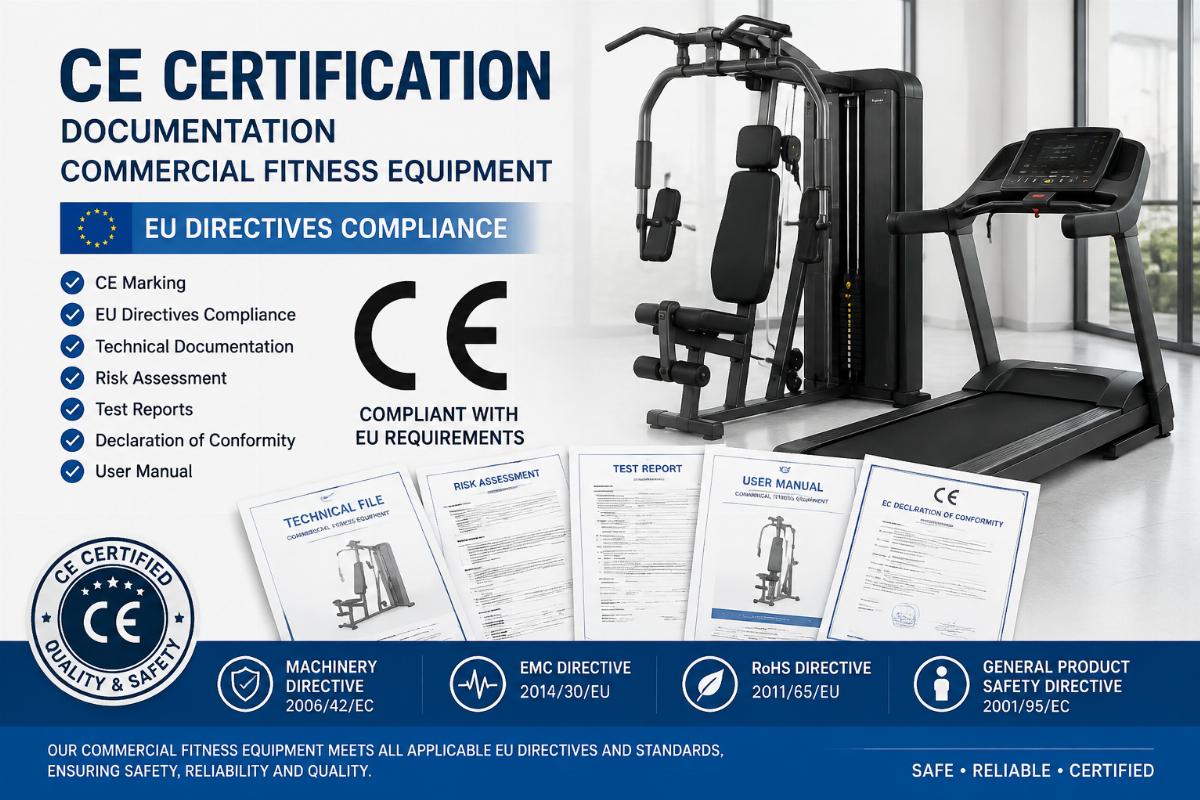
CE marking is the baseline requirement, but buyers must confirm which specific EU directives apply to each equipment type — mechanical safety and electrical safety directives don’t automatically cover all machine categories. [NEED_CITE: EU CE marking directive requirements for commercial fitness equipment imports]
Most buyers treat CE certification as a checkbox — the factory has it, so the product is cleared. This assumption creates real risk at Dutch customs and, more importantly, in liability exposure if an end-user gets injured.
Commercial fitness equipment falls under multiple EU directives depending on configuration. A motorized treadmill triggers the Machinery Directive and the Low Voltage Directive. A purely mechanical plate-loaded machine falls under the Machinery Directive but may not require Low Voltage coverage. A spin bike with an electronic console introduces electromagnetic compatibility requirements. The CE certificate a factory presents must explicitly list the directives covered — a certificate that only references the Machinery Directive doesn’t clear an electrically powered unit for import.
Beyond CE, Dutch buyers should verify EN standards alignment for specific equipment categories. The EN ISO 20957 series covers stationary training equipment across multiple parts — part one for general safety requirements, part two for treadmills, part four for strength benches, part five for stationary bikes, and so on. A factory that tests to these specific parts demonstrates compliance depth beyond a generic CE stamp.
| Certification Layer | What It Covers | Verification Point |
|---|---|---|
| CE Marking | EU market access baseline | Confirm listed directives match equipment type |
| EN ISO 20957 Parts | Equipment-category safety standards | Request test reports for specific parts |
| Electrical Safety | Motor and control system compliance | Low Voltage Directive coverage for powered units |
| Material Safety | Surface coating and rubber compound | REACH compliance for chemical substances |
A Scandinavian gym chain once received a container of strength machines with CE certificates that only covered the mechanical frame — the electronic stack-selector displays had no separate electrical certification. The units were held at Rotterdam port for weeks while the factory scrambled to obtain supplemental testing documentation. The delay cost more in demurrage than the certification process itself. [NEED_CITE: EU customs detention cases for fitness equipment with incomplete CE documentation]
The practical takeaway: request the full test report, not just the certificate cover page. Read the directive list. Confirm it matches every powered component on the machine.
How to Optimize Container Loading for Netherlands Port Delivery?
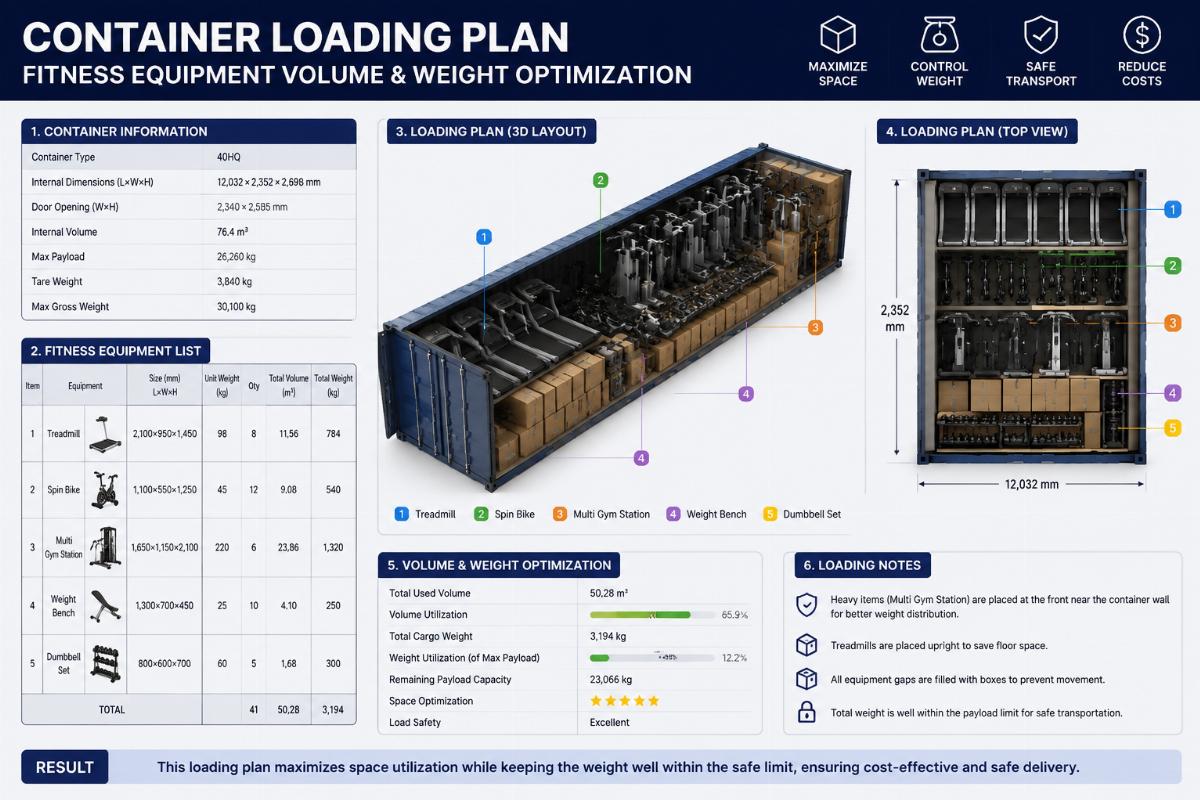
Consolidated container loading requires precise calculation by equipment volume and weight ratio — not unit count — or buyers risk discovering wasted space or overweight penalties after the container is sealed. [NEED_CITE: container loading optimization methodology for mixed fitness equipment shipments]
A 40-foot high-cube container offers a fixed volume envelope and a maximum payload weight. Fitness equipment is notoriously awkward to load because items vary wildly in density. A commercial treadmill is heavy but relatively compact. A set of adjustable benches is light but voluminous. A rack of dumbbells is extremely dense. Throwing units into a container based on "we need twenty treadmills and ten benches" without calculating volumetric fill leads to two failure modes: the container hits its weight limit before it’s full, or it’s physically full before reaching the weight limit — and in both cases, you’ve paid for unused capacity.
The correct approach starts with a loading plan that maps each SKU’s dimensions and net weight against the container’s usable space and payload ceiling. Heavy items — weight stacks, plate-loaded frames, dumbbell sets — go on the floor as a base layer. Mid-density items — cardio machines, functional trainers — stack above. Light but bulky items — bench pads, foam rollers, flooring rolls — fill the gaps and top layer.
| Loading Sequence | Equipment Type | Density Profile | Placement Logic |
|---|---|---|---|
| Base layer | Weight stacks, plate-loaded frames | High weight, moderate volume | Floor-level weight distribution |
| Middle layer | Treadmills, ellipticals, cable machines | Moderate weight, larger volume | Stacked above base with bracing |
| Top layer | Benches, flooring, accessories | Low weight, high volume | Gap-fill and ceiling-level packing |
A hotel developer in Rotterdam ordered a complete fitness center package — cardio range, selectorized line, free-weight zone, and rubber flooring. The initial loading plan counted units without calculating volumetric efficiency. The result: the container was weight-maxed at roughly two-thirds volume fill. The remaining flooring and accessory items had to ship as a separate less-than-container-load consignment, adding freight cost and a separate customs clearance event. A revised loading plan on the next order — same total equipment list — fit everything into a single container with weight and volume both balanced within tolerance. [NEED_CITE: fitness equipment container loading efficiency case study mixed SKU consolidation]
The principle is simple but often ignored: plan the container like a three-dimensional puzzle before anything gets loaded. The factory’s logistics team should provide a loading diagram with volumetric calculations before the container is sealed.
What Are the MOQ and OEM Options for Dutch Distributors?
Single-unit orders are feasible for direct buyers, while OEM private-label programs require evaluating mold investment against long-term order volume to determine cost-effectiveness. [NEED_CITE: fitness equipment OEM minimum order quantity and mold cost structure]
For gym owners and hotel developers buying for their own facilities, minimum order quantity is essentially irrelevant — a factory-direct supplier will fulfill a single treadmill or a complete gym package without MOQ barriers. The transaction is straightforward: spec confirmation, production, shipping.
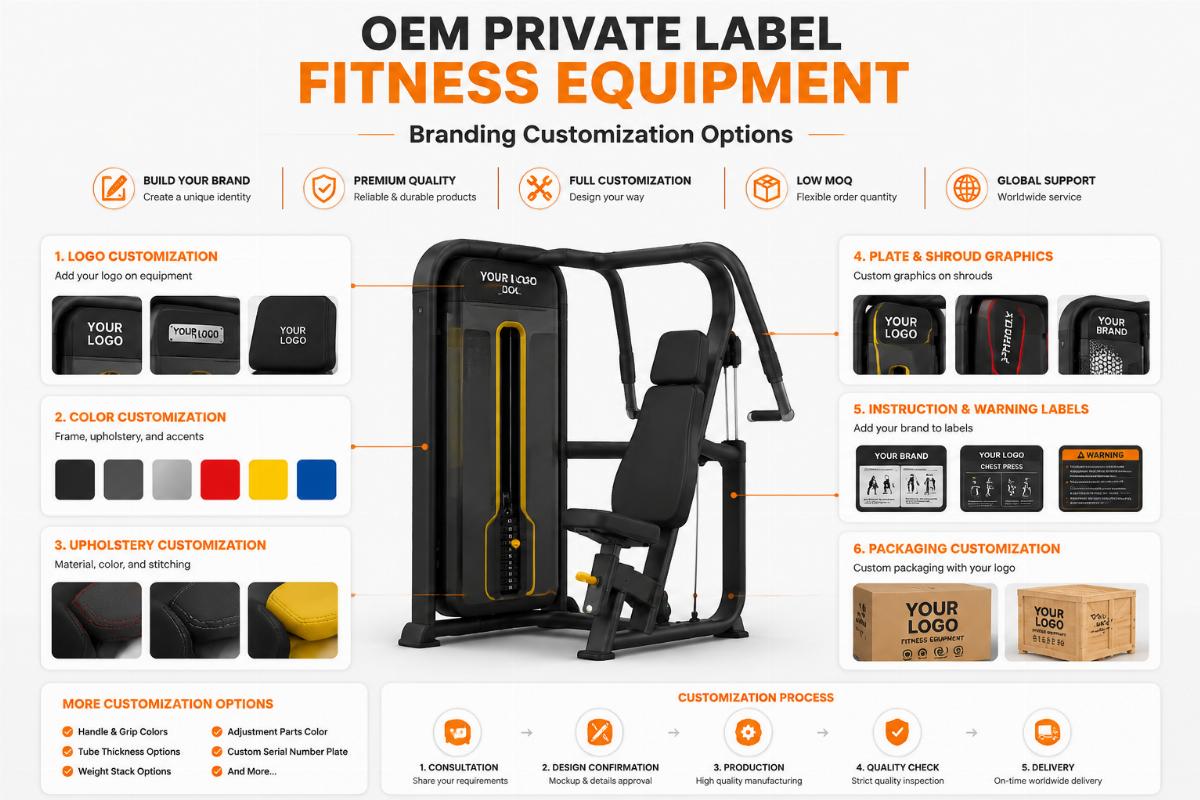
For distributors building a private-label brand in the Netherlands or broader European market, the conversation shifts. OEM branding — your logo on the equipment, your color scheme, your packaging — requires tooling investment. Custom console faceplates, branded shroud panels, silk-screened frame markings, and printed packaging all involve mold or setup costs. These costs are amortized across the order run, which means a small first order carries a high per-unit mold burden, while a larger order spreads that cost thin.
The practical decision framework: if you’re testing a new product line or entering a new market segment, start with a modest order using the factory’s existing tooling with minimal branding — perhaps just logo stickers and custom packaging. Once sales velocity is proven, commit to a larger order with full custom molds for branded components. This staged approach limits upfront capital risk while building toward full brand differentiation.
| OEM Stage | Branding Scope | Tooling Investment | Recommended Order Size |
|---|---|---|---|
| Entry level | Logo labels, custom packaging | Minimal | Small batch, market testing |
| Mid stage | Branded console panels, color matching | Moderate | Medium batch, proven demand |
| Full custom | Custom shrouds, proprietary molds | Substantial | Large batch, established brand |
A distributor in the Benelux region wanted to launch a private-label strength line. His initial plan called for full custom molds on every machine in the range — a substantial upfront investment. We suggested starting with his top-selling three models at full OEM spec, while running the remaining models with basic branding. His first order was manageable in cash flow, and within a year, sales data justified expanding full custom tooling to the rest of the range. The alternative — committing to full custom across the entire line from day one — would have tied up capital in molds before market response was known. [NEED_CITE: fitness equipment distributor OEM staging strategy case study]
Spare parts availability is the other half of the OEM equation. A private-label brand is only as strong as its after-sales support. Confirm that the factory maintains component inventory for your specific configurations and can supply replacement parts on a defined timeline — not just at the time of original order, but years later when end-users need console replacements, cable swaps, or upholstery refreshes.
Conclusion
Sourcing commercial fitness equipment from a China factory direct delivers structural cost savings for Dutch buyers — but only when specifications, certifications, loading plans, and OEM terms are handled with precision rather than assumption. Match equipment specs to how Dutch users actually train, verify CE directive coverage at the component level, calculate container loading by volume and weight rather than unit count, and stage OEM investment based on proven sales data. The price advantage is real, but it rewards buyers who do their homework before the container is sealed.


