Commercial Gym Equipment Warranty Terms Explained | OEM Supplier
"Lifetime warranty" on gym equipment almost never means what buyers assume it means.
Commercial gym equipment warranty terms are structured by component tiers: frames receive the longest coverage, motors and electronics carry mid-range periods, and wear parts are either excluded or covered for a minimal window. Understanding this hierarchy, along with claim procedures and exclusion clauses, is the single most effective way to prevent on-site disputes and unexpected replacement costs.
I still remember a shipment we sent to a hotel project in the Middle East. The treadmill control boards started burning out within the first few months of operation. The buyer pointed at a line in the contract that read "warranty coverage" and assumed full replacement was on the table. We ended up airfreighting replacement boards at our own expense just to close the account and preserve the relationship. That incident pushed me to scrutinize every phrase inside gym equipment warranty terms, especially how wear parts are defined, how claims are processed, and what response timelines actually look like in practice [NEED_CITE: warranty dispute frequency in international fitness equipment trade].

Let me walk you through what these terms actually mean when the equipment is running on a gym floor thousands of miles from the factory.
What Does "Lifetime Warranty" Actually Cover on Gym Equipment?
A "lifetime warranty" in the fitness industry almost always applies exclusively to the structural frame, not to motors, electronics, or any moving component.
When a buyer sees "lifetime" on a spec sheet, the natural assumption is that the entire machine is covered for as long as it exists. The reality is far more segmented. Manufacturers separate gym equipment warranty terms into distinct tiers, and the frame sits at the top of that hierarchy. The frame is the welded steel skeleton—upright posts, base rails, main body structures. Because these parts are made from heavy-gauge steel and rarely fail under normal use, offering extended coverage on them carries minimal cost risk for the manufacturer [NEED_CITE: structural warranty standards in commercial fitness equipment manufacturing].
Motors, by contrast, sit in a middle tier. A commercial treadmill motor, for instance, typically carries a multi-year warranty, but the period is finite. Electronics—control boards, displays, sensors—usually receive an even shorter window. The reasoning is straightforward: electronic components are sensitive to voltage fluctuations, humidity, and operating environment, all of which vary wildly from one installation site to another.
Here is where disputes begin. A hotel procurement manager in Southeast Asia once received a full container of cardio equipment. The marketing brochure said "lifetime warranty" in bold letters. When the display panels on several ellipticals failed after extended use, the buyer expected free replacements. The manufacturer’s position was that the lifetime clause covered only the frame. The electronics had their own separate, shorter period, which had already expired. Neither side was technically wrong—the contract was simply ambiguous.
The lesson is simple: always ask for a written breakdown of warranty periods by component category before signing. If the document only says "warranty coverage" without specifying tiers, treat it as a red flag.

How Are Wear Parts Defined in Fitness Equipment Warranties?
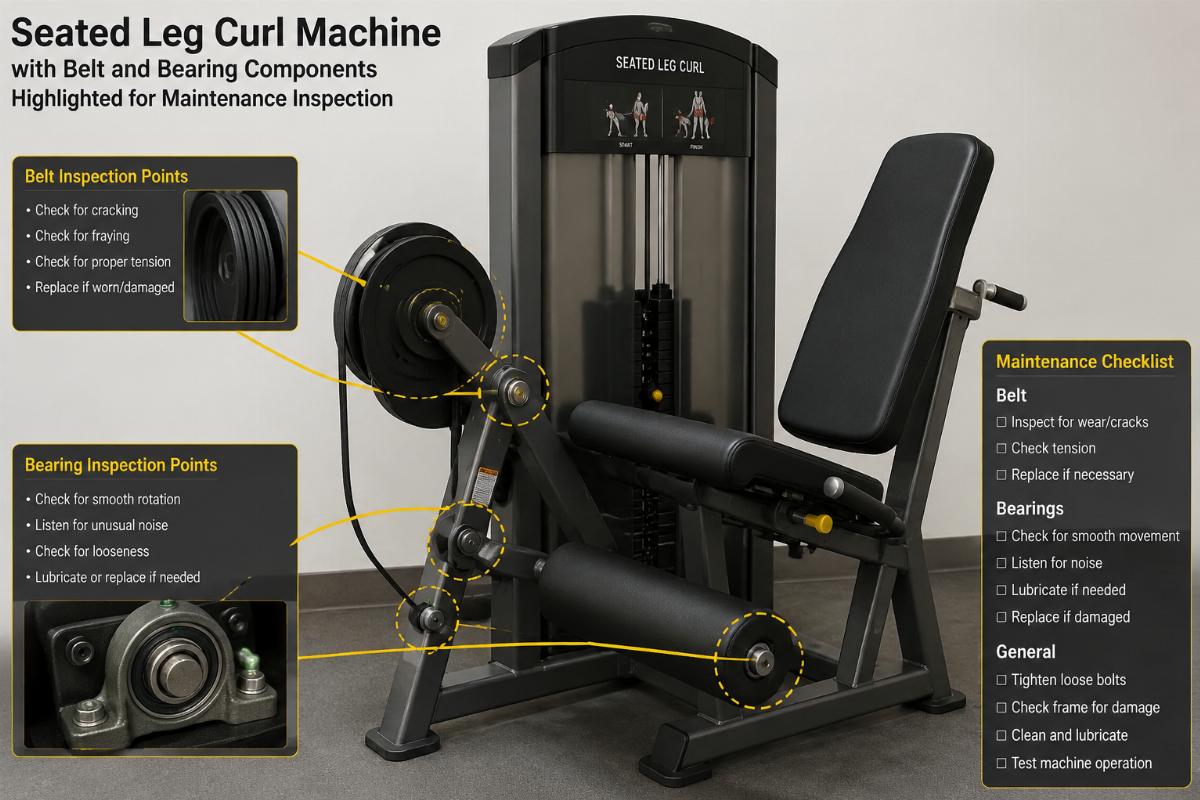
Wear parts—belts, bearings, running belts, cables, and grips—are typically excluded from standard warranty coverage or covered for a minimal period, regardless of the machine’s overall warranty length.
This is the section of gym equipment warranty terms that causes the most frustration among gym owners and distributors. Wear parts are components designed to degrade through normal use. A treadmill running belt stretches and thins over time. Drive belts on ellipticals crack. Bearings in spin bikes develop play. Cables on cable crossover machines fray. These are not defects; they are expected consumption.
Manufacturers classify these items separately from structural or functional components. The logic is that wear part replacement is a maintenance cost, not a warranty event. Some suppliers include a short initial coverage window for wear parts, acknowledging that premature failure can occur during the break-in period. Beyond that window, replacement is the responsibility of the end user [NEED_CITE: wear part classification standards in fitness equipment service agreements].
I worked with a distributor in Africa who ordered a full batch of strength equipment. Within a short period, several cable crossover machines needed cable replacements. The distributor filed a warranty claim. The manufacturer’s response was that cables are classified as consumables and fall outside the standard warranty scope. The distributor argued that the cables frayed far too quickly to be considered normal wear. The technical reality was that the installation environment had high humidity and no climate control, which accelerated cable degradation. Neither the warranty document nor the maintenance manual had specified environmental requirements clearly enough, and the resulting argument cost both sides time and money.
The practical approach is to request a complete wear parts list with definitions before purchase. Ask which items are classified as consumables, what the initial coverage period is for each, and whether the supplier offers a standing spare parts supply arrangement. Factories that maintain dedicated spare parts inventory and can ship replacements quickly reduce the operational impact of wear part failures, even when those failures fall outside warranty scope.

What’s the Claim Process When Gym Equipment Fails On-Site?
The standard warranty claim process for gym equipment follows a four-step sequence: initial report, remote video diagnosis, parts shipment, and on-site replacement—with shipping cost responsibility determined by the warranty tier and failure cause.
Understanding this sequence is critical because gym equipment warranty terms rarely describe the process in detail. Most documents state what is covered and for how long, but leave the how completely vague. This ambiguity is where international deals break down.
Step one is the initial report. The end user or site technician contacts the supplier or distributor with a description of the failure. This step should include the machine model, serial number, date of installation, and a clear description of the symptom.
Step two is remote video diagnosis. This is where experienced suppliers separate themselves from the rest. A qualified technical team reviews video footage of the malfunction, identifies whether the issue is a warranty-covered defect, a wear part failure, or an installation error. Video diagnosis eliminates the need for an immediate site visit and dramatically reduces response time [NEED_CITE: remote diagnostic efficiency in international fitness equipment after-sales service].
Step three is parts shipment. Once the diagnosis confirms a warranty-covered failure, the supplier prepares and ships the replacement component. Here, the question of who pays for freight becomes critical. Some warranty terms specify that the supplier covers parts but not shipping. Others split freight costs based on the warranty tier. This must be clarified in writing before the order is placed.
Step four is on-site replacement. In most cases, the replacement part is installed by the end user’s local technician, guided by the supplier’s technical support team. For complex failures involving motors or control boards, the supplier may provide remote installation guidance or, in extreme cases, dispatch a technician—though international dispatch costs are rarely covered under standard warranty terms.
A gym owner in the Middle East experienced a complete motor failure on a commercial treadmill. The warranty terms covered the motor, but the freight clause was silent. The supplier shipped the replacement motor, but the international freight cost was substantial. The buyer refused to pay, arguing that a covered failure should include delivery. The supplier argued that parts coverage does not automatically include logistics. The dispute took weeks to resolve and damaged the business relationship.
The fix is straightforward: ensure the warranty document explicitly states freight responsibility for each component tier. Suppliers who provide clear claim procedures, maintain spare parts inventory, and support video diagnosis significantly reduce the friction of this process.

Which Warranty Clauses Cause the Most Disputes in International Deals?
The warranty clauses that generate the highest volume of international disputes are vague coverage language, undefined voltage and environment requirements, and missing maintenance record obligations.
Having reviewed hundreds of warranty documents across multiple markets, I can identify the patterns that consistently lead to conflict. These are not edge cases—they are the standard friction points that appear in deals across the Middle East, Africa, Southeast Asia, and Latin America.
The first major dispute trigger is vague coverage language. Phrases like "warranty coverage" or "full warranty" without component-level breakdowns are the single largest source of post-sale conflict. Buyers interpret these phrases broadly; suppliers intend them narrowly. The gap between these interpretations is where disputes live [NEED_CITE: common warranty clause ambiguities in international fitness equipment contracts].
The second trigger is undefined voltage and environmental requirements. Commercial gym equipment is designed for specific electrical standards. A machine built for stable voltage environments can suffer control board failures in regions with frequent power fluctuations. If the warranty document does not explicitly state the required voltage range and the consequences of operating outside that range, the supplier faces claims for failures that are actually caused by site conditions. Similarly, humidity, temperature, and ventilation requirements must be documented. Without these specifications, any failure in a harsh environment becomes a warranty debate.
The third trigger is maintenance record obligations. Most warranty terms require the end user to perform routine maintenance—lubrication, belt tension checks, bolt torque verification—and to keep records of that maintenance. When a failure occurs and the supplier requests maintenance logs, the absence of those records gives the supplier grounds to deny the claim. Buyers often view maintenance record requirements as administrative overhead and ignore them. When a major component fails, that oversight becomes expensive.
A distributor in Southeast Asia placed a large order for a hotel chain. The warranty document included a maintenance record clause, but the distributor did not communicate this requirement to the hotel’s facility management team. When several machines experienced premature failures, the supplier requested maintenance logs. None existed. The claim was denied. The distributor absorbed the cost and the relationship with the hotel was strained.
This is where a supplier’s after-sales infrastructure matters. Manufacturers who provide detailed maintenance schedules, offer remote technical support, and maintain accessible spare parts supply chains help buyers stay compliant with warranty requirements. Clear documentation, proactive communication, and responsive technical support transform warranty terms from a source of conflict into a framework for long-term equipment reliability.

Conclusion
Gym equipment warranty terms are component-specific, process-dependent, and highly sensitive to documentation clarity. Frames carry the longest coverage, motors and electronics carry defined mid-range periods, and wear parts are largely excluded. Claims follow a diagnosis-first process where freight responsibility must be pre-negotiated. Vague language, undefined site requirements, and missing maintenance records are the primary drivers of international disputes. Buyers who demand written component-level breakdowns, explicit freight clauses, and clear maintenance obligations before signing will avoid the majority of post-sale conflicts.