
Commercial Treadmill Price in Russia: 2026 Wholesale Buyer Guide
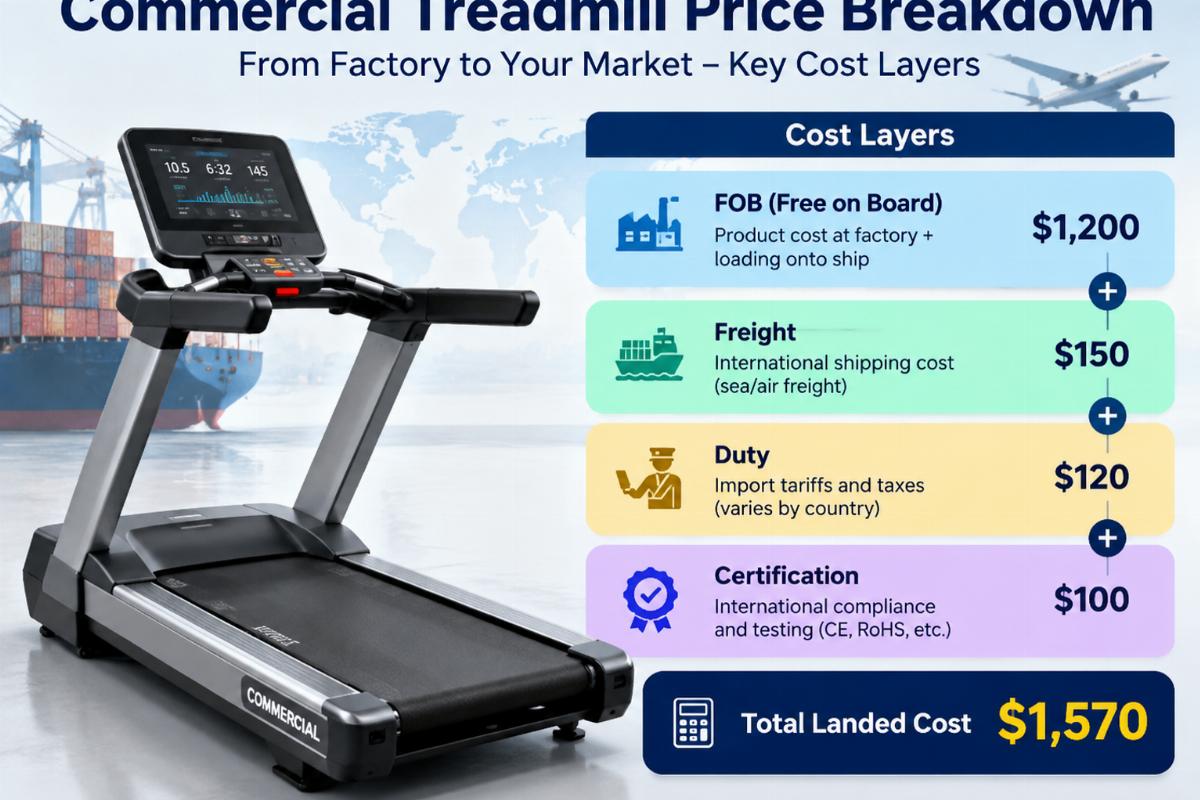
Most buyers think a higher commercial treadmill price in Russia means better quality. The real cost driver is not the machine itself — it is how the price is structured across four layers: FOB factory cost, ocean freight, EAEU customs duty, and GOST-R certification fees.
A realistic commercial treadmill price in Russia for a full-container order lands between a few thousand dollars per unit for basic commercial models and significantly more for heavy-duty AC-motor flagship units, depending on configuration, container mix, and certification strategy. Buyers who only compare single-unit FOB quotes often overpay by a noticeable margin once landing costs are calculated.
I still remember standing in a Ningjin welding shop years ago, watching sparks fly off a treadmill frame while the foreman argued with me about steel thickness. Later, when I started visiting buyer sites across the Middle East, I realized the same argument happens in every market — buyers compare spec sheets line by line, but rarely understand which numbers actually matter. A hotel owner in Riyadh once pulled out a European brand catalog and challenged me on motor horsepower and belt thickness, page by page. After breaking down every component cost and packing a mixed-SKU container, the per-unit price dropped noticeably compared to the initial single-model quote [NEED_CITE: commercial treadmill pricing structure breakdown by component and logistics layer]. That is when I learned: the commercial treadmill price in Russia — or anywhere — is never just about the machine.
Let me walk you through what actually determines the commercial treadmill price in Russia in 2026, how to read spec sheets without getting misled, and why container-level buying changes the math entirely.
What Does a Commercial Treadmill Actually Cost in Russia in 2026?
The terminal landing price of a commercial treadmill in Russia is built from four cost blocks: FOB factory price, CIF ocean freight, EAEU import tariff, and GOST-R certification allocation — ignoring any single block distorts the real commercial treadmill price in Russia.
When a buyer receives a quotation, the first instinct is to compare the number at the bottom of the page. But that number usually only reflects the FOB price — the cost of the machine sitting at the factory gate in China. From there, ocean freight to Russian ports like Vladivostok or Novorossiysk adds a variable layer depending on container type and shipping route [NEED_CITE: EAEU customs tariff rates for fitness equipment under HS code 9506]. Then comes the EAEU common external tariff, which applies a percentage on the CIF value. Finally, GOST-R certification costs must be amortized across the order quantity.
Here is what a typical cost structure looks like for a standard commercial treadmill entering Russia:
| Cost Component | Basic Commercial Model | Heavy-Duty AC Model |
|---|---|---|
| FOB Factory Price | Budget tier | Premium tier |
| Ocean Freight Allocation (per unit) | Noticeably reduced in full container | Noticeably reduced in full container |
| EAEU Import Duty | Standard rate applied | Standard rate applied |
| GOST-R Certification Share | Lower per unit in large orders | Lower per unit in large orders |
| Inland Transport to Final Destination | Variable by region | Variable by region |
A distributor in Moscow once told me his first sample order cost roughly double per unit compared to his later full-container order. The difference was not a factory discount — it was the freight and certification分摊 dilution across a larger volume. The commercial treadmill price in Russia shifts dramatically between a single-unit sample and a mixed-SKU container load.

How to Read a Treadmill Spec Sheet Without Getting Tricked?
Peak horsepower and continuous horsepower are not the same thing — and confusing them is the most common reason buyers overpay for a commercial treadmill price in Russia that does not match actual performance.
Manufacturers love to advertise peak horsepower because the number looks impressive. But peak horsepower is what the motor can deliver for a few seconds under ideal conditions. Continuous horsepower (CHP) is what the motor sustains during hours of daily gym use. A treadmill listed at peak 4.0 HP might only deliver continuous 2.0 CHP — and that is the number that determines whether the machine survives in a commercial environment [NEED_CITE: EN ISO 20957 standards for treadmill motor rating classification].
Then there is the running deck. Thickness matters more than most buyers realize. A deck that is too thin will warp under repeated impact, leading to belt slippage and motor strain. The steel frame gauge is equally critical — lighter frames flex under heavy users, creating noise and accelerating wear on rollers and bearings.
Here is a comparison matrix that shows what to look for:
| Specification Parameter | Entry-Level Commercial | Mid-Range Commercial | Heavy-Duty Commercial |
|---|---|---|---|
| Motor Type | DC or low-CHP AC | Standard AC | High-CHP AC |
| Continuous Horsepower | Basic tier | Standard tier | Robust tier |
| Peak Horsepower (marketing) | Moderately listed | Prominently listed | Prominently listed |
| Running Deck Thickness | Minimal | Standard | Substantially thicker |
| Frame Steel Gauge | Lighter | Standard | Heavy-duty |
| Running Belt Area | Compact | Standard | Extended |
| Electronic Controller | Basic | Mid-range | Brand-name or verified |
I once reviewed a spec sheet for a gym project in St. Petersburg where the quoted treadmill had an impressive peak HP number but a deck thickness that fell short of what sustained commercial use demands. The commercial treadmill price in Russia looked attractive on paper, but the projected maintenance frequency would have erased any upfront savings within a year.

Single Unit vs. Full Container — Which Buying Method Saves More?
The commercial treadmill price in Russia drops noticeably when buyers shift from single-unit samples to full-container mixed-SKU orders — but the savings come from freight dilution and certification amortization, not just factory discounts.
A fitness equipment distributor in southern Russia started with a single sample treadmill to test market response. The per-unit cost was high because freight was calculated on a less-than-container basis and the GOST-R certification fee was absorbed by one machine. When he returned for a full container, mixing treadmills with ellipticals and spin bikes, the per-unit treadmill cost dropped substantially — even though the factory FOB price barely changed.
The key is container consolidation. A standard 40HQ container can hold a significant number of treadmills if they are non-folding commercial models, or fewer if the units are bulkier. Mixing cardio equipment with strength machines in the same container allows buyers to fill every cubic meter, spreading the fixed freight and customs costs across more SKUs [NEED_CITE: container loading optimization methods for mixed fitness equipment shipments].
| Buying Method | Freight Per Unit | Certification Per Unit | Factory Unit Price | Total Landed Cost |
|---|---|---|---|---|
| Single Sample Unit | Substantially higher | Fully absorbed by one unit | Highest tier | Noticeably highest |
| Partial Container (single SKU) | Moderately high | Spread across moderate volume | Standard tier | Moderately high |
| Full Container (mixed SKU) | Noticeably reduced | Spread across large volume | Most competitive tier | Most competitive |
The same principle applied for a hotel chain project in the Gulf, where the buyer insisted on comparing European brand catalogs line by line. Once we broke down every component — motor, controller, deck, handrail, console — and repacked the container with a mix of treadmill models and complementary equipment, the total container price shifted by a noticeable percentage. The commercial treadmill price in Russia works the same way: the unit number on the quotation is only the starting point.

What Certifications and Import Rules Apply to Russia?
EAEU customs duties and GOST-R certification are mandatory for importing treadmills into Russia — and planning for them early prevents the commercial treadmill price in Russia from inflating unexpectedly.
Russia, as a member of the Eurasian Economic Union, applies the EAEU Common Customs Tariff to fitness equipment imports. The tariff rate is calculated as a percentage of the CIF value (cost, insurance, and freight to the port of entry) [NEED_CITE: EAEU Common Customs Tariff database for sports and gym equipment]. Getting the HS classification wrong can result in overpayment or customs delays.
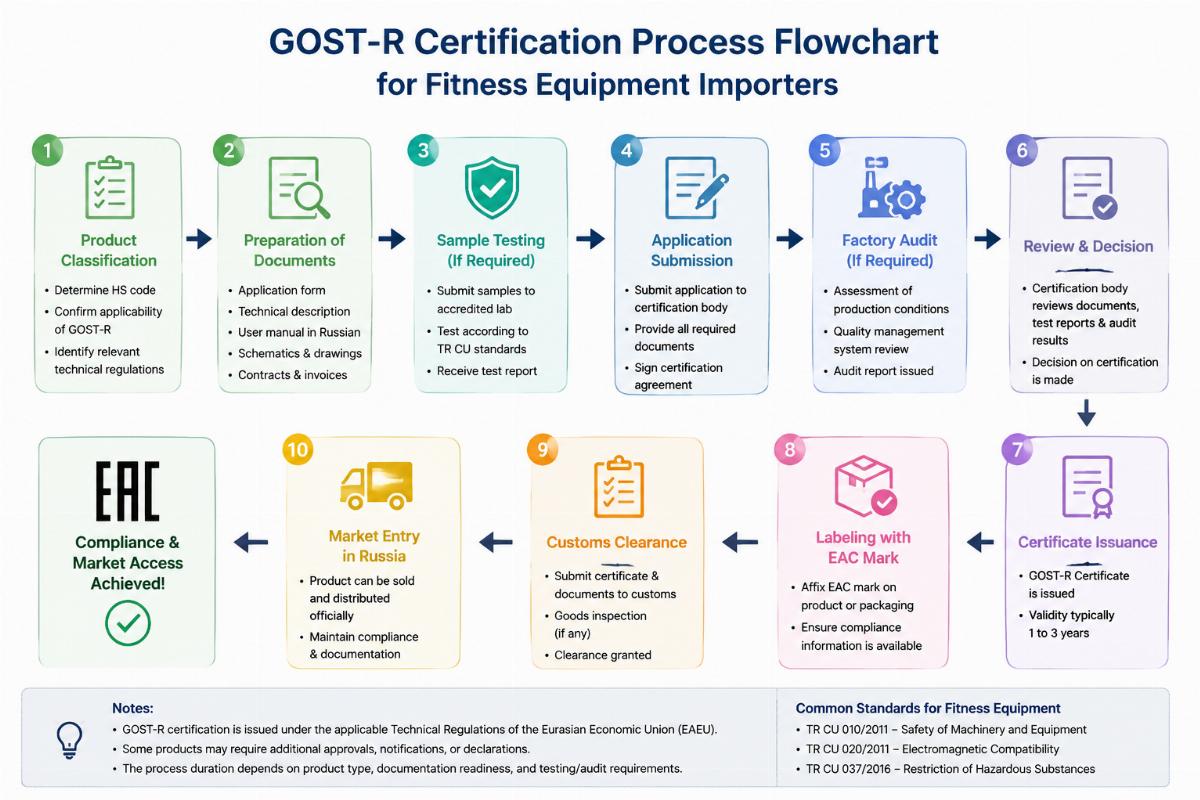
Beyond tariffs, GOST-R certification is required for gym equipment sold or operated commercially in Russia. This certification verifies that the equipment meets Russian safety and performance standards. The important detail most buyers miss: GOST-R certification is charged per model series, not per individual unit. Adding variants within the same series — such as different console colors or minor spec adjustments — incurs minimal marginal certification cost [NEED_CITE: GOST-R certification requirements and series-based fee structure for fitness equipment].
Here is what the certification and import process typically involves:
- HS Code Classification: Confirm the correct code under the EAEU tariff schedule to determine the exact duty rate.
- GOST-R Application: Submit technical documentation, including motor specifications, electrical safety test reports, and structural drawings.
- Testing and Inspection: Depending on the certification body, sample testing or factory audit may be required.
- Certificate Issuance: The certificate is valid for a defined period and covers the registered model series.
- Customs Clearance: Present the certificate alongside commercial invoice, packing list, and bill of lading at the port of entry.
A buyer from Kazakhstan once shipped a container of treadmills without confirming the GOST-R series coverage in advance. When customs flagged a console variant that was not explicitly listed, the clearance was delayed and additional testing fees were applied. The lesson: the commercial treadmill price in Russia includes not just the machine and the shipping, but the paperwork that lets it legally enter the market.
How to Choose the Right Supplier for the Russian Market?
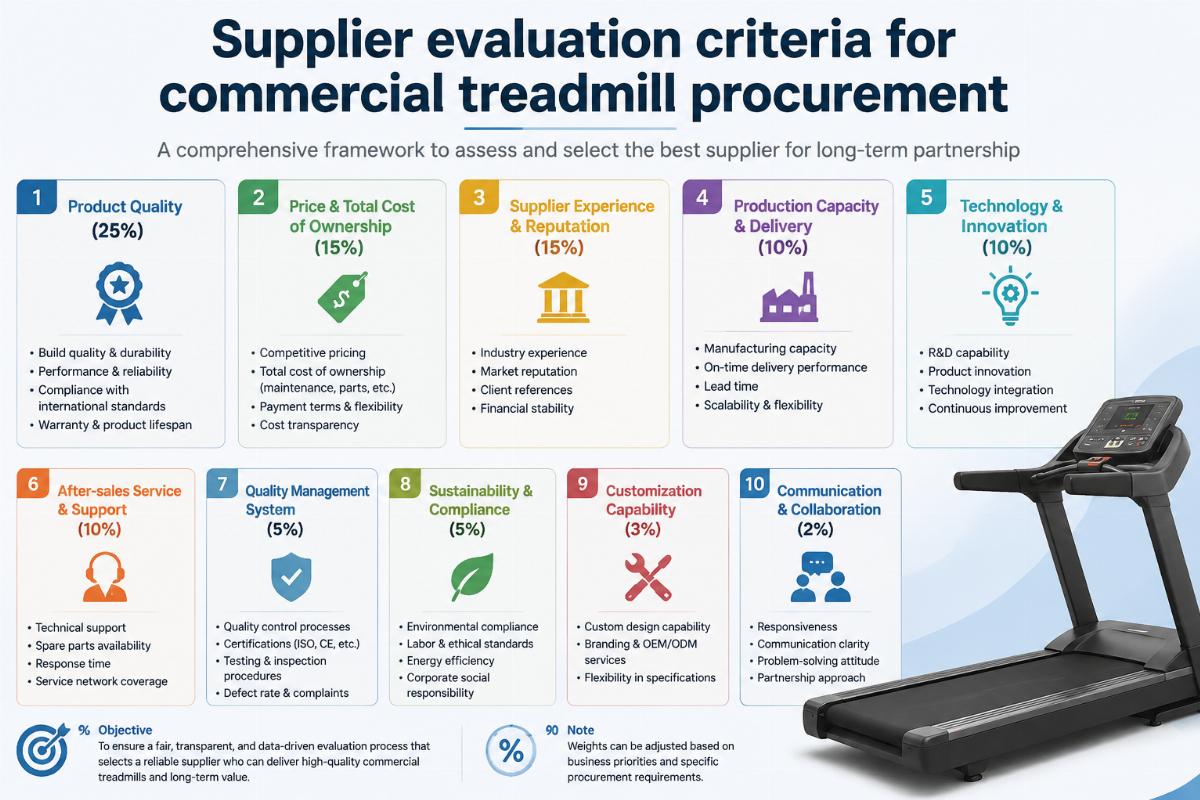
The right supplier determines whether the commercial treadmill price in Russia stays competitive over the long term — because factory-direct pricing, OEM flexibility, and spare parts availability matter far more than the initial quotation.
After years of visiting gym sites and dealer warehouses, I have seen the same pattern: buyers who choose a supplier based solely on the lowest FOB price end up paying more in maintenance, downtime, and replacement parts. The real cost of a treadmill is not just the purchase price — it is the total cost of ownership over its service life.
Three factors separate a reliable long-term supplier from a one-time quotation source:
Factory-Direct Pricing with Transparency: A manufacturer that breaks down component costs — motor, frame, deck, electronics — allows buyers to understand where the commercial treadmill price in Russia comes from and where adjustments can be made without sacrificing durability.
OEM and Branding Flexibility: Distributors in Russia often need private-label branding, custom console languages, or specific voltage configurations. A supplier with full OEM and ODM capability can accommodate these requirements without adding excessive lead time or cost [NEED_CITE: OEM and ODM service models in commercial fitness equipment manufacturing].
Spare Parts and After-Sales Infrastructure: The most durable treadmill will eventually need belt replacements, roller changes, or controller repairs. A supplier that maintains a spare parts inventory and provides technical documentation ensures that downtime is measured in days, not weeks.
| Supplier Evaluation Factor | Basic Quotation Source | Long-Term Manufacturing Partner |
|---|---|---|
| Pricing Transparency | Single total price | Component-level breakdown |
| OEM/ODM Capability | Limited or none | Full customization support |
| Certification Support | Buyer handles independently | Integrated guidance |
| Spare Parts Availability | Ad hoc | Structured supply system |
| Container Consolidation | Single-product focus | Mixed-SKU capability |
The commercial treadmill price in Russia is ultimately a reflection of the relationship between buyer and supplier. A partner who understands EAEU regulations, container logistics, and component-level engineering will deliver a lower total cost than a factory that simply quotes the cheapest number.
Conclusion
The commercial treadmill price in Russia is never a single number — it is a layered structure of factory cost, logistics, tariffs, and certification. Buyers who understand spec sheet details, leverage full-container mixed-SKU ordering, and plan for EAEU compliance from the start will consistently land at a lower total cost than those who focus only on the initial quotation.


